40) If you lay your forearm along the table, you can rotate it so that your hand changes from a
palm-down to a palm-up position. This is possible because your radius and ulna join at a
________ joint.
A) ball-and-socket
B) hinge
C) pivot
D) twist
41) Which one of the following is used to combat osteoporosis?
A) calcium and vitamin therapy
B) anti-inflammatory medicines
C) opiates
D) splints or casts
42) What best helps a broken bone heal?
A) grafting new bone to the region
B) exercising the area with the broken bone
C) taking calcium supplements
D) returning the broken bone parts back to their natural shape and then immobilizing the bone
43) Arthritis is a common result of aging, affecting persons’ ability to ________.
A) catch their breath after exercise
B) move their joints
C) heal broken bones
D) produce red blood cells
44) Muscles are connected to bones by ________.
A) thick filaments
B) ligaments
C) tendons
D) myofibrils
45) Functionally, what is the muscle fiber’s fundamental unit of contraction?
A) thick filament
B) thin filament
C) myofibril
D) sarcomere
46) A thick filament is made up of ________.
A) actin
B) myosin
C) sarcomere
D) actin and myosin
47) According to the sliding-filament model of muscle contraction, a sarcomere contracts when
its ________.
A) thick filaments slide across the ends of the sarcomere
B) thin filaments slide across the ends of the sarcomere
C) thin and thick filaments slide further away from each other
D) thin and thick filaments slide past each other to get closer together
48) Would you expect motor units to vary in size? If so, which of these structures would
probably have the largest ones?
A) No; all motor units are the same size.
B) Yes; a motor unit in the thigh to control leg movements would be the largest one.
C) Yes; a motor unit that controls eye movements would be the largest one.
D) Yes; a motor unit that controls hand movements would be the largest one.
49) A baseball player leaping for a baseball and a cricket jumping away from a frog are both
using ________.
I) sensory receptors
II) the central nervous system
III) a muscle system
A) I only
B) II only
C) III only
D) I, II, and III
50) In a species, what is required for a new sensory adaptation to evolve by natural selection?
A) Individuals that needed this trait mutated a sensory receptor to create the new adaptation.
B) Individuals that possessed this trait produced more offspring than those that did not possess
the trait.
C) Individuals that possessed this trait survived by chance, and passed on the trait to their
offspring.
D) Individuals immigrated to a new area, and brought the trait with them.
27.2 Art Questions
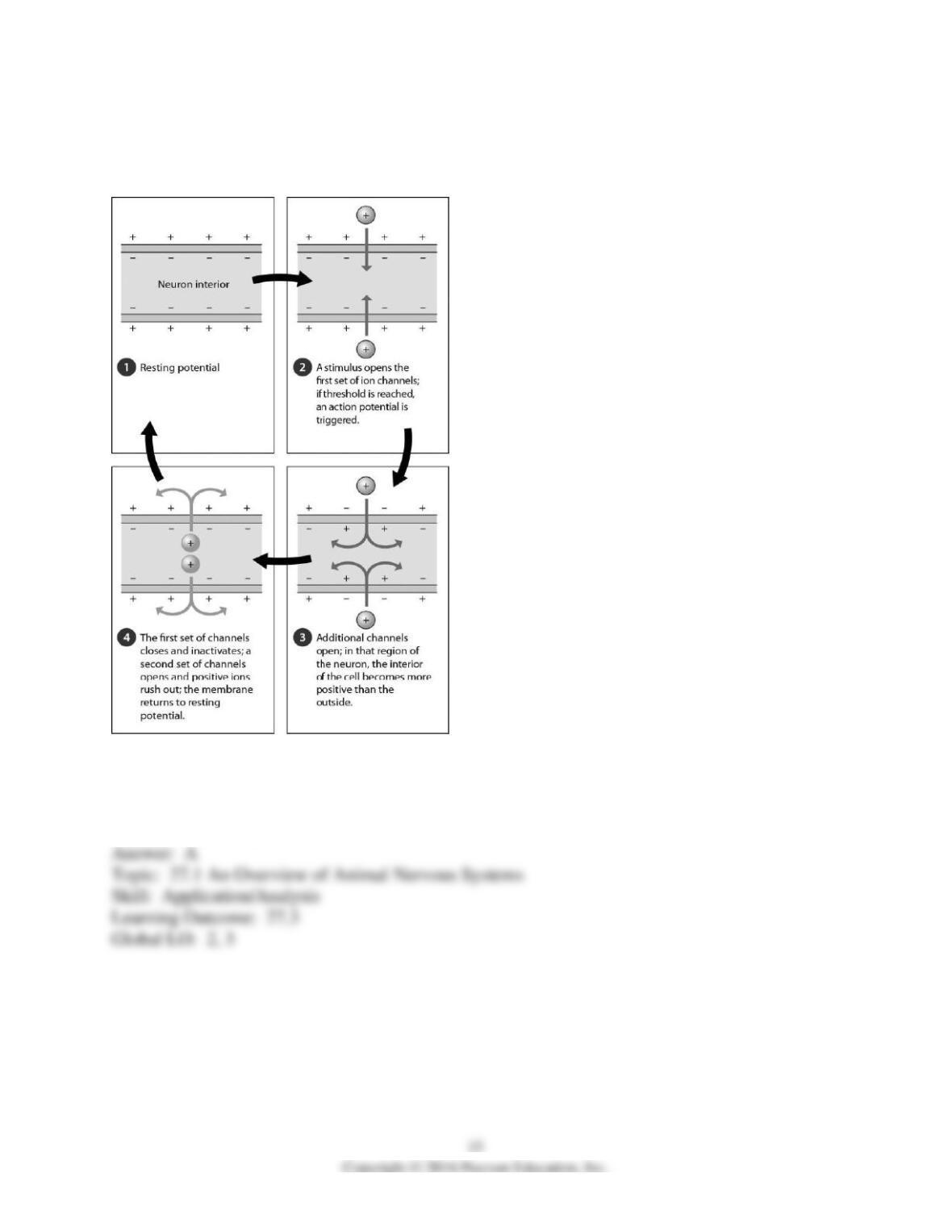
1) Examine the figure below. Once an action potential is triggered, ________.
A) the interior of the cell becomes positively charged relative to the outside
B) the interior of the cell becomes negatively charged relative to the outside
C) all ion channels close
D) the cell soon reaches threshold
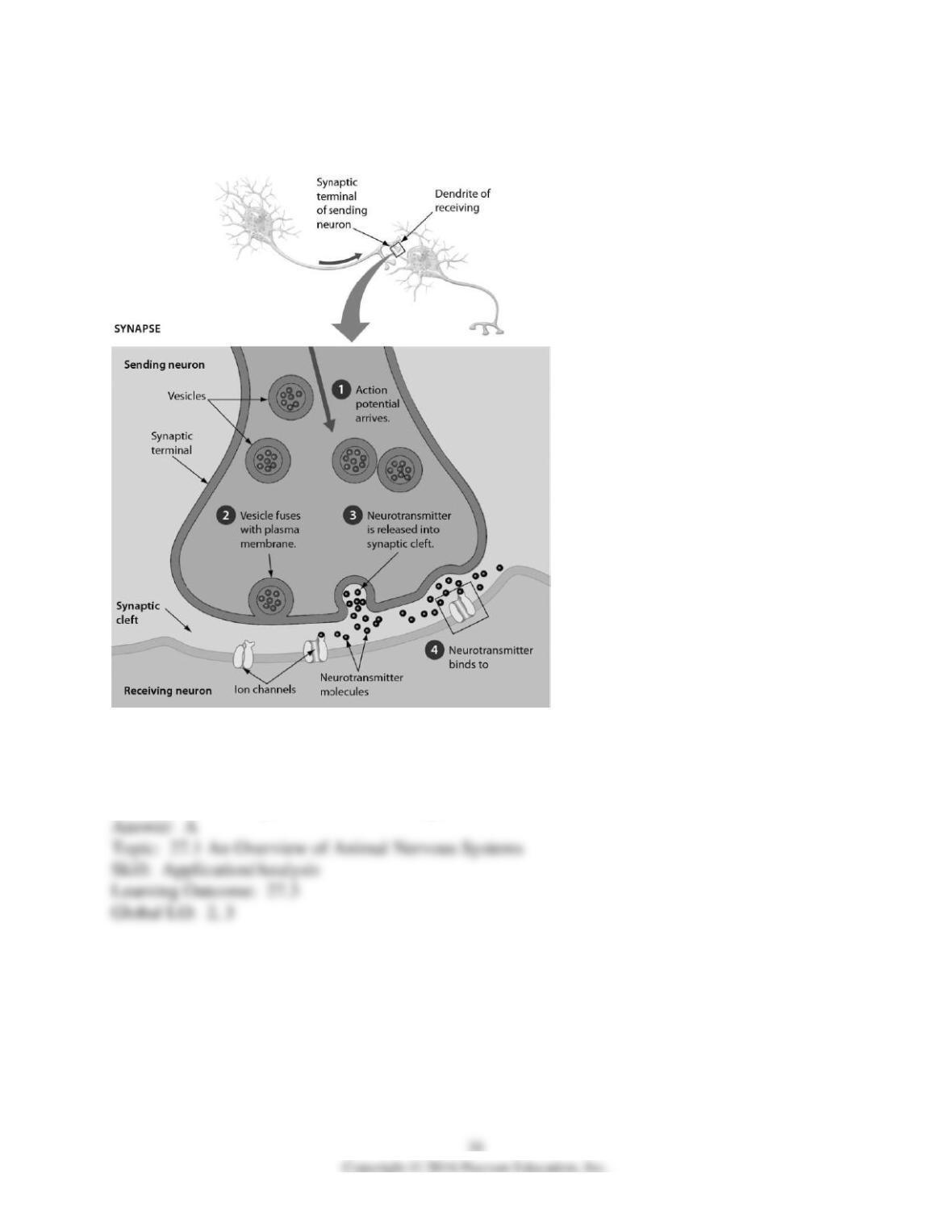
2) Examine the neurotransmitters in the synapse in the accompanying figure. What might happen
to these neurotransmitters after step 4 is complete? The neurotransmitters ________.
A) are transported back to the sending neuron
B) are transported into the receiving neuron
C) remain in the synaptic cleft
D) trigger an action potential in the sending neuron
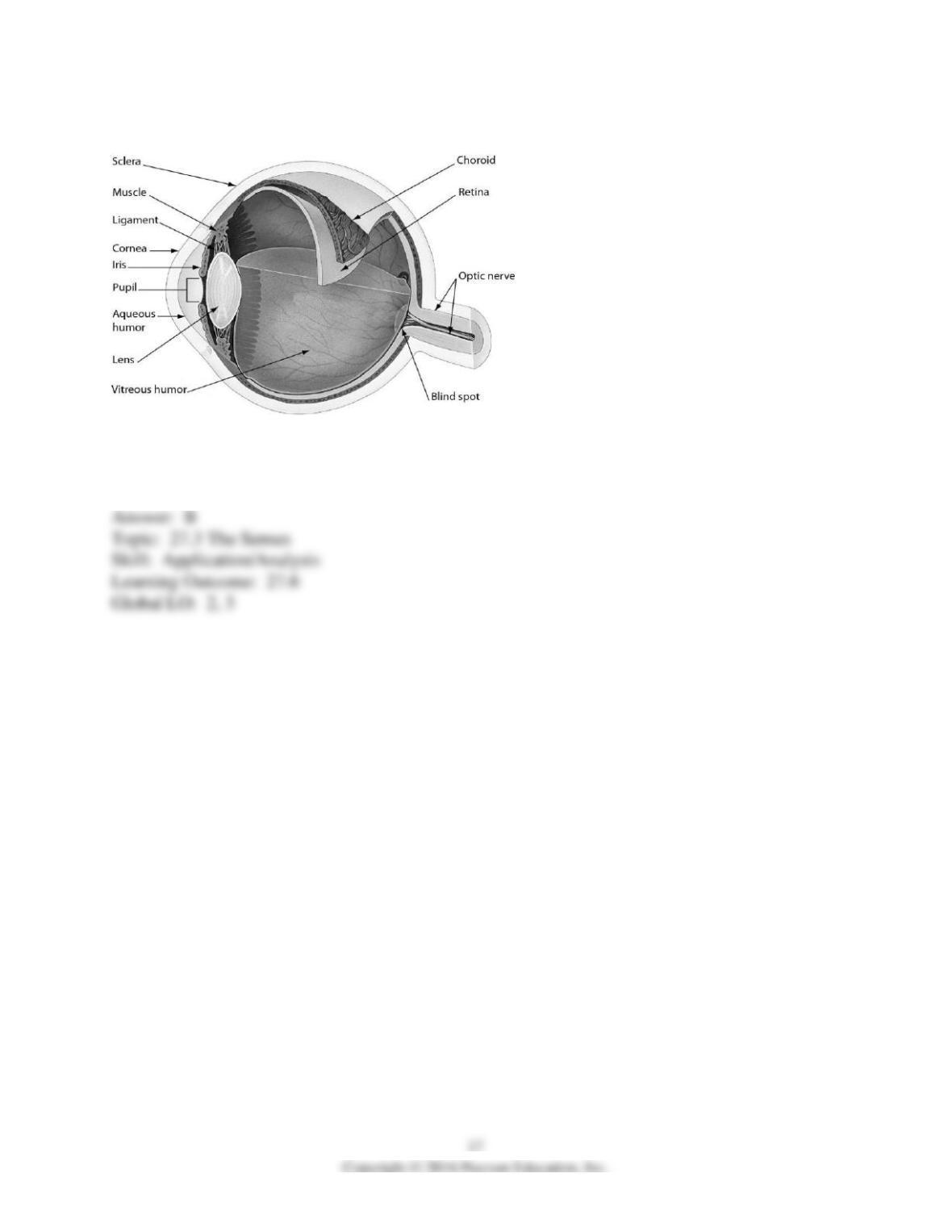
3) The figure shows the human eye. Which part of the eye gives the eye its color?
A) sclera
B) iris
C) pupil
D) retina
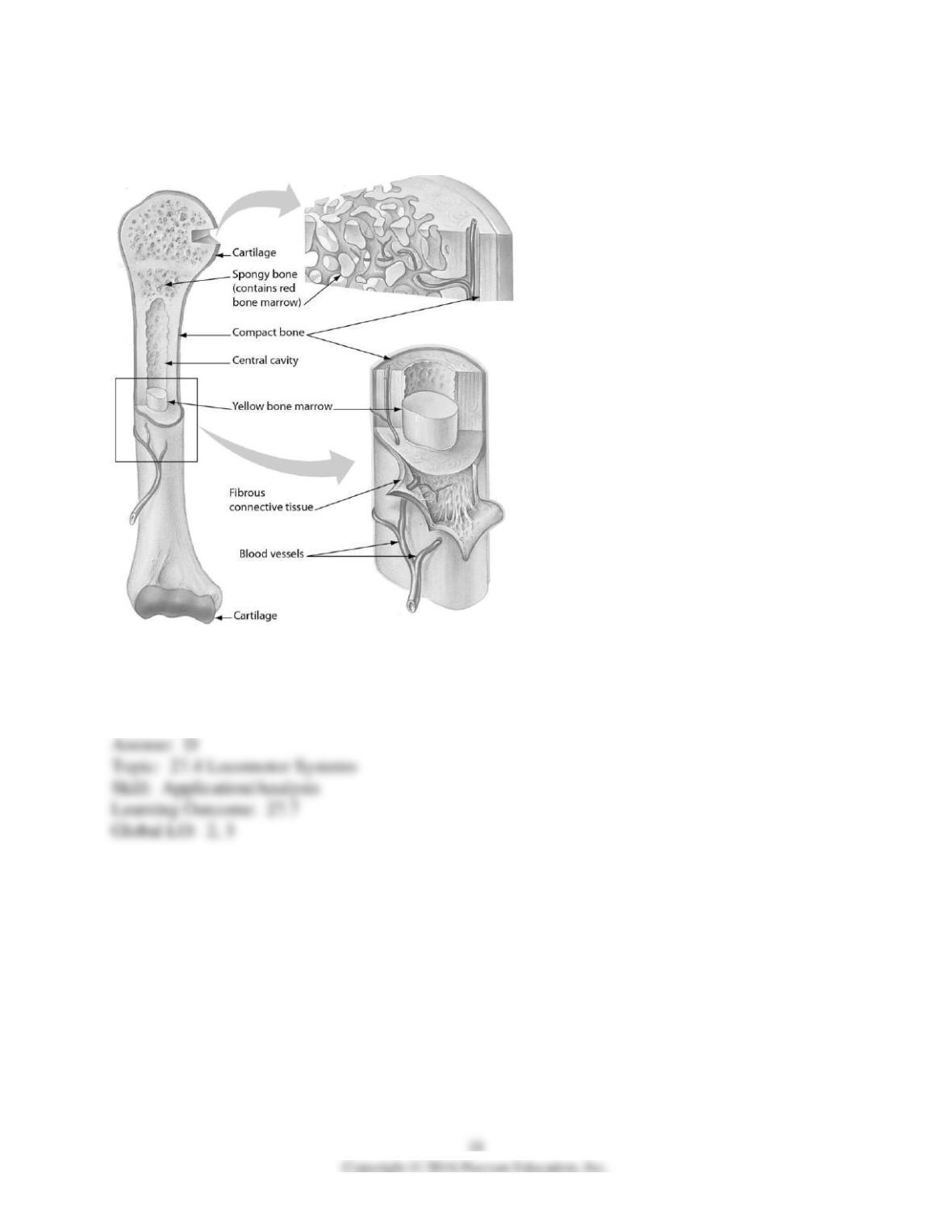
4) The figure below shows the structure of an arm bone. Which part of a bone contains stored
fat?
A) red bone marrow
B) cartilage
C) the ends
D) yellow bone marrow
19
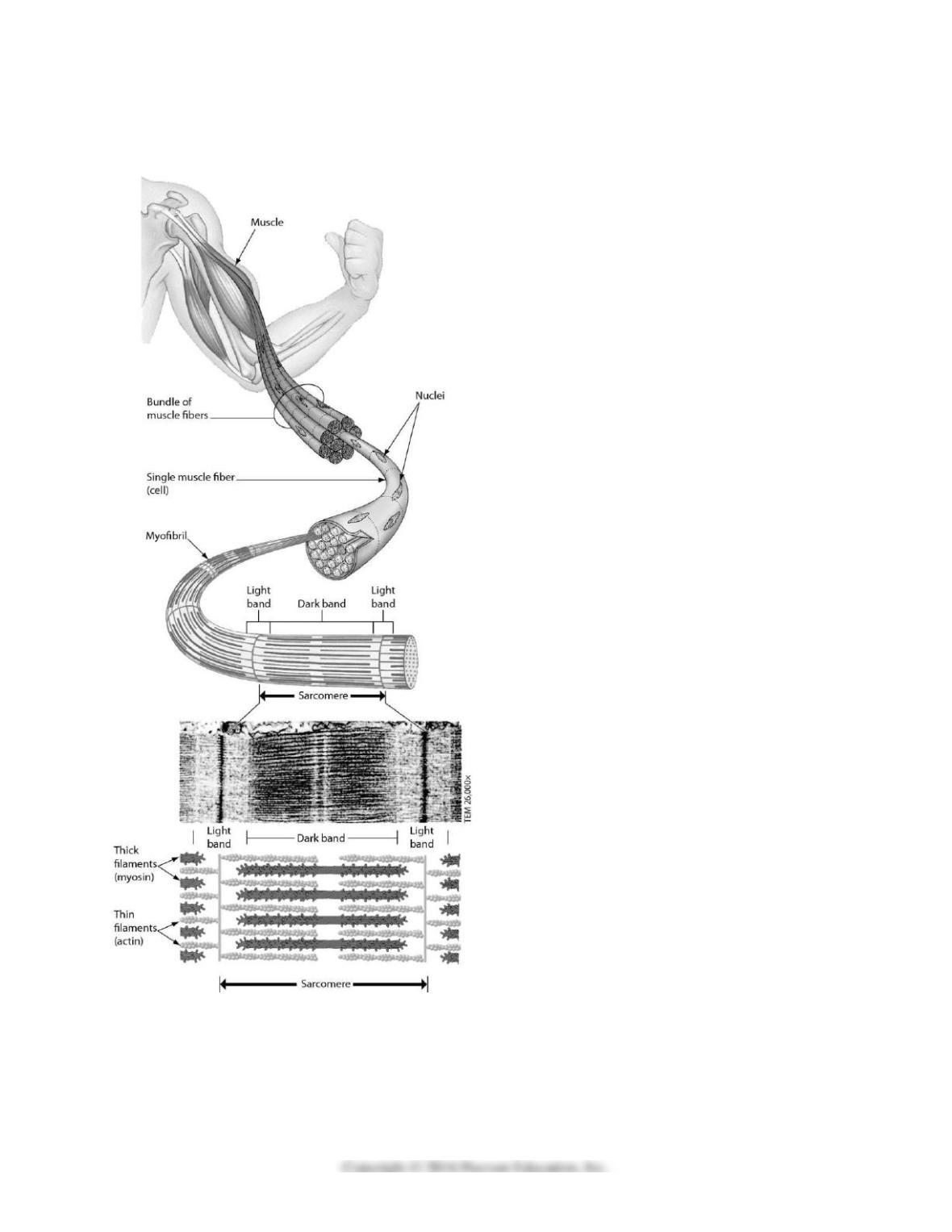
5) Examine the structure of a muscle cell in the accompanying figure. Which one of the
following statements about muscle structure is TRUE?
A) Each muscle cell has one nucleus.
B) Each myofibril consists of many muscle cells.
C) Each muscle cell has one sarcomere.
D) A sarcomere contains thick and thin filaments.
27.3 Scenario Questions
Please read the following paragraph and then answer the following questions.
The human eye is an incredible organ, capable of gathering light to focus on images near and far,
in bright light or dim, and with quick adjustments between these extremes. However, eyes can
develop problems, such as floaters, which are small particles that interfere with the transmission
of light between the lens and the retina, and bloodshot eyes, which occur when irritants such as
dust or smoke get in the eye.
1) Eyes can become bloodshot when irritants in the eye trigger an increased blood flow to the
connective tissue covering the eye. These swollen blood vessels are located on the ________.
A) cornea
B) sclera
C) iris
D) lens
2) If floaters are small particles that interfere with the transmission of light between the lens and
the retina, they must be located in the ________.
A) pupil
B) cornea
C) jellylike fluid of the eye
D) blind spot
3) When light levels suddenly increase, our eyes adjust quickly by reducing the size of the
________.
A) pupil
B) retina
C) iris
D) cornea
Please read the following paragraph and then answer the following questions.
Huntington’s disease is a genetic disorder in which a mutation causes the production of a protein,
which damages cells in the brain. Symptoms typically begin with changes in personality,
attention, and reasoning. Uncoordinated and uncontrolled movements develop, such that physical
abilities become limited. Cognitive problems worsen into dementia. There is currently no cure
for Huntington’s disease.
4) Given the symptoms of Huntington’s disease, which structure in the brain is being damaged by
the abnormal protein?
A) cerebellum
B) cerebrum
C) hypothalamus
D) brainstem
5) Scientists hypothesize that the abnormal protein stops vesicles from moving through the
cytoskeleton. Predict the effect of this protein on the nervous system.
A) Neurotransmitters cannot be released.
B) Receptor potentials cannot occur.
C) Cerebrospinal fluid leaks out of the brain.
D) Action potentials become smaller.
Please read the following paragraph and then answer the following questions.
Amyotrophic lateral sclerosis (ALS), or Lou Gehrig’s disease, is a fatal disorder characterized by
muscle weakness. Stumbling when walking or difficulty with using a hand is a typical early
symptom. Individuals with ALS lose the ability to consciously control movement, though
cognitive and sensory functions generally remain unimpaired. There is currently no cure for
ALS.
6) Given the symptoms of ALS, what part of the nervous system is functioning abnormally?
A) autonomic nervous system
B) central nervous system
C) motor system
D) sympathetic division
7) In ALS, sensory input and integration are unaffected, and muscle cells still respond to
neurotransmitters when they are present. Which structure would you recommend scientists to
study to find a cure for ALS?
A) sensory neurons
B) interneurons
C) motor neurons
D) mechanoreceptors