
61) Using similarities in body symmetry and other anatomical features to assign an organism to a
clade involves
1. cladistics based on body plan.
2. molecular-based phylogeny.
3. morphology-based phylogeny.
A) 1 only
B) 2 only
C) 3 only
D) 1 and 2 only
E) 1 and 3 only

20
27.2 Art Questions
21
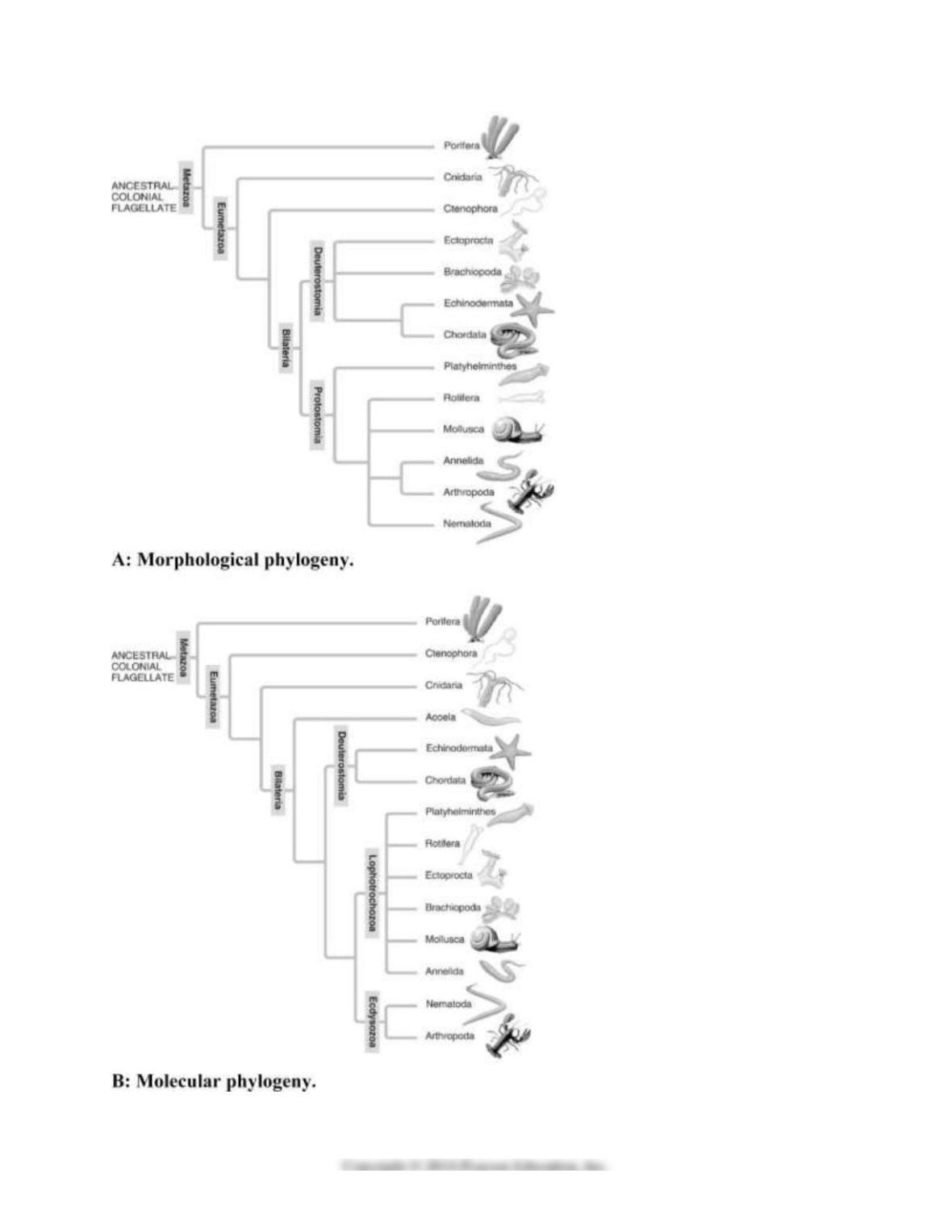
1) Which of the following is a point of conflict between the phylogenetic analyses presented in
these two figures?
A) the relationship of taxa of segmented animals to taxa of nonsegmented animals
B) that sponges are basal animals
C) that chordates are deuterostomes
D) the evolutionary relationship between Nematoda and Arthropoda
2) What is true in the molecular phylogeny (B) that is not true in the traditional phylogeny (A)?
A) Deuterostomia is paraphyletic.
B) To maintain Deuterostomia as a clade, some phyla had to be removed from it.
C) Deuterostomia now includes the Acoela.
D) It diverged from the rest of the Bilateria earlier than did the Acoela.
3) In the traditional phylogeny (A), the phylum Platyhelminthes is depicted as a sister taxon to
the rest of the protostome phyla and as having diverged earlier from the lineage that led to the
rest of the protostomes. In the molecular phylogeny (B), Platyhelminthes is depicted as a
lophotrochozoan phylum. What probably led to this change?
A) Platyhelminthes ceased to be recognized as true protostomes.
B) The removal of the acoel flatworms (Acoela) from the Platyhelminthes allowed the remaining
flatworms to be clearly tied to the Lophotrochozoa.
C) All Platyhelminthes must have a well-developed lophophore as their feeding apparatus.
D) Platyhelminthes’ close genetic ties to the arthropods became clear as their Hox gene
sequences were studied.

Table 27.1. Proposed Number of Hox Genes in Various Extant and Extinct Animals
4) What conclusion is apparent from the data in Table 27.1?
A) Land animals have more Hox genes than do those that live in water.
B) All bilaterian phyla have had the same degree of expansion in their numbers of Hox genes.
C) Acoel flatworms should be expected to contain seven Hox genes.
D) The expansion in number of Hox genes throughout vertebrate evolution cannot be explained
merely by three duplications of the ancestral vertebrate Hox cluster.
E) Extant insects all have seven Hox genes.
5) All things being equal, which of these is the simplest explanation for the change in the number
of Hox genes from the last common ancestor of insects and vertebrates to ancestral vertebrates,
as shown in Table 27.1?
A) The occurrence of seven independent duplications of individual Hox genes.
B) The occurrence of 14 independent duplications of individual Hox genes
C) The occurrence of two distinct duplications of the entire seven-gene cluster, followed by the
loss of one cluster.
D) The occurrence of a single duplication of the entire seven-gene cluster.
27.3 Scenario Questions
Please use the following information to answer the question(s) below.
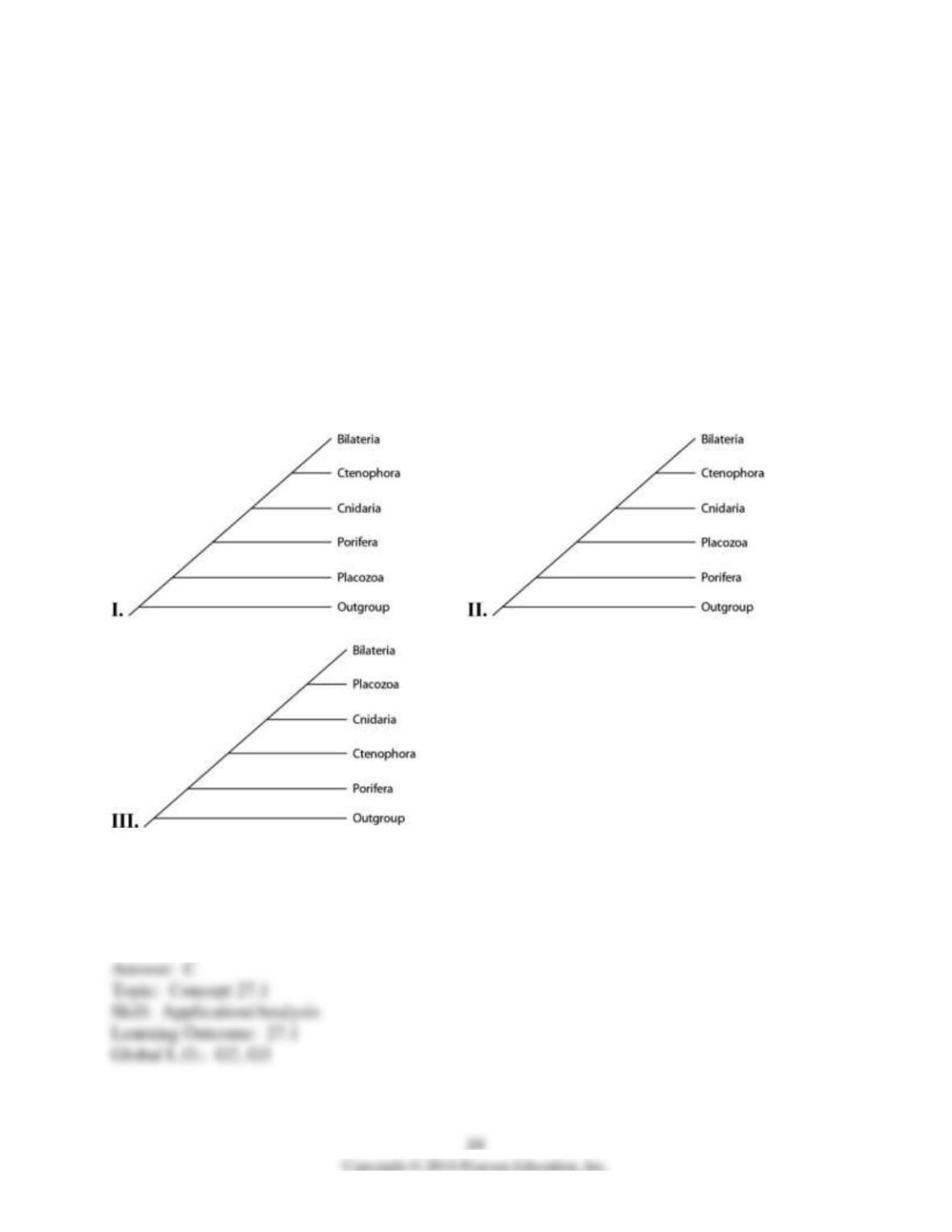
Placozoan evolutionary relationships to other animals are currently unclear, and different
phylogenies can be created, depending on the characters used to infer relatedness. Placozoans are
multicellular invertebrates with a simple structure of only two tissue layers and only four cell
types. They have the smallest amount of DNA measured in any animal. In comparison, sponges
have no tissues but about 20 cell types. One species of placozoans, Tp (Trichoplax adhaerens),
produces a neuropeptide almost identical to one found in cnidarians. The genome of Tp, although
the smallest of any known animal, shares many features of complex eumetazoan (even human!)
genomes. The next three questions refer to the phylogenetic trees that follow. In the trees, the
outgroup is a taxon that is outside the group of interest; members of the group of interest are
more closely related to one another than to the outgroup.
1) Which tree(s) has (have) been created by emphasizing genomic features of placozoans?
A) I only
B) II only
C) III only
D) I and II
2) Which tree(s) has (have) been created by emphasizing the structural simplicity of placozoans?
A) I only
B) II only
C) III only
D) II and III
3) Which tree(s) has (have) been created by emphasizing a protein found in placozoans?
A) I only
B) II only
C) III only
D) I and III
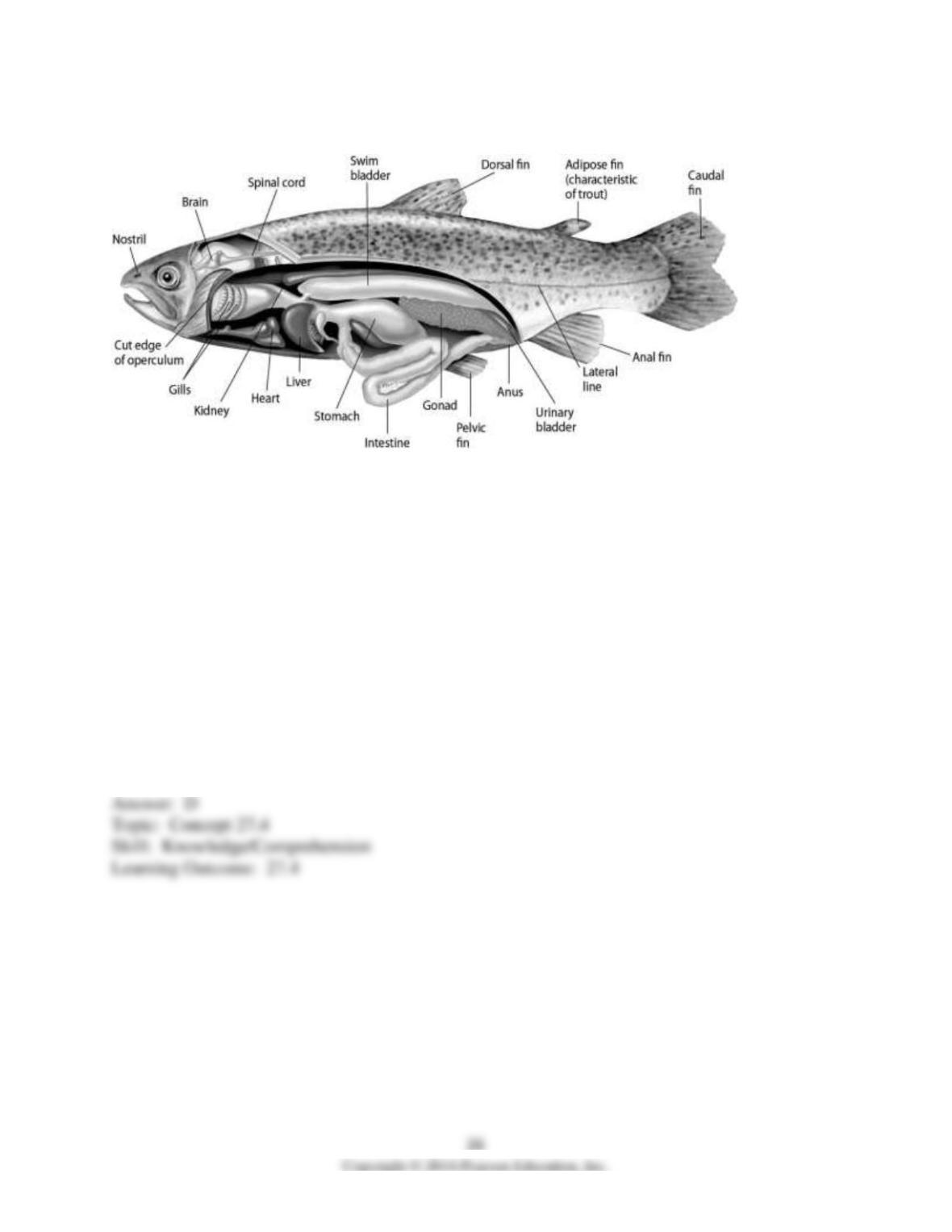
Please use the following information to answer the question(s) below.
Figure 27.2
Fishes that have swim bladders can regulate their density and thus their buoyancy. There are two
types of swim bladder: physostomous and physoclistous. The ancestral version is the
physostomous version, in which the swim bladder is connected to the esophagus via a short tube
(Figure 27.2). The fish fills this version by swimming to the surface, taking gulps of air, and
directing them into the swim bladder. Air is removed from this version by “belching.” The
physoclistous version is more derived and has lost its connection to the esophagus. Instead, gas
enters and leaves the swim bladder via special circulatory mechanisms within the wall of the
swim bladder.
4) The presence of a swim bladder allows the typical ray-finned fish to stop swimming and still
A) effectively circulate its blood.
B) be highly maneuverable.
C) use its swim bladder as a respiratory organ.
D) not sink.

5) If a physoclistous fish removes gas from its swim bladder, this fish’s density cannot actually
change until that gas arrives at the
A) mouth.
B) gills.
C) skin.
D) heart.
E) anus.
28
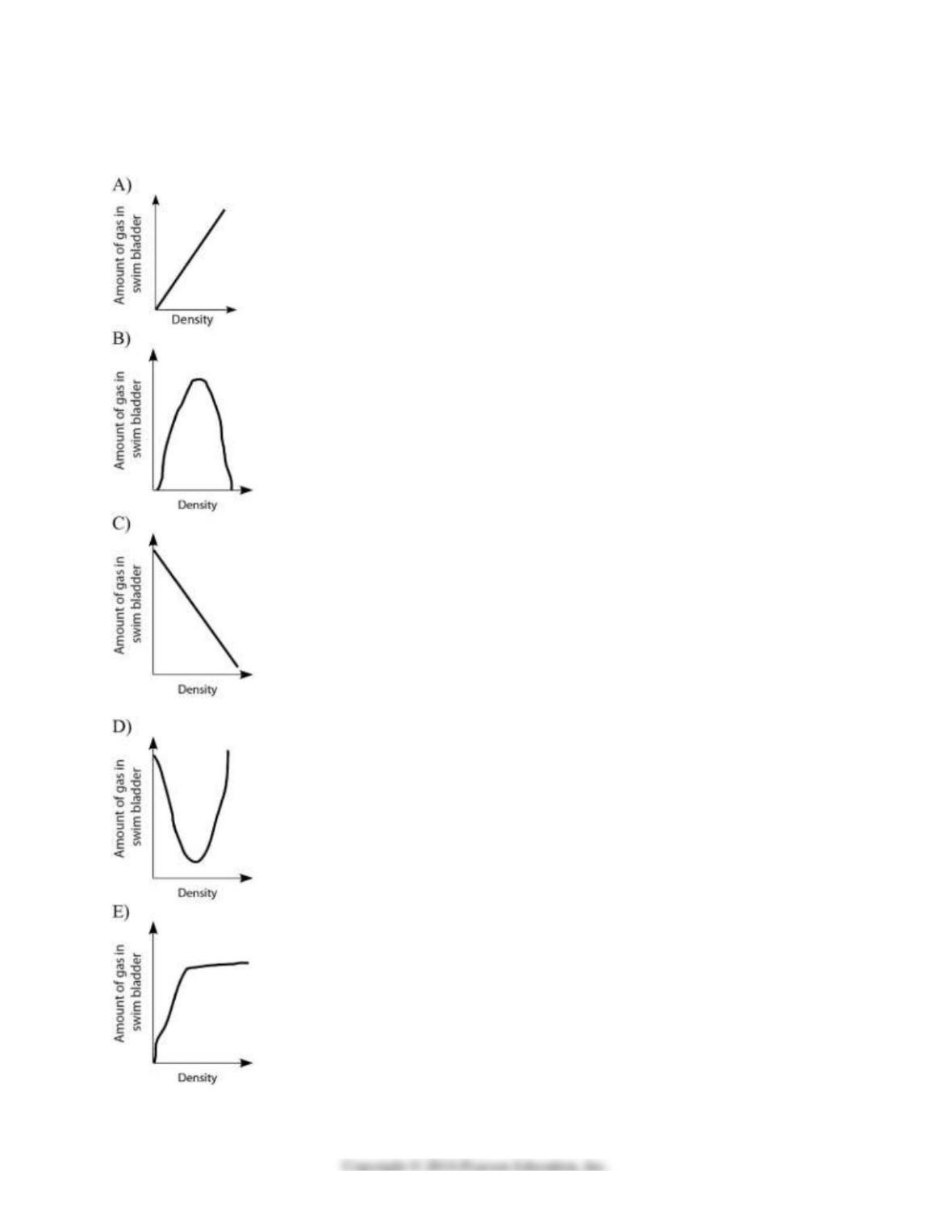
6) Which graph properly depicts the relationship between the amount of gas in the swim bladder
and the density of the fish?
A) A
B) B
C) C
D) D
E) E
7) How do a physoclistous fish and a physotomous fish compare in terms of the amount of
energy each must use to maintain its position (depth) in the water column over the long term?
A) a physoclistous fish uses more energy than a physostomous fish
B) a physostomous fish uses more energy than a physoclistous fish
C) a physoclistous fish and a physostomous fish use the same amount of energy
D) a physoclistous fish initially uses more energy than a physostomous fish but then decreases its
energy use to be equal to the physostomous fish
Please use the following information to answer the question(s) below.
Trichoplax adhaerens (Tp) is the only living species in the phylum Placozoa. Individuals are
about 1 mm wide and only 27 μm high, are irregularly shaped, and consist of a total of about
2,000 cells, which are diploid (2n = 12). There are four types of cells, none of which is a nerve or
muscle cell, and none of which has a cell wall. They move using cilia, and any “edge” can lead.
Tp feeds on marine microbes, mostly unicellular green algae, by crawling atop the algae and
trapping it between its ventral surface and the substrate. Enzymes are then secreted onto the
algae, and the resulting nutrients are absorbed. Tp sperm cells have never been observed, nor
have embryos past the 64-cell (blastula) stage.
8) In which of the following ways is Tp similar to a typical animal?
1. Tp is multicellular.
2. Tp lacks muscle and nerve cells.
3. Tp has cilia.
4. Tp lacks cell walls.
5. Tp does not have observable sperm cells.
A) 1 and 2 only
B) 1 and 3 only
C) 1, 3, and 5 only
D) 3, 4, and 5 only
E) 1, 2, 3, 4, and 5
9) On the basis of the information in the previous paragraph, which of these should be able to be
observed in Tp?
A) the act of fertilization
B) the process of gastrulation
C) the presence of eggs
D) A and B only
E) A, B and C
10) Tp’s body symmetry seems to be most like that of
A) most sponges.
B) cnidarians.
C) worms.
D) tetrapods.
Please use the following information to answer the question(s) below.
An elementary school science teacher decided to liven up the classroom with a saltwater
aquarium. Knowing that saltwater aquaria can be quite a hassle, the teacher proceeded stepwise.
First, the teacher conditioned the water. Next, the teacher decided to stock the tank with various
marine invertebrates, including a sea star, a sponge, a sea urchin, a jellyfish, several hermit crabs,
some sand dollars, and an ectoproct. Last, she added some vertebrates — a parrotfish and a
clownfish. She arranged for daily feedings of copepods and feeder fish.
11) One day, Tommy (a student in an undersupervised class of 40 fifth graders) got the urge to
pet Nemo (the clownfish), who was swimming among the waving petals of a pretty underwater
“flower” that had a big hole in the midst of the petals. Tommy giggled upon finding that these
petals felt sticky. A few hours later, Tommy was in the nurse’s office with nausea and cramps.
Microscopic examination of his fingers would probably have revealed the presence of
A) teeth marks.
B) spines.
C) spicules.
D) nematocysts.
E) a radula.
12) Had the teacher wanted to point out organisms that move and feed using the same structural
adaptation, the teacher should have chosen the
A) sponge and the jellyfish.
B) hermit crabs and the ecotoprot.
C) sea star, sea urchin, and sand dollars.
D) vertebrates.

Please use the following information to answer the question(s) below.
The most recently discovered phylum in the animal kingdom (1995) is the phylum Cycliophora.
It includes three species of tiny organisms that live in large numbers on the outsides of the
mouthparts and appendages of lobsters. When in the feeding stage, a cycliophoran permanently
attaches to the lobster via an adhesive disk and collects scraps of food from its host’s feeding by
capturing the scraps in a current created by a ring of cilia. Its body is sac-like and has a U-shaped
intestine that brings the anus close to the mouth. Cycliophorans are eucoelomate (have a body
cavity that is a coelom) and do not molt (though their host does).
13) Which of these features is least useful in assigning the phylum Cycliophora to a clade of
animals?
A) having a true coelom as a body cavity
B) having a body symmetry that permits a U-shaped intestine
C) lacking ecdysis (molting)
D) its feeding mechanism
14) Basing your inferences on information in the previous paragraph, to which clade(s) should
cycliophorans belong?
1. Eumetazoa
2. Deuterostomia
3. Bilateria
4. Ecdysozoa
5. Lophotrochozoa
A) 1 only
B) 1 and 3 only
C) 1, 3, and 5 only
D) 2, 3, and 4 only
E) 2, 3, and 5 only
15) What is true of the feeding stage of cycliophorans?
1. It is chemoheterotrophic.
2. It is sessile.
3. Its tube feet allow it to feed efficiently.
4. It has radial symmetry.
A) 1 and 2 only
B) 1 and 3 only
C) 2 and 4 only
D) 1, 2, and 3 only
E) 2, 3, and 4 only
16) Cycliophorans have two types of larvae. One type of larva is produced when the digestive
system of a female is impregnated by a male. The digestive system then collapses and develops
into a larva, which swims away in search of a new host after the surrounding female dies. Which
is the embryonic tissue that is apparently most important in forming this type of larva?
A) mesoderm
B) ectoderm
C) endoderm
D) mantle
27.4 End-of-Chapter Questions
1) Which of the following clades contains the greatest number of animal species?
A) the vertebrates
B) the bilaterians
C) the deuterostomes
D) the insects
2) Fossil steroid and molecular clock evidence suggests that animals originated
A) between 710 and 770 million years ago.
B) more than 100 million years before the oldest known fossils of large animals.
C) during the Cambrian explosion.
D) both A and B
3) Which of the following was probably the least important factor in bringing about the
Cambrian explosion?
A) the emergence of predator-prey relationships among animals
B) the accumulation of sufficient atmospheric oxygen to support the more active metabolism of
mobile animals
C) the movement of animals onto land
D) the origin of Hox genes and other genetic changes affecting the regulation of developmental
genes
4) Which of the following could be considered the most recent common ancestor of living
tetrapods?
A) a sturdy-finned, shallow-water lobe-fin whose appendages had skeletal supports similar to
those of terrestrial vertebrates
B) an armored gnathostome with two pairs of appendages
C) an early ray-finned fish that developed bony skeletal supports in its paired fins
D) a salamander that had legs supported by a bony skeleton but moved with the side-to-side
bending typical of fishes

5) Which clade does not include humans?
A) synapsids
B) lobe-fins
C) lophotrochozoans
D) tetrapods
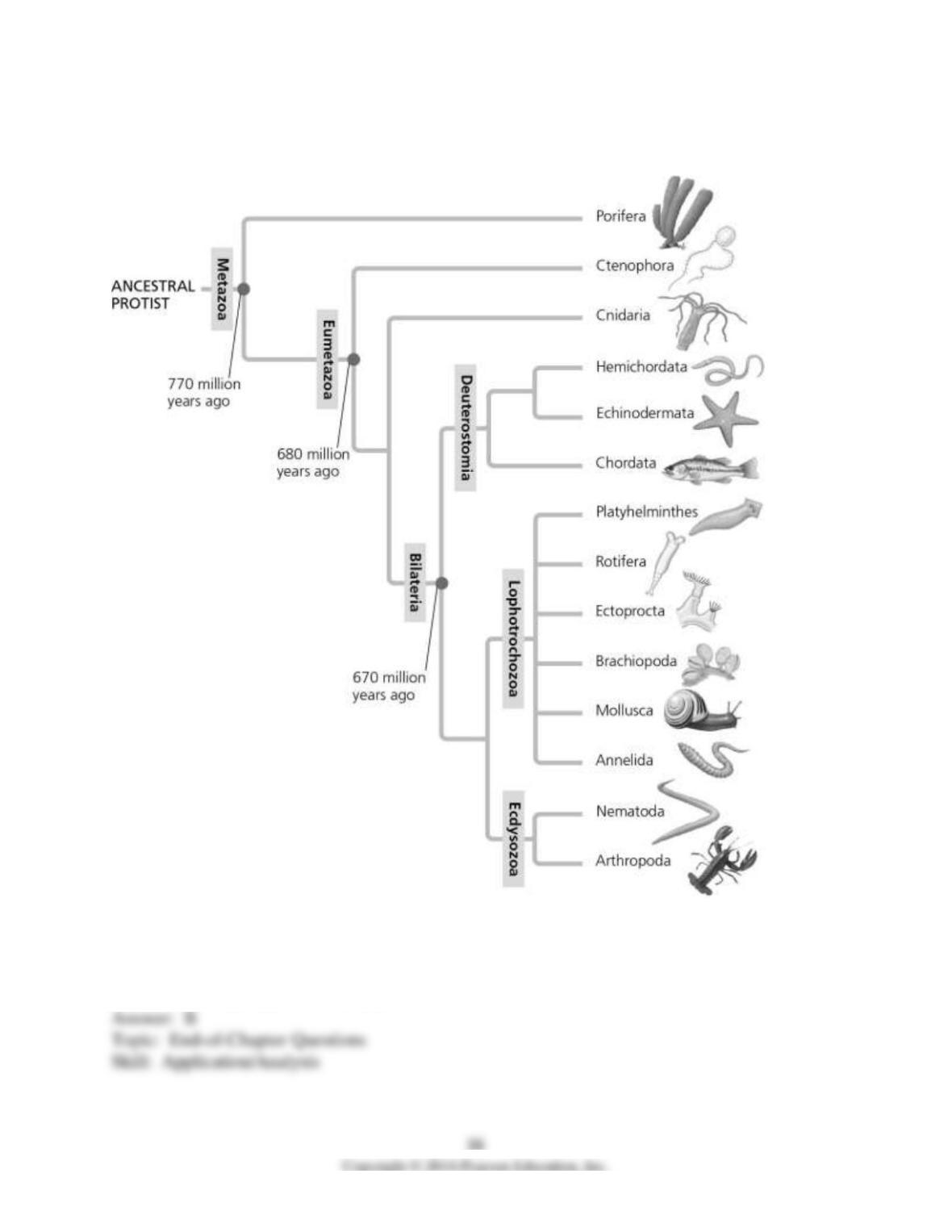
6) In the figure given below, the Deuterostomia clade is most closely related to which two main
clades?
A) Ctenophora and Cnidaria
B) Lophotrochozoa and Ecdysozoa
C) Cnidaria and Platyhelminthes
D) Echinodermata and Hemichordata