
31) Drinking water supplies are routinely tested for the presence of
A) Giardia.
B) Cryptosporidium.
C) fecal coliforms.
D) fecal viruses.
E) Vibrio.
32) Aerobic respiration occurs in
A) anaerobic sludge digestion.
B) primary sewage treatment.
C) secondary sewage treatment.
D) tertiary sewage treatment.
E) water treatment.
33) In the ONPG and MUG test for fecal coliforms, a sample that is positive for E. coli will be
A) positive for ONPG; fluorescent in UV light.
B) negative for ONPG; fluorescent in UV light.
C) positive for ONPG; non-fluorescent in UV light.
D) negative for ONPG; non-fluorescent in UV light.

34) Filtration to remove protozoa occurs in
A) anaerobic sludge digestion.
B) primary sewage treatment.
C) secondary sewage treatment.
D) tertiary sewage treatment.
E) water treatment.
35) Which of the following do NOT fix atmospheric nitrogen?
A) cyanobacteria
B) lichens
C) mycorrhizae
D) Rhizobium
E) Azotobacter
36) Which of the following is mismatched?
A) CO2 + 4H2 → CH4 + 2H2O – Methane-producing bacteria
B) 2 NO2– + O2→ 2 NO3 – Nitrobacter
C) 6CO2 + 6H2O → C6H12O6 + 6O2 – Clostridium
D) N2 + 6H+ → 2NH3 – Beijerinckia
E) SO42- + 10H+ → H2S + 4H2O – Desulfovibrio

37) Bacteria can increase the Earth’s temperature by
A) generating a great deal of heat in metabolism.
B) producing CH4, which is a greenhouse gas.
C) using the greenhouse gas CO2.
D) providing nutrients for plant growth.
E) oxidizing CH4.
38) Which of the following is NOT characteristic of fecal coliforms?
A) gram-negative
B) non-spore forming
C) rod-shaped
D) lactose-fermenting
E) pathogenic
39) Which one of the following processes in sewage treatment requires bacterial metabolism?
A) chlorination
B) primary treatment
C) removal of BOD
D) sedimentation
E) None of the answers is correct.
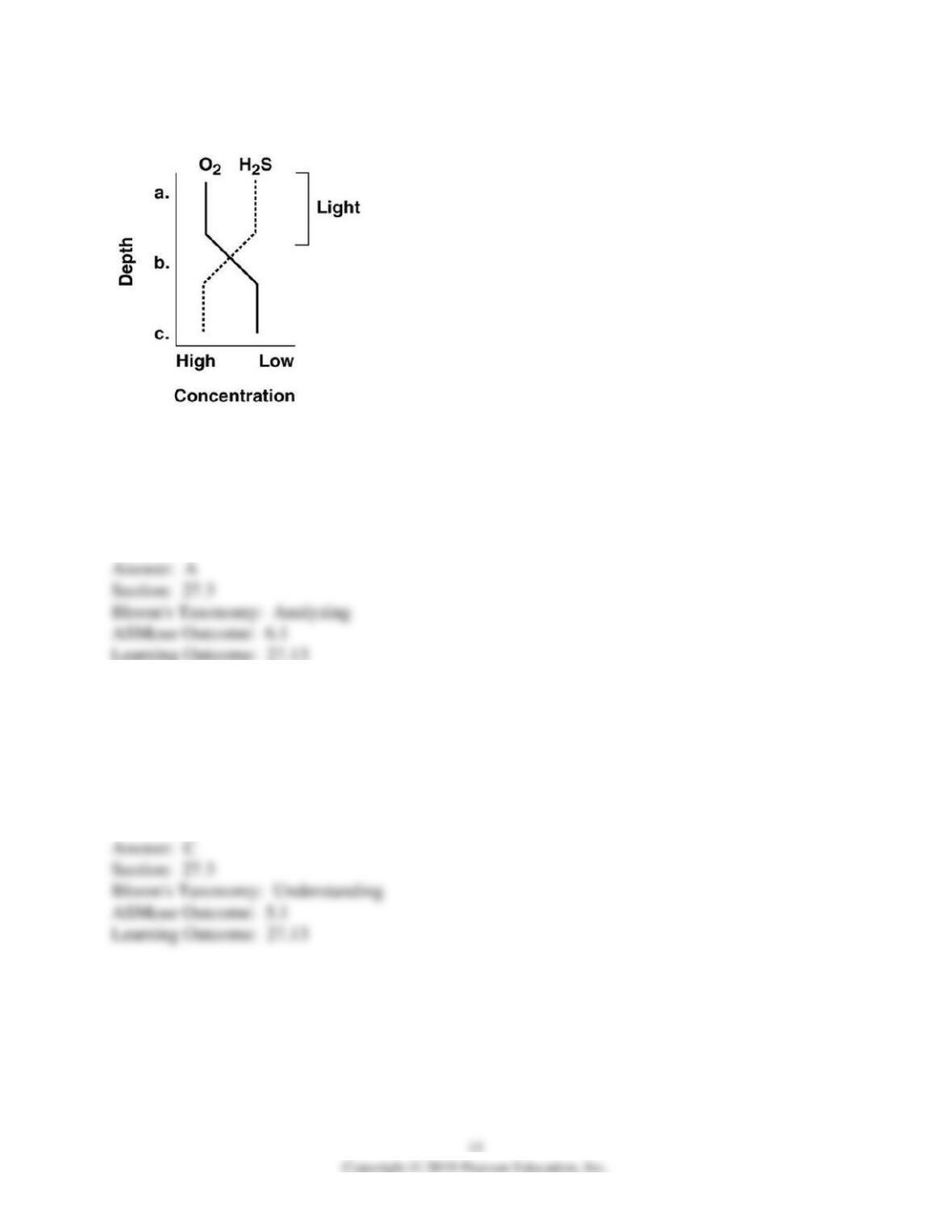
Figure 27.2
40) Where are photosynthetic bacteria most likely to be found in Figure 27.2?
A) a
B) b
C) c
D) a and b
E) b and c
41) Where are the benthic microbes such as Desulfovibrio and Clostridium most likely to be
found in Figure 27.2?
A) a
B) b
C) c
D) a and b
E) b and c

42) What is true about the seawater microbiota?
A) Large Archaea populations exist under the seafloor.
B) In seawater ecosystems nitrogen is not fixed but obtained from run-off from land sources.
C) Ocean life depends on the marine phytoplankton.
D) Estimate places 1/3 of all life on the planet within the seafloor.
E) Large Archaea populations exist under the seafloor and the marine phytoplankton supports all
ocean life.
43) The release of phosphate-containing detergents into a river would
A) kill algae.
B) increase algal growth.
C) kill bacteria.
D) improve the water quality.
E) None of the answers is correct.
44) Untreated sewage is released into a river. Which of the following statements is FALSE?
A) The untreated sewage is a health hazard.
B) The untreated sewage increases the BOD.
C) The untreated sewage decreases the dissolved oxygen.
D) The untreated sewage kills bacteria.
E) All of the statements are true.
45) One problem related to numerous septic systems in sandy soil is that
A) the high porosity can lead to contamination of water supplies with leached chemicals or
pathogens.
B) the systems may become impaired because the effluent will not drain properly.
C) few microbes exist in sandy soil to completely degrade the leached organic matter.
D) grains of sand clog the systems.
E) some human pathogens tend to multiply within a sand matrix increasing the likelihood of
disease transmission.
46) If nitrates are important in the nitrogen cycle, why are they also contaminants of the water
systems?
A) If ingested, nitrate is converted to nitrogen gas, which is toxic at low levels.
B) When ingested, nitrate is converted to nitrite and competes for oxygen in the blood, which is
especially harmful to infants.
C) It indicates the presence of fecal contamination.
D) It is the major cause of eutrophication.
E) None of these pertain to nitrate.
47) What is true about the nitrogen cycle?
A) The form of nitrogen present in significant levels in the atmosphere is easily assimilated by
most organisms.
B) Most of the nitrogen in the atmosphere exists as organic molecules.
C) The activity of specific types of microorganisms is important to convert atmospheric nitrogen
molecules into usable forms.
D) Both most of the nitrogen in the atmosphere exists as organic molecules and the activity of
specific types of microorganisms is important to convert atmospheric nitrogen molecules into
usable forms.
E) All organisms can incorporate atmospheric nitrogen into their proteins and nucleic acids.

48) What is true about the sulfur cycle?
A) H2S is the oxidized form of sulfur.
B) Green and purple photosynthesizing bacteria oxidize H2S.
C) Sulfates are utilized to become part of the carbohydrate molecules.
D) H2S represents a source of energy for some autotrophic bacteria.
E) Both green and purple photosynthesizing bacteria oxidize H2S and H2S represents a source of
energy for some autotrophic bacteria.
49) Put the stages of anaerobic sludge digestion in order
I. anaerobic fermentation produces carbon dioxide and organic acids
II. methane produced from product of previous stage
III. hydrogen and carbon dioxide produced from product of previous stage
A) I, II, III
B) II, I, III
C) I, III, II
D) II, III, I
E) III, II, I
50) Bioaugmentation involves
A) adding nitrogen and phosphorus to an area in need of remediation.
B) adding specialized microbes to an area in need of remediation.
C) producing humus from plant waste.
D) producing a methane by-product for powering facility equipment.
E) using microbes to filter out impurities from leach water.

27.2 True/False Questions
1) In water treatment, the purpose of flocculation is to remove microbes, such as Giardia and
Cryptosporidium.
2) Bioremediation involves the use of microbes to degrade or detoxify pollutants.
3) The water from tertiary sewage treatment can be used as drinking water.
4) Coliforms detected in water samples always have a fecal source.
5) The BOD is a measurement of the amount of bacteria present before and after the sewage
treatment process.

6) The bacteriological safety of drinking water is determined by testing water samples for the
presence of human pathogens.
7) The dense growth of algae in an algal bloom leads to increased oxygen levels in lakes that
enhance the habitat for fish.
8) Microorganisms in deep-sea vents and caves serve as autotrophic primary producers in the
absence of sunlight.
9) Nitrogen fixation by bacteria occurs only in the root nodules of leguminous plants.
10) In small communities lacking municipal sewage systems, sewage is treated in septic systems
or oxidation ponds.

27.3 Essay Questions
1) What is the effect of discharging primary-treated sewage on the BOD and dissolved O2 (DO)
of the receiving body of water? What is the effect of secondary-treated sewage on the BOD and
DO?
2) A newspaper headline reported “Algal Bloom Kills Fish.” What actually caused fish death,
given that the algae were not toxic? What could have caused the algal bloom?
3) Based on your knowledge of extremophiles and endoliths, describe the characteristics you
would expect of microorganisms capable of living on Mars or other non-Earth environments.
4) Differentiate endomycorrhizae from ectomycorrhizae and give an example of each.
5) An oil spill occurred in the waters near a local beach and the oil is depositing on the shore.
Describe the methods that might be used to clean up the spill that involve the activity of
microorganisms. Include a discussion of the limitations for each method.