Microbiology: An Introduction, 13e (Tortora et al.)
Chapter 27 Environmental Microbiology
27.1 Multiple-Choice Questions
1) All of the following are habitats for extremophiles EXCEPT
A) an acid mine wash.
B) the topmost portions of the Atlantic Ocean.
C) inside rock.
D) a salt-evaporating pond.
E) 100°C water.
2) Which of the following organisms is using sulfur as a source of energy?
A) Thiobacillus: H2S → S0
B) Desulfovibrio: SO42- → H2S
C) Proteus: Amino acids → H2S
D) Redwood tree: SO42- → Amino acids
E) Photosynthetic bacteria: H2S → S0
3) Which of the following is NOT a symbiotic pair of organisms?
A) elk and rumen bacteria
B) orchid and mycorrhizae
C) termites and cellulose-degrading bacteria
D) bean plant and Rhizobium
E) sulfur and Thiobacillus
4) All of the following are true of mycorrhizae EXCEPT
A) they are fungi that form beneficial relationships with plants.
B) an example is the food delicacy truffles.
C) the arbuscular mycorrhizae are a type of ectomycorrhizae.
D) they enable plants to absorb soil nutrients.
E) ectomycorrhizae extend the surface area of roots for nutrient absorption.
5) The guano deposited by seabirds is used a source for which of the following fertilizer
components?
A) phosphate
B) nitrate
C) sulfate
D) carbonate
E) potassium
6) Adding untreated sewage to a freshwater lake would cause the biochemical oxygen demand to
A) increase.
B) decrease.
C) stay the same.
D) The answer cannot be determined based on the information provided.
3
7) In freshwater lakes and ponds, the majority of photosynthetic microbes are located in the
________ zone(s).
A) benthic
B) profundal
C) limnetic
D) littoral
E) benthic and profundal
8) All of the following are used in secondary sewage treatment EXCEPT
A) trickling filters.
B) sludge granules or floc formation.
C) aeration.
D) anaerobic digestion.
E) activated sludge.
9) 6H2S + 6CO2 6S0 + glucose
A) takes place under aerobic conditions.
B) takes place under anaerobic conditions.
C) The amount of oxygen does not make any difference.
10) Which of the following requires aerobic conditions?
A) nitrogen fixation
B) sludge digestion
C) primary sewage treatment
D) secondary sewage treatment
E) water treatment
11) All of the following organisms are involved in carbon fixation EXCEPT
A) green and purple sulfur bacteria.
B) cyanobacteria.
C) lichens.
D) algae.
E) mycorrhizae.
12) Fill in the blanks with the most appropriate set of terms. In a(n) ________ sludge digester,
________ bacteria decrease organic solids by degrading them.
A) activated; benthic
B) sedimentation; suspended
C) tertiary; Zooglea
D) anaerobic; methane-producing
E) aerobic; hydrogen-gas producing.
13) NH3 → NO2–
A) takes place under aerobic conditions.
B) takes place under anaerobic conditions.
C) The amount of oxygen does not make any difference.
14) Bioremediation of petroleum
A) takes place under aerobic conditions.
B) takes place under anaerobic conditions.
C) The amount of oxygen does not make any difference.
15) Biochemical oxygen demand is a measure of the
A) number of bacteria present in a water sample.
B) amount of oxygen present in a water sample.
C) amount of organic matter present in a water sample.
D) amount of undissolved solid matter present in a water sample.
E) amount of nitrogen in a water sample.
16) For the biogeochemical cycles of the following elements, which does NOT have an
atmospheric cycle?
A) carbon
B) phosphorus
C) sulfur
D) nitrogen
17) Which of the following is required for composting?
A) addition of non-biodegradable materials
B) addition of nitrogen and phosphorus sources
C) periodic turning or raking of the compost pile
D) addition of thermophilic microbes
E) constant anaerobic conditions
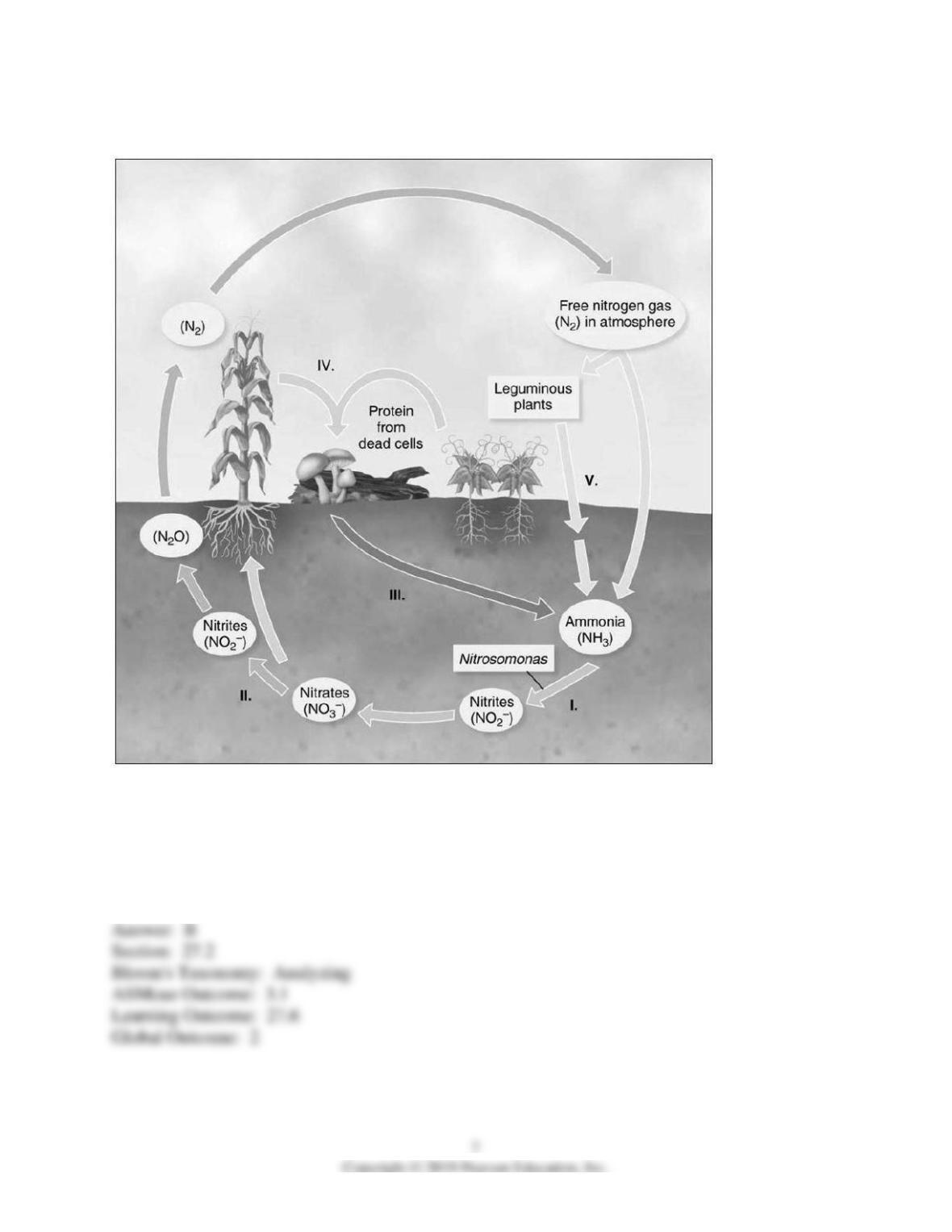
Figure 27.1
18) Which step in Figure 27.1 represents anaerobic respiration?
A) I
B) II
C) III
D) IV
E) V
19) Which term in Figure 27.1 describes step V?
A) ammonification
B) denitrification
C) dissimilation
D) nitrification
E) nitrogen fixation
20) Which step in Figure 27.1 represents the following reaction: amino acid (-NH2) → NH3?
A) I
B) II
C) III
D) IV
E) V
21) Nitrification is beneficial to farmers. It is represented by which step in Figure 27.1?
A) I
B) II
C) III
D) IV
E) V
22) Which of the following terms describes step III in Figure 27.1?
A) ammonification
B) denitrification
C) nitrification
D) nitrogen fixation
E) assimilation
23) Which of the following terms describes NO3– → NO2– → N2O → N2?
A) ammonification
B) denitrification
C) nitrification
D) nitrogen fixation
E) anaerobic respiration
24) Which of the following is an assimilation process?
A) Thiobacillus: H2S → S0
B) Desulfovibrio: SO42- → H2S
C) Proteus: Sulfhydryl-containing amino acids → H2S
D) Redwood tree: SO42- → Sulfhydryl groups of amino acids
E) Photosynthetic bacteria: H2S → S0
25) Which wastewater treatment process is responsible for removal of most of the BOD in
sewage?
A) anaerobic sludge digestion
B) primary sewage treatment
C) secondary sewage treatment
D) tertiary sewage treatment
E) water treatment
26) Which wastewater treatment process produces BOD-containing effluent used for irrigation?
A) anaerobic sludge digestion
B) primary sewage treatment
C) secondary sewage treatment
D) tertiary sewage treatment
E) water treatment
27) Besides the use of chlorine, other method(s) used to disinfect municipal water include
A) ozone.
B) nitrite.
C) flocculant.
D) UV light.
E) both UV light and ozone.
28) Sedimentation of sludge occurs in
A) anaerobic sludge digestion.
B) primary sewage treatment.
C) secondary sewage treatment.
D) tertiary sewage treatment.
E) water treatment.
29) The product of which process contains the highest BOD?
A) anaerobic sludge digestion
B) primary sewage treatment
C) secondary sewage treatment
D) tertiary sewage treatment
E) water treatment
30) Zoogloea form flocculent masses in
A) anaerobic sludge digestion.
B) primary sewage treatment.
C) activated sludge digestion.
D) tertiary sewage treatment.
E) water treatment.