Campbell Biology, 10e (Reece)
Chapter 27 Bacteria and Archaea
1) The predatory bacterium Bdellovibrio bacteriophorus drills into a prey bacterium and, once
inside, digests it. In an attack upon a Gram-negative bacterium that has a slimy cell covering,
what is the correct sequence of structures penetrated by B. bacteriophorus on its way to the
prey’s cytoplasm?
1. membrane composed mostly of lipopolysaccharide
2. membrane composed mostly of phospholipids
3. peptidoglycan
4. capsule
A) 2, 4, 3, 1
B) 1, 3, 4, 2
C) 1, 4, 3, 2
D) 4, 1, 3, 2
2) Jams, jellies, preserves, honey, and other foods with high sugar content hardly ever become
contaminated by bacteria, even when the food containers are left open at room temperature. This
is because bacteria that encounter such an environment ____.
A) undergo death as a result of water loss from the cell
B) are unable to metabolize the glucose or fructose, and thus starve to death
C) are obligate anaerobes
D) are unable to swim through these thick and viscous materials
Use the information in the following paragraph to answer the question(s) below.
A hypothetical bacterium swims among human intestinal contents until it finds a suitable
location on the intestinal lining. It adheres to the intestinal lining using a feature that also
protects it from phagocytes, bacteriophages, and dehydration. Fecal matter from a human in
whose intestine this bacterium lives can spread the bacterium, even after being mixed with water
and boiled. The bacterium is not susceptible to the penicillin family of antibiotics. It contains no
plasmids and relatively little peptidoglycan.
3) This bacterium’s ability to survive in a human who is taking penicillin pills may be due to the
presence of _____.
1. penicillin-resistance genes
2. a secretory system that removes penicillin from the cell
3. a Gram-positive cell wall
4. a Gram-negative cell wall
5. an endospore
A) 1 or 5
B) 2 or 3
C) 4 or 5
D) 2, 4, or 5
4) Adherence to the intestinal lining by this bacterium is due to its possession of _____.
A) fimbriae
B) pili
C) a capsule
D) a flagellum
5) What should be true of the cell wall of this bacterium?
A) Its innermost layer is composed of a phospholipid bilayer.
B) After it has been subjected to Gram staining, the cell should remain purple.
C) It has an outer membrane of lipopolysaccharide.
D) It is mostly composed of a complex, cross-linked polysaccharide.
6) In which feature(s) should one be able to locate a complete chromosome of this bacterium?
1. nucleolus
2. prophage
3. endospore
4. nucleoid
A) 4 only
B) 1 and 3
C) 2 and 3
D) 3 and 4
The following table depicts characteristics of five prokaryotic species (A-E). Use the information
in the table to answer the question(s) below
Trait
Species A
Species B
Species C
Species D
Species E
Plasmid
R
None
R
F
None
Gram Staining
Results
Variable
Variable
Negative
Negative
Negative
Nutritional
Mode
Chemohetero-
troph
Chemoauto-
troph
Chemohetero-
troph
Chemohetero-
troph
Photoautotroph
Specialized
Metabolic
Pathways
Aerobic
methanotroph
(obtains carbon
and energy
from methane)
Anaerobic
methanogen
Anaerobic
butanolic
fermentation
Anaerobic lactic
acid
fermentation
Anaerobic
nitrogen
fixation and
aerobic
photosystems
I and II
Other Features
Fimbriae
Internal
membranes
Flagellum
Pili
Thylakoids
7) Which two species should have much more phospholipid, in the form of bilayers, in their
cytoplasms than most other bacteria?
A) species A and B
B) species A and C
C) species B and E
D) species C and D
8) Which species are capable of directed movement?
A) species A
B) species B
C) species C
D) species D
9) How many of these species probably have a cell wall that consists partly of an outer
membrane of lipopolysaccharide?
A) only one species
B) two species
C) three species
D) four species
10) Which of the following observations about flagella is true and is consistent with the scientific
conclusion that the flagella from protists and bacteria evolved independently?
A) The flagella of both protists and bacteria are made of the same protein, but the configuration
is different.
B) The mechanics of movement and protein structure are the same in these flagella, but there are
significant genetic differences.
C) Although the mechanism of movement in both flagella is the same, the protein that
accomplishes the movement is different.
D) The protein structure and the mechanism of movement in protist flagella are different from
those of bacteria flagella.
11) In a bacterium that possesses antibiotic resistance and the potential to persist through very
adverse conditions, such as freezing, drying, or high temperatures, DNA should be located
within, or be part of, which structures?
1. nucleoid region
2. endospore
3. fimbriae
4. plasmids
A) 1 and 2 only
B) 1 and 4 only
C) 2 and 4 only
D) 1, 2, and 4
12) If a bacterium regenerates from an endospore that did not possess any of the plasmids that
were contained in its original parent cell, the regenerated bacterium will probably also _____.
A) lack antibiotic-resistant genes
B) lack a cell wall
C) lack a chromosome
D) lack water in its cytoplasm
13) Chloramphenicol is an antibiotic that targets prokaryotic (70S) ribosomes, but not eukaryotic
(80S) ribosomes. Which of these questions stems from this observation, plus an understanding of
eukaryotic origins?
A) Can chloramphenicol also be used to control human diseases that are caused by archaeans?
B) Can chloramphenicol pass through the capsules possessed by many cyanobacteria?
C) If chloramphenicol inhibits prokaryotic ribosomes, should it not also inhibit mitochondrial
ribosomes?
D) Why aren’t prokaryotic ribosomes identical to eukaryotic ribosomes?
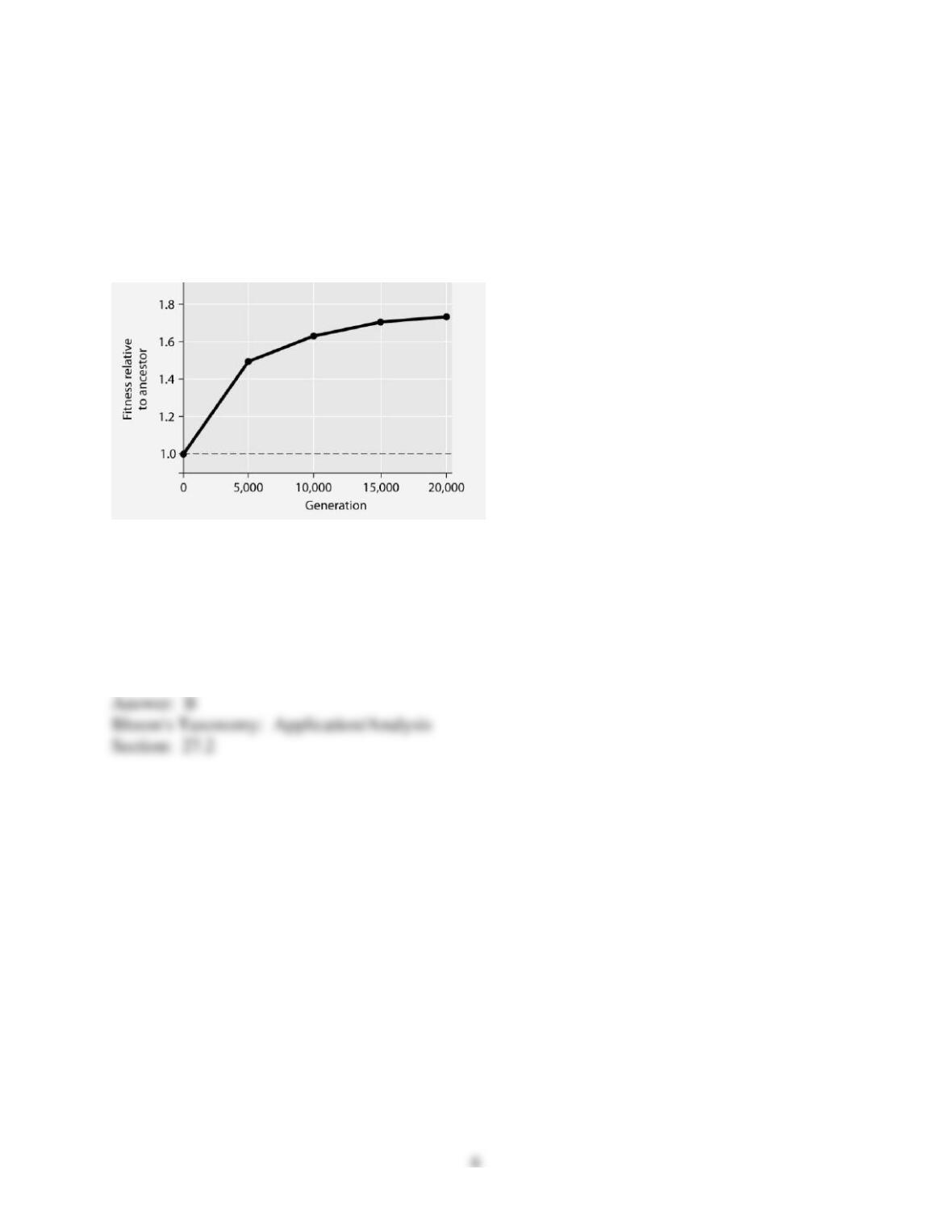
The following questions refer to the figure below.
In this eight-year experiment, twelve populations of E. coli, each begun from a single cell, were
grown in low-glucose conditions for 20,000 generations. Each culture was introduced to fresh
growth medium every twenty-four hours. Occasionally, samples were removed from the
populations, and their fitness in low-glucose conditions was tested against that of members
sampled from the ancestral (common ancestor) E. coli population.
14) If new genetic variation in the experimental populations arose solely by spontaneous
mutations, then the most effective process for subsequently increasing the prevalence of the
beneficial mutations in the population over the course of generations is _____.
A) transduction
B) binary fission
C) conjugation
D) transformation
7
Use the following information and graph to answer the question(s) below.
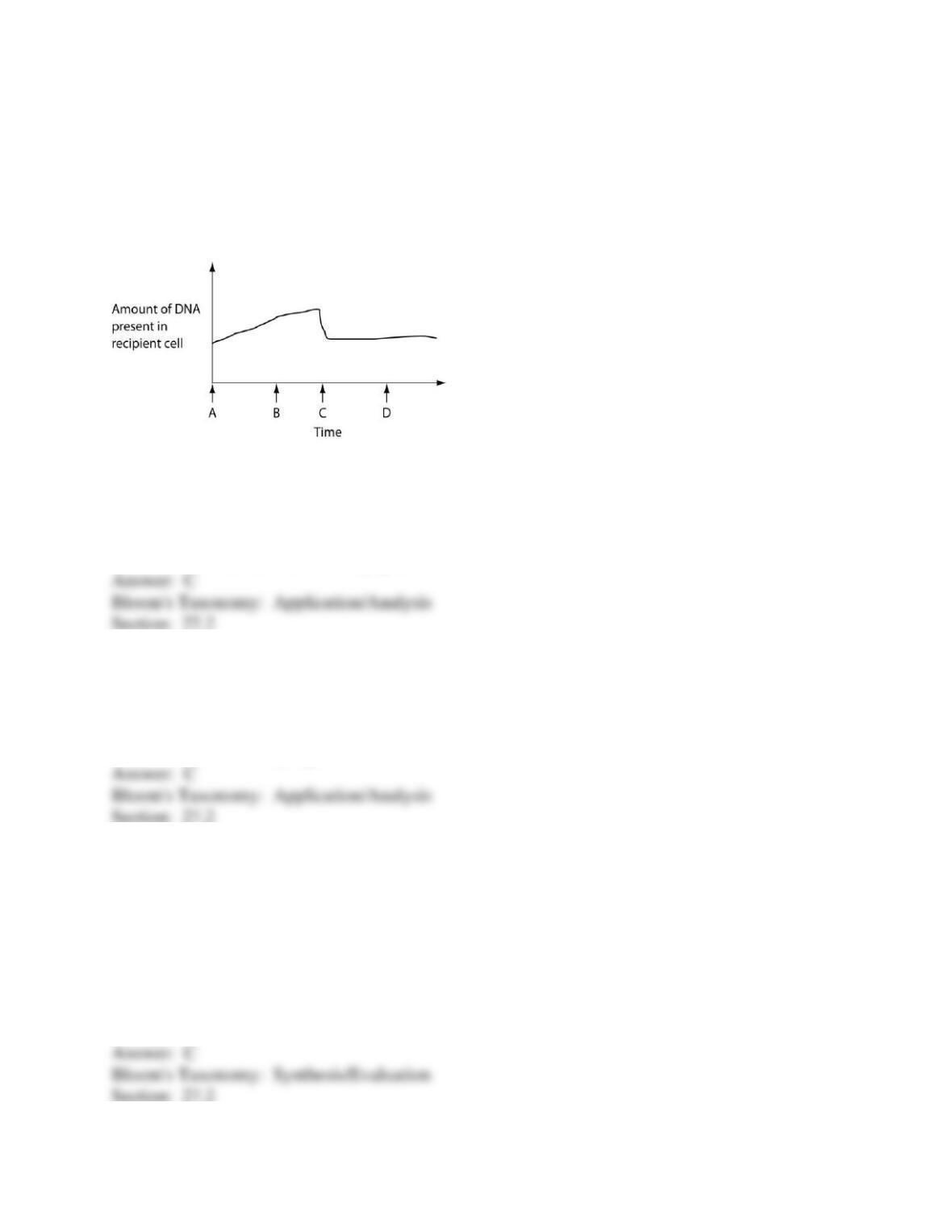
The figure below depicts changes to the amount of DNA present in a recipient cell that is
engaged in conjugation with an Hfr cell. Hfr cell DNA begins entering the recipient cell at Time
A. Assume that reciprocal crossing over occurs (in other words, a fragment of the recipient’s
chromosome is exchanged for a homologous fragment from the Hfr cell’s DNA).
15) What is occurring at Time C that is decreasing the DNA content?
A) crossing over
B) cytokinesis
C) degradation of DNA that was not retained in the recipient’s chromosome
D) reversal of the direction of conjugation
16) How is the recipient cell different at Time D than it was at Time A?
A) It has a greater number of genes.
B) It has a greater mass of DNA.
C) It has a different sequence of base pairs.
D) It contains bacteriophage DNA.
17) Which two processes are responsible for the shape of the curve at Time B?
1. transduction
2. entry of single-stranded Hfr DNA
3. rolling circle replication of single-stranded Hfr DNA
4. activation of DNA pumps in plasma membrane
A) 1 and 2
B) 1 and 4
C) 2 and 3
D) 3 and 4
18) During which two times can the recipient accurately be described as “recombinant” due to
the sequence of events portrayed in the figure?
A) during Times C and D
B) during Times A and C
C) during Times A and B
D) during Times B and D
Use the information in the following paragraph to answer the question(s) below.
A hypothetical bacterium swims among human intestinal contents until it finds a suitable
location on the intestinal lining. It adheres to the intestinal lining using a feature that also
protects it from phagocytes, bacteriophages, and dehydration. Fecal matter from a human in
whose intestine this bacterium lives can spread the bacterium, even after being mixed with water
and boiled. The bacterium is not susceptible to the penicillin family of antibiotics. It contains no
plasmids and relatively little peptidoglycan.
19) The cell also lacks F factors and F plasmids. Upon its death, this bacterium should be able to
participate in _____.
A) conjugation
B) transduction
C) transformation
D) conjugation and transduction
The following table depicts characteristics of five prokaryotic species (A-E). Use the information
in the table to answer the question(s) below
Trait
Species A
Species B
Species C
Species D
Species E
Plasmid
R
None
R
F
None
Gram Staining
Results
Variable
Variable
Negative
Negative
Negative
Nutritional
Mode
Chemohetero-
troph
Chemoauto-
troph
Chemohetero-
troph
Chemohetero-
troph
Photoautotroph
Specialized
Metabolic
Pathways
Aerobic
methanotroph
(obtains carbon
and energy
from methane)
Anaerobic
methanogen
Anaerobic
butanolic
fermentation
Anaerobic lactic
acid
fermentation
Anaerobic
nitrogen
fixation and
aerobic
photosystems
I and II
Other Features
Fimbriae
Internal
membranes
Flagellum
Pili
Thylakoids
20) Species D is pathogenic if it gains access to the human intestine. Which other species, if it
coinhabited a human intestine along with species D, is most likely to result in a recombinant
species that is both pathogenic and resistant to some antibiotics?
A) species A
B) species B
C) species C
D) species E
21) Which species might be able to include Hfr cells?
A) species A
B) species B
C) species C
D) species D
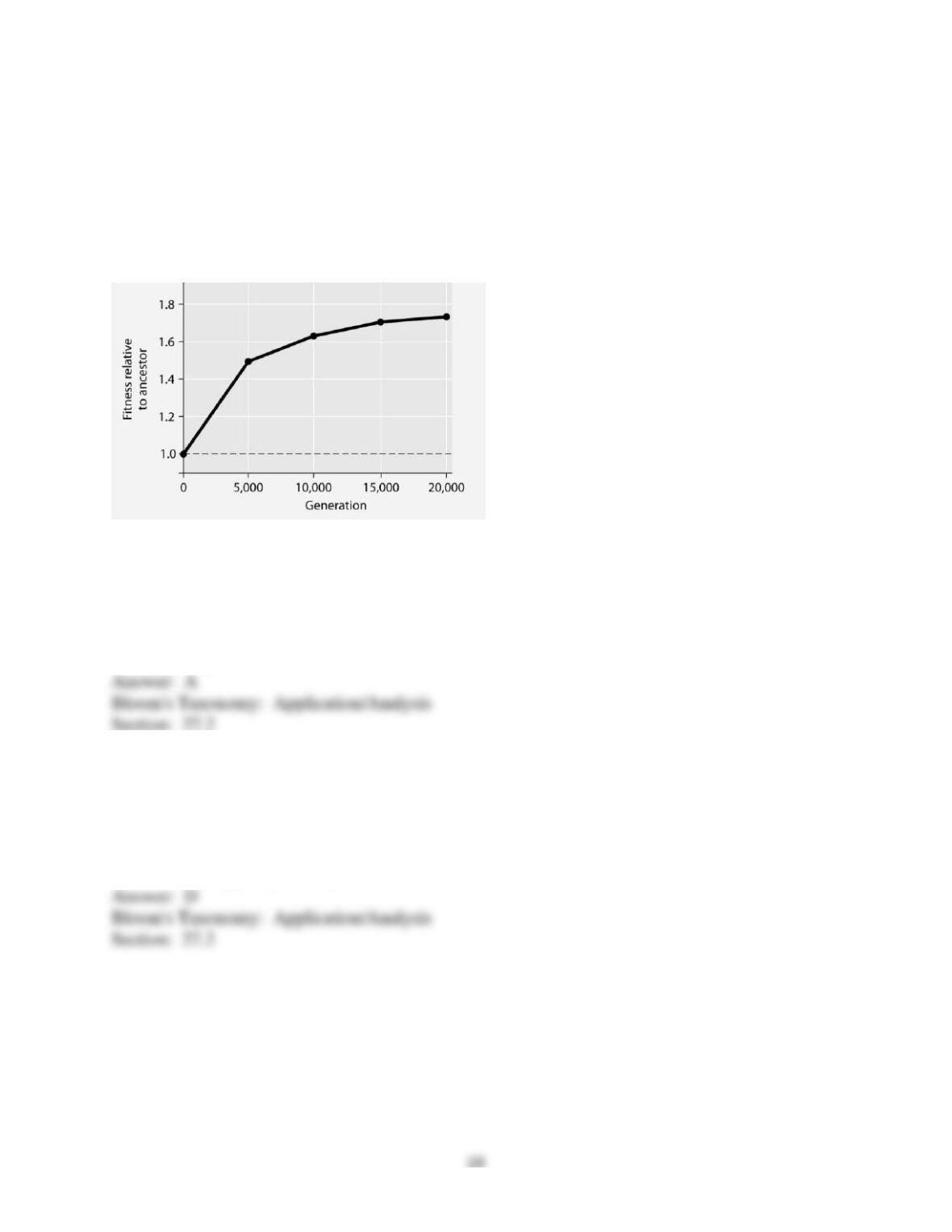
The following questions refer to the figure below.
In this eight-year experiment, twelve populations of E. coli, each begun from a single cell, were
grown in low-glucose conditions for 20,000 generations. Each culture was introduced to fresh
growth medium every twenty-four hours. Occasionally, samples were removed from the
populations, and their fitness in low-glucose conditions was tested against that of members
sampled from the ancestral (common ancestor) E. coli population.
22) Which term best describes what has occurred among the experimental populations of cells
over this eight-year period?
A) microevolution
B) speciation
C) adaptive radiation
D) stabilizing selection
23) Compare the bacteria in the figure above in generation 1 and generation 20,000. The bacteria
in generation 1 have a greater _____.
A) efficiency at exporting glucose from the cell to the environment
B) ability to survive on simple sugars, other than glucose
C) ability to synthesize glucose from amino acid precursors
D) reliance on glycolytic enzymes
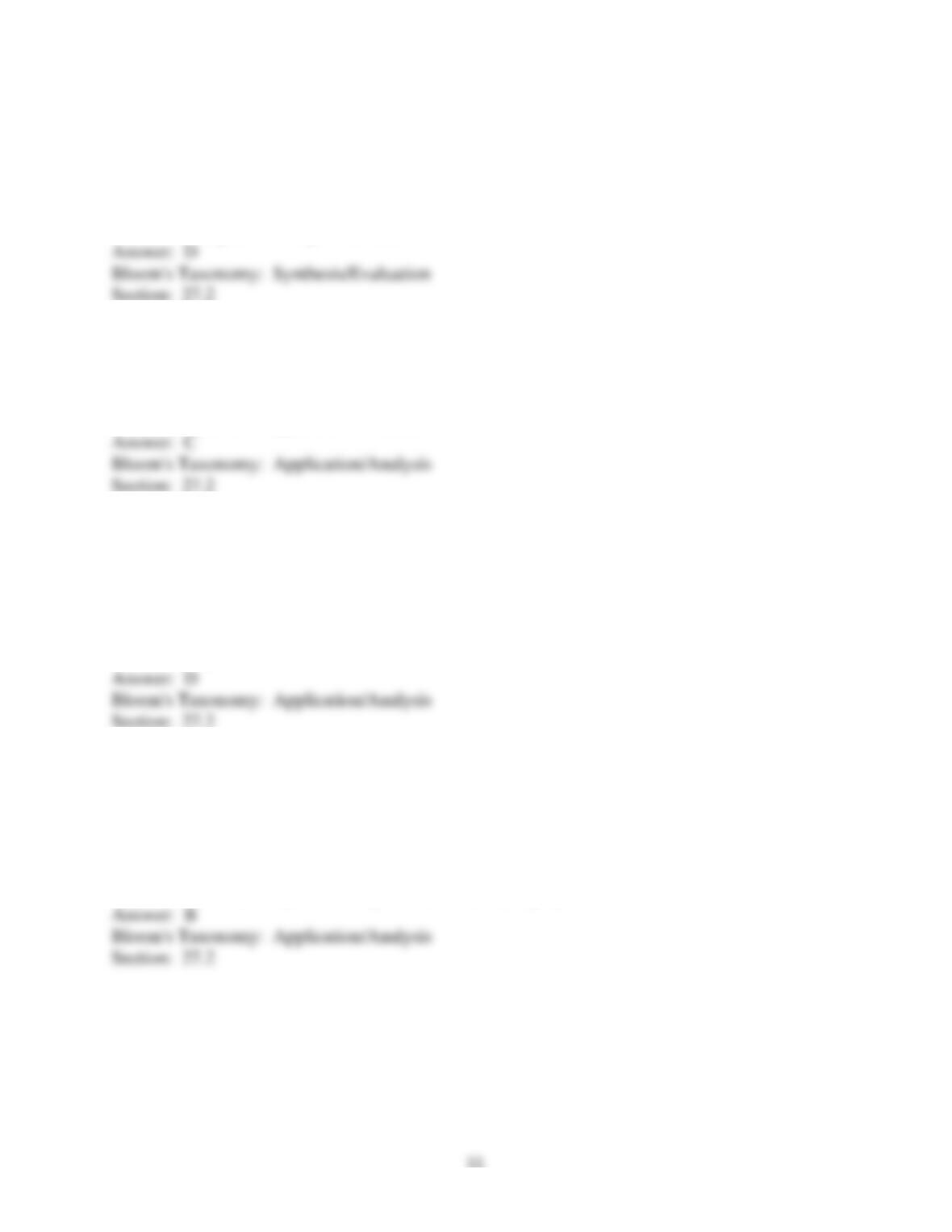
24) If the vertical axis of the figure above refers to relative fitness, then which of the following is
the most valid and accurate measure of fitness?
A) number of daughter cells produced per mother cell per generation
B) average swimming speed of cells through the growth medium
C) amount of glucose synthesized per unit time
D) number of generations per unit time
25) E. coli cells typically make most of their ATP by metabolizing glucose. Under the conditions
of this experiment, as time passed, E. coli generation times should be _____.
A) the same as in the typical environment
B) faster than in the typical environment
C) slower than in the typical environment
26) If the experimental population of E. coli lacks an F factor or F plasmid, and if bacteriophages
are excluded from the bacterial cultures, then beneficial mutations might be transmitted
horizontally to other E. coli cells via _____.
A) sex pili
B) transduction
C) conjugation
D) transformation
27) In a hypothetical situation, the genes for sex pilus construction and for tetracycline resistance
are located on the same plasmid within a particular bacterium. If this bacterium readily performs
conjugation involving a copy of this plasmid, then the result should be the _____.
A) temporary possession by this bacterium of a completely diploid genome
B) rapid spread of tetracycline resistance to other bacteria in that habitat
C) subsequent loss of tetracycline resistance from this bacterium
D) production of endospores among the bacterium’s progeny
28) Which of the following is LEAST associated with the others?
A) horizontal gene transfer
B) conjugation
C) transformation
D) binary fission
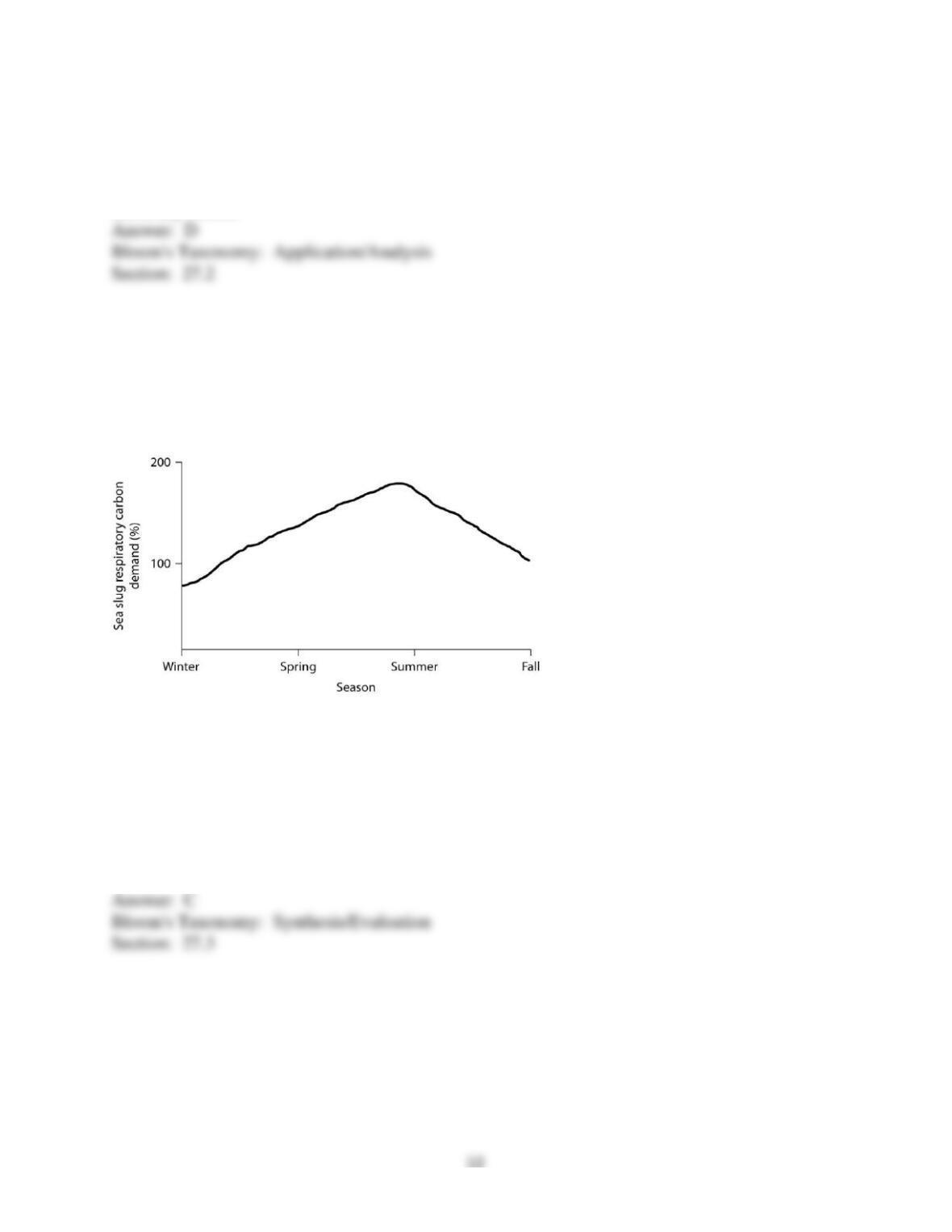
Use the following information and figure to answer the question(s) below.
The sea slug Pteraeolidia ianthina (P. ianthina) can harbor living dinoflagellates (photosynthetic
protists) in its skin. These endosymbiotic dinoflagellates reproduce quickly enough to maintain
their populations. Low populations do not affect the sea slugs very much, but high populations (>
5 x 10⁵ cells/mg of sea slug protein) can promote sea slug survival.
Percent of sea slug respiratory carbon demand provided by indwelling dinoflagellates.
29) If we assume that carbon is the sole nutrient needed by sea slugs to drive their cellular
respiration, then based on the graph, during which season(s) is it LEAST necessary for P.
ianthina to act as a chemoheterotroph?
A) winter
B) spring
C) summer
D) fall

30) Use of synthetic fertilizers often leads to the contamination of groundwater with nitrates.
Nitrate pollution is also a suspected cause of anoxic “dead zones” in the ocean. Which of the
following might help reduce nitrate pollution?
A) growing improved crop plants that have nitrogen-fixing enzymes
B) adding nitrifying bacteria to the soil
C) adding denitrifying bacteria to the soil
D) using ammonia instead of nitrate as a fertilizer
31) Biologists sometimes divide living organisms into two groups: autotrophs and heterotrophs.
These two groups differ in _____.
A) their sources of energy
B) their electron acceptors
C) their mode of nutrition
D) the way that they generate ATP