
62) Which of the following can be found in gymnosperms?
A) non-fertile flower parts
B) fruits
C) pollen
D) carpels
63) Which of the following statements is true of the pine life cycle?
A) Cones are homologous to the capsules of moss plants.
B) The pine tree is a gametophyte.
C) Male and female gametophytes are in close proximity during gamete synthesis.
D) Conifer pollen grains contain male gametophytes.
64) Within a gymnosperm megasporangium, what is the correct sequence in which the following
should appear during development, assuming that fertilization occurs?
1. sporophyte embryo
2. female gametophyte
3. egg cell
4. megaspore
A) 4 → 3 → 2 → 1
B) 4 → 2 → 3 → 1
C) 4 → 1 → 2 → 3
D) 1 → 4 → 3 → 2
E) 1 → 4 → 2 → 3

65) Generally, wind pollination is most likely to be found in seed plants that grow
A) close to the ground.
B) in dense, single-species stands.
C) in relative isolation from other members of the same species.
D) along coastlines where prevailing winds blow from the land out to sea.
E) in well-drained soils.
66) Which of the following statements correctly describes a portion of the pine life cycle?
A) Female gametophytes use mitosis to produce eggs.
B) Seeds are produced in pollen-producing cones.
C) Pollen grains contain female gametophytes.
D) A pollen tube slowly digests its way through the triploid endosperm.
67) A researcher has developed two stains for use with seed plants. One stains sporophyte tissue
blue; the other stains gametophyte tissue red. If the researcher exposes pollen grains to both
stains and then rinses away the excess stain, what will occur?
A) The pollen grains will be pure red.
B) The pollen grains will be pure blue.
C) The pollen grains will have red interiors and blue exteriors.
D) The pollen grains will have blue interiors and red exteriors.
68) Gymnosperms differ from both extinct and extant (living) ferns because they
A) are woody.
B) have macrophylls.
C) have pollen.
D) have sporophylls.
E) have spores.

69) Which of the following is most important in making the typical seed more resistant to
adverse conditions than the typical spore?
A) a different type of sporopollenin
B) an internal reservoir of liquid water
C) integument(s)
D) ability to be dispersed
E) waxy cuticle
70) Which of the following cellular structures is functionally important in cells of the
gametophytes of both angiosperms and gymnosperms?
A) sporangium
B) anthers
C) cell walls
D) apical meristems
71) The seed coat’s most important function is to provide
A) a nonstressful environment for the megasporangium.
B) a means for dispersal.
C) dormancy.
D) a nutrient supply for the embryo.
E) protection for the embryo.
72) In addition to seeds, which of the following characteristics is unique to the seed-producing
plants?
A) sporopollenin
B) lignin present in cell walls
C) pollen
D) use of air currents as a dispersal agent
E) megaphylls

73) What is thought to be the correct sequence of the following events during the Carboniferous
period?
1. Vascular plants become more prevalent.
2. Megaphylls with large surface areas become more prevalent.
3. Atmospheric CO2 levels decline dramatically.
4. Global cooling occurs, leading to widespread glaciations.
A) 1, 2 ,3, 4
B) 2, 1, 3, 4
C) 2, 1, 4, 3
D) 1, 2, 4, 3
E) 3, 4, 1, 2
74) The fruit of the mistletoe, a parasitic angiosperm, is a one-seeded berry. In members of the
genus Viscum, the outside of the seed is viscous (sticky), which permits the seed to adhere to
surfaces, such as the branches of host plants or the beaks of birds. What should be expected of
the fruit if the viscosity of Viscum seeds is primarily an adaptation for dispersal rather than an
adaptation for infecting host plant tissues?
A) It should be drab in color.
B) It should be colored so as to provide it with camouflage.
C) It should be nutritious.
D) It should secrete enzymes that can digest bark.
75) What is the greatest threat to plant diversity?
A) insects
B) grazing and browsing by animals
C) pathogenic fungi
D) competition with other plants
E) human population growth

76) The microsporidian Brachiola gambiae parasitizes the mosquito Anopheles gambiae. Adult
female mosquitoes must take blood meals in order for their eggs to develop, and it is while they
take blood that they transmit malarial parasites to humans. Male mosquitoes drink flower nectar.
If humans are to safely and effectively use Brachiola gambiae as a biological control to reduce
human deaths from malaria, then how many of the following statements should be true?
1. Brachiola should kill the mosquitoes before the malarial parasite they carry reaches maturity.
2. Brachiola must be harmful to male mosquitoes, but not to female mosquitoes.
3. Microsporidians should infect mosquito larvae, rather than mosquito adults.
4. The subsequent decline in Anopheles gambiae should not significantly disrupt human food
resources or other food webs.
A) 3 and 4 only
B) 1 and 3 only
C) 1 and 4 only
D) 2 and 4 only
77) Lichens are symbiotic associations of fungi and
I. mosses.
II. cyanobacteria.
III. green algae.
IV. gymnosperms
A) I only
B) I and II
C) II and III
D) III and IV

78) In both lichens and mycorrhizae, what does the fungal partner provide to its photosynthetic
partner?
A) carbohydrates
B) fixed nitrogen
C) antibiotics
D) water and minerals
E) protection from harmful UV
79) Which of the following is a characteristic of all angiosperms?
A) complete reliance on wind as the pollinating agent
B) double internal fertilization
C) free-living gametophytes
D) carpels that contain microsporangia
E) ovules that are not contained within ovaries
80) Which of the following statements are true of monocots?
I. Over 25% of extant angiosperms are monocots.
II. Monocots include both crop plants and ornamental plants.
III. Monocots are most closely related to eudicots.
IV. Monocots possess multiple cotyledons.
A) I and II
B) II and IV
C) I, III, and IV
D) I, II, and III
81) What do fungi and arthropods have in common?
A) The haploid state is dominant in both groups.
B) Both groups are predominantly heterotrophs that ingest their food.
C) The protective coats of both groups are made of chitin.
D) Both groups have cell walls.
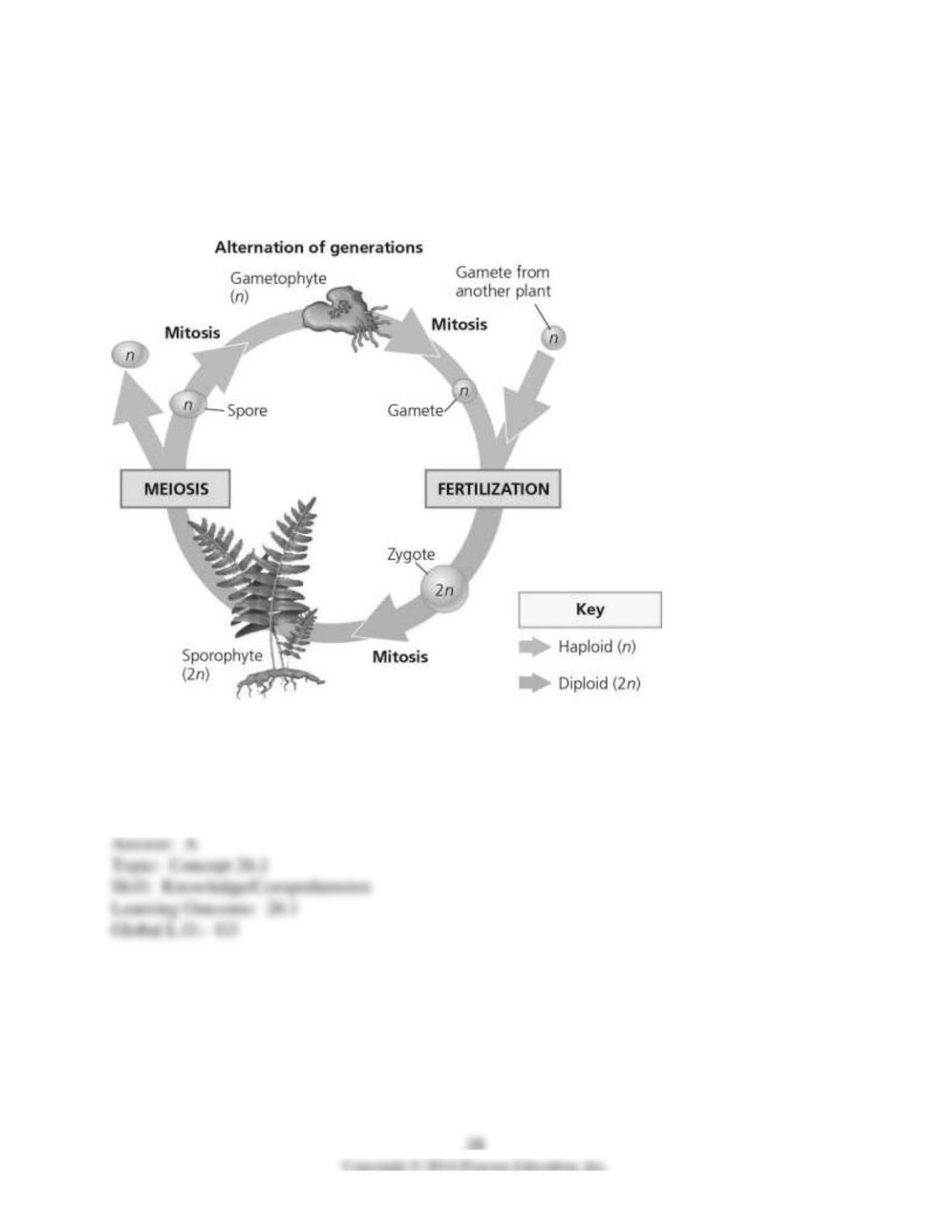
26.2 Art Questions
The following question(s) refer to the generalized life cycle for land plants shown in the figure.
Each number within a circle represents a specific plant or plant part, and each number in a box
refers to a biological process.
1) In the figure, which number produces haploid gametes by mitosis?
A) 1
B) 2
C) 3
D) 4
2) In the figure, which structure produces haploid spores by meiosis?
A) 1
B) 2
C) 3
D) 4
3) Meiosis is most likely to be represented by which number?
A) 4
B) 5
C) 6
D) 2
4) What describes the product of number 2?
A) a haploid gametophyte
B) a diploid gametophyte
C) a haploid sporophyte
D) a diploid sporophyte
5) In the figure, what are the processes for numbers 4, 5, and 6, respectively?
A) nuclear fission, meiosis, binary fission
B) mitosis, meiosis, binary fission
C) mitosis, meiosis, fertilization
D) fertilization, mitosis, meiosis
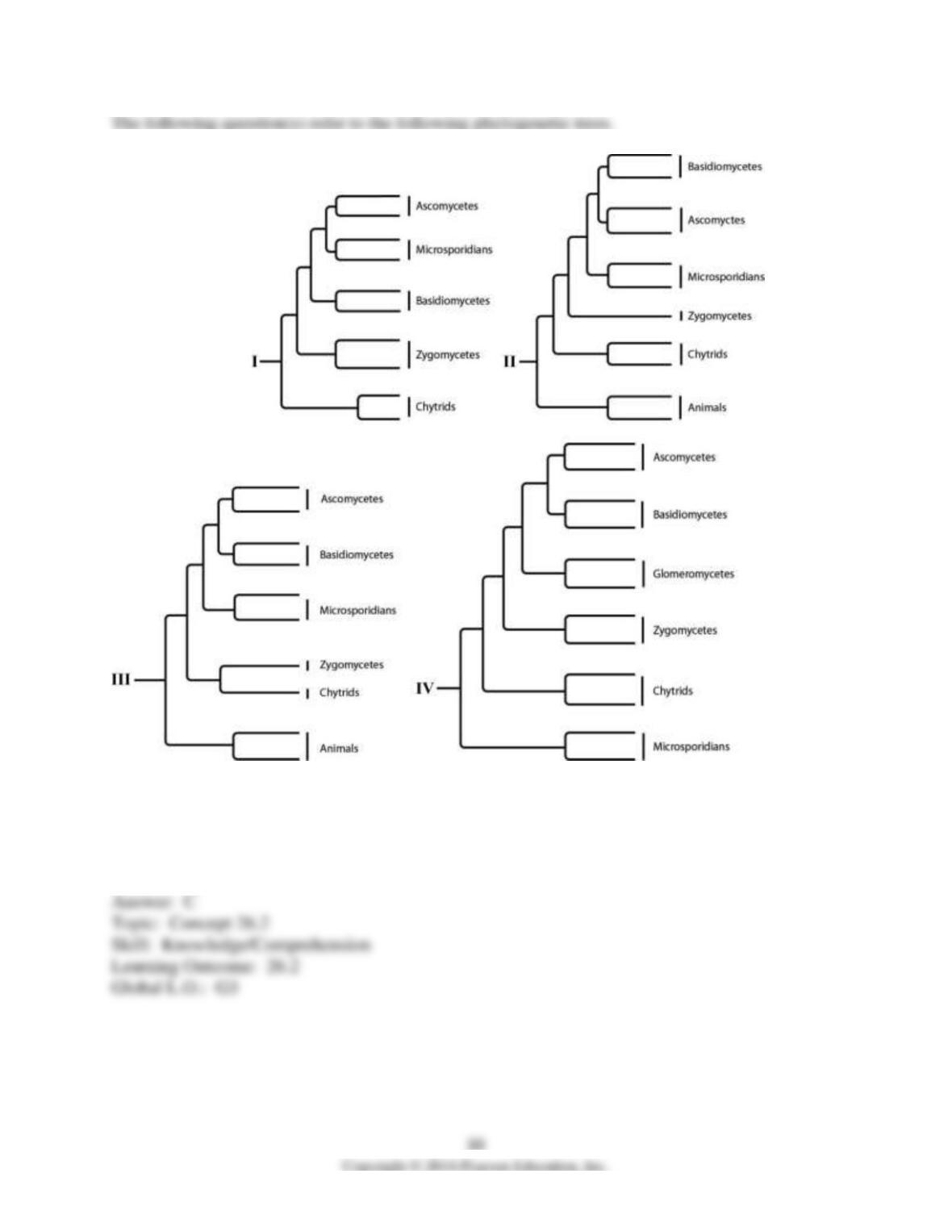
6) Which tree depicts all of the currently recognized major groups of fungi?
A) I
B) II
C) III
D) IV

7) Which tree depicts the closest relationship between zygomycetes and chytrids?
A) I
B) II
C) III
D) IV
8) In phylogenetic tree I, which group of organisms is most directly related to the common
ancestor of the tree?
A) zygomycetes
B) basidiomycetes
C) ascomycetes
D) chytrids
9)
What is true of the phylogenetic tree in the figure?
1. It depicts uncertainty about whether the bryophytes or the vascular plants evolved first.
2. It is hypothetical.
3. It shows that ferns are the closest living relatives to the seed plants.
4. It indicates that seeds are a shared ancestral character of all vascular plants.
A) 1 only
B) 2 only
C) 3 and 4 only
D) 1 and 3 only
26.3 Scenario Questions
Please use the following information to answer the question(s) below.
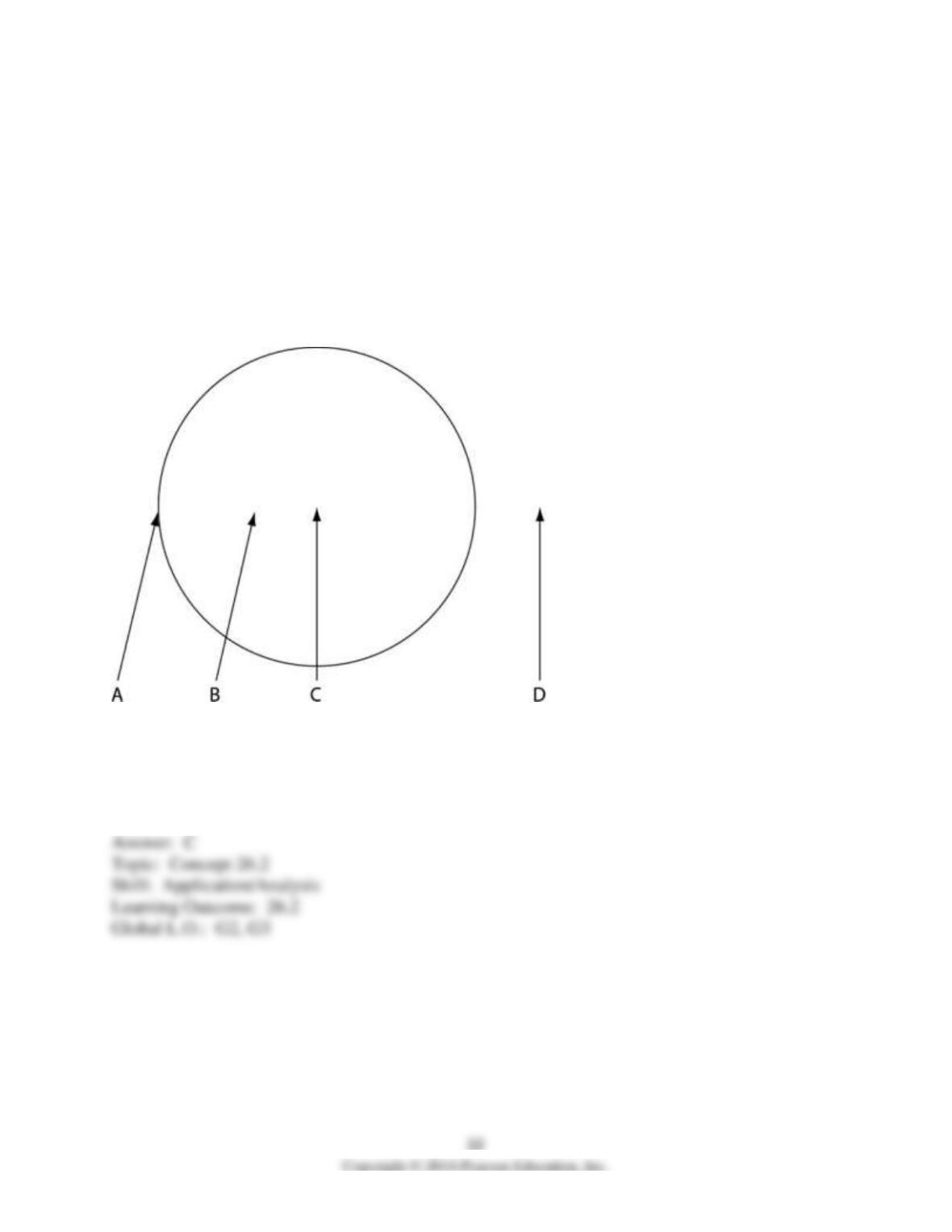
Fairy rings are circles of fungi that often appear in open meadows and in forest areas. In the soil
beneath the fungi is an ever-extending mycelium. As the mycelium spreads to seek out more
food, it sometimes will produce the fungi we see above ground. The figure depicts the outline of
a fairy ring that has appeared overnight in an open meadow, as viewed from above. The ring
represents the farthest advance of this mycelium through the soil. Locations A-D are all 0.5
meters below the soil surface.
1) What is the most probable location of the oldest portion of this mycelium?
A) A
B) B
C) C
D) D

2) Which location is nearest to basidiocarps?
A) A
B) B
C) C
D) D
3) At which location should one find the lowest concentration of fungal enzymes, assuming that
the enzymes do not diffuse far from their source and that no other fungi are present in this
habitat?
A) A
B) B
C) C
D) D
4) All four locations are 0.5 m below the surface. On a breezy day with prevailing winds blowing
from left to right, where should one expect to find the highest concentration of free basidiospores
in an air sample?
A) A
B) B
C) C
D) D

Please use the following information to answer the question(s) below.
Diploid nuclei of the ascomycete Neurospora crassa contain 14 chromosomes. A single diploid
cell in an ascus will undergo one round of meiosis, followed in each of the daughter cells by one
round of mitosis, producing a total of eight ascospores.
5) If a single, diploid G2 nucleus in an ascus contains 400 nanograms (ng) of DNA, then a single
ascospore nucleus of this species should contain how much DNA (ng), carried on how many
chromosomes?
A) 100, carried on 7 chromosomes
B) 100, carried on 14 chromosomes
C) 200, carried on 7 chromosomes
D) 200, carried on 14 chromosomes
E) 400, carried on 14 chromosomes
6) What is the ploidy of a single mature ascospore?
A) haploid
B) diploid
C) triploid (three homologous sets of chromosomes)
D) tetraploid (four homologous sets of chromosomes)

Please use the following information to answer the question(s) below.
For several decades now, amphibian species worldwide have been in decline. A significant
proportion of the decline seems to be due to the spread of the chytrid fungus Batrachochytrium
dendrobatidis (Bd). Chytrid sporangia reside within the epidermal cells of infected animals,
animals that consequently show areas of sloughed skin. Infected animals can also be lethargic,
which is expressed through failure to hide and failure to flee. The infection cycle typically takes
four to five days, at the end of which zoospores are released from sporangia into the
environment. Zoospores are spores of fungi (as well as some algae and protozoans) that use a
flagella for swimming locomotion. In some amphibian species, mortality rates approach 100%;
other species seem able to survive the infection.
7) The chytrid sporangia reside within the amphibian epidermal cells. Consequently, which
term(s) apply to Bd?
A) 1 and 2 only
B) 1 and 3 only
C) 2 and 4 only
D) 2, 3, and 5 only
E) 2, 4, and 5 only
8) Sexual reproduction has not been observed in Bd. A Bd sporangium initially contains a single
haploid cell. Which of the following processes must be involved in generating the multiple
zoospores eventually produced by each sporangium?
1. S phase
2. cytokinesis
3. mitosis
4. meiosis
A) 1 and 2 only
B) 1 and 3 only
C) 2 and 3 only
D) 1, 2, and 3 only
E) 1, 2, and 4 only