Chapter 26 The Pentose Phosphate Pathway
Matching Questions
Use the following to answer questions 1-10:
Choose the correct answer from the list below. Not all of the answers will be used.
a) non-oxidative phase
b) oxidative phase
c) transketolase
d) glucose 6-phosphate
e) reducing equivalents
f)lactonase
g) transaldolase
h) glutathione reductase
i) glycolysis
j) NADH
k) fructose-6-phosphate
l) NADPH
m) glucose
1.
____________ is a substrate for the pentose phosphate pathway.
2.
____________ is the key source of biosynthetic reducing equivalents.
Ans: l
Section: Introduction
3.
____________ The second phase of the pentose phosphate pathway.
Ans: a
Section: 26.1
4.
____________ Excess carbons of the pentose phosphate pathway are shunted to this other
metabolic pathway.
Ans: i
Section: 26.1
5.
____________ and transketolase are the enzymes that link glycolysis and the pentose phosphate
pathway.
Ans: g
Section: 26.1
6.
____________ Ribulose 5-phosphate is the product of this phase.
Ans: b
Section: 26.1
Ans: d
Section: 26.1
Chapter 26 The Pentose Phosphate Pathway
2
7.
____________ results in a C3 and a C7 carbohydrate from two C5 carbohydrate precursors.
8.
____________ Two molecules of this product are formed in Phase II of the pentose phosphate
pathway.
Section: 26.1
9.
____________ A deficiency of glucose 6-phosphate can cause hemolytic anemia. This is due to
a loss in activity in this enzyme in red blood cells.
Section: 26.3
10.
____________ 6-phosphogluconate is the product of this reaction.
Section: 26.2
Fill–in-the-Blank Questions
11.
The two key components required for growth are _____ and biochemical reducing power.
12.
_____ is the committed step of the pentose phosphate pathway.
13.
Hemolytic anemia is a result of an increase in reactive oxygen species. The manifestation of the
disease is actually caused by a defect in_____.
Ans: glucose 6-phosphate dehydrogenase Section: 26.3
14.
_____ is converted to xylulose-5-phosphate by the enzyme phosphopentose epimerase.
15.
Isomers with multiple asymmetric centers differing in only one asymmetric center are_____.
16.
The enzyme transketolase transfers a _____ -carbon fragment from a ketose to an aldose.
Ans: two Section: 26.1
17.
_____ is the enzynme that catalyzes the hydrolysis of the ester linkage of the lactone resulting in
the ring opening.
18.
The oxidative phase of the pentose phosphate pathway produces _____, which is required for
lipid biosynthesis.
Ans: NADPH Section: 26.2
19.
NADPH is required by the liver and adipose for synthesis of _____.
Section: 26.1
Chapter 26 The Pentose Phosphate Pathway
3
20.
Hemolytic anemia is caused by a deficiency of the enzyme _____.
Multiple-Choice Questions
21.
ATP is called the energy currency. The currency of biosynthetic reducing power is
A) NADPH. B) NADH. C) AMP. D) ADP. E) None of the above.
Ans: A Section: Introduction
22.
The pentose phosphate pathway
A)
is stimulated by NADH.
D)
is contained within the mitochondria of
adipose cells.
B)
is stimulated by NADPH.
E)
None of the above.
C)
operates primarily in non-dividing
cells.
Ans: E Section: 26.2
23.
The sugar(s) that is (are) converted into ribulose 5-phosphate by a single enzymatic step is (are):
A)
ribose 5-phosphate.
D)
A and B
B)
xyulose 5-phosphate.
E)
B and C
C)
erythrose 4-phosphate.
Ans: D Section: 26.1
24.
_____ oxidizes the C3 hydroxyl to a ketone.
A)
Lactonase
D)
Transketolase
B)
Glucose 6-phosphate dehydrogenase
E)
6-phosphogluconate dehydrogenase
C)
Transaldolase
Ans: E Section: 26.1
25.
Which biosynthetic pathway requires NADPH?
A)
cholesterol
D)
All of the above.
B)
fatty acid
E)
None of the above.
C)
nucleotide
Ans: D Section: 26.1
26.
In mode two, _____
A)
the needs for NADPH and ribose 5-
phosphate are balanced.
D)
NADPH and CO2 are required.
B)
much more NADPH than ribose 5-
phosphate is required.
E)
NAD+ is needed in excess.
C)
more ribose 5-phosphate than NADPH
is required.
Ans: A Section: 26.2
27.
The purpose of the pentose phosphate pathway is to:
A)
generate ATP.
D)
A and B
B)
generate NADPH.
E)
B and C
C)
synthesize five-carbon sugars.
Ans: E Section: 26.1 & introduction
Ans: glucose-6-phosphate dehydrogenase Section: 26.3

Chapter 26 The Pentose Phosphate Pathway
4
28.
Reduced glutathione maintains red blood cell structure by:
A)
protecting against falciparum malaria.
D)
A and C
B)
maintaining hemoglobin structure.
E)
B and C
C)
preventing Heinz body formation.
29.
Which of the following reactions is NOT part of the pentose phosphate pathway?
A)
Transketolase
C5C5C3C7
+
+
B)
++C6
C3
C5
C4Transketolase
C)
Transaldolase
C3C7C6C4
+
+
D)
C5C6C2C9
+
+Transketolase
E)
All of the above.
Ans:D Section: 26.1
30.
What is the net reaction of the transketolase and transaldolase steps?
A)
3C5 2C6 + C3
D)
2C5 2C4 + C2
B)
2C5 C6 + C4
E)
None of the above.
C)
3C5 C6 + 3C3
Ans: A Section: 26.1
31.
Glucose-6-phosphate dehydrogenase is inhibited by low levels of:
A)
NADPH.
B)
NADP+.
C)
ribose-5-phosphate.
D)
A and C
E)
B and C
Ans: B Section: 26.2
32.
In the non-oxidative stage of the pentose phosphate pathway, intermediates of _____________
are produced.
A)
the citric acid cycle
B)
glycolysis
C)
glycogen degradation
D)
A and C
E)
B and C
Ans: B Section: 26.1
Ans: E Section: 26.3

Chapter 26 The Pentose Phosphate Pathway
5
33.
Section 26.3 in the text highlights several conditions due to a deficiency in glucose 6-phosphate
dehydrogenase. All of these conditions include anemia as a symptom. Why?
A)
The oxidized form of glutathione is the substance that normally eliminates peroxides and
is depleted in the absence of NADPH.
B)
Peroxides cause damage to red blood cells because there is no NADPH being produced.
C)
Red blood cells with diminished glucose 6-phosphate dehydrogenase activity have an
overactive response to oxidative stress.
D)
Reactive oxygen species formation is enhanced by reduced glutathione leading to cell
membrane disruption.
E)
There is an abundance of NADPH in red blood cells due to the loss of mitochondria.
34.
Under what conditions might the pentose phosphate pathway produce large amounts of NADPH
without significant net production of ribose-5-phosphate?
A)
Synthesis of fatty acids in the liver.
B)
Pyruvate is synthesized to generate ATP.
C)
Cells are rapidly dividing.
D)
A and C
E)
B and C
Ans: A Section: 26.1
35.
NADPH is required for which of the following detoxification reactions or enzymes?
A)
cytochrome P450 monooxygenase
B)
reduction of glutathione(ox).
C)
deamination of serine
D)
A and B
E)
All of the above.
Ans: D Section: 26.1
36.
The link between the pentose phosphate pathway and glycolysis is well documented. How does
this link facilitate the growth of rapidly dividing cancer cells?
A)
Rapidly dividing cells switch to anaerobic glycolysis to meet their NADP+ needs.
B)
Glycolytic intermediates are rapidly depleted due to the increased demand for ATP to
synthesize cellular structures leading to decreased production of ribose 5-phosphate.
C)
Accumulated glycolytic intermediates are used by the pentose phosphate pathway to
synthesize ribose 5-phosphate.
D)
Lactonase is allosterically activated by the increase in glycolytic intermediates.
E)
6-Phosphogluconate dehydrogenase switches to NADH formation to speed up ribose 5-
phosphate synthesis.
Ans: C Section: 26.2
Ans: B Section: 26.3
Chapter 26 The Pentose Phosphate Pathway
6
37.
The following reaction summarizes the formation of ribose 5-phosphate when the cell requires
ribose for biosynthesis, but does not require NADPH. Identify the enzyme that catalyzes the
reaction that requires ATP.
5 glucose 6-phosphate + ATP → 6 ribose 5-phosphate + ADP
A)
lactonase
B)
glutathione reductase
C)
aldolase
D)
phosphofructokinase
E)
6-phosphogluconate dehydrogenase
38.
If C-1 of ribose 5-phosphate is labeled with radioactive 14C , where would this label be after the
following reaction?
xylulose 5-phosphate + ribose 5-phosphate ↔
glyceraldehyde 3-phosphate + sedoheptulose 7-phosphate
A)
C-1 of glyceraldehyde 3-phosphate
B)
C-3 of glyceraldehyde 3-phosphate
C)
C-1 of sedoheptulose 7-phosphate
D)
C-2 of sedoheptulose 7-phosphate
E)
C-3 of sedoheptulose 7-phosphate
Ans: E Section: 26.1
Short-Answer Questions
39.
What enzyme controls the pentose phosphate pathway?
of NADP+, the rate of this is due to the activity of glucose 6-phosphoate dehydrogenase.
Section: 26.1
40.
What is the common feature of the mechanism of the metabolic oxidations of 6-
phosphogluconate and isocitrate?
decarboxylates to form a keto product.
Section: 26.1
41.
How is the pentose phosphate pathway regulated?
inhibit the dehydrogenation of glucose-6-phosphate because NADP+ is required as the
electron acceptor, and NADPH competes with NADP+ in the binding active site of the
enzyme. The non-oxidative phase of the pathway is primarily controlled by the
availability of the substrates.
Section: 26.2
Ans: D Section: 26.1
Chapter 26 The Pentose Phosphate Pathway
7
42.
Several physiological modes are possible for the metabolic need for NADPH, ribose 5-
phosphate, and ATP. In one scenario, such as found in adipose tissue, much more NADPH is
required than ribose 5-phosphate. How is this maintained?
43.
How can a deficiency of glucose 6-phosphate confer a physiological advantage?
mechanism against malaria and is observed in greater frequency among populations from
malaria-infested regions.
Section: 26.3
44.
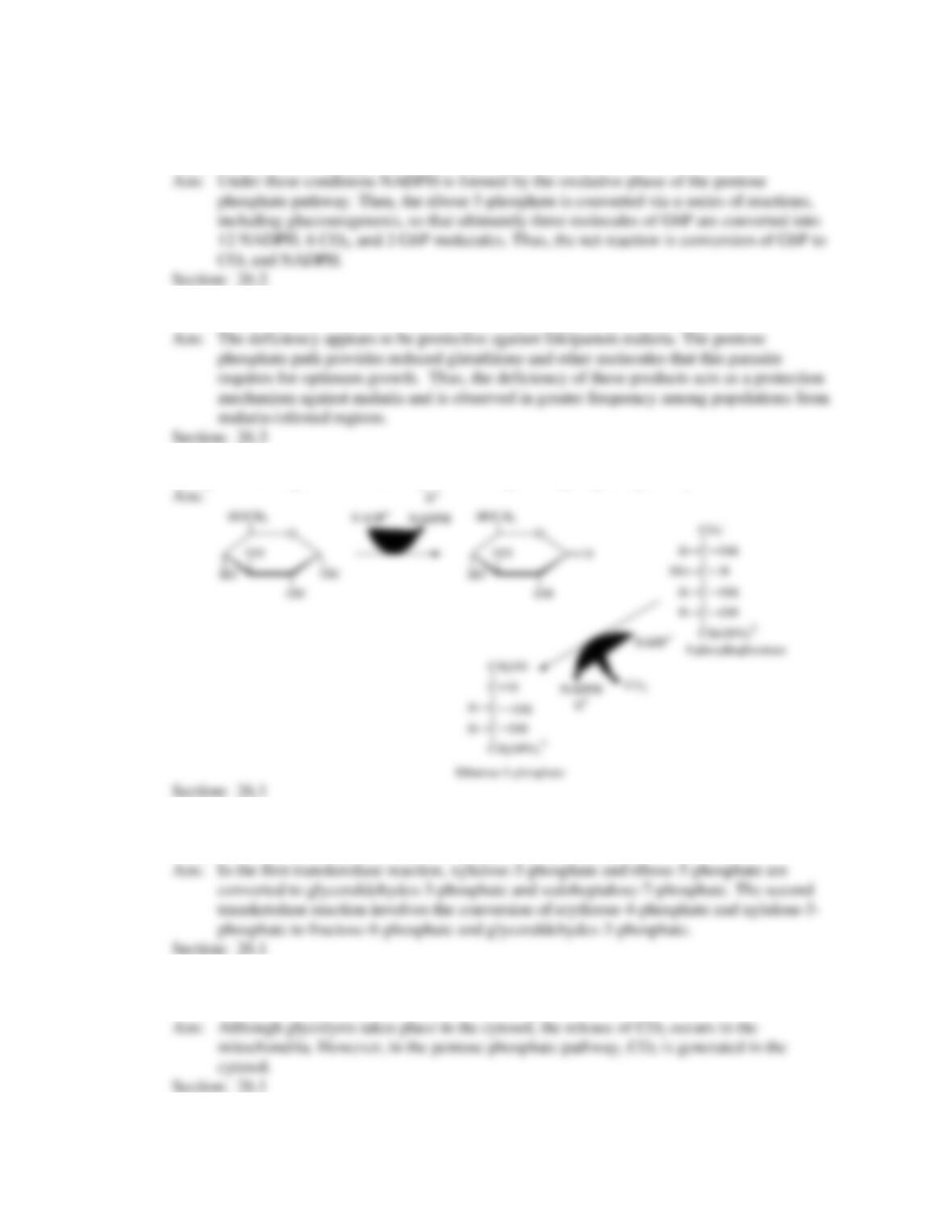
Using structures, give the oxidative phase of the pentose phosphate pathway.
Section: 26.1
45.
In the non-oxidative phase of the pentose phosphate pathway, two reactions are catalyzed by
transketolase. What are the substrates and products of these reactions?
transketolase reaction involves the conversion of erythrose-4-phosphate and xylulose-5-
phosphate to fructose-6-phosphate and glyceraldehydes-3-phosphate.
Section: 26.1
46.
What is a primary difference between the oxidation of glucose to CO2 by glycolysis and the
citric acid cycle vs. by the pentose phosphate pathway?
mitochondria. However, in the pentose phosphate pathway, CO2 is generated in the
cytosol.
Section: 26.1
12 NADPH, 6 CO2, and 2 G6P molecules. Thus, the net reaction is conversion of G6P to
Section: 26.2
Chapter 26 The Pentose Phosphate Pathway
8
47.
How does NADPH protect red blood cells from hemolysis?
48.
What are the reactions in the oxidative phase of the pentose phosphate pathway?
phosphocluconate is further oxidized and decarboxylated to ribulose-5-phosphate and
49.
In Mode 4 of the pentose phosphate pathway, pyruvate is the final product. What does this mode
provide for the cell?
phosphate derived from the non-oxidative reactions of the pentose phosphate pathway
Section: 26.2
reactive oxygen species, is eliminated by the enzyme glutathione peroxidase. This
enzyme uses reduced glutathione as a reducing agent.
Section: 26.3