
9) If infection primarily involves the outermost layers of adult amphibian skin, and if the chytrids
use the skin as their sole source of nutrition, then which term best applies to the chytrids?
A) anaerobic chemoautotroph
B) aerobic chemoautotroph
C) anaerobic chemoheterotroph
D) aerobic chemoheterotroph
10) The fact that infection by Bd causes lethargy in many infected amphibians can have what
effect on efforts to accurately census the numbers of dead or dying amphibians at a particular
time, in a particular habitat?
I. It can cause underestimation due to infected amphibians preferring to seek out refuges
relative to uninfected amphibians.
II. It can cause underestimation due to increased predation on, and removal of, infected
amphibians relative to uninfected amphibians.
III. It can cause overestimation because infected frogs should be more readily observable to
human census-takers than should uninfected amphibians.
A) II only
B) I and II
C) II and III
D) I, II, and III

11) When adult amphibian skin harbors populations of the bacterium Janthinobacterium lividum
(Jl), chytrid infection seems to be inhibited. Which of the following represents the best
experimental design for conclusively determining whether this inhibition is real?
A) Inoculate uninfected amphibians with Jl and determine whether the amphibians continue to
remain uninfected by chytrids.
B) Inoculate infected amphibians with Jl and determine whether the amphibians recover from
infection by chytrids.
C) Take infected amphibians and assign them to two populations. Leave one population alone;
inoculate the other with Jl. Measure the rate at which infection proceeds in both populations.
D) Take infected amphibians and assign them to two populations. Inoculate one population with
a high dose of Jl; inoculate the other with a low dose of Jl. Measure the survival frequency in
both populations.
12) A researcher took water in which a Jl population had been thriving, filtered the water to
remove all bacterial cells, and then applied the water to the skins of adult amphibians to see if
there would subsequently be a reduced infection rate by Bd when frog skins were inoculated
with Bd. For which of the following hypotheses is this procedure a potential test?
A) the hypothesis that a toxin secreted by Jl cells kills Bd cells when both are present together on
frog skin
B) the hypothesis that Jl cells infect and kill Bd cells when both are present together on frog skin
C) the hypothesis that Jl outcompetes Bd when both are present together on a frog’s skin
D) the hypothesis that the presence of Jl on frog skin causes a skin reaction that prevents
attachment by Bd cells

Please use the following information to answer the question(s) below.
A biology student hiking in a forest happens upon an erect, 15-cm-tall plant that bears
microphylls and a strobilus (a cone) at its tallest point. When disturbed, the cone emits a dense
cloud of brownish dust. The student takes the dust back to the laboratory, where a microscope
reveals the dust to be composed of tiny spheres with a high oil content.
13) This student has probably found a(n)
A) immature pine tree.
B) bryophyte sporophyte.
C) fern sporophyte.
D) horsetail gametophyte.
E) lycophyte sporophyte.
14) A dissection of the interior of this organism’s stem should reveal
A) lignified vascular tissues.
B) a cuticle.
C) that it is composed of only a single, elongated cell.
D) a relatively high proportion of dead, water-filled cells.

Please use the following information to answer the question(s) below.
Big Bend National Park in Texas is mostly Chihuahuan desert where rainfall averages about 10
inches per year. Yet when hiking in this bone-dry desert it is not uncommon to encounter mosses
and ferns. One such plant is called “flower of stone.” It is not a flowering plant, nor does it
produce seeds. Under arid conditions, its leaflike structures curl up. However, when it rains, it
unfurls its leaves, which form a bright green rosette on the desert floor. Consequently, it is
sometimes called the “resurrection plant.”
15) Upon closer inspection of the leaves of flower of stone, one can observe tiny, cone-like
structures. Each cone-like structure emits spores of two different sizes. Further investigation also
reveals that the roots of flower of stone branch only at the growing tip of the root, forming a Y-
shaped structure. Consequently, flower of stone should be expected to possess which other
characteristics?
1. a gametophyte generation that is dominant
2. lignified vascular tissues
3. microphylls
4. spores that are diploid when mature
A) 1 and 2 only
B) 1 and 5 only
C) 2 and 3 only
D) 2, 3, and 4 only
E) 1, 3, and 4 only

16) In which combination of locations would one who is searching for the gametophytes of
flower of stone have the best chance of finding them?
1. moist soil
2. underground, nourished there by symbiotic fungi
3. permanently shady places
4. far from any flower of stone sporophytes
A) 1 only
B) 1 and 2 only
C) 1, 2, and 3 only
D) 2, 3, and 4 only
Please use the following information to answer the question(s) below.
The cycads, a mostly tropical phylum of gymnosperms, evolved about 300 million years ago and
were dominant forms during the age of the dinosaurs. Though their sperm are flagellated, their
ovules are pollinated by beetles. These beetles get nutrition (they eat pollen) and shelter from
microsporophylls (leaflike structures that contain microsporangia). Upon visiting
megasporophylls (leaflike structures where megaspores are formed), the beetles transfer pollen to
the exposed ovules. In cycads, pollen cones and seed cones are borne on different plants. Cycads
synthesize neurotoxins, especially in the seeds, that are effective against most animals, including
humans.
17) Which feature of cycads distinguishes them from most other gymnosperms?
1. They have exposed ovules.
2. They have flagellated sperm.
3. They are pollinated by animals.
A) 1 only
B) 2 only
C) 3 only
D) 2 and 3 only
E) 1, 2, and 3

18) Which feature of cycads makes them similar to many angiosperms?
1. They have exposed ovules.
2. They have flagellated sperm.
3. They are pollinated by animals.
A) 1 only
B) 2 only
C) 3 only
D) 2 and 3 only
E) 1, 2, and 3
19) If the beetles survive by consuming cycad pollen, then whether the beetles should be
considered mutualists with, or parasites of, the cycads depends upon
A) the extent to which their overall activities affect cycad reproduction.
B) the extent to which the beetles are affected by the neurotoxins.
C) the extent to which the beetles damage the cycad flowers.
D) the distance the beetles must travel between cycad microsporophylls and cycad
megasporophylls.
20) On the Pacific island of Guam, large herbivorous bats called “flying foxes” commonly feed
on cycad seeds, a potent source of neurotoxins. The flying foxes do not visit male cones.
Consequently, what should be true?
A) The flying foxes are attracted to cycad fruit and eat the enclosed seeds only by accident.
B) Flying foxes are highly susceptible to the effects of the neurotoxins.
C) The flying foxes assist the beetles as important pollinating agents of the cycads.
D) Flying foxes can be dispersal agents of cycad seeds when they swallow the seeds whole
(without getting chewed).

Please use the following information to answer the question(s) below.
In onions (Allium), cells of the sporophyte have 16 chromosomes within each nucleus.
21) How many chromosomes should be in an embryo nucleus?
A) 4
B) 8
C) 16
D) 24
E) 32
22) How many chromosomes should be in a megasporangium nucleus?
A) 4
B) 8
C) 16
D) 24
E) 32
Please use the following information to answer the question(s) below.
Oviparous (egg-laying) animals have internal fertilization (sperm cells encounter eggs within the
female’s body). Yolk and/or albumen is (are) provided to the embryo, and a shell is then
deposited around the embryo and its food source. Eggs are subsequently deposited in an
environment that promotes their further development or are incubated by one or both parents.
23) The shell of an animal egg is analogous to which feature of an angiosperm?
A) endosperm
B) pollen tube
C) carpels
D) fruit
E) integuments

24) The internal fertilization that occurs in animals prior to shell deposition is analogous to
which features of an angiosperm?
A) endosperm and sperm nuclei
B) pollen tube and sperm nuclei
C) carpels
D) fruit
E) integuments
Please use the following information to answer the question(s) below.
The Brazil nut tree, Bertholletia excels (n = 17), is native to tropical rain forests of South
America. It is a hardwood tree that can grow to over 50 meters tall, is a source of high-quality
lumber, and is a favorite nesting site for harpy eagles. As the rainy season ends, tough-walled
fruits, each containing 8-25 seeds (Brazil nuts), fall to the forest floor. Brazil nuts are composed
primarily of endosperm. About $50 million worth of nuts are harvested each year. Scientists have
discovered that the pale yellow flowers of Brazil nut trees cannot fertilize themselves and admit
only female orchid bees as pollinators. The agouti (Dasyprocta spp.), a cat-sized rodent, is the
only animal with teeth strong enough to crack the hard wall of Brazil nut fruits. It typically eats
some of the seeds, buries others, and leaves still others inside the fruit, which moisture can then
enter. The uneaten seeds may subsequently germinate.
25) The agouti is most directly involved with the Brazil nut tree’s dispersal of
A) male gametophytes.
B) female gametophytes.
C) sporophyte embryos.
D) sporophyte megaspores.
E) female gametes.

26) Orchid bees are to Brazil nut trees as ________ are to pine trees.
A) breezes
B) rain droplets
C) seed-eating birds
D) squirrels
27) The harpy eagle, Harpia harpyja, is the largest, most powerful raptor in the Americas. It
nests only in trees taller than 25 meters. It is a “sloth specialist,” but will also kill agouti. Thus, if
these eagles capture too many agoutis from a particular locale, they might contribute to their own
demise by
A) having too many offspring.
B) increasing habitat loss.
C) decreasing atmospheric CO2.
D) increasing the number of sloths.
28) People who attempted to plant Brazil nuts in hopes of establishing plantations of Brazil nut
trees played roles most similar to those of
A) agoutis.
B) orchid bees.
C) pollen tubes.
D) harpy eagles.

29) The same bees that pollinate the flowers of the Brazil nut trees pollinate orchids, which are
epiphytes (plants that grow on other plants); however, orchids cannot grow on Brazil nut trees.
These observations explain
A) the coevolution of Brazil nut trees and orchids.
B) why Brazil nut trees do not set fruit in areas where only orchids are grown and harvested.
C) why male orchid bees do not pollinate Brazil nut tree flowers.
D) why male orchid bees are smaller than female orchid bees.
E) the importance of orchid and Brazil nut tree flowers for the production of orchid bee honey.
30) Entrepreneurs attempted, but failed, to harvest nuts from plantations grown in Southeast
Asia. Attempts to grow Brazil nut trees in South American plantations also failed. In both cases,
the trees grew vigorously, produced healthy flowers in profusion, but set no fruit. Consequently,
what is the likely source of the problem?
A) poor sporophyte viability
B) poor sporophyte fertility
C) failure to produce fertile ovules
D) failure to produce pollen
E) pollination failure
46
Please use the following information to answer the question(s) below.
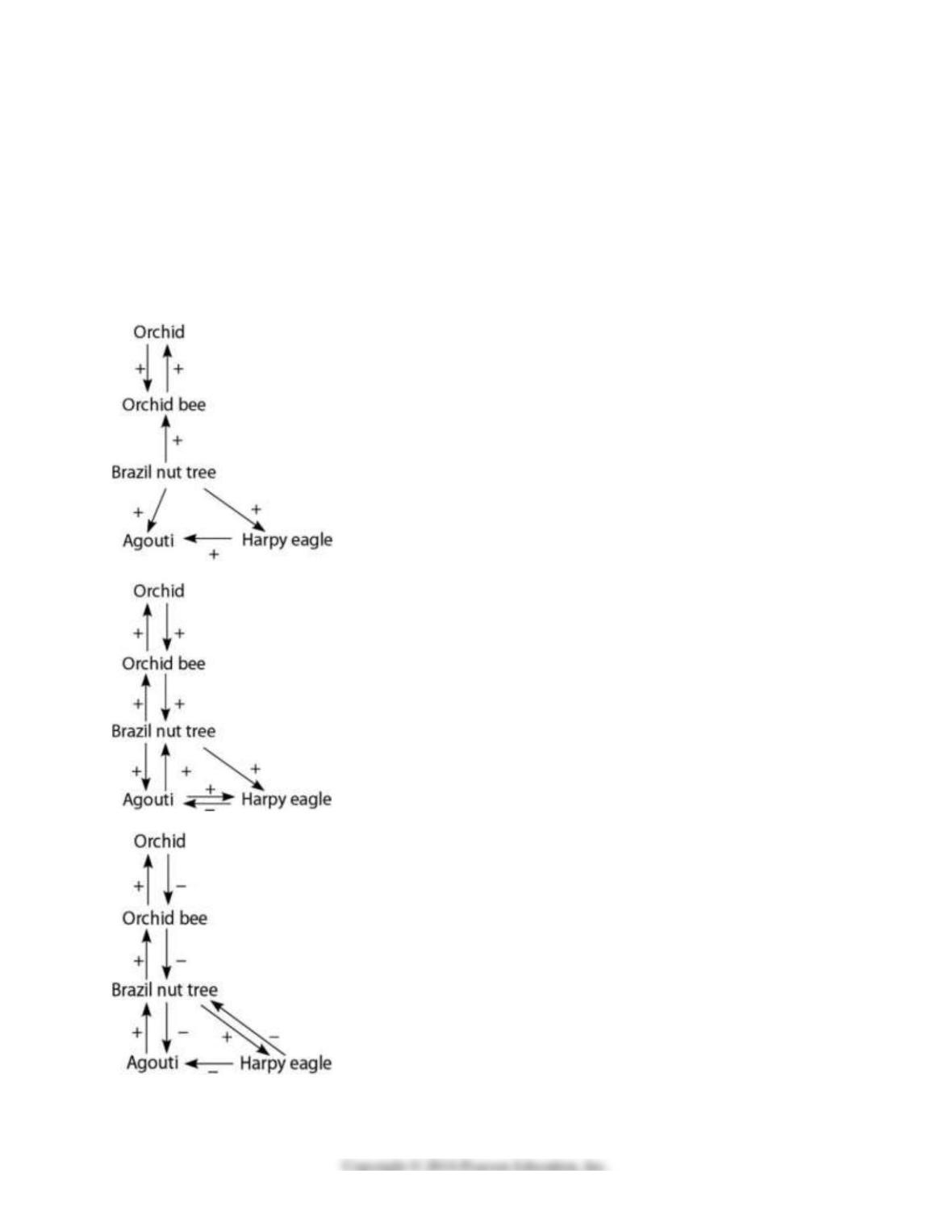
Ecologists often build models to depict the relationships between organisms. In such models, an
arrow is used to link two organisms in a relationship. The arrowhead is next to the organism that
is affected. If the effect is positive, the arrow is labeled with (+), and if negative, the label is (–).
31) Which of the following models best illustrates the relationship of the Brazil nut tree and the
other organisms associated with it?
A)
B)
C)
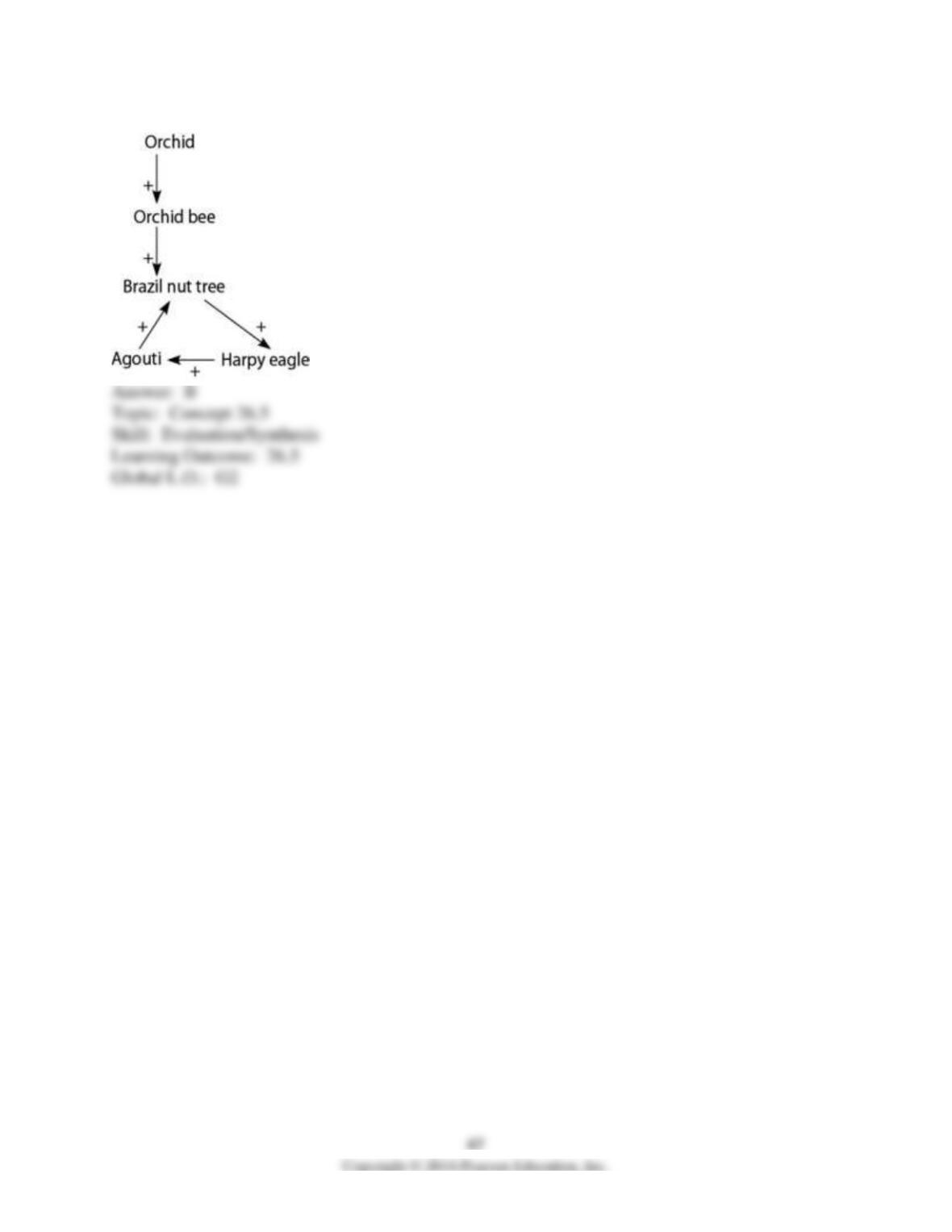
D)
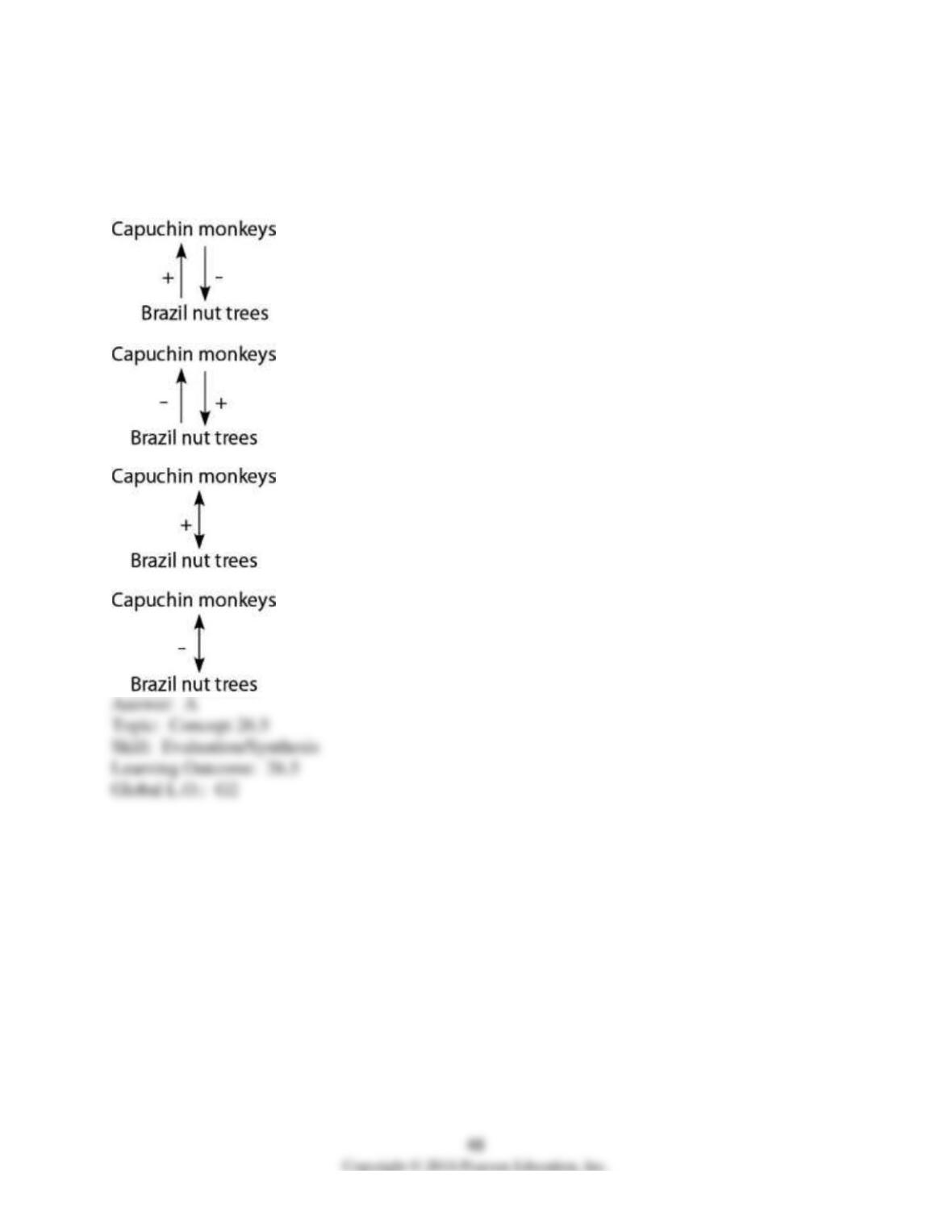
32) Capuchin monkeys have been known to use rocks to smash open the fruits of Brazil nut
trees. On the rare occasions this has been observed, the monkeys consume all of the Brazil nuts.
Thus, which of the following correctly depicts the relationship between capuchin monkeys and
Brazil nut trees?
A)
B)
C)
D)

26.4 End-of-Chapter Questions
1) All fungi are
A) symbiotic.
B) heterotrophic.
C) flagellated.
D) decomposers.
2) Which of the following characteristics of plants is absent in their closest relatives, the
charophyte algae?
A) chlorophyll b
B) cellulose in cell walls
C) multicellularity
D) alternation of generations
3) Among the organisms listed here, which are thought to be the closest relatives of fungi?
A) slime molds
B) vascular plants
C) animals
D) mosses
4) The adaptive advantage associated with the filamentous nature of fungal mycelia is primarily
related to
A) the ability to form haustoria and parasitize other organisms.
B) avoiding sexual reproduction until the environment changes.
C) the potential to inhabit almost all terrestrial habitats.
D) an extensive surface area well suited for invasive growth and absorptive nutrition.