Please use the following information to answer the question(s) below.
You are given four test tubes, each containing an unknown protist. Your task is to read the
following description and match these four protists to the correct test tube.
When red and blue light are shone on the tubes, oxygen bubbles accumulate on the inside of test
tubes 1 and 2. Chemical analysis of test tube 1 indicates the presence of a chemical that is toxic
to fish and humans. Chemical analysis of test tube 2 indicates the presence of substantial
amounts of silica. Microscopic analysis of organisms in test tube 3 reveals the presence of an
apicoplast in each. Microscopic analysis of the contents in test tube 4 reveals thousands of cilia
on the surface of the organism.
3) Test tube 4 contains
A) Paramecium.
B) Navicula (diatom).
C) Pfiesteria (dinoflagellate).
D) Plasmodium.
4) Test tube 2 contains
A) Paramecium.
B) Navicula (diatom).
C) Pfiesteria (dinoflagellate).
D) Plasmodium.
5) Test tube 1 contains
A) Paramecium.
B) Navicula (diatom).
C) Pfiesteria (dinoflagellate).
D) Plasmodium.
6) Test tube 3 contains
A) Paramecium.
B) Navicula (diatom).
C) Pfiesteria (dinoflagellate).
D) Plasmodium.
Please use the following information to answer the question(s) below.
Giardia intestinalis is an intestinal parasite of humans and other mammals that causes intestinal
ailments in most people. It can infect people when they drink water contaminated with feces
containing Giardia cysts. Upon ingestion, each cyst releases two motile cells, called trophozoites.
These attach to the small intestine’s lining via a ventral adhesive disk. The trophozoites
anaerobically metabolize glucose from the host’s intestinal contents to produce ATP.
Reproduction is completely asexual, occurring by longitudinal binary fission of trophozoites,
with each daughter cell receiving two haploid nuclei (n = 5). A trophozoite will often encyst as it
passes into the large intestine by secreting around itself a case that is resistant to cold, heat, and
dehydration.
7) Giardia’s mitosome can be said to be “doubly degenerate,” because it is a degenerate form of
________, an organelle that is itself a degenerate form of ________.
A) nucleus; archaean
B) nucleus; bacterium
C) mitochondrion; proteobacterium
D) mitochondrion; spirochete
E) chloroplast; cyanobacterium
8) Given its mode of reproduction and internal structures, which of the following should be
expected to occur in Giardia at some stage of its life cycle?
1. separation (segregation) of daughter chromosomes
2. crossing over
3. meiosis
A) 1 only
B) 3 only
C) 1 and 2
D) 1 and 3
E) 2 and 3
9) Unlike most excavates, Giardia trophozoites have no oral groove and are unable to form food
vacuoles. Thus, we should expect its nutrition (mostly glucose) to come from
A) its mitosomes.
B) endosymbiotic cyanobacteria.
C) the ventral disk by which it adheres to the intestinal lining.
D) osmosis involving aquaporins (proteins that transport water across cell membranes).
E) plasma membrane proteins that are transporters or pumps.
10) During passage through the large intestine, a trophozoite will often secrete a case around
itself, forming a cyst. Cysts contain four haploid nuclei. When cysts “hatch” within a new host,
two trophozoites are released. Thus, which of the following must happen within the cyst prior to
hatching?
1. meiosis
2. nuclear division
3. S phase
4. binary fission
A) 1 only
B) 1 and 2
C) 2 and 3
D) 2 and 4
E) 2, 3, and 4
11) The cysts of Giardia are most analogous to the
A) mitochondria of ancestral diplomonads.
B) nuclei of archaeans.
C) endospores of bacteria.
D) capsids of viruses.
12) If the mitosomes of Giardia contain no DNA, yet are descendants of what were once free-
living organisms, then where are we likely to find the genes that encode their structures, and
what accounts for their current location there?
A) plasmids; conjugation
B) plasmids; transformation
C) nucleus; horizontal gene transfer
D) nucleus; S phase
13) The primary treatment for giardiasis (infection with Giardia), trichomoniasis (infection with
Trichomonas vaginalis), and amoebic dysentery (infection with Entamoeba histolytica) is a drug
marketed as Flagyl (generic name is metronidazole). The drug also kills anaerobic gut bacteria.
Consequently, which of these are cues that Flagyl’s mode of action has nothing to do with
attacking or disabling flagella, as the drug’s name might imply?
1. Flagyl would also harm the flagellated lining of the human intestine.
2. Entamoeba possesses pseudopods, not flagella, yet it is killed by Flagyl.
3. Not all anaerobic gut bacteria possess flagella, yet flagyl kills these bacteria.
A) 1 only
B) 2 only
C) 1 and 2
D) 2 and 3
E) 1 and 3
Please use the following information to answer the question(s) below.
Paulinella chromatophora is one of the few cercozoans that is autotrophic, carrying out aerobic
photosynthesis with its two elongated “cyanelles.” The cyanelles are contained within vesicles of
the host cell, and each is derived from a cyanobacterium, though not the same type of
cyanobacterium that gave rise to the chloroplasts of algae and plants.
14) What must occur for asexual reproduction to be successful in P. chromatophora?
1. mitosis
2. S phase
3. meiosis
4. equal distribution of cyanelles during cytokinesis
A) 1 only
B) 1 and 2
C) 1, 2, and 3
D) 1, 2, and 4
E) 2, 3, and 4
15) The closest living relative of P. chromatophora is the heterotroph P. ovalis. What type of
evidence permits biologists to make this claim about relatedness?
A) morphological
B) ecological
C) biochemical
D) genetic
E) fossil
16) The closest living relative of P. chromatophora is the heterotroph P. ovalis. P. ovalis uses
threadlike pseudopods to capture its prey, which it digests internally. Which of the following, if
observed, would be the best reason for relabeling P. chromatophora as a mixotroph?
A) a threadlike pseudopod
B) a vacuole with food inside
C) a secretory vesicle
D) a contractile vacuole
17) Which of the following represents the true significance of the finding that the cyanelles of P.
chromatophora stem from a different type of cyanobacterium than gave rise to chloroplasts?
A) This finding indicates that there is a second evolutionary lineage of photosynthetic
eukaryotes.
B) This finding represents the first time that primary endosymbiosis has been directly observed.
C) This finding is the strongest evidence yet for the theory of endosymbiosis.
D) This finding is an example of the phenomenon known as “serial endosymbiosis.”
E) This finding is the first evidence that eukaryotic cells do not necessarily digest prokaryotic
cells that manage to gain access to their cytoplasm.
18) If true, which of the following would be most important in determining whether P.
chromatophora‘s cyanelle is still an endosymbiont or is an organelle, as the term cyanelle
implies?
A) if P. chromatophora is less fit without its cyanelle than with it
B) if the cyanelle is less fit without the host cercozoan than with it
C) if there is ongoing metabolic cooperation between the cyanelle and the host cercozoan
D) if there has been movement of genes from the cyanelle genome to the nuclear genome, such
that these genes are no longer present in the cyanelle genome
19) If true, which of the following is the best evidence that the cyanelles are providing nutrition
(in other words, calories) to the surrounding cercozoan?
A) if the cyanelle performs aerobic photosynthesis
B) if the vesicle membrane that surrounds each cyanelle possesses glucose-transport proteins
C) if the cyanelle performs aerobic respiration
D) if radiolabeled 14CO2 enters the cyanelle and if, subsequently, radiolabeled glucose is
present in cercozoan cytosol
20) A crucial photosynthetic gene of the cyanobacterium that gave rise to the cyanelle is called
psaE. This gene is present in the nuclear genome of the cercozoan, but is not in the genome of
the cyanelle. This is evidence of
A) reciprocal mutations in the cyanelle and nuclear genomes.
B) horizontal gene transfer from bacterium to eukaryotes.
C) genetic recombination involving a protist and an archaean.
D) the origin of photosynthesis in protists.
E) transduction by a phage that infects both prokaryotes and eukaryotes.
21) Including the membrane of the surrounding vesicle, how many phospholipid (not
lipopolysaccharide) bilayers should be found around each cyanelle, and which one of these
bilayers should have photosystems embedded in it?
A) two; innermost
B) two; outermost
C) three; innermost
D) three; middle
E) three; outermost
Please use the following information to answer the question(s) below.
Healthy individuals of Paramecium bursaria contain photosynthetic algal endosymbionts of the
genus Chlorella. When within their hosts, the algae are referred to as zoochlorellae. In aquaria
with light coming from only one side, P. bursaria gathers at the well-lit side, whereas other
species of Paramecium gather at the opposite side. The zoochlorellae provide their hosts with
glucose and oxygen, and P. bursaria provides its zoochlorellae with protection and motility. P.
bursaria can lose its zoochlorellae in two ways: (1) if kept in darkness, the algae will die; and (2)
if prey items (mostly bacteria) are absent from its habitat, P. bursaria will digest its
zoochlorellae.
22) Which term best describes the symbiotic relationship of well-fed P. bursaria with their
zoochlorellae?
A) mutualistic (each species benefits from the other)
B) photosynthetic
C) parasitic
D) predatory
23) The motility that permits P. bursaria to move toward a light source is provided by
A) pseudopods.
B) a single flagellum composed of the protein flagellin.
C) many cilia.
D) contractile vacuoles.
24) A P. bursaria cell that has lost its zoochlorellae is said to be aposymbiotic. It might be able
to replenish its contingent of zoochlorellae by ingesting them without subsequently digesting
them. Which of the following situations would be most favorable to the reestablishment of
resident zoochlorellae, assuming that compatible Chlorella are present in P. bursaria’s habitat?
A) abundant light, no bacterial prey
B) abundant light, abundant bacterial prey
C) no light, no bacterial prey
D) no light, abundant bacterial prey
25) Theoretically, P. bursaria can obtain zoochlorella either vertically (via the asexual
reproduction of its mother cell) or horizontally (by ingesting free-living Chlorella from its
habitat). Consider a P. bursaria cell containing zoochlorellae, but whose habitat lacks free-living
Chlorella. If this cell subsequently undergoes many generations of asexual reproduction, if all of
its daughter cells contain roughly the same number of zoochlorellae as it had originally
contained, and if the zoochlorellae are all haploid and identical in appearance, then what is true?
A) The zoochlorellae also reproduced asexually, at an increasing rate over time.
B) The zoochlorellae also reproduced asexually, at a decreasing rate over time.
C) The zoochlorellae also reproduced asexually, at a fairly constant rate over time.
D) The zoochlorellae reproduced sexually, undergoing mitosis and meiosis.
26) Which term most accurately describes the nutritional mode of healthy P. bursaria?
A) photoautotroph
B) photoheterotroph
C) chemoheterotroph
D) chemoautotroph
E) mixotroph
27) When diatoms die, their shells fall to the floor of the ocean or lake that they inhabit and form
sediments called diatomaceous earth (DE).
Diatoms can be identified by their shells. Different species of diatoms prefer different water
temperatures. What information can be gained if scientists take samples of long-existing DE and
identify the diatom species that created it?
A) Scientists can decipher evolutionary lineages between diatom species.
B) Scientists can predict future trends in greenhouse gas emissions.
C) Scientists can learn about past climates.
D) Scientists can better understand how wind currents affect water temperature.
28) The diatoms’ porous shells are hard but often break and result in sharp edges. Crop farmers
incorporate DE into their soil to help kill insect pests. When insects encounter DE, sharp shell
edges cut through their exoskeletons and then softer, broken down DE absorbs insect body
fluids, thereby causing the insects to die due to dehydration. Why might farmers who raise large
livestock also use DE in the animals’ feed?
A) The sharp shells can damage the tissue of intestinal parasites and eventually kill them.
B) DE helps to slow down the livestocks’ digestion of food, thereby increasing nutrient
absorption.
C) The porous nature of the shells in the DE helps keep livestock hydrated.
D) DE encourages growth of “healthy” intestinal bacteria.
25.3 End-of-Chapter Questions
1) The oldest fossil eukaryote that can be resolved taxonomically is of
A) a red alga that lived 1.2 billion years ago.
B) a red alga that lived 635 million years ago.
C) a fungus that lived 2 billion years ago.
D) an Ediacaran that lived 550 million years ago.
2) The evolution of complex multicellularity in eukaryotes
A) occurred only once, in the common ancestor of all eukaryotes.
B) occurred only once, in the common ancestor of all multicellular eukaryotes.
C) occurred only once, in the animal lineage.
D) occurred independently in several eukaryotic lineages.
3) Plastids that are surrounded by more than two membranes are evidence of
A) evolution from mitochondria.
B) fusion of plastids.
C) origin of the plastids from archaea.
D) secondary endosymbiosis.
4) Biologists think that endosymbiosis gave rise to mitochondria before plastids partly because
A) the products of photosynthesis could not be metabolized without mitochondrial enzymes.
B) all eukaryotes have mitochondria (or their remnants), whereas many eukaryotes do not have
plastids.
C) mitochondrial DNA is less similar to prokaryotic DNA than is plastid DNA.
D) without mitochondrial CO2 production, photosynthesis could not occur.
5) Which group is incorrectly paired with its description?
A) diatoms–important producers in aquatic communities
B) red algae–acquired plastids by secondary endosymbiosis
C) apicomplexans–parasites with intricate life cycles
D) diplomonads–protists with modified mitochondria
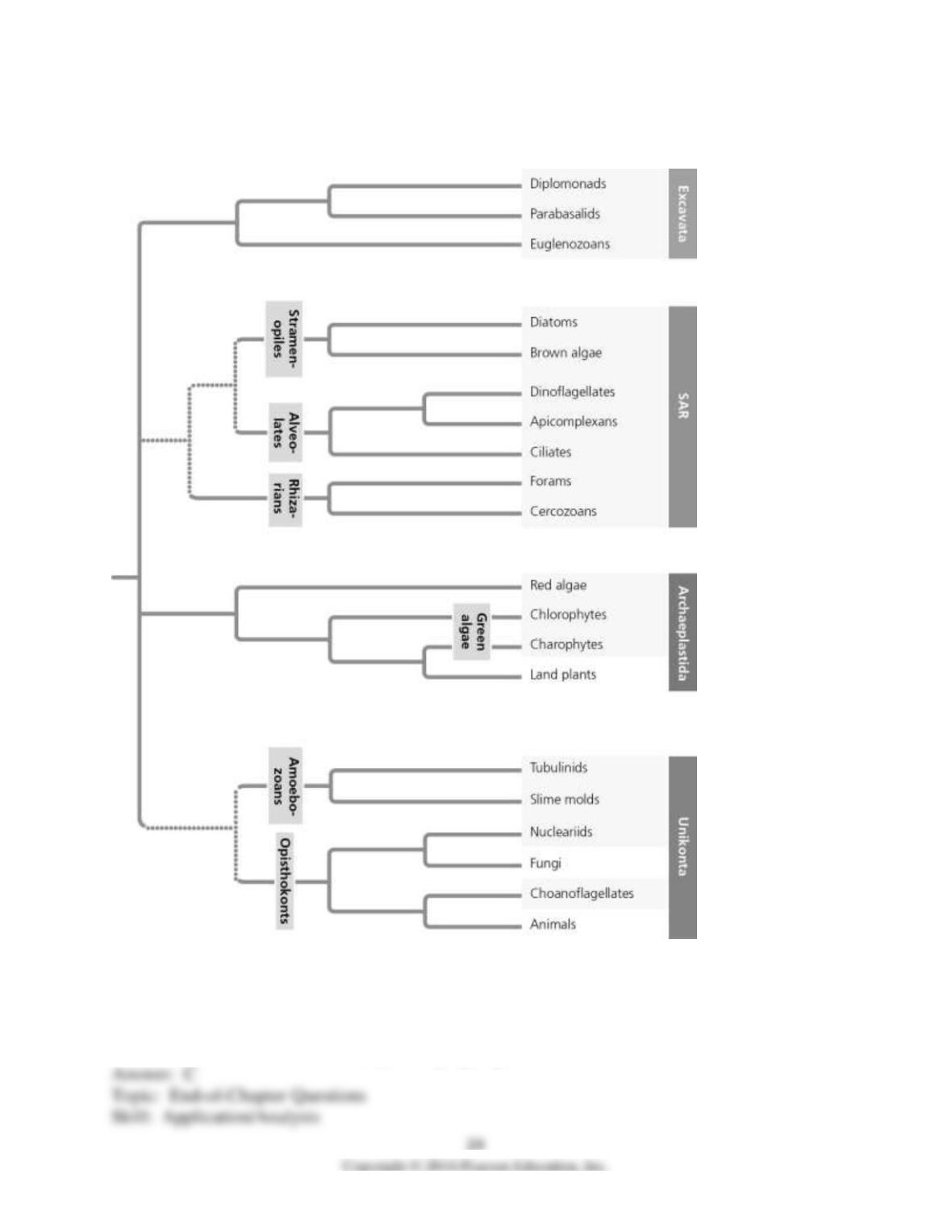
6) Based on the phylogenetic tree in the figure given below, which of the following statements is
correct?
A) The most recent common ancestor of Excavata is older than that of SAR.
B) The most recent common ancestor of red algae and plants is older than that of nucleariids and
fungi.
C) The most basal (first to diverge) eukaryotic supergroup cannot be determined.
D) Excavata is the most basal eukaryotic supergroup.