Campbell Biology in Focus, 2e (Urry)
Chapter 25 The Origin and Diversification of Eukaryotes
25.1 Multiple-Choice Questions
1) The chloroplasts of all of the following are thought to be derived from ancestral red algae,
except those of
A) diatoms.
B) dinoflagellates.
C) green algae.
D) brown algae.
2) What is thought to be the correct sequence of these events, from earliest to most recent, in the
evolution of life on Earth?
1. origin of mitochondria
2. origin of multicellular eukaryotes
3. origin of chloroplasts
4. origin of cyanobacteria
5. origin of fungal-plant symbioses
A) 4, 3, 2, 1, 5
B) 4, 1, 2, 3, 5
C) 4, 1, 3, 2, 5
D) 4, 3, 1, 5, 2
E) 4, 3, 1, 2, 5
3) Which of these observations gives the most support to the endosymbiotic theory for the origin
of eukaryotic cells?
A) the existence of structural and molecular differences between the plasma membranes of
prokaryotes and the internal membranes of mitochondria and chloroplasts
B) the similarity in size between the cytosolic ribosomes of prokaryotes and the ribosomes
within mitochondria and chloroplasts
C) the size disparity between most prokaryotic cells and most eukaryotic cells
D) the observation that some eukaryotic cells lack mitochondria
4) All protists are
A) unicellular.
B) eukaryotic.
C) symbionts.
D) monophyletic.
E) mixotrophic.
5) According to the endosymbiotic theory of the origin of eukaryotic cells, how did mitochondria
originate?
A) from infoldings of the plasma membrane, coupled with mutations of genes for proteins in
energy-transfer reactions
B) from engulfed, originally free-living proteobacteria
C) by secondary endosymbiosis
D) from the nuclear envelope folding outward and forming mitochondrial membranes
E) when a protoeukaryote engaged in a symbiotic relationship with a protocell
6) An individual mixotroph loses its plastids, yet continues to survive. Which of the following
most likely accounts for its continued survival?
A) It relies on photosystems that float freely in its cytosol.
B) It must have gained extra mitochondria when it lost its plastids.
C) It engulfs organic material by phagocytosis or by absorption.
D) It has an endospore.
E) It has multiple alveoli.
7) Which of the following was derived from an ancestral cyanobacterium?
A) chloroplast
B) mitochondrion
C) hydrogenosome
D) mitosome
8) Why can eukaryotes be considered “combination” organisms?
A) Some of their genes and cellular characteristics were derived from archaea, and others from
bacteria.
B) They eventually developed flagella.
C) Their diversity outnumbers prokaryotes by over 1 million species.
D) They eventually developed cellulose plates.
9) In a sample of pond water, a new organism is identified with the following characteristics: It
consists of 70 cells surrounded by rigid cell walls that join the cells together. Inside each of these
identical cells are mitochondria and chloroplasts. Such an organism would most likely be
classified as a
A) colonial photosynthetic eukaryote.
B) fungal photosynthetic eukaryote.
C) colonial photosynthetic prokaryote.
D) multicellular photosynthetic prokaryote.
E) colonial eukaryotic fungus.
10) Which of the following is the most likely sequence of events, from earliest to most recent, in
the evolution of sponges (organisms with many cells that have different functions)?
1. single-celled eukaryote
2. single-celled prokaryote
3. multicellular eukaryote
4. colonial eukaryote
A) 2, 1, 4, 3
B) 2, 1, 3, 4
C) 1, 2, 3, 4
D) 1, 2, 4, 3
11) The evolution of multicellularity in animals required adaptations that promoted
A) cellular migration and intercellular communication.
B) cellular migration and cellular adhesion.
C) cellular adhesion and intercellular communication.
D) photosynthesis and cellular migration.
E) cellular fusion and regeneration.
12) The last common ancestor of fungi and animals was most likely a
A) multicellular photosynthetic eukaryote.
B) colonial photosynthetic prokaryote.
C) multicellular photosynthetic prokaryote.
D) single-celled eukaryote.
13) The evolution of multicellularity in animals has primarily occurred by
A) changing how existing genes are used.
B) deleting many old genes.
C) producing many new genes.
D) deleting many old chromosomes.
14) Multicellular colonies of plant cells adhere to each other primarily by ________, whereas
multicellular colonies of animal cells are typically held together by ________.
A) fusion of cellular membranes; cell walls
B) cell walls; fused cellular membranes
C) cell walls; proteins
D) interlocking chloroplasts; interlocking mitochondria
E) interlocking cellular shapes; large, calcified capsules
15) Which of the following organism pairs is/are an example of secondary endosymbiosis?
I. red algae–heterotrophic eukaryote
II. green algae–heterotrophic eukaryote
III. E. coli bacteria–photosynthetic cyanobacterium
IV. Chlamydomonas and Gonium
A) I only
B) III and IV
C) I and II
D) II and III
16) Which of the following pairs of protists and their characteristics are mismatched?
A) apicomplexans–internal parasites
B) mixotrophs–combine photosynthesis and heterotrophic nutrition
C) euglenozoans–unicellular flagellates
D) ciliates–red tide organisms
17) Which of the following statements about dinoflagellates is true?
A) They possess two flagella.
B) All known varieties are autotrophic.
C) Their walls are usually composed of silica plates.
D) Many types lack mitochondria.
E) Their dead cells accumulate on the seafloor and are mined to serve as a filtering material.
18) Why is the filamentous morphology of the slime molds considered a case of convergent
evolution with fungi?
A) Water molds evolved from filamentous fungi.
B) Body shape reflects ancestor-descendant relationships among organisms.
C) DNA sequence analyses indicate that slime molds descended from different unicellular
ancestors than did fungi.
D) Filamentous body shape is evolutionarily ancestral for all eukaryotes.
19) Diatoms are mostly asexual members of the phytoplankton. They obtain their nutrition from
functional chloroplasts, and each diatom is encased within two porous, glasslike valves. Which
question would be most important for one interested in the day-to-day survival of individual
diatoms?
A) How does carbon dioxide get into these protists with their glasslike valves?
B) How do diatoms get transported from one location on the water’s surface layers to another
location on the surface?
C) How do diatoms with their glasslike valves keep from sinking into poorly lit waters?
D) How do diatoms with their glasslike valves avoid being shattered by the action of waves?
E) How do diatom sperm cells locate diatom egg cells?
20) A large seaweed that floats freely on the surface of deep bodies of water would be expected
to lack which of the following?
A) alveoli
B) bladders
C) holdfasts
D) flagella
21) Rhizarians that feed using threadlike pseudopodia include which of the following group(s)?
I. forams
II. red algae
III. cercozoans
IV. green algae
A) I and III
B) II and III
C) I and IV
D) II and IV
22) A snail-like, coiled, porous test (shell) of calcium carbonate is characteristic of which group?
A) diatoms
B) foraminiferans
C) red algae
D) cercozoans
23) The chloroplasts of land plants are thought to have been derived according to which
evolutionary sequence?
A) cyanobacteria → green algae → land plants
B) cyanobacteria → green algae → fungi → land plants
C) red algae → brown algae → green algae → land plants
D) cyanobacteria → red algae → green algae → land plants
24) A biologist discovers an alga that is marine, multicellular, and can absorb both green and
blue light. This alga probably belongs to which group?
A) red algae
B) brown algae
C) green algae
D) dinoflagellates
25) Green algae differ from land plants in that some green algae
A) are heterotrophs.
B) are unicellular.
C) have plastids.
D) have alternation of generations.
E) have cell walls containing cellulose.
26) Some scientists who study organismal classification believe that green algae should be in an
expanded “plant” kingdom called Viridiplantae. If land plants are excluded from this kingdom,
then what will be true of it?
A) It will be monophyletic.
B) It will more accurately depict evolutionary relationships than does the current taxonomy.
C) It will be paraphyletic.
D) It will be a true clade.
27) The best evidence for not classifying the slime molds as fungi comes from slime molds’
A) DNA sequences.
B) nutritional modes.
C) choice of habitats.
D) physical appearance.
E) reproductive methods.
28) Which pair of alternatives is highlighted by the life cycle of the cellular slime molds, such as
Dictyostelium?
A) prokaryotic or eukaryotic
B) unicellular or multicellular
C) diploid or haploid
D) autotroph or heterotroph
29) Which of the following statements concerning protists is true?
A) All protists have mitochondria, although in some species they are much reduced and known
by different names.
B) The primary organism that transmits malaria to humans by its bite is the tsetse fly.
C) All apicomplexans are autotrophic.
D) All slime molds have an amoeboid stage that may be followed by a stage during which spores
are produced.
E) Euglenozoans that are mixotrophic lack functional chloroplasts.
30) Of the four supergroups of eukaryotes, which one contains red algae, green algae, and all
land plants?
A) SAR
B) Archeplastida
C) Excavata
D) Unikonta
31) Why is there controversy surrounding the eukaryotic tree?
A) It suggests that the unikonts are evolutionarily derived from the archeplastids.
B) It suggests that amoebozoans are more closely related (evolutionarily) to red algae than green
algae.
C) The tree lacks branches for species that have yet to be classified.
D) The root of the tree is uncertain such that it is unknown which supergroup was the first to
diverge from all other eukaryotes.
32) Which of the following is correctly described as a primary producer?
A) foram
B) kinetoplastid
C) apicomplexan
D) diatom
33) You discover a new species of aerobic, mixotrophic protist that can perform photosynthesis
in fairly deep water (for example, 250 m deep). It can also crawl about and engulf small
particles. Which two characteristics does your protist have to have in order to successfully
complete these tasks?
1. hydrogenosome
2. apicoplast
3. pseudopods
4. chloroplast from red alga
5. chloroplast from green alga
A) 1 and 2
B) 2 and 3
C) 2 and 4
D) 3 and 4
E) 4 and 5
34) In a synthetic biology experiment, you are given a task to design a new species of aquatic
protist. Your design should account for the following characteristics:
1. The protist functions as a primary producer.
2. It cannot swim on its own.
3. It must stay in well-lit surface waters.
4. It must be resistant to physical damage from wave action.
Based on these criteria, you decide to model your creation after a(n)
A) diatom.
B) dinoflagellate.
C) apicomplexan.
D) red alga.
E) radiolarian.
35) Which of the following is (are) mutualistic partnerships between a protist and a host
organism?
I. cellulose-digesting gut protists—wood-eating termites
II. dinoflagellates—reef-building coral animals
III. Trichomonas—humans
IV. algae—certain foraminiferans
A) I only
B) II and IV
C) I, II, and III
D) I, II, and IV
36) Living diatoms contain brownish plastids. If global warming causes blooms of diatoms in the
surface waters of Earth’s oceans, how might this be harmful to the animals that build coral reefs?
A) The coral animals, which capture planktonic organisms, may be outcompeted by the diatoms.
B) The coral animals’ endosymbiotic dinoflagellates may get “shaded out” by the diatoms.
C) The coral animals may die from overeating the plentiful diatoms.
D) The diatoms’ photosynthetic output may over-oxygenate the water.
37) Which two genera have members that can evade the human immune system by frequently
changing their surface proteins?
1. Plasmodium
2. Trichomonas
3. Paramecium
4. Trypanosoma
A) 1 and 2
B) 1 and 4
C) 2 and 3
D) 2 and 4
25.2 Scenario Questions
Please use the following information to answer the question(s) below.
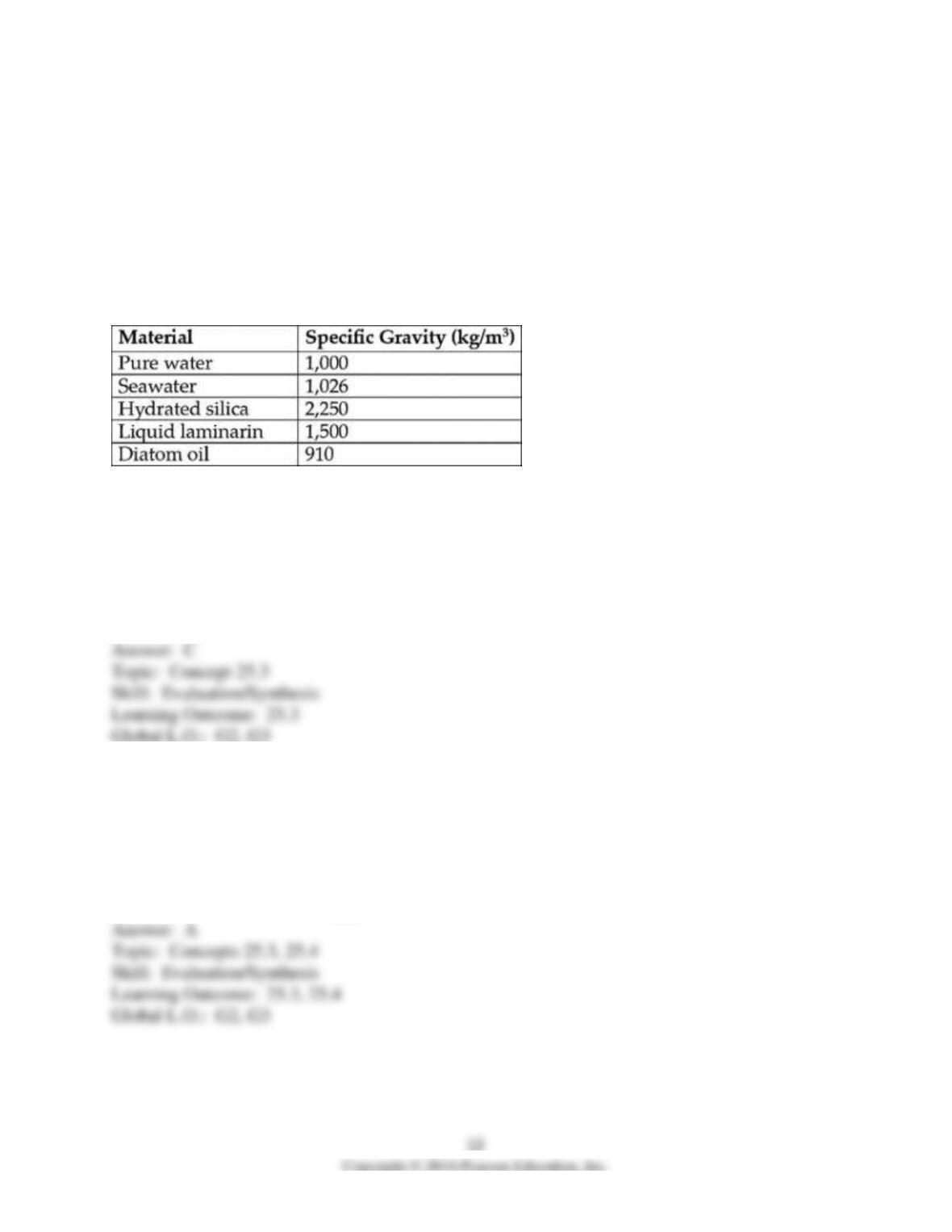
Diatoms are encased in cases (valves) made of translucent hydrated silica whose thickness can
vary. The material used to store excess calories can also vary. At certain times, diatoms store
excess calories in the form of the liquid polysaccharide laminarin and at other times as oil. The
table shows data concerning the density (specific gravity) of various components of diatoms and
of their environment.
1) Judging from the table and given that water’s density and, consequently, its buoyancy decrease
at warmer temperatures, in which environment should diatoms (and other suspended particles)
sink most slowly?
A) cold pure water
B) warm pure water
C) cold seawater
D) warm seawater
2) Using dead diatoms to “pump” CO2 to the seafloor is feasible only if dead diatoms sink
quickly. Consequently, application of mineral fertilizers, such as iron, should be most effective at
times when diatom valves
A) are thickest, and laminarin is being produced rather than oil.
B) are thickest, and oil is being produced rather than laminarin.
C) are thinnest, and laminarin is being produced rather than oil.
D) are thinnest, and oil is being produced rather than laminarin.