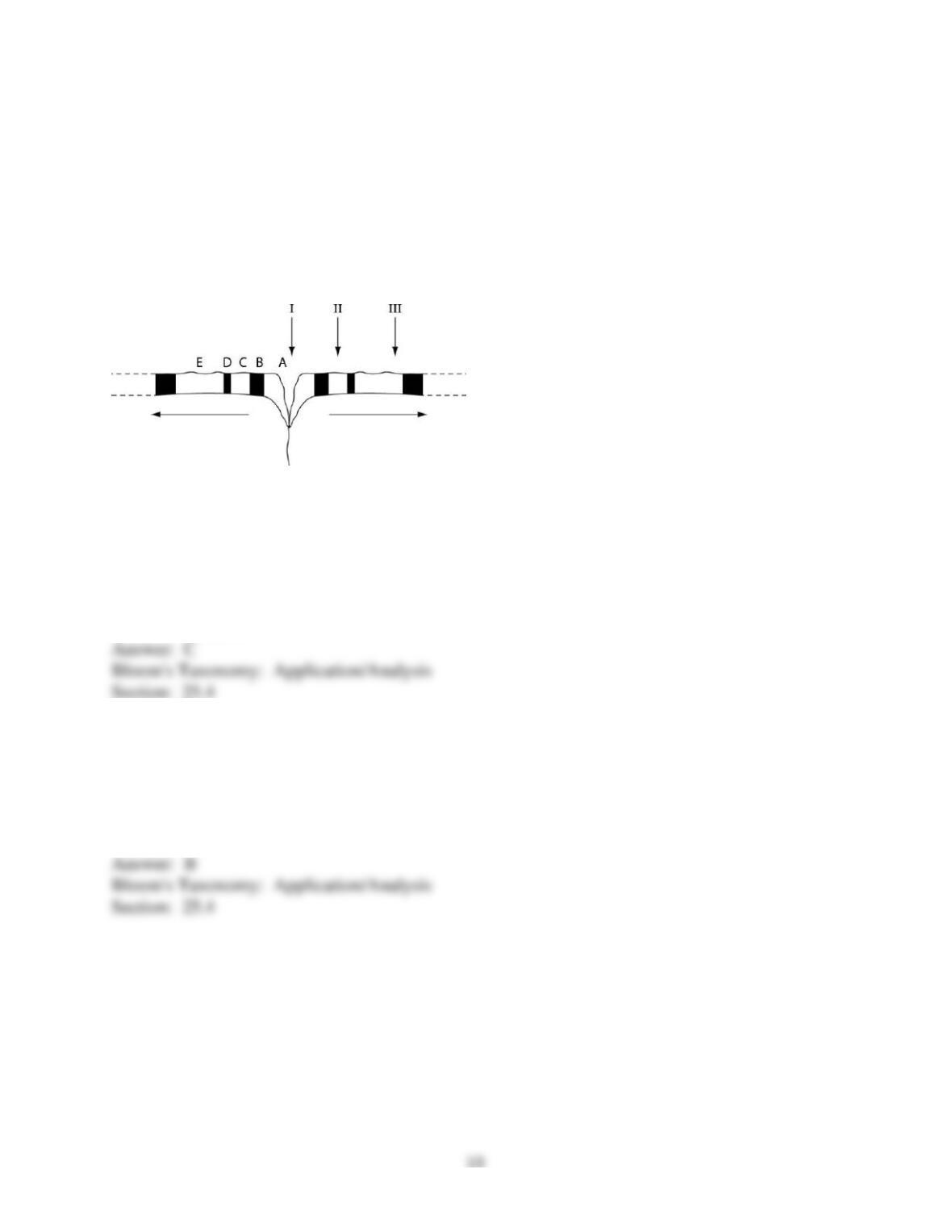
The questions below refer to the following description and figure.
The figure below represents a cross section of the sea floor through a mid-ocean rift valley, with
alternating patches of black and white indicating sea floor with reversed magnetic polarities. At
the arrow labeled “I” (the rift valley), the igneous rock of the sea floor is so young that it can be
accurately dated using carbon-14 dating. At the arrow labeled “III,” however, the igneous rock is
about one million years old, and potassium-40 dating is typically used to date such rocks. Note:
The horizontal arrows indicate the direction of sea-floor spreading, away from the rift valley.
32) Assuming that the rate of sea-floor spreading was constant during the one-million-year
period depicted above, on average Earth’s magnetic field has undergone reversal once every
_____.
A) 25,000 years
B) 100,000 years
C) 250,000 years
D) 1,000,000 years
33) How many other bands of sea-floor crust in the figure above have the same magnetic polarity
as the crust that directly straddles the rift valley?
A) two bands
B) four bands
C) five bands
D) eight bands
34) Assuming that the rate of sea-floor spreading was constant during the one-million-year
period depicted above, what should be the approximate age of marine fossils found in
undisturbed sedimentary rock immediately overlying the igneous rock at the arrow labeled “II”?
A) 10,000 years
B) 250,000 years
C) 500,000 years
D) 1,000,000 years
35) The Permian period ended and then rapid speciation occurred as new animal and plant forms
evolved. The most likely explanation for this is _____.
I) adaptive radiation
II) ecological opportunity
III) lack of competition
IV) morphological innovation
A) just one of the above
B) two of the above
C) three of the above
D) all of the above
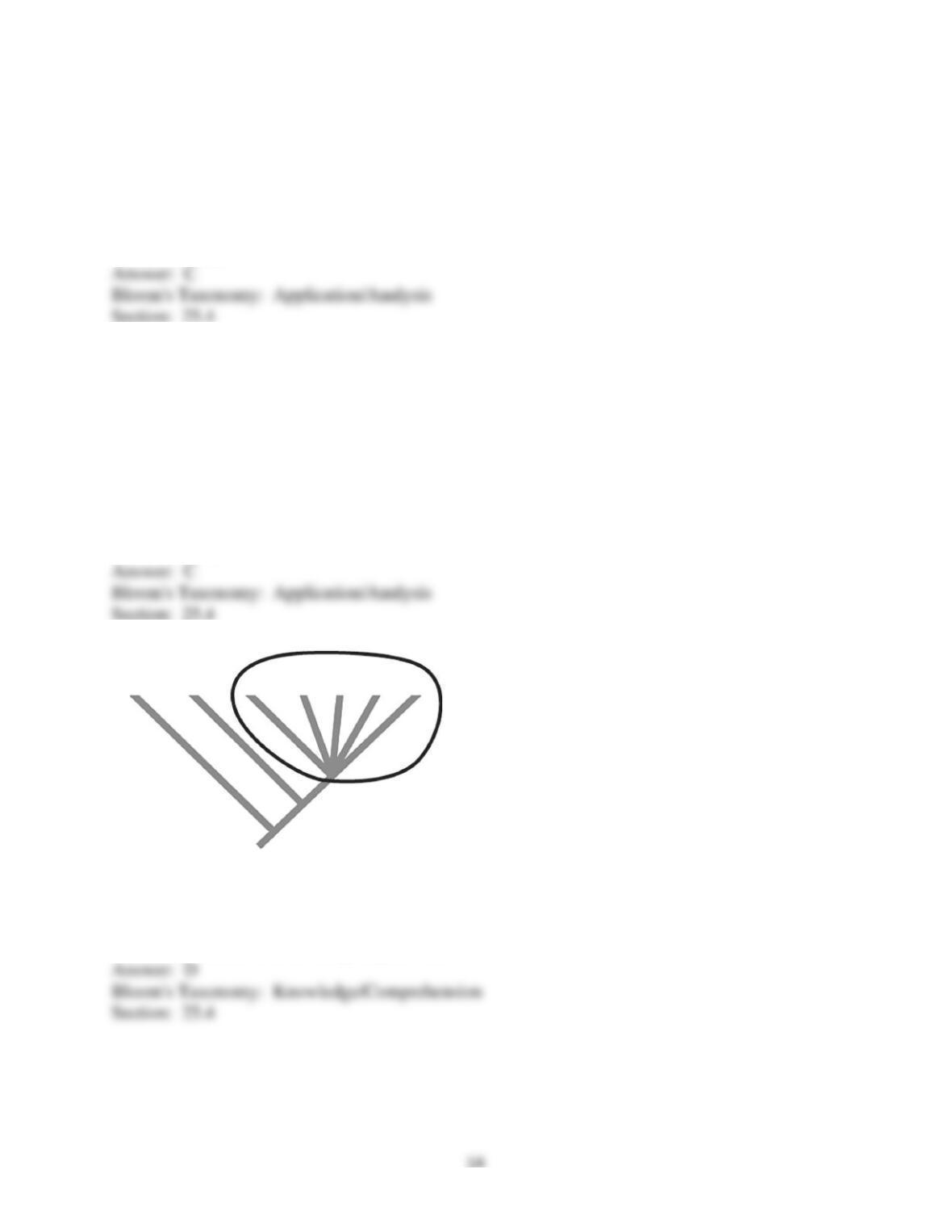
36) What does the circled part of the phylogenetic tree above indicate?
A) an adaptive radiation
B) a mass extinction event
C) rapid speciation
D) an adaptive radiation and rapid speciation

37) A hypothetical island lies far from any other landmasses. There are many different types of
plants, but only one animal, a beetle, that can fly or walk from plant to plant and feeds by
chewing leaves. Given that the beetle is not exploiting all of the resources on the island, which
morphological change would be most likely to trigger an adaptive radiation of the beetles?
A) a change in wing shape that improves flight speed
B) an additional segment on a pair of legs
C) a mouthpart that can pierce fruits and seeds
38) On the basis of their morphologies, how might Linnaeus have classified the Hawaiian
silverswords? Linnaeus would have _____.
A) placed them all in the same species.
B) classified them the same way that modern botanists do.
C) placed more of them in different genera than modern botanists do.
D) used evolutionary relatedness as the primary criterion for their classification.
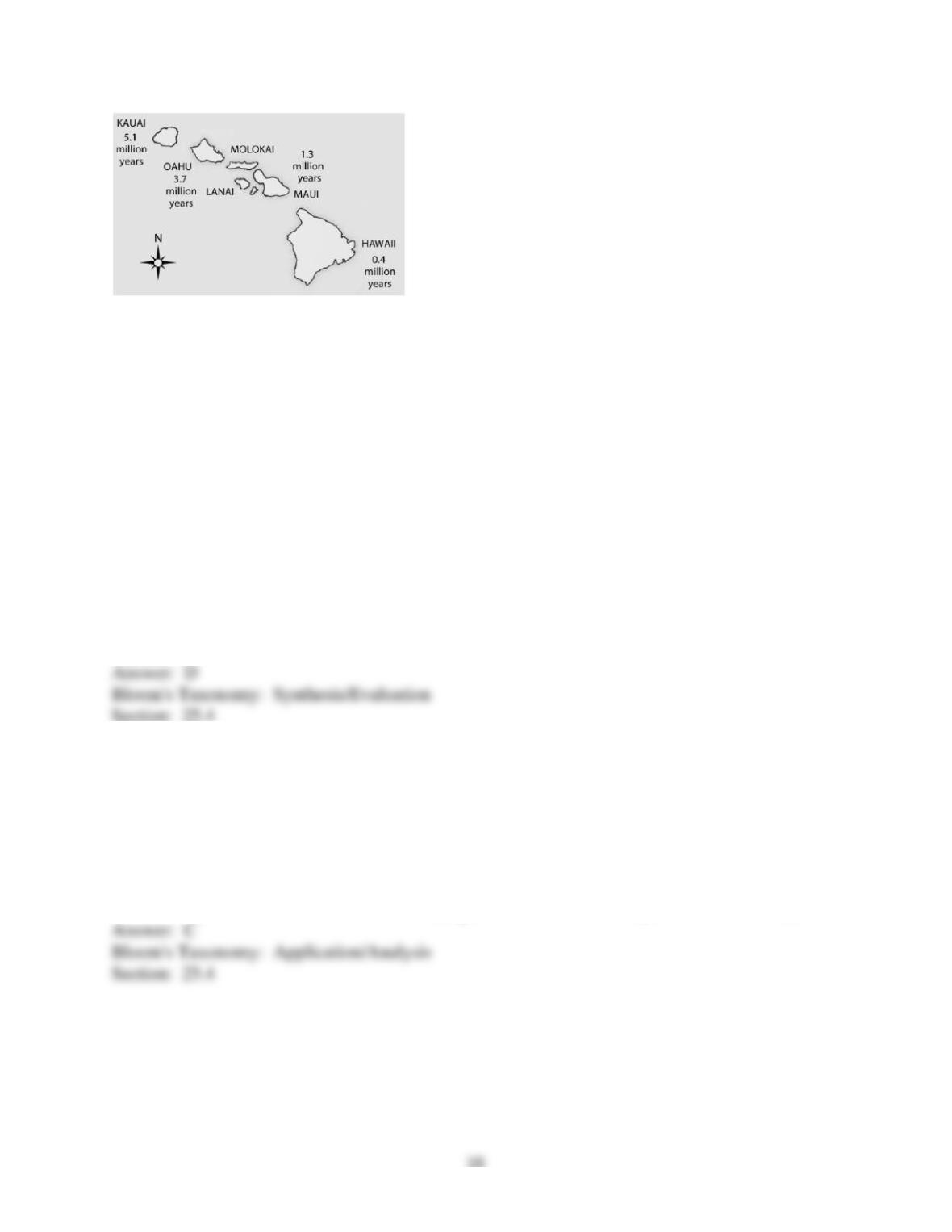
39) According to the theory of sea-floor spreading, oceanic islands, such as the Hawaiian Islands
depicted in the figure above, form as oceanic crustal plates move over a stationary “hot spot” in
the mantle. Currently, the big island of Hawaii is thought to be over a hot spot, which is why it is
the only one of the seven large islands that has active volcanoes. What should be true of the
island of Hawaii?
1. Scientists in search of ongoing speciation events are more likely to find them here than on the
other six large islands.
2. Its species should be more closely related to those of nearer islands than to those of farther
islands.
3. It should have a rich fossil record of terrestrial organisms.
4. It should have species that are not found anywhere else on Earth.
5. On average, it should have fewer species per unit surface area than the other six islands.
A) 1, 2, and 3
B) 1, 2, and 5
C) 1, 2, 3, and 4
D) 1, 2, 4, and 5
40) Hawaii is the most southeastern of the seven largest islands and is also closest to the sea-
floor spreading center from which the Pacific plate originates, which lies about 5600 km further
to the southeast. Assuming equal sedimentation rates, what should be the location of the thickest
sediment layer and, thus, the area with the greatest diversity of fossils above the oceanic crust?
A) between the island of Hawaii and the sea-floor spreading center
B) around the base of the island of Hawaii
C) around the base of Kauai, the oldest of the large Hawaiian islands
D) where the islands are most concentrated (highest number of islands per unit surface area)

41) Upon being formed, oceanic islands, such as the Hawaiian Islands, should feature what
characteristic, leading to which phenomenon?
A) mass extinctions, leading to bottleneck effect
B) major evolutionary innovations, leading to rafting to nearby continents
C) a variety of empty ecological niches, leading to adaptive radiation
D) adaptive radiation, leading to founder effect
Refer to the following information to answer the question*s) below.
Fossils of Lystrosaurus, a dicynodont therapsid, are most common in parts of modern-day South
America, South Africa, Madagascar, India, South Australia, and Antarctica. The animal
apparently lived in arid regions, and was mostly herbivorous. It originated during the mid-
Permian period, survived the Permian extinction, and dwindled by the late Triassic, though there
is evidence of a relict population in Australia during the Cretaceous period. Some dicynodonts
had two large tusks, extending down from their upper jaws. The tusks were not used for food
gathering, and in some species were limited to males. Food was gathered using an otherwise
toothless beak. Judging from the fossil record in sedimentary rocks, these pig-sized organisms
were the most common mammal-like reptiles of the Permian.
42) Which of the following is the most likely explanation for the modern-day distribution of
dicynodont fossils? The dicynodonts were_____.
A) carnivores that traveled widely to find prey
B) evenly distributed throughout all of Pangaea
C) most abundantly distributed throughout Gondwanaland
D) amphibious and able to swim long distances
43) If an organism has a relatively large number of Hox genes in its genome, it most likely
_____.
A) has Hox genes expressed in all cells of its body
B) has multiple paired appendages along the length of its body
C) has a relatively complex anatomy
D) belongs to one of the first groups to evolve on Earth
18
44) Bagworm moth caterpillars feed on evergreens and carry a silken case or bag around with
them in which they eventually pupate. Adult female bagworm moths are larval in appearance;
they lack the wings and other structures of the adult male and instead retain the appearance of a
caterpillar even though they are sexually mature and can lay eggs within the bag. This is a good
example of _____.
A) allometric growth
B) paedomorphosis
C) sympatric speciation
D) adaptive radiation
45) The loss of ventral spines by modern freshwater sticklebacks is due to natural selection
operating on the phenotypic effects of Pitx1 gene _____.
A) duplication (gain in number)
B) elimination (loss)
C) mutation (change)
D) silencing (loss of expression)
The following questions refer to this hypothetical situation.
A female fly, full of fertilized eggs, is swept by high winds to an island far out to sea. She is the
first fly to arrive on this island and the only fly to arrive in this way. Thousands of years later,
her numerous offspring occupy the island, but none of them resembles her. There are, instead,
several species, each of which eats only a certain type of food. None of the species can fly and
their balancing organs (halteres) are now used in courtship displays. The male members of each
species bear modified halteres that are unique in appearance to their species. Females bear
vestigial halteres. The ranges of all of the daughter species overlap.
46) In each fly species, the entire body segment that gave rise to the original flight wings is
missing. The mutation(s) that led to the flightless condition could have _____.
A) duplicated all of the Hox genes in these flies’ genomes
B) resulted in paedomorphosis
C) altered the expression of a Hox gene
D) originated in another species
47) A genetic change that caused a certain Hox gene to be expressed along the tip of a vertebrate
limb bud instead of farther back helped make possible the evolution of the tetrapod limb. This
type of change is illustrative of _____.
A) the influence of environment on development
B) paedomorphosis
C) a change in a developmental gene or its regulation that altered the spatial organization of body
parts
D) heterochrony
48) The duplication of homeotic (Hox) genes has been significant in the evolution of animals
because it _____.
A) permitted the evolution of novel forms
B) caused the extinction of major groups
C) reduced morphological diversity into simpler forms of life
D) allowed animals to survive on significantly fewer calories
49) Why would gene duplication events, such as those seen in the Hox gene complex, set the
stage for adaptive radiation?
A) There are more copies of genes, meaning speciation had occurred by polyploidy.
B) The original gene copy is the outgroup, and the new gene copies are the adaptive radiation.
C) Without duplicated genes, species would be vulnerable to extinction.
D) One copy of a gene can perform the original function, while other copies are available to take
on new functions.
50) All of the following events can trigger an adaptive radiation EXCEPT _____.
A) an unusual event splitting a habitat, such as a severe hurricane
B) the evolution of a new morphological feature
C) the extinction of competitors
D) Hox gene duplication events

The following questions refer to the description below.
All animals with eyes or eyespots that have been studied so far share a gene in common. When
mutated, the gene Pax–6 causes lack of eyes in fruit flies, tiny eyes in mice, and missing irises
(and other eye parts) in humans. The sequence of Pax-6 in humans and mice is identical. There
are so few sequence differences with fruit fly Pax-6 that the human/mouse version can cause eye
formation in eyeless fruit flies, even though vertebrates and invertebrates last shared a common
ancestor more than five hundred million years ago.
51) Pax-6 usually causes the production of a type of light-receptor pigment. In vertebrate eyes,
though, a different gene (the rh gene family) is responsible for the light-receptor pigments of the
retina. The rh gene, like Pax-6, is ancient. In the marine ragworm, for example, the rh gene
causes production of c-opsin, which helps regulate the worm’s biological clock. Which of the
following most likely accounts for vertebrate vision?
A) The Pax-6 gene mutated to become the rh gene among early mammals.
B) During vertebrate evolution, the rh gene for biological clock opsin was co-opted as a gene for
visual receptor pigments.
C) In animals more ancient than ragworms, the rh gene(s) coded for visual receptor pigments; in
lineages more recent than ragworms, rh has flip-flopped several times between producing
biological clock opsins and visual receptor pigments.
D) Pax-6 was lost from the mammalian genome, and replaced by the rh gene much later.
52) A swim bladder is a gas-filled sac that helps fish maintain buoyancy. The evolution of the
swim bladder from lungs of an ancestral fish is an example of _____.
A) exaptation
B) changes in Hox gene expression
C) paedomorphosis
D) adaptive radiation
53) Which of the following is a limit of evolution that results in exaptations?
A) Natural selection and sexual selection can work at cross-purposes to each other.
B) Evolution is limited by historical constraints.
C) Adaptations are often compromises.
D) Chance events affect the evolutionary history of populations in environments that can change
unpredictably.
54) Insect wings may have begun to evolve as lateral extensions of the body that were used as
heat dissipaters for thermoregulation. When they had become sufficiently large, these extensions
became useful for gliding through the air. Additional selection refined them as flight-producing
wings. If this hypothesis is correct, modern insect wings would be an example of _____.
A) the loss of Hox genes in the evolution of new form
B) mutations
C) an exaptation
D) an adaptive radiation
55) If one organ is an exaptation of another organ, then these two organs _____.
A) are homologous
B) are undergoing convergent evolution
C) are found in the same species
D) have the same function
56) Many species of snakes lay eggs. However, in the forests of northern Minnesota, where
growing seasons are short, only live-bearing snake species are present. This trend toward species
that have live birth in a particular environment is an example of _____.
A) an exaptation
B) sexual selection
C) species selection
D) goal direction in evolution
57) The existence of evolutionary trends, such as increasing body sizes among horse species, is
evidence that _____.
A) a larger volume-to-surface area ratio is adaptive in many mammals
B) evolution generally progresses toward some goal
C) evolution tends toward increased complexity or increased size
D) in particular environments, similar adaptations can be beneficial to more than one species

The following questions are based on the observation that several dozen different proteins
comprise the prokaryotic flagellum and its attachment to the prokaryotic cell, producing a highly
complex structure.
58) If the complex protein assemblage of the prokaryotic flagellum arose by the same general
processes as those of the complex eyes of molluscs (such as squids and octopi), then _____.
A) natural selection cannot account for the rise of the prokaryotic flagellum
B) ancestral versions of this protein assemblage were either less functional or had different
functions than modern prokaryotic flagella
C) neither eyes nor flagella could have arisen by evolution because both are too complex to have
evolved
D) the need for more complex structure must have driven evolution
59) Certain proteins of the complex motor that drives bacterial flagella are modified versions of
proteins that had previously belonged to plasma membrane pumps. This evidence supports the
claim that _____.
A) natural selection produces organs that will be needed in future environments
B) the motors of bacterial flagella must have originated in other organisms
C) natural selection can produce new structures by coupling together parts of other structures
D) bacteria that possess flagella must have lost the ability to pump certain chemicals across their
plasma membranes

The following questions refer to this hypothetical situation.
A female fly, full of fertilized eggs, is swept by high winds to an island far out to sea. She is the
first fly to arrive on this island and the only fly to arrive in this way. Thousands of years later,
her numerous offspring occupy the island, but none of them resembles her. There are, instead,
several species, each of which eats only a certain type of food. None of the species can fly and
their balancing organs (halteres) are now used in courtship displays. The male members of each
species bear modified halteres that are unique in appearance to their species. Females bear
vestigial halteres. The ranges of all of the daughter species overlap.
60) Which of these fly organs, as they exist in the description above, best illustrates an
exaptation?
A) vestigial halteres
B) halteres
C) mouthparts
D) eggs
61) One hypothesis that has been proposed regarding the origin of life suggests that life evolved
from an “RNA world” to today’s “DNA world.” Considering the properties of RNA and DNA
molecules, which questions would direct an investigation of the most insightful test(s) of this
hypothesis?
A) Is it likely that RNA molecules functioned as ribozymes to synthesize DNA from amino
acids, and that this role was reversed when DNA became the information source?
B) Is it likely that simple, yet stable RNA molecules served as a primitive precursor to a less
stable DNA molecule that was more capable of storing more information?
C) Could RNA have provided a template for DNA assembly, thereby enabling a more stable
molecule that is replicated more accurately?
D) Since ribozymes could freely enter and leave the vesicles, could these molecules have
brought external DNA into the cell as a less stable, but more reliable storage molecule of double-
stranded DNA?

62) Endosymbiosis is an evolutionary theory that explains the origin of eukaryotes and suggests
a specific order in which this might have occurred. Ancestral cells engulfed and then began to
use the metabolic processes of the smaller cells. Based on shared core processes and features,
which statement most accurately describes the order, the theory and the evolutionary
implications for all organisms within domain Eukarya?
A) Ancestral heterotrophic eukaryotes most likely engulfed both a heterotrophic and an
autotrophic prokaryote, whereas ancestral photosynthetic eukaryotes probably provided the host
cell for the first mitochondria. Over time, natural selection favored these relationships and these
cells became ancestors of all eukaryotes.
B) All ancestral eukaryotes would have most likely consumed a nucleus-like prokaryote that
eventually became the eukaryotic nucleus. These new eukaryotic cells would have had an
advantage over prokaryotic cells by acquiring a nuclear command center for regulating cellular
activities.
C) As carbon dioxide levels were increasing over time, natural selection would have favored
organisms that acquired a photosynthetic prokaryote to convert carbon dioxide into sugars. These
would have likely been the first eukaryotic cells. At which point, these ancestral cells engulfed
mitochondria-like prokaryotes that would have provided an even greater advantage for cells in
this environment.
D) As Earth was becoming more aerobic, mitochondria would have provided an advantage to
host cells by converting “toxic” oxygen into energy for heterotrophic cells. Since mitochondria
are found in all eukaryotes, these combinations likely evolved first. Photosynthetic eukaryotes
probably acquired an autotrophic prokaryote, which developed an advantageous symbiotic
relationship with the host cell.