
Campbell Biology, 10e (Reece)
Chapter 25 The History of Life on Earth
1) Which of the following is the correct sequence of events in the origin of life?
I. formation of protobionts
II. synthesis of organic monomers
III. synthesis of organic polymers
IV. formation of DNA-based genetic systems
A) I, II, III, IV
B) I, III, II, IV
C) II, III, I, IV
D) II, III, IV, I
2) Which of the following is a defining characteristic that all protocells had in common?
A) the ability to synthesize enzymes
B) a surrounding membrane or membrane-like structure
C) RNA genes
D) the ability to replicate RNA
3) The first genetic material on Earth was probably _____.
A) DNA produced by reverse transcriptase from abiotically produced RNA
B) DNA molecules whose information was transcribed to RNA and later translated in
polypeptides
C) self-replicating RNA molecules
D) oligopeptides located within protobionts
4) Several scientific laboratories across the globe are involved in research concerning the origin
of life on Earth. Which of these questions is currently the most problematic and would have the
greatest impact on our understanding if we were able to answer it?
A) How can amino acids, simple sugars, and nucleotides be synthesized abiotically?
B) How did RNA sequences come to carry the code for amino acid sequences?
C) How could polymers involving lipids and/or proteins form membranes in aqueous
environments?
D) How can RNA molecules act as templates for the synthesis of complementary RNA
molecules?

5) Which of the following steps has yet to be accomplished by scientists studying the origin of
life?
A) synthesis of small RNA polymers by ribozymes
B) abiotic synthesis of polypeptides
C) formation of molecular aggregates with selectively permeable membranes
D) formation of protocells that use DNA to direct the polymerization of amino acids
6) How were conditions on the early Earth of more than three billion years ago different from
those on today’s Earth? Unlike Earth today, early Earth _____.
A) had an atmosphere rich in gases released from volcanic eruptions
B) had an oxidizing atmosphere
C) experienced little high energy radiation from the sun
D) had an atmosphere with significant quantities of ozone
3
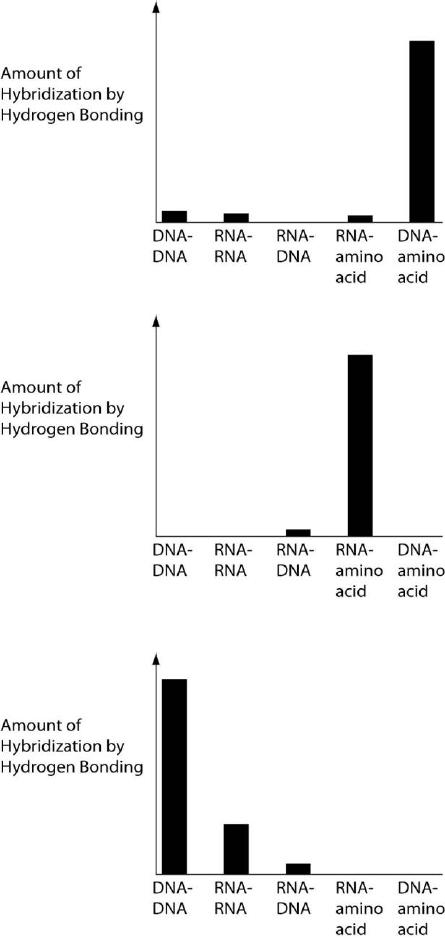
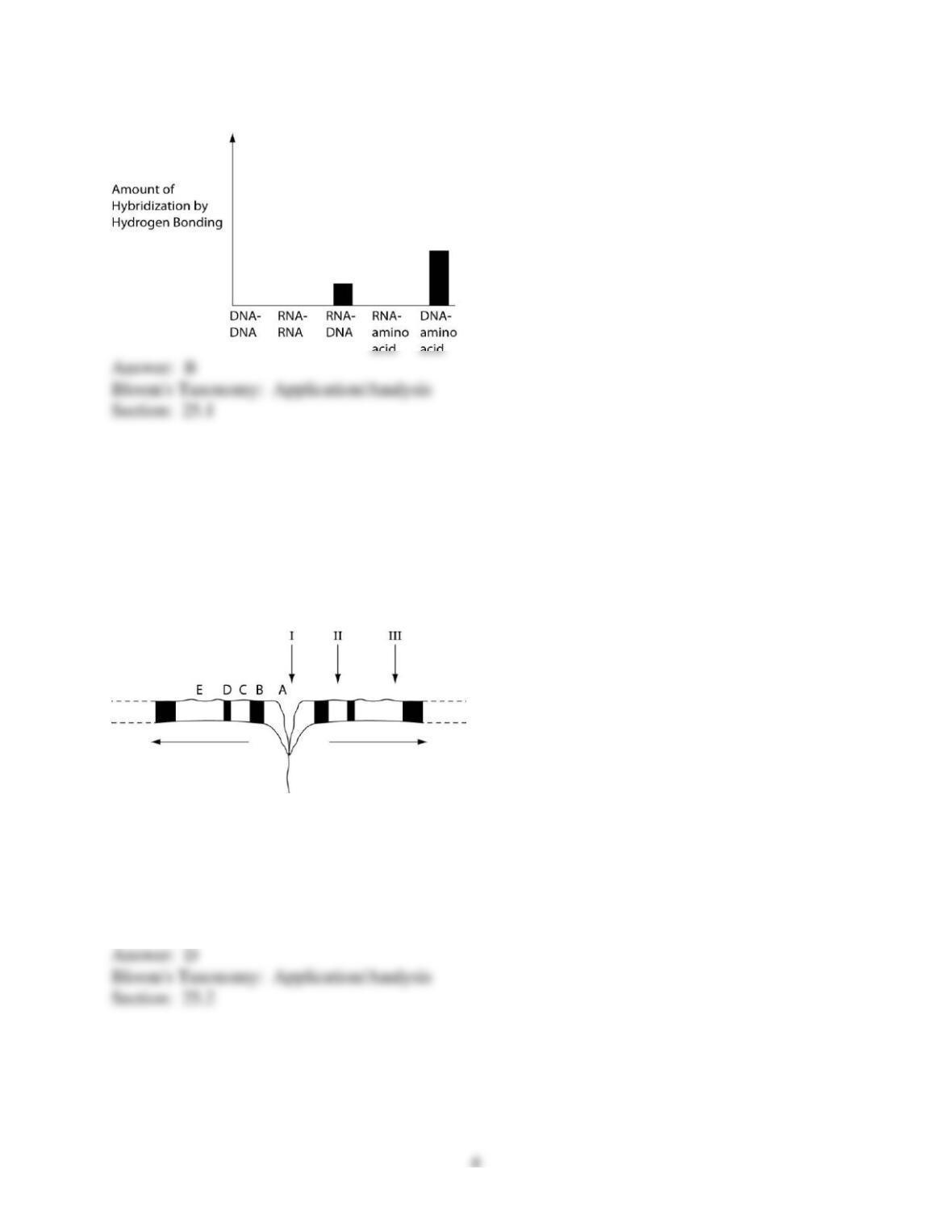
7) Several scientific laboratories across the globe are performing research concerning the origin
of life on Earth. Which of the following are the most likely results of abiotic experiments testing
the potential for hydrogen bonding between various nucleic acids and amino acids? Base your
response on our current understanding of Earth’s first genetic systems.
A)
B)
C)
D)
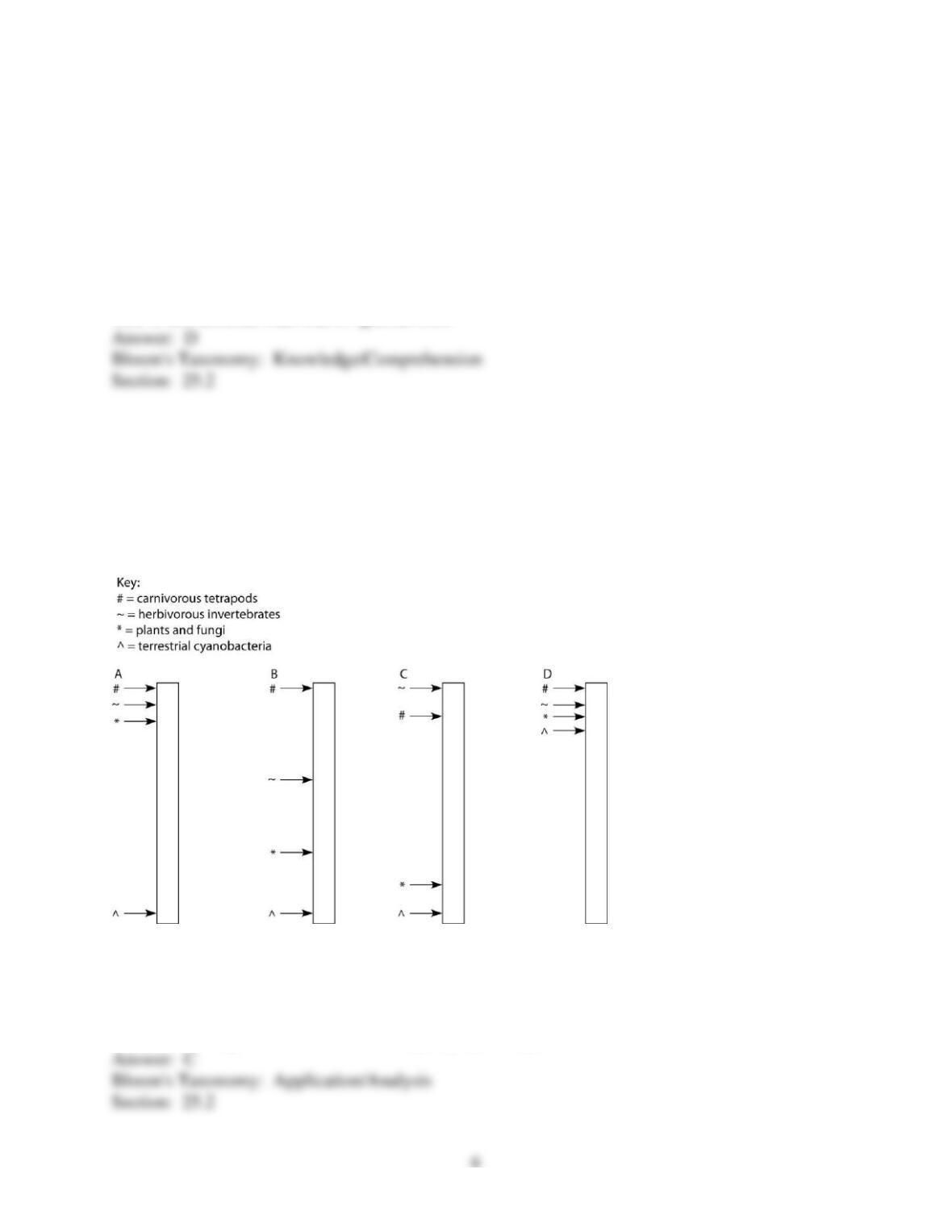
The questions below refer to the following description and figure.
The figure below represents a cross section of the sea floor through a mid-ocean rift valley, with
alternating patches of black and white indicating sea floor with reversed magnetic polarities. At
the arrow labeled “I” (the rift valley), the igneous rock of the sea floor is so young that it can be
accurately dated using carbon-14 dating. At the arrow labeled “III,” however, the igneous rock is
about one million years old, and potassium-40 dating is typically used to date such rocks. Note:
The horizontal arrows indicate the direction of sea-floor spreading, away from the rift valley.
8) Which section of sea-floor crust should have the thickest layer of overlying sediment,
assuming a continuous rate of sediment deposition?
A) A
B) B
C) D
D) E

9) If a particular marine organism is fossilized in the sediments immediately overlying the
igneous rock at the arrow labeled “II,” at which other location, labeled A-E, would a search be
most likely to find more fossils of this organism?
A) B
B) C
C) D
D) E
10) Which of the following organisms would be most likely to fossilize?
A) a rare worm
B) a common worm
C) a rare squirrel
D) a common squirrel
11) Which of the following would be LEAST likely in the fossil record?
A) burrowing species
B) marine-dwelling species
C) marsh-dwelling species
D) desert-dwelling species
12) If the half-life of carbon-14 is about 5730 years, then a fossil that has one-sixteenth the
normal proportion of carbon-14 to carbon-12 should be about how many years old?
A) 2800
B) 11,200
C) 16,800
D) 22,900
13) What is true of the fossil record of mammalian origins?
A) It shows that mammals and birds evolved from the same kind of dinosaur.
B) It includes transitional forms with progressively specialized teeth.
C) It indicates that mammals and dinosaurs did not overlap in geologic time.
D) It includes a series that shows the gradual change of scales into fur.
14) If a fossil is encased in a stratum of sedimentary rock without any strata of volcanic rock (for
example, lava or ash) nearby, then it should be _____.
A) easy to determine the absolute age of the fossil, because the radioisotopes in the sediments
will not have been “reset” by the heat of the igneous rocks
B) easy to determine the absolute age of the fossil, because the igneous rocks will not have
physically obstructed the deposition of sediment of a single age next to the fossil
C) difficult to determine the absolute age of the fossil, because the “marker fossils” common to
igneous rock will be absent
D) difficult to determine the absolute age of the fossil, because radiometric dating of sedimentary
rock is less accurate than that of igneous rock
The questions below refer to the following paragraph.
A sediment core is removed from the floor of an inland sea. The sea has been in existence, off
and on, throughout the entire time that terrestrial life has existed. Researchers wish to locate and
study the terrestrial organisms fossilized in this core. The core is illustrated as a vertical column,
with the top of the column representing the most recent strata and the bottom representing the
time when land was first colonized by life.
15) To assign absolute dates to fossils in this sediment core, it would be most helpful if _____.
A) we knew the order in which the fossils occurred
B) the sediments had not been affected by underwater currents during their deposition
C) volcanic ash layers were regularly interspersed between the sedimentary strata
D) fossils throughout the column were equally spaced apart

Refer to the following information to answer the questions below.
Fossils of Lystrosaurus, a dicynodont therapsid, are most common in parts of modern-day South
America, South Africa, Madagascar, India, South Australia, and Antarctica. The animal
apparently lived in arid regions, and was mostly herbivorous. It originated during the mid-
Permian period, survived the Permian extinction, and dwindled by the late Triassic, though there
is evidence of a relict population in Australia during the Cretaceous period. Some dicynodonts
had two large tusks, extending down from their upper jaws. The tusks were not used for food
gathering, and in some species were limited to males. Food was gathered using an otherwise
toothless beak. Judging from the fossil record in sedimentary rocks, these pig-sized organisms
were the most common mammal-like reptiles of the Permian.
16) Anatomically, Lystrosaurus _____.
A) would have had a lower jaw that consisted of a single pair of bones
B) was a tetrapod
C) had skin without scales, typical of modern amphibians
D) would have had no temporal fenestra in its skull
17) What is thought to be the correct sequence of these events, from earliest to most recent, in
the evolution of life on Earth?
1. origin of mitochondria
2. origin of multicellular eukaryotes
3. origin of chloroplasts
4. origin of cyanobacteria
5. origin of fungal-plant symbioses
A) 4, 3, 2, 1, 5
B) 4, 1, 2, 3, 5
C) 4, 1, 3, 2, 5
D) 4, 3, 1, 5, 2
18) Which of these observations gives the most support to the endosymbiotic theory for the
origin of eukaryotic cells?
A) the existence of structural and molecular differences between the plasma membranes of
prokaryotes and the internal membranes of mitochondria and chloroplasts
B) the similarity in size between the cytosolic ribosomes of prokaryotes and the ribosomes
within mitochondria and chloroplasts
C) the size disparity between most prokaryotic cells and most eukaryotic cells
D) the observation that some eukaryotic cells lack mitochondria

19) Which of the following was derived from an ancestral cyanobacterium?
A) chloroplast
B) mitochondrion
C) flagella
D) mitosome
20) For many years scientists believed that almost all animal lineages burst into being during the
Cambrian era (just after the end of the Precambrian super eon). However, there have been many
recent findings of animal-like fossils and “trace fossils” (fossils of an animal-like organisms
movement) from the late Precambrian. Which of the following best explains why it took so long
to realize there was animal-like life in the Precambrian?
A) Animals from the late Precambrian had soft bodies.
B) There were many hard-shelled animals in the Cambrian.
C) The global climate was such that there was poor fossilization in the Precambrian.
D) There were very few animals during this period.
21) Which of the following showed their greatest diversity during the Mesozoic era, but were a
small, less diverse group during the Paleozoic era?
A) gymnosperms
B) fungi
C) flowering plants
D) mammals
22) Which listing of geological periods is in the correct order, from oldest to most recent?
A) Cambrian, Devonian, Permian, Cretaceous
B) Devonian, Cambrian, Permian, Cretaceous
C) Cambrian, Permian, Devonian, Cretaceous
D) Permian, Cambrian, Cretaceous, Devonian

23) You are the lucky student of a wacky professor who develops a time machine. He asks if you
will test it with him. You get in and there is an immediate glitch–the date readout fails so that
when you land you are not sure what era you are in. Your professor begins to panic, but you see
something that tells you are in the Cenozoic era. Which of the following could it be?
A) a rabbit eating a daisy
B) a water lily floating in a pond
C) masses of green ferns with dragonflies hovering above them
D) a bee pollinating a flower
24) You are the lucky student of a wacky professor who develops a time machine. He asks if you
will test it with him. You get in and there is an immediate glitch–the date readout fails so that
when you land you are not sure what era you are in. As your time machine lands, you see an
unusual landscape before you. As you open the door you realize you cannot breathe. You quickly
shut the door, realizing you are in the _____.
A) Archaean eon
B) Cambrian period
C) Cenozoic era
D) Mesozoic era
25) An early consequence of the release of oxygen gas by plant and bacterial photosynthesis was
to _____.
A) change the atmosphere from oxidizing to reducing
B) make it easier to maintain reduced molecules
C) cause iron in ocean water and terrestrial rocks to rust (oxidize)
D) prevent the formation of an ozone layer
26) What is true of the Cambrian explosion?
A) There are fossils of animals in geological strata that are older than the Cambrian explosion.
B) Only the fossils of microorganisms are found in geological strata older than the Cambrian
explosion.
C) The Cambrian explosion is evidence for the instantaneous creation of life on Earth.
D) The Cambrian explosion marks the appearance of filter-feeding animals in the fossil record.

27) Which of the following characteristics are expected in the first animals to have colonized
land?
1. were probably herbivores (ate photosynthesizers)
2. had four appendages
3. had the ability to resist dehydration
4. had lobe-finned fishes as ancestors
5. were invertebrates
A) 3 only
B) 3 and 5
C) 1, 3, and 5
D) 1, 2, 3, and 4
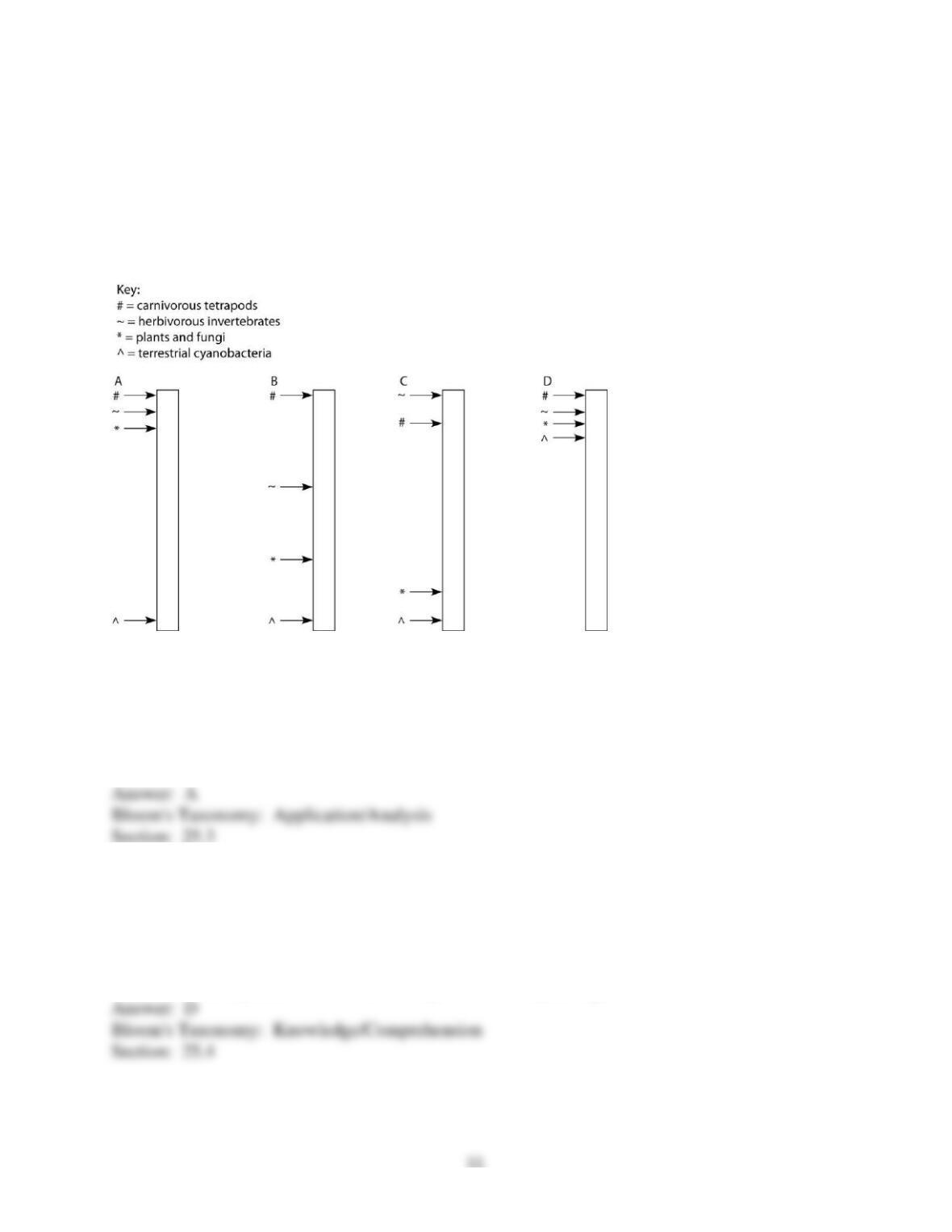
The questions below refer to the following paragraph.
A sediment core is removed from the floor of an inland sea. The sea has been in existence, off
and on, throughout the entire time that terrestrial life has existed. Researchers wish to locate and
study the terrestrial organisms fossilized in this core. The core is illustrated as a vertical column,
with the top of the column representing the most recent strata and the bottom representing the
time when land was first colonized by life.
28) If arrows indicate locations in the column where fossils of a particular type (see key above)
first appear, then which core in the figure above has the most accurate arrangement of fossils?
A) core A
B) core B
C) core C
D) core D
29) Which factor most likely caused animals and plants in India to differ greatly from species in
nearby southeast Asia?
A) The climates of the two regions are similar.
B) India is in the process of separating from the rest of Asia.
C) Life in India was wiped out by ancient volcanic eruptions.
D) India was a separate continent until forty-five million years ago.

The following questions refer to the description below.
All animals with eyes or eyespots that have been studied so far share a gene in common. When
mutated, the gene Pax–6 causes lack of eyes in fruit flies, tiny eyes in mice, and missing irises
(and other eye parts) in humans. The sequence of Pax-6 in humans and mice is identical. There
are so few sequence differences with fruit fly Pax-6 that the human/mouse version can cause eye
formation in eyeless fruit flies, even though vertebrates and invertebrates last shared a common
ancestor more than five hundred million years ago.
30) The appearance of Pax-6 in all animals with eyes can be explained in multiple ways. Based
on the information above, which explanation is most likely?
A) Pax-6 in all of these animals is not homologous; it arose independently in many different
animal phyla due to intense selective pressure favoring vision.
B) The Pax-6 gene is really not one gene. It is many different genes that, over evolutionary time
and due to convergence, have come to have a similar nucleotide sequence and function.
C) The Pax-6 gene was an innovation of an ancestral animal of the early Cambrian period.
Animals with eyes or eyespots are descendants of this ancestor.
D) The need for eyes has resulted in the separate evolution of Pax-6 genes.
31) Fruit-fly eyes are of the compound type, which is structurally very different from the camera-
type eyes of mammals. Even the camera-type eyes of molluscs, such as octopi, are structurally
quite different from those of mammals. Yet, fruit flies, octopi, and mammals possess very similar
versions of Pax-6. The fact that the same gene helps produce very different types of eyes is most
likely due to _____.
A) the few differences in nucleotide sequence among the Pax-6 genes of these organisms
B) variations in the number of Pax-6 genes among these organisms
C) the independent evolution of this gene at many different times during animal evolution
D) differences in the control of Pax-6 expression among these organisms