
Microbiology with Diseases by Body System, 5e (Bauman)
Chapter 24 Microbial Diseases of the Urinary and Reproductive Systems
24.1 Multiple Choice Questions
1) The ________ connects the kidney to the bladder.
A) collecting duct
B) renal capsule
C) urethra
D) ureter
E) fallopian tube
2) The normal pH of the vagina is
A) pH 7.
B) pH 8.
C) pH 4.5
D) pH 6
E) pH 6.5
3) The prostate produces
A) sperm.
B) urine.
C) hormones.
D) antimicrobials.
E) semen.

4) The disorder ________ is a complication of systemic infections with Streptococcus in which
antigen-antibody complexes form in the blood and get trapped in the kidneys.
A) cystitis
B) glomerulonephritis
C) pyelonephritis
D) leptospirosis
E) urethritis
5) When bacteria invade the kidney, the result can be
A) cystitis.
B) ectopic.
C) prostatitis.
D) pyelonephritis.
E) bacteriosis.
6) Which of the following is commonly the source of leptospirosis?
A) infected animal urine
B) infected animal bites
C) humans infected with leptospirosis
D) infected animal feces
E) infected human urine
7) During the spring calving season, a ranch hand begins to run a fever and feel nauseous and
achy. After he develops a headache and vomiting, he goes to a clinic. A microscopic exam of a
urine sample reveals long thin microbes which move very rapidly in a corkscrewing pattern. The
man may have contracted
A) lymphogranuloma venereum.
B) glomerulonephritis.
C) leptospirosis.
D) staphylococcal toxic shock syndrome.
E) trichomoniasis.

8) The majority of cases of staphylococcal toxic shock syndrome are diagnosed in
A) newly delivered mothers.
B) uncircumcised males.
C) anyone with a Staphylococcus aureus infection.
D) nasal surgery patients.
E) menstruating women.
9) Which of the following is a characteristic of bacterial vaginosis frequently used to confirm
diagnosis?
A) an abnormal vaginal discharge
B) an acidic vaginal pH
C) fever and rash
D) the presence of buboes
E) the presence of clue cells
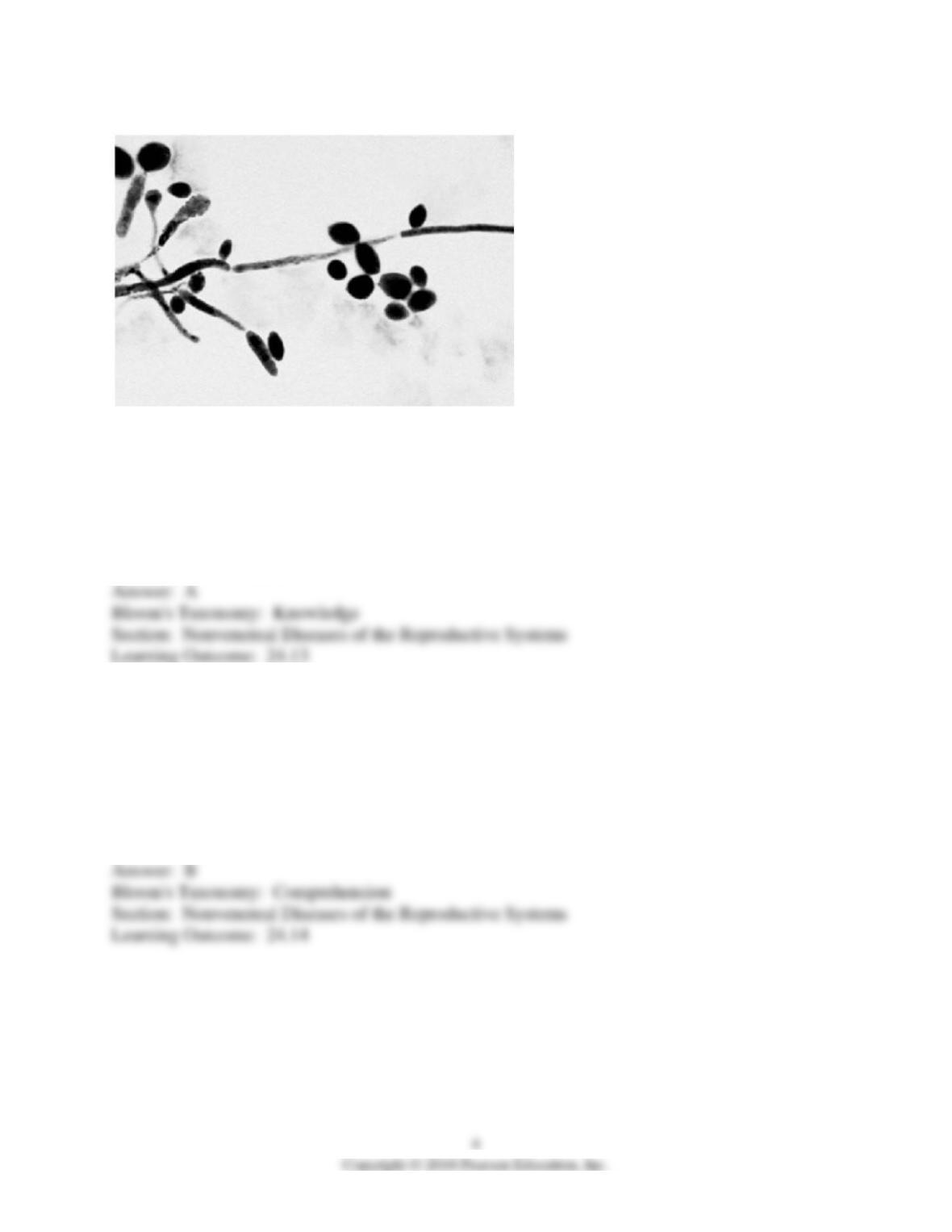
10)
The presence of the specimen shown in the figure in a vaginal discharge is evidence of infection
with
A) Candida albicans.
B) Neisseria gonorrhoeae.
C) Treponema palladium.
D) Chlamydia trachomatis.
E) Trichomonas vaginalis.
11) Why does taking antibacterial medications put women at risk for candidiasis?
A) Antibacterials can alter metabolism, creating conditions that favor the growth of Candida
albicans.
B) Antibacterials deplete the normal bacterial microbiota, resulting in a change of pH.
C) Antibacterials serve as growth stimulants for Candida albicans.
D) Bacteria killed by antibacterials provide nutrients for Candida albicans.
E) Depletion of the bacterial microbiota results in higher carbon dioxide levels, (which favor the
growth of Candida albicans).

12) Untreated infection of males with Neisseria gonorrhoeae may result in
A) gummas.
B) sterility.
C) trachoma.
D) glomerulonephritis.
E) penile cancer.
13) Neisseria gonorrhoeae of the reproductive tract in women
A) is usually initially asymptomatic.
B) produces severe inflammation of the vagina and cervix.
C) results in the formation of curd-like discharge.
D) results in the production of a yellow-greenish frothy discharge.
E) produces painful ulcerations.
14) Which of the following contributes to the invasiveness of Treponema pallidum?
A) hyaluronidase
B) fimbriae
C) lipooligosaccharide in the cell wall
D) TSST
E) IgA protease
15) Which of the following statements is FALSE regarding gonorrhea?
A) It is easily confused with syphilis.
B) The causative agent can grow on most mucous membranes of the body.
C) Women usually experience no symptoms early in infection.
D) Untreated infections may result in ectopic pregnancy.
E) Gonorrhea does not elicit long-term specific immunity.

16) Neisseria gonorrhoeae most commonly infects which of the following in females?
A) the uterus
B) the vagina
C) the cervix
D) the fallopian tubes
E) the ovaries
17) The presence of Gram-negative diplococci in pus from an inflamed penis is diagnostic for
infection by
A) human herpesvirus 2.
B) Treponema pallidum.
C) Neisseria gonorrhoeae.
D) Chlamydia trachomatis.
E) Mycoplasma hominis.
18) The typical sign of primary syphilis is
A) a chancre at the site of infection.
B) a widespread rash.
C) lymphadenopathy.
D) gummas in various organs.
E) paralysis.
19) Diagnosis of syphilis is usually made by
A) the MHA-TP test.
B) culturing specimens on laboratory media.
C) microscopic evaluation of stained specimens.
D) DNA probes.
E) a Pap smear.

20) A distinctive feature of secondary syphilis is
A) a widespread rash that can include the palms and soles.
B) hard, red, painless bumps.
C) rubbery, painful lesions.
D) soft, painful ulcers.
E) blister-like lesions which ulcerate.
21) Syphilis can be transmitted
A) by sexual contact.
B) from mother to fetus.
C) by fomites.
D) both by sexual contact and from mother to fetus.
E) by sexual contact, by fomites, and from mother to fetus.
22) The noninfective, obligately intracellular forms of chlamydia are called
A) elementary bodies.
B) phagosomes.
C) pseudohyphae.
D) trachomas.
E) reticulate bodies.
23) Which of the following statements is CORRECT regarding the incidence of STDs?
A) Bacterial STDs are declining worldwide as a result of the ready availability of antibiotics.
B) The incidence of STDs is known with a high degree of accuracy.
C) Viruses transmitted by sexual contact are not widespread.
D) Viral STDs in the U.S. are considered epidemic.
E) The incidence of most STDs could be reduced by vaccination.

24) In addition to the genital tract, various strains of Chlamydia trachomatis can infect which of
the following?
A) lymph nodes
B) the lungs
C) the conjunctiva
D) lymph nodes and conjunctiva
E) lymph nodes, lungs, and conjunctiva
25) A young adult shows up at a free clinic complaining of painful swellings in the groin. The
young woman has a history of occasional casual sex, but denies noticing any genital sores or
experiencing painful urination. The young woman is most likely infected with
A) Chlamydia trachomatis.
B) Neisseria gonorrhoeae.
C) Mycoplasma hominis.
D) Treponema pallidum.
E) Trichomonas vaginalis.
26) Which of the following can mimic gonorrhea infections?
A) syphilis
B) genital herpes
C) trichomoniasis
D) chlamydia
E) candidiasis
27) What is the effect of TSST-1 exotoxin on the body?
A) It causes red blood cell lysis.
B) It damages the endothelial cells of capillaries.
C) It binds to receptors on T cells and activates them.
D) It is a pyrogen, causing fever.
E) It kills epithelial cells of mucous membranes.

28) Which of the following can cause pelvic inflammatory disease, characterized by fever and
abdominal pain?
A) Neisseria gonorrhoeae.
B) Treponema pallidum.
C) Staphylococcus aureus.
D) Chlamydia trachomatis
E) both Chlamydia trachomatis and Neisseria gonorrhoeae
29) A diagnosis of genital herpes is confirmed by the
A) detection of herpesvirus DNA by PCR.
B) location of herpetic lesions.
C) appearance and size of herpetic lesions.
D) appearance of stained tissue specimens.
E) binding of fluorescent antibodies.
30) Which of the following statements is TRUE regarding genital herpes?
A) Reappearance of lesions is the result of new infections.
B) It can only be transmitted when lesions are evident.
C) There is an effective vaccine to prevent infection.
D) Acyclovir is effective in reducing the occurrence of lesions, but is not a cure.
E) Herpes can be prevented using vaginal spermicidal creams.
31) Some strains of the virus responsible for genital warts can cause the development of
A) tertiary syphilis.
B) cervical cancer.
C) trichomoniasis.
D) genital herpes.
E) vaginosis.

32) Condylomata acuminata are associated with infections of which of the following?
A) Trichomonas vaginalis
B) human herpesvirus 1
C) papillomaviruses
D) human herpesvirus 2
E) Neisseria gonorrhoeae
33)
Observation of the microbes shown in the figure from a vaginal discharge specimen is diagnostic
for
A) Chlamydia infection.
B) gonorrhea.
C) trichomoniasis.
D) trachoma.
E) syphilis.

34) A woman goes to her gynecologist and reports that she is experiencing pain during
intercourse and frequently has an unusual vaginal discharge that is increased in quantity and sort
of foamy. A vaginal smear shows normal appearing epithelial cells along with small leaf-shaped
cells with prominent oval nuclei. What disease is the woman experiencing?
A) cervical cancer
B) herpes
C) leptospirosis
D) syphilis
E) trichomoniasis
35) Trichomonas vaginalis is usually transmitted during sexual intercourse because it
A) requires a growth factor found only in the vagina.
B) penetrates cells lining the genitourinary tract.
C) participates with HIV in coinfections.
D) produces cysts that germinate in the vagina.
E) cannot live long outside the body.
24.2 True/False Questions
1) The risk of developing toxic shock syndrome is increased by the use of super-absorbent
tampons.
2) Gonorrhea in women is not a risk factor for sterility.
3) Genital herpes and genital warts are both caused by human herpesviruses.

4) The normal microbiota of the vagina help maintain a vaginal pH of around 7.5.
5) The urethra is the only part of the urinary system in which one would expect to find normal
microbiota.
6) Mental confusion is often the only sign of a urinary tract infection in elderly patients.
7) Clinical manifestations of Chlamydia infections arise primarily from an inflammatory
response to the destruction of infected cells.
8) Severe suppression of immune function is the only condition that results in reactivation of
latent herpesvirus infection.
9) A whitlow is the result of human papillomavirus infection of the skin of the hand.
10) Men infected with Trichomonas vaginalis rarely have symptoms.

24.3 Short Answer Questions
1) Because the (ductus/urethra/ureter) is shorter in females than in males, it can be a portal of
entry for pathogens.
2) Babies exposed to an intracellular parasite normally transmitted by sexual contact are at risk
for (conjunctivitis/trachoma/warts).
3) Glycogen is converted to acid in the vagina by (Lactobacilli/Streptococci/yeast), thereby
contributing to an acidic pH in that area.
4) When bacteria infect the bladder, the condition is known as (cystitis/pyelonephritis/urethritis).
5) The frequent, urgent, and painful urination that often results from urinary tract infections is
called (dysuria/cystitis/glomerulonephritis).
6) The zoonosis (leptospirosis/trichomoniasis/vaginosis) is is acquired by skin contact and
becomes a systemic infection.

7) A patient with systemic bacterial infection develops high blood pressure, and the urine output
declines, but what urine is passed contains blood. The patient does not experience pain with
urination. These signs are consistent with (cystitis/glomerulonephritis/urethritis).
8) The presence of (bacillus/clue/streptococcal) cells is an important aspect of the diagnosis of
bacterial vaginosis.
9) The yeast infection (candidiasis/trichomoniasis/vaginosis) can become systemic in AIDS
patients.
10) A small, red, hard but painless lesion is a sign of infection with (gonorrhea/herpes/syphilis).
11) The appearance of a wart on the genitalia is a sign of infection with
(chlamydia/herpes/papilloma) virus.
12) A vaccine is available to prevent infection with (herpes/HIV/HPV).
13) The drug of choice for treating primary and secondary syphilis is
(amoxicillin/penicillin/streptomycin) G.

14) When chlamydias spread from the genitalia to the rectum, they can cause an inflammatory
process called (PID/proctitis/pyelonephritis).
15) A lesion known as a whitlow is the result of infection with (chlamydia/herpes/syphilis).
1) Explain why a female who has a history of gonorrhea infections is more likely to have an
ectopic pregnancy.
2) Some areas of the genitourinary tract are normally sterile, whereas other areas have a variety
of microbiota. Describe the defense mechanisms of the genitourinary tract that contribute to this
dichotomy.

3) A patient complains of fever, pain on one side of the body, and fatigue. The clinician notes the
patient’s blood pressure is elevated. The patient reports experiencing some painful urination for a
few days during the previous week. Tests on a urine sample reveal the presence of motile Gram-
negative bacilli. What is the patient most likely suffering from?
4) Explain why some syphilis patients may only experience the symptoms of primary syphilis,
while other patients may progress all the way to tertiary syphilis.
5) A young woman is brought to the ER who is running a high fever and is confused about where
she is. She also has an extensive red rash. She begins vomiting, and her blood pressure drops.
The ER staff determine she is menstruating. What is the likely diagnosis?