1
Campbell Biology in Focus, 2e (Urry)
Chapter 24 Early Life and the Diversification of Prokaryotes
24.1 Multiple-Choice Questions
1) How were conditions on the early Earth of more than 3 billion years ago different from those
on today’s Earth?
A) Only early Earth was intensely bombarded by large space debris.
B) Only early Earth had an oxidizing atmosphere.
C) Less ultraviolet radiation penetrated early Earth’s atmosphere.
D) Early Earth’s atmosphere had significant quantities of ozone.
2) Which of the following is the correct sequence of events in the origin of life?
I. formation of protobionts
II. synthesis of organic monomers
III. synthesis of organic polymers
IV. formation of DNA-based genetic systems
A) I, II, III, IV
B) I, III, II, IV
C) II, III, I, IV
D) II, III, IV, I
3) Which of the following is a defining characteristic that all protobionts had in common?
A) the ability to synthesize enzymes
B) a surrounding membrane or membrane-like structure
C) RNA genes
D) the ability to replicate RNA

2
4) The first genes on Earth were probably
A) DNA produced by reverse transcriptase from abiotically produced RNA.
B) DNA molecules whose information was transcribed to RNA and later translated in
polypeptides.
C) self-replicating RNA molecules.
D) antibiotic resistant.
5) Several scientific laboratories across the globe are involved in research concerning the origin
of life on Earth. Which of these questions is currently the most problematic and would have the
greatest impact on our understanding if we were able to answer it?
A) How can amino acids, simple sugars, and nucleotides be synthesized abiotically?
B) How can RNA molecules catalyze reactions?
C) How did RNA sequences come to carry the code for amino acid sequences?
D) How could polymers involving lipids and/or proteins form membranes in aqueous
environments?
E) How can RNA molecules act as templates for the synthesis of complementary RNA
molecules?
6) Approximately how far back in time does the fossil record extend?
A) 3.5 million years
B) 5.0 million years
C) 3.5 billion years
D) 5.0 billion years
3
7) Scientists hypothesize that prokaryotes evolved before eukaryotes because
A) prokaryotic cells lack nuclei.
B) the meteorites that have struck Earth contain fossils only of prokaryotes.
C) laboratory experiments have produced ribosomes abiotically.
D) ribosomes closely resemble prokaryotic cells.
E) the oldest fossilized cells resemble prokaryotes.
8) Suppose it were possible to conduct sophisticated microscopic and chemical analyses of
microfossils found in 3.5-billion-year-old stromatolites. Which of the following structures would
be surprising to observe?
I. RNA
II. vesicles
III. a nucleus
IV. ribozymes
A) I
B) II
C) III
D) IV
9) In 2009, which of the following did scientists discover was possible on early Earth?
A) abiotic synthesis of RNA monomers
B) bacterial cell walls made mainly of chitin
C) gram-positive bacteria with outer membranes that contain lipopolysaccharides
D) gram-negative bacteria with cell walls composed of a thick layer of peptidoglycan
4
10) The first genetic material on early Earth was most likely
A) DNA.
B) RNA.
C) peptidoglycan.
D) protocells.
11) Which of the following is likely the greatest impact that organisms have ever had on Earth?
A) Early cyanobacteria released hydrogen to Earth’s atmosphere during the water-splitting step
of photosynthesis.
B) Early cyanobacteria released carbon dioxide to Earth’s atmosphere during the water-splitting
step of photosynthesis.
C) Early cyanobacteria released oxygen to Earth’s atmosphere during the water-splitting step of
photosynthesis.
D) Early cyanobacteria released nitrogen to Earth’s atmosphere during the water-splitting step of
photosynthesis.
12) Which of the following is an accurate characteristic of bacterial cell walls?
A) They are primarily made of chitin.
B) They prevent cells from bursting in hypertonic environments.
C) They prevent cells from bursting in hypotonic conditions.
D) They only have peptidoglycan if they are gram-negative.

5
13) The predatory bacterium Bdellovibrio bacteriovorus drills into a prey bacterium and, once
inside, digests it. In an attack upon a gram-negative bacterium that has a slimy cell covering,
what is the correct sequence of structures penetrated by B. bacteriovorus on its way to the prey’s
cytoplasm?
1. membrane composed mostly of lipopolysaccharide
2. membrane composed mostly of phospholipids
3. peptidoglycan
4. capsule
A) 2, 4, 3, 1
B) 1, 3, 4, 2
C) 1, 4, 3, 2
D) 4, 1, 3, 2
E) 4, 3, 1, 2
14) Jams, jellies, preserves, honey, and other foodstuffs with high sugar content hardly ever
become contaminated by bacteria, even when the food containers are left open at room
temperature. This is because bacteria that encounter such an environment
A) undergo death as a result of water loss from the cell.
B) are unable to metabolize the glucose or fructose and thus starve to death.
C) experience lysis.
D) are obligate anaerobes.
E) are unable to swim through these thick and viscous materials.

15) In a bacterium that possesses antibiotic resistance and the potential to persist through very
adverse conditions, such as freezing, drying, or high temperatures, DNA should be located
within, or be part of, which structure(s)?
1. nucleoid region
2. endospore
3. fimbriae
4. plasmids
A) 1 only
B) 1 and 2 only
C) 1 and 4 only
D) 2 and 4 only
E) 1, 2, and 4
16) Which two structures play direct roles in permitting bacteria to adhere to each other or to
other surfaces?
1. capsules
2. endospores
3. fimbriae
4. plasmids
5. flagella
A) 1 and 2
B) 1 and 3
C) 2 and 3
D) 3 and 4
E) 3 and 5
7
17) The typical prokaryotic flagellum features
A) an external covering provided by the plasma membrane.
B) a complex “motor” embedded in the cell wall and plasma membrane.
C) a basal body that is similar in structure to the cell’s centrioles.
D) a membrane-enclosed organelle with motor proteins.
18) Prokaryotic ribosomes differ from those present in eukaryotic cytosol. Because of this, which
of the following is correct?
A) Some antibiotics can block protein synthesis in bacteria without effects in the eukaryotic host.
B) Eukaryotes did not evolve from prokaryotes.
C) Translation can occur at the same time as transcription in eukaryotes but not in prokaryotes.
D) Some antibiotics can block the synthesis of peptidoglycan in the walls of bacteria.
E) Prokaryotes are unable to use a greater variety of molecules as food sources than can
eukaryotes.
19) Which statement about the genomes of prokaryotes is correct?
A) Prokaryotic genomes are diploid throughout most of the cell cycle.
B) Prokaryotic chromosomes are sometimes called plasmids.
C) Prokaryotic cells have more proteins than eukaryotes.
D) The prokaryotic chromosome is not contained within a nucleus but, rather, is found at the
nucleolus.
E) Prokaryotic genomes are composed of circular DNA.
20) If a bacterium regenerates from an endospore that did not possess any of the plasmids that
were contained in its original parent cell, the regenerated bacterium will probably also
A) lack antibiotic-resistant genes.
B) lack a cell wall.
C) lack chromosomes.
D) lack water in its cytoplasm.
E) be unable to survive in its normal environment.

21) Prokaryotes’ essential genetic information is located in the
A) flagella.
B) nucleoid.
C) capsule.
D) plasmids.
E) endospore.
22) Chloramphenicol is an antibiotic that targets prokaryotic (70S) ribosomes, but not eukaryotic
(80S) ribosomes. Which of these questions stems from this observation plus an understanding of
eukaryotic origins?
A) Can chloramphenicol also be used to control human diseases that are caused by archaeans?
B) Can chloramphenicol pass through the capsules possessed by many cyanobacteria?
C) If chloramphenicol inhibits prokaryotic ribosomes, should it not also inhibit mitochondrial
ribosomes?
D) Why aren’t prokaryotic ribosomes identical to eukaryotic ribosomes?
E) How is translation affected in ribosomes that are targeted by chloramphenicol?
23) Match the numbered terms to the description that follows. Choose all appropriate terms.
1. autotroph
2. heterotroph
3. phototroph
4. chemotroph
a prokaryote that obtains both energy and carbon as it decomposes dead organisms
A) 1 only
B) 4 only
C) 1 and 3
D) 2 and 4
E) 1, 3, and 4

9
24) Match the numbered terms to the description that follows. Choose all appropriate terms.
1. autotroph
2. heterotroph
3. phototroph
4. chemotroph
an organism that obtains both carbon and energy by ingesting prey
A) 1 only
B) 4 only
C) 1 and 3
D) 2 and 4
E) 1, 3, and 4
25) Match the numbered terms to the description that follows. Choose all appropriate terms.
1. autotroph
2. heterotroph
3. phototroph
4. chemotroph
an organism that obtains energy from light
A) 1 only
B) 3 only
C) 1 and 3
D) 2 and 4
E) 1, 3, and 4
26) Which of the following oxidizes inorganic substances to obtain energy that is used, in part, to
fix CO2?
A) photoautotrophs
B) photoheterotrophs
C) chemoautotrophs
D) chemoheterotrophs that perform decomposition
10
27) In a hypothetical situation, the genes for sex pilus construction and for tetracycline resistance
are located together on the same plasmid within a particular bacterium. If this bacterium readily
performs conjugation involving a copy of this plasmid, then the result should be
A) a bacterium that has undergone transduction.
B) the rapid spread of tetracycline resistance to other bacteria in that habitat.
C) the subsequent loss of tetracycline resistance from this bacterium.
D) the production of endospores among the bacterium’s progeny.
E) the temporary possession by this bacterium of a completely diploid genome.
28) Although not present in all bacteria, this cell covering often enables cells that possess it to
resist the defenses of host organisms, especially their phagocytic cells.
A) endospore
B) sex pilus
C) cell wall
D) capsule
29) Thiobacillus ferrooxidans is a type of bacteria that oxidizes iron compounds for energy and
then uses that energy to build carbohydrates. We might best recognize this bacterium as the rust–
colored ring that builds up inside toilet bowls. Thiobacillus ferrooxidans is an example of a
A) photoautotroph.
B) chemoheterotroph.
C) photoheterotroph.
D) chemoautotroph.
11
30) Why can prokaryotic populations be magnitudes larger than populations of multicellular
eukaryotes?
I. Prokaryotes are small.
II. Prokaryotes reproduce by binary fission.
III. Prokaryotes often have short generation times.
IV. Prokaryotes have cells walls primarily made of cellulose.
A) I only
B) I and III
C) II, III, IV
D) I, II, III
31) Regarding prokaryotic genetics, which statement is correct?
A) Crossing over during prophase I introduces some genetic variation.
B) Prokaryotes feature the union of haploid gametes, as do eukaryotes.
C) Prokaryotes exchange some of their genes by conjugation, the union of haploid gametes, and
transduction.
D) Mutation is a primary source of variation in prokaryote populations.
E) Prokaryotes skip sexual life cycles because their life cycle is too short.
32) Which of these statements about prokaryotes is correct?
A) Bacterial cells conjugate to mutually exchange genetic material.
B) Their genetic material is confined within vesicles known as plasmids.
C) They divide by binary fission, without mitosis or meiosis.
D) The persistence of bacteria throughout evolutionary time is due to their lack of genetic
variation.
E) Genetic variation in bacteria is not known to occur because of their asexual mode of
reproduction.
12
33) Which of the following is least associated with the others?
A) horizontal gene transfer
B) genetic recombination
C) conjugation
D) transformation
E) binary fission
34) Mitochondria are thought to be the descendants of certain alpha proteobacteria. They are,
however, no longer able to lead independent lives because most genes originally present on their
chromosome have moved to the nuclear genome. Which phenomenon accounts for the
movement of these genes?
A) transduction
B) conjugation
C) translation
D) binary fission
E) horizontal gene transfer
35) Suppose bacteria are grown on a petri dish that contains nutrient agar and the antibiotic
ampicillin. After observing the bacteria growth on the plate for two days, you notice that only
some of the bacteria have survived. What is a plausible explanation for your observations?
A) Some of the bacterial DNA was not able to replicate because it lacked some of its own
genetic material.
B) The bacteria that survived were transformed with a plasmid that contains the resistance gene
for ampicillin.
C) The pili of the bacterial could not attach to the ampicillin.
D) F plasmids were not present to transfer bacterial DNA.
13
36) Scientists have identified two major branches of prokaryotic evolution. What was the basis
for dividing prokaryotes into two domains?
A) microscopically observed staining characteristics of the cell wall
B) metabolic characteristics such as the production of methane gas
C) metabolic characteristics such as chemoautotrophy and photosynthesis
D) genetic characteristics such as ribosomal RNA sequences
E) ecological characteristics such as the ability to survive in extreme environments
37) Which statement about the domain Archaea is true?
A) Genetic prospecting has recently revealed the existence of many previously unknown
archaean species.
B) No archaeans can reduce CO2 to methane.
C) The genomes of archaeans are unique, containing no genes that originated within bacteria.
D) No archaeans can inhabit solutions that are nearly 30% salt.
E) No archaeans are adapted to waters with temperatures above the boiling point.
38) If archaeans are more closely related to eukaryotes than to bacteria, then which of the
following is a reasonable prediction?
A) Archaean DNA should have no introns.
B) Archaean chromosomes should have no protein bonded to them.
C) Archaean DNA should be single-stranded.
D) Archaean ribosomes should be larger than typical prokaryotic ribosomes.
E) Archaeans should lack cell walls.

14
39) Which of the following traits do archaeans and bacteria share?
1. composition of the cell wall
2. presence of plasma membrane
3. lack of a nuclear envelope
4. identical rRNA sequences
A) 1 only
B) 3 only
C) 1 and 3
D) 2 and 3
E) 2 and 4
40) Assuming that each possesses a cell wall, which of these prokaryotes should be expected to
be most strongly resistant to plasmolysis in hypertonic environments?
A) extreme halophiles
B) extreme thermophiles
C) methanogens
D) cyanobacteria
E) nitrogen-fixing bacteria that live in root nodules

41) The thermoacidophile Sulfolobus acidocaldarius lacks peptidoglycan, but still possesses a
cell wall. What is likely to be true of this species?
1. It is a bacterium.
2. It is an archaean.
3. The optimal pH of its enzymes lies above pH 7.
4. The optimal pH of its enzymes lies below pH 7.
5. It could inhabit certain hydrothermal springs.
6. It could inhabit alkaline hot springs.
A) 1, 3, and 6
B) 2, 4, and 6
C) 2, 4, and 5
D) 1, 3, and 5
E) 1, 4, and 5
42) A fish that has been salt-cured subsequently develops a reddish color. You suspect that the
fish has been contaminated by the extreme halophile Halobacterium. Which of these features of
cells removed from the surface of the fish, if confirmed, would support your suspicion?
1. the presence of the same photosynthetic pigments found in cyanobacteria
2. cell walls that lack peptidoglycan
3. cells that are isotonic to conditions on the surface of the fish
4. cells unable to survive salt concentrations lower than 9%
5. the presence of very large numbers of ion pumps in the plasma membrane
A) 2 and 5
B) 3 and 4
C) 1, 4, and 5
D) 3, 4, and 5
E) 2, 3, 4, and 5
16
43) Mycoplasmas are bacteria that lack cell walls. On the basis of this structural feature, which
statement concerning mycoplasmas should be true?
A) They are gram-negative.
B) They are subject to lysis in hypotonic conditions.
C) They lack a cell membrane as well.
D) They contain less cellulose than do bacteria that possess cell walls.
E) They possess typical prokaryotic flagella.
44) What is a main difference between endotoxins and exotoxins?
A) Endotoxins are proteins and exotoxins are lipopolysaccharides.
B) Endotoxins are lipopolysaccharides and exotoxins are proteins.
C) Exotoxins are released only when the bacteria die and their cell walls break down.
D) Exotoxins are made of RNA and endotoxins are made of DNA.
45) Which of the following is an important source of endotoxin in gram-negative species?
A) endospore
B) sex pilus
C) flagellum
D) cell wall
E) capsule
17
46) The termite gut protist Mixotricha paradoxa has at least two kinds of bacteria attached to its
outer surface. One kind is a spirochete that propels its host through the termite gut. A second
type of bacteria synthesizes ATP, some of which is used by the spirochetes. The locomotion
provided by the spirochetes introduces the ATP-producing bacteria to new food sources. Which
of the following terms is (are) applicable to the relationship between the two kinds of bacteria?
1. mutualism
2. parasitism
3. symbiosis
4. metabolic cooperation
A) 1 only
B) 1 and 2
C) 2 and 3
D) 1, 3, and 4
E) 2, 3, and 4
47) In general, what is the primary ecological role of prokaryotes?
A) parasitizing eukaryotes, thus causing diseases
B) breaking down organic matter
C) metabolizing materials in extreme environments
D) adding methane to the atmosphere
E) serving as primary producers in terrestrial environments
48) If all prokaryotes on Earth suddenly vanished, which of the following would be the most
likely and most direct result?
A) The number of organisms on Earth would decrease by 10-20%.
B) Human populations would thrive in the absence of disease.
C) Bacteriophage numbers would dramatically increase.
D) The recycling of nutrients would be greatly reduced, at least initially.
E) There would be no more pathogens on Earth.

18
49) In a hypothetical situation, a bacterium lives on the surface of a leaf, where it obtains
nutrition from the leaf’s nonliving, waxy covering while inhibiting the growth of other microbes
that are plant pathogens. If this bacterium gains access to the inside of a leaf, however, it causes
a fatal disease in the plant. Once the plant dies, the bacterium and its offspring decompose the
plant. What is the correct sequence of ecological roles played by the bacterium in the situation
described here? Use only those that apply.
1. nutrient recycler
2. mutualist
3. commensal
4. pathogen
5. primary producer
A) 1, 3, 4
B) 2, 3, 4
C) 2, 4, 1
D) 1, 2, 5
E) 1, 2, 3
50) Broad-spectrum antibiotics inhibit the growth of most intestinal bacteria. Consequently,
assuming that nothing is done to counter the reduction of intestinal bacteria, a hospital patient
who is receiving broad-spectrum antibiotics is most likely to become
A) unable to fix carbon dioxide.
B) antibiotic resistant.
C) unable to fix nitrogen.
D) unable to synthesize peptidoglycan.
E) deficient in certain vitamins and nutrients.
19
24.2 Art Questions
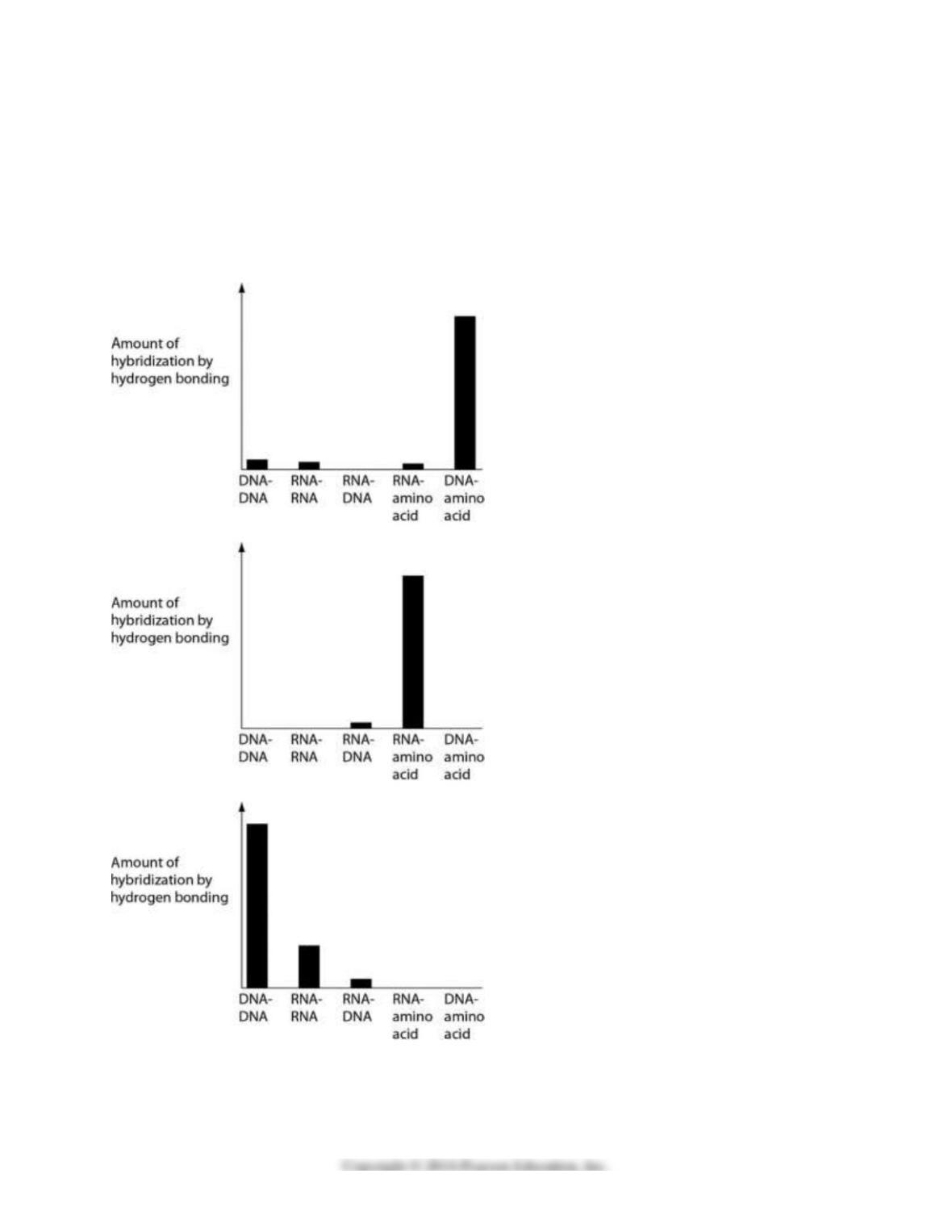
1) Several scientific laboratories across the globe are performing research concerning the origin
of life on Earth. Suppose one of these laboratories conducts abiotic experiment(s) to test the
potential for hydrogen bonding between various nucleic acids and amino acids. Which of the
following results of such experiments are most consistent with our current understanding of
Earth’s first genetic systems?
A)
B)
C)