Chapter 24 Glycogen Degradation
Matching Questions
Use the following to answer questions 1-10:
Choose the correct answer from the list below. Not all of the answers will be used.
a) reducing
b) -1,6-glycosidic
c) phosphorylase kinase
d) -1,4-glycoside
e) non-reducing
f) phosphorylase a
g) glucose 6-phosphatase
h) UTP-glucose
i) calmodulin
j) phosphorolysis
k) epinephrine
l) glucagon
1.
____________ Most of the glucose residues in glycogen are linked by this type of bond.
2.
____________is the end of glycogen where the anomeric carbon is free to change to the open or
closed conformation.
Ans: a
Section: 24.1
3.
____________ This is the process by which a bond is cleaved by the addition of
orthophosphate.
Ans: j
Section: 24.1
4.
____________ This type of bond is located at the branch points in glycogen.
Section: 24.1
5.
____________ This is the liver enzyme that cleaves the phosphate from glucose-6-phosphate.
Ans: g
Section: 24.1
Ans: d
Section: Introduction
Chapter 24 Glycogen Degradation
2
6.
____________ This enzyme catalyzes the phosphorylation of glycogen phosphorylase.
7.
____________ This protein is the δ subunit of phosphorylase kinase.
Ans: i
Section: 24.2
8.
____________ This hormone signifies the starved state.
Ans: l
Section: 24.3
9.
____________ Takes place instead of hydrolysis in glycogen breakdown.
Ans: j
Section: 24.1
10.
Ans: f
Section: 24.3
____________ This enzyme serves as the glucose “sensor” enzyme in liver cells.
Fill–in-the-Blank Questions
11.
In order to degrade branches in glycogen, two enzymes are required; a transferase and _____.
Ans: α-1,6-glucosidase Section: 24.1
12.
Phosphoglucomutase requires the intermediate _____ for the interconversion of glucose-1-
phosphate and glucose-6-phosphate.
Ans: glucose-1,6-bisphosphate Section: 24.1
13.
In skeletal muscle, the binding of _____ stabilizes phosphorylation b into the active form.
Ans: AMP Section: 24.2
14.
Phosphorylase kinase becomes fully active by being phosphorylated and binding _____.
Ans: calcium ions Section: 24.2
15.
_____ markedly stimulates glycogen breakdown in muscle by initiating a cAMP signal-
transduction cascade.
Ans: Epinephrine, adrenalin Section: 24.3
16.
The transferase enzyme shifts a block of _____ glycosyl units.
Ans: three Section: 24.1
17.
The hydrolysis catalyzed by α-1,6-glucosidase releases a _____ molecule.
Ans: free glucose Section: 24.1
Ans: c
Section: 24.2
Chapter 24 Glycogen Degradation
3
18.
In the liver, glycogen synthesis and degradation are regulated to maintain levels of _____ in
blood.
19.
Which GTP binding protein is activated by epinephrine binding to the adrenergic 7TM receptor?
_____.
Ans: Gαs Section: 24.3
20.
One mechanism for turning off glycogen degradation involves the removal of a phosphate group
from glycogen phorphorylase by the enzyme _____.
Ans: protein phosphatase 1 Section: 24.3
Multiple-Choice Questions
21.
The major site(s) of glycogen storage is (are):
A)
adipose tissue.
D)
B and C
B)
liver.
E)
A, B, and C
C)
skeletal muscle.
Ans: D Section: Introduction
22.
The key enzyme in glycogen degradation is:
A)
glycogen phosphatase.
D)
All of the above.
B)
glycogen phosphorylase.
E)
None of the above.
C)
glucose 1-phosphate synthase.
Ans: B Section: 24.1
23.
Calcium binds and leads to the activation of what enzyme in glycogen degradation?
A)
phosphorylase
D)
phosphorylase kinase
B)
phosphoglucomutase
E)
glycogen phosphorylase
C)
protein kinase C
Ans: D Section: 24.2
24.
Conversion of glucose 1-phosphate to glucose 6-phosphate is carried out by the enzyme:
A)
phosphoglucomutase.
D)
All of the above.
B)
kinase 1-P.
E)
None of the above.
C)
phosphoglycerate mutase.
Ans: A Section: 24.1
25.
What molecule must be excluded from the active site of glycogen phosphorylase?
A)
glucose
D)
All of the above.
B)
glucose 1-phosphate
E)
None of the above.
C)
water
Ans: C Section: 24.1
Ans: glucose Section: 24.1
Chapter 24 Glycogen Degradation
4
26.
How is phosphorylase b converted into phosphorylase a?
A)
addition of a phosphate to a serine residue
B)
dimerization, which forms the active site pocket
C)
cleavage of 10 amino acids from the N-terminal end of the protein
D)
All of the above.
E)
None of the above.
27.
Why is the T state of glycogen phosphorylase less active?
A)
The adjacent amino acids are not phosphorylated and thus the catalysis cannot be carried
out.
B)
The active site is partially blocked.
C)
ATP cannot be bound by the T state.
D)
All of the above.
E)
None of the above.
Ans: B Section: 24.2
28.
What physiological conditions render phosphorylase b less active?
A)
high ATP, high AMP, and glucose 6-phosphate levels
B)
high ATP and low calcium ion levels
C)
high ATP and high glucose 6-phosphate levels
D)
All of the above.
E)
None of the above.
Ans: C Section: 24.2
29.
What is the function of liver glycogen degradation?
A)
for glucose export to other tissues when glucose levels are low
B)
to maintain glucose levels after a large meal
C)
to provide for the large energy needs of the liver
D)
All of the above.
E)
None of the above.
Ans: A Section: 24.2
30.
Phosphorylase kinase is regulated by:
A)
calcium ions.
B)
cAMP activated PKA (Protein Kinase A).
C)
glycogen levels.
D)
A, B, and C.
E)
A and B.
Ans: E Section: 24.2
31.
Two critical hormones that signal for glycogen breakdown are:
A)
insulin and epinephrine.
D)
All of the above.
B)
glucagon and epinephrine.
E)
None of the above.
C)
glucagon and insulin.
Ans: B Section: 24.3
Ans: A Section: 24.2
Chapter 24 Glycogen Degradation
5
32.
Muscle phosphorylase is mostly inactive when:
A)
the enzyme is in the b state.
D)
All of the above.
B)
in the R state.
E)
None of the above.
C)
bound to AMP.
33.
What is required to remove branches in glycogen?
A)
a debranching enzyme
B)
a transferase enzyme
C)
a glycosidase enzyme
D)
A and C.
E)
All of the above.
Ans: E Section: 24.1
34.
Which liver enzyme is deficient in Hers disease?
A)
phosphorylase
D)
phosphoglucomutase.
B)
transferase
E)
None of the above.
C)
glucosidase
Ans: A Section: 24.2
35.
Inhibition of muscle glycogen phosphorylase by glucose 6-phosphate is an example of what
kind of inhibition?
A)
allosteric heterotrophic activation
B)
allosteric homotrophic inhibition
C)
feedback inhibition
D)
feedforward inhibition
E)
mixed inhibition
Ans: C Section: 24.2
36.
Why does it make sense that muscle cells are not responsive to glucagon, but both types of cells
are responsive to epinephrine?
A)
Glucagon in liver signals the need for glycogen synthesis.
B)
Phosphorylase b in muscle transitions to the T state in the presence of epinephrine so that
control is independent of liver phosphorylase b.
C)
Epinephrine stimulates the transferase enzyme so that glycogen is more readily available
in highly active muscles.
D)
Formation of lactate in muscle cells is released into the blood where it is taken up by the
liver for gluconeogenesis.
E)
The function of epinephrine is to maintain a nearly constant concentration of glucose in
the blood during periods of relaxation.
Ans: D Section: 24.3
Ans: D Section: 24.2
Chapter 24 Glycogen Degradation
6
37.
You are taking your new puppy for a walk and a vicious-looking dog comes rushing out from an
unfenced yard. You pick up your puppy and take off down the road. What is the most likely
form of the phosphorlase in muscle?
A)
phosphorlyase a, R state, not phosphorylated
B)
phosphorylase a, R state, phosphorylated
C)
phosphorlyase a, T state, phosphorylated
D)
phosphorylase b, R state, phosphorylated
E)
phosphorylase b, T state, phosphorylated
38.
You are on a long car trip and stop to fill up on gas and sugary snacks. Once back on the road,
what is the most likely form of phosphorlyase in the liver?
A)
phosphorlyase a, R state, not phosphorylated
B)
phosphorylase a, R state, phosphorylated
C)
phosphorlyase a, T state phosphorylated
D)
phosphorylase b, R state, phosphorylated
E)
phosphorylase b, T state, phosphorylated
Ans: C Section: 24.3
Short-Answer Questions
39.
What are some of the advantages of having glycogen as a readily available glucose source?
glucose, such as during strenuous exercise. It can provide some energy even in the
absence of oxygen.
Sections: Introduction, 24.3
40.
What are the three steps in glycogen degradation?
Ans:
The steps are 1) release of glucose 1-phosphate from glycogen, 2) remodeling of
glycogen substrate, and 3) formation of glucose 6-phosphate from glucose 1-phosphate.
Section: Introduction
41.
Why is the formation of glucose-1-phosphate advantageous?
Ans:
It is advantageous because the released sugar is phosphorylated without the expense of
using an ATP.
Section: 24.1
42.
Why can’t the glucose 1-phosphate diffuse out of the cell?
Ans:
There is no membrane transporter for glc-1-phosphate and the negative charge traps it
inside so it cannot diffuse through the cell membrane.
Section: 24.1
43.
Why does the liver possess a specific enzyme that can cleave glucose 6-phosphate to form
glucose and orthophosphate?
Ans:
The liver controls the blood glucose concentration. Thus, it must be able to remove the
phosphate so the glucose can be released from liver cells.
Ans: B Section: 24.3
Chapter 24 Glycogen Degradation
7
44.
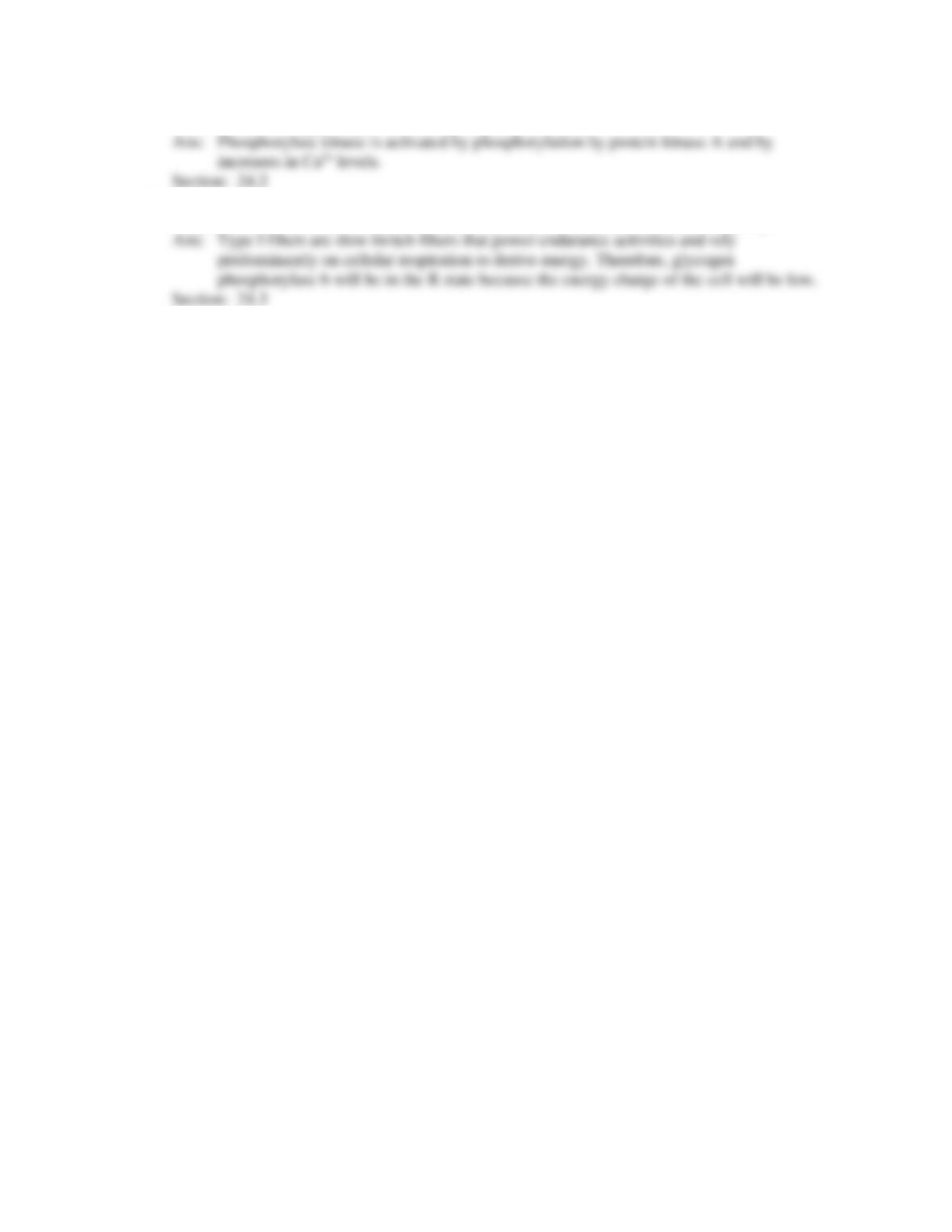
Draw a structure showing the most common linkage between glucose units found in glycogen.
45.
Why must glycogen control be manifested differently in muscle and liver?
Ans:
It is because the muscle maintains glucose for its own use, whereas the liver maintains
glucose homeostasis for the whole organism.
46.
How does epinephrine stimulate glycogen breakdown in muscle? (Describe the series of events.)
phosphorylase a. This can be seen in Figure 24.11.
47.
What path in addition to the cAMP-induced signal transduction is used in the liver to stimulate
glycogen breakdown by epinephrine?
released, which bind to calmodulin, and further stimulates phosphorylase kinase and
Section: 24.3
48.
Both phosphorylase a and b exist in equilibrium between R and T states. Which are the most
active and least active combinations?
Ans:
The most active is phorphorylase a in the R state and the least active is phosphorylase b
in the T state.
O
O
O
CH2OH CH2OH
O
O
OH OH
OH
OH
-1,4-glycosidic linkage
This is depicted in Figure 24.2.
Chapter 24 Glycogen Degradation
8
49.
What are the two regulatory controls for phosphorylase kinase?
50.
Your puppy has grown into a dog that needs lots of exercise so you take her out everyday for a
long, slow bike ride. Which type of muscle fiber are you using and what state is glycogen in?
Section: 24.3
increases in Ca2+ levels.