Microbiology with Diseases by Body System, 5e (Bauman)
Chapter 23 Microbial Diseases of the Digestive System
23.1 Multiple Choice Questions
1) The ________ is an accessory organ of the digestive system.
A) esophagus
B) stomach
C) tongue
D) duodenum
E) anus
2) Where in the digestive tract does most of the absorption of nutrients take place?
A) the large intestine
B) the small intestine
C) the rectum
D) the stomach
E) the esophagus
3) Which of the following is a fungus that commonly lives in the large intestine?
A) Bacteroides
B) Escherichia
C) Campylobacter
D) Candida
E) Lactobacillus
4) The bacterium ________ adheres to and grows on teeth, contributing to dental plaque
formation.
A) Streptococcus mutans
B) Streptococcus agalactiae
C) viridians streptococci
D) Porphyromonas gingivalis
E) Enterobacter
5) Porphyromonas gingivalis contributes to the development of
A) gastroenteritis.
B) typhoid fever.
C) periodontitis.
D) food poisoning.
E) hepatitis.
6) Most peptic ulcers are the result of colonization of the stomach by
A) Vibrio cholerae.
B) Escherichia coli O157:H7.
C) Shigella dysenteriae.
D) Salmonella enterica.
E) Helicobacter pylori.
7) Urease is an important virulence factor of which of the following?
A) Porphyromonas gingivalis
B) Vibrio cholerae
C) Escherichia coli O157:H7
D) Helicobacter pylori
E) Shigella dysenteriae
8) The virulence factor of Vibrio cholera, which is primarily responsible for the signs and
symptoms of cholera, is
A) the presence of polar flagella.
B) its ability to survive in freshwater.
C) its ability to form biofilms in saltwater.
D) its activation of certain genes within the human body.
E) its ability to produce a potent exotoxin.
9) The major symptoms of cholera are attributable to which of the following?
A) production of urease
B) activity of a type III secretion system
C) cessation of protein synthesis in host cells
D) death of cells lining the intestinal tract
E) activation of adenylate cyclase
10) Infection with some Salmonella enterica serotypes can progress to typhoid fever when the
bacteria
A) attach to cells of the small intestine.
B) induce endocytosis by intestinal cells.
C) reproduce within cells of the small intestine.
D) produce type III secretion system proteins.
E) enter the blood and are engulfed by phagocytes.
11) Which of the following produce the type III secretion system virulence factor?
A) E. coli O157:H7
B) Shigella
C) Salmonella
D) both E. coli O157:H7 and Salmonella
E) E. coli O157:H7, Shigella and Salmonella
12) Escherichia coli O157:H7 is primarily associated with which of the following foods?
A) ground beef
B) dairy products
C) eggs
D) fomites
E) pork
13) The most common cause of traveler’s diarrhea is
A) Salmonella enterica.
B) Giardia intestinalis.
C) Cryptosporidium parvum.
D) Escherichia coli.
E) Shigella flexneri.
14) Shigellosis can be differentiated from salmonellosis by the fact that Shigella
A) stimulates intestinal epithelial cells to phagocytize it.
B) multiplies in phagocytic vesicles.
C) kills host cells.
D) multiplies in the host cell’s cytosol.
E) causes severe diarrhea, abdominal cramps, and fever.
15) The most common bacterial cause of diarrhea that sends people to doctors in the United
States is
A) Salmonella.
B) Staphylococcus.
C) Vibrio.
D) Escherichia.
E) Campylobacter.
16) A young woman being treated for serious burns develops severe diarrhea accompanied by
intense abdominal pain. She passes several watery, foul-smelling, bloody stools a day. A
colonoscopy reveals patches of yellowish lesions in the large intestine. The probable causative
agent is
A) Giardia intestinalis.
B) Clostridium difficile.
C) Campylobacter.
D) Salmonella enterica serotype Typhi.
E) Vibrio cholerae.
17) Staphylococcal food poisoning is called an intoxication disorder because
A) toxic bacteria are ingested in the food.
B) the bacteria produce type III secretion system toxins.
C) affected people appear drunk.
D) toxins produced by the bacteria growing in the food are ingested along with the food.
E) the bacteria release toxins when they are digested.
18) Which of the following statements is TRUE with regard to oral herpes?
A) Lesions become more severe with each recurrence.
B) Ninety percent of all cases are caused by human herpesvirus 2 (HHV-2).
C) Lesions can be triggered by emotional stress or physiologic changes.
D) Primary infections are usually characterized by severe lesions.
E) There is an effective cure for oral herpes.
19) Which of the following is the major sign or symptom of mumps?
A) diarrhea
B) nausea and vomiting
C) deafness
D) parotitis
E) difficulty in breathing
20) The viruses responsible for the majority of infant deaths resulting from diarrhea in the world
are the
A) noroviruses.
B) rotaviruses.
C) caliciviruses.
D) astroviruses.
E) hepaciviruses.
21) Chronic infection with ________ may progress to hepatic cancer.
A) HAV
B) HBV
C) HCV
D) HEV
E) both HBV and HCV
22) The intracellular parasite usually acquired in contaminated drinking water that causes a
persistent watery diarrhea is
A) hepatitis A virus.
B) Cryptosporidium parvum.
C) Entamoeba histolytica.
D) Vibrio cholerae.
E) norovirus.
23) Which of the following conditions usually results in severe acute liver damage?
A) co-infection with hepatitis A and hepatitis B viruses
B) superinfection with hepatitis B and hepatitis delta viruses
C) co-infection with hepatitis B and hepatitis delta viruses
D) superinfection with hepatitis A and hepatitis E viruses
E) co-infection with hepatitis B and hepatitis C viruses
24) The primary treatment for viral gastroenteritis is
A) fever reducers.
B) antiviral medications.
C) antitoxins.
D) rehydration therapy.
E) antidiarrheal medication.
25) Of the following, who is most likely to develop a chronic infection with hepatitis B virus?
A) children between the ages of 2 and 12
B) newborns
C) females at puberty
D) young adults
E) the elderly
26) A man reports to his doctor that he is tired all the time and his urine has become darker in
color. He has not experienced fever or vomiting recently. The physician notes that his eyes are
yellowish and his abdomen is swollen and tender. The man has a history of kidney transplant.
The man may be infected with
A) hepatitis A virus.
B) hepatitis C virus.
C) norovirus.
D) Shigella.
E) Entamoeba histolytica.
27) Diagnosis of hepatitis B infection is made by the observation of which of the following in the
patient’s body fluids?
A) O antigens
B) enterotoxins
C) endospores
D) oocysts
E) Dane particles
28) Which of the following is a notable symptom of giardiasis?
A) “rice-water” stools
B) irritability and sleep disturbance
C) jaundice
D) foul-smelling “rotten egg” stools
E) dysentery
29) Eating sashimi (uncooked fish) is a risk factor for infection with
A) Entamoeba histolytica.
B) Taenia saginata.
C) Giardia intestinalis.
D) Enterobius vermicularis.
E) Anisakis simplex.
30) Which of the following statements is TRUE with regard to Entamoeba histolytica?
A) It reproduces by schizogony.
B) It may invade the peritoneal cavity, causing serious disease.
C) It causes a form of hepatitis.
D) It is an intracellular parasite.
E) An effective vaccine against infection is available.
31) Where in a tapeworm would you expect to find fertilized eggs?
A) the neck region of the strobila
B) at the end of the strobila
C) inside the scolex
D) outside the cuticle
E) in all proglottids
32) Intermediate hosts become infested with tapeworms through ingestion of
A) cysticerci.
B) gravid proglottids.
C) tapeworm eggs.
D) mature tapeworms.
E) tapeworm larvae.
33) Human infestation with Taenia saginata results from ingesting ________ in undercooked
intermediate host.
A) scolex
B) cysticerci
C) proglottids
D) eggs
E) cysts
34) Which of the following is a common childhood parasite in the United States?
A) Taenia solium
B) Enterobius vermicularis
C) Entamoeba histolytica
D) Cryptosporidium parvum
E) Giardia intestinalis
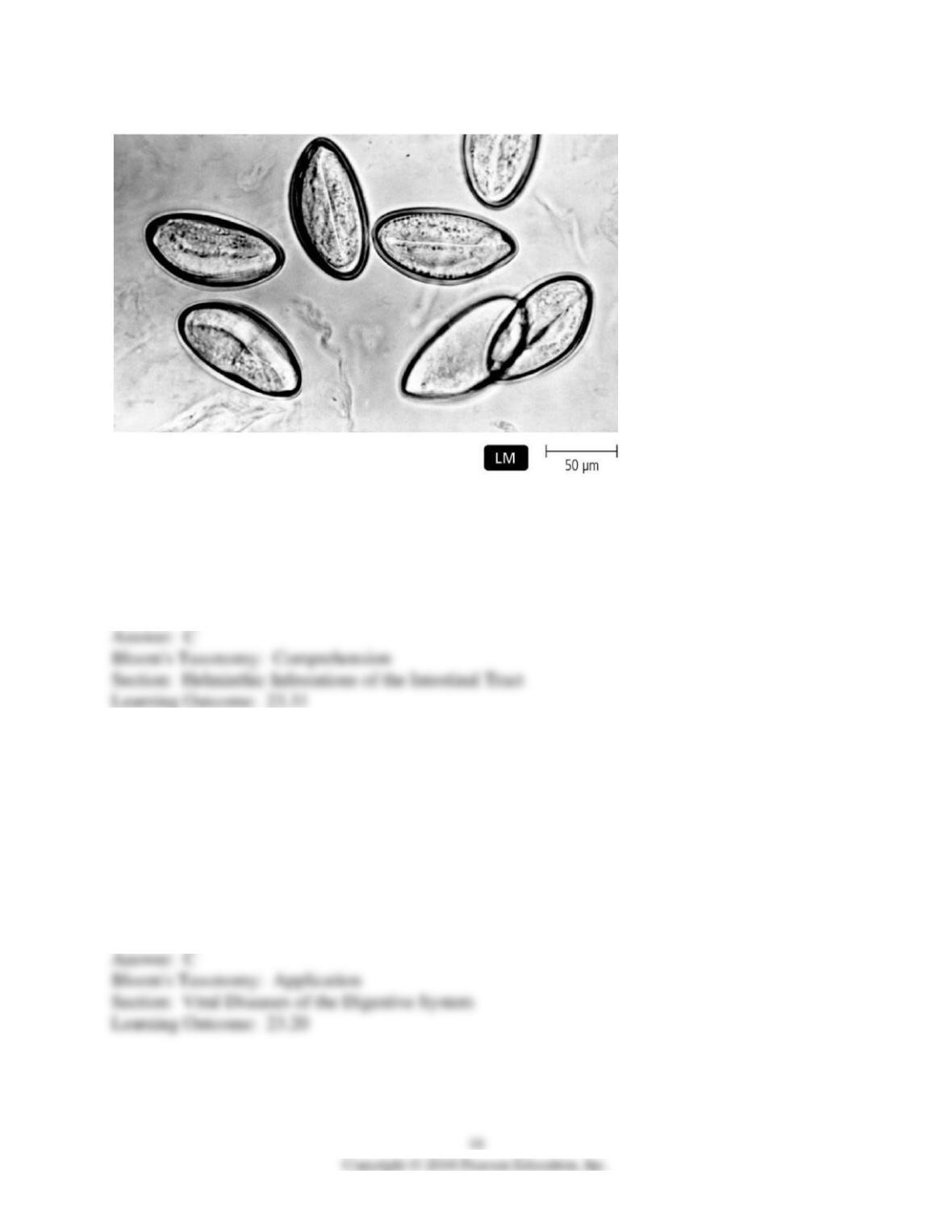
35)
Observation of the specimens in the figure is diagnostic for
A) anisakiasis.
B) amebiasis.
C) pinworms.
D) giardiasis.
E) tapeworms.
36) A large number of people in a community experience diarrhea with fever. Public health
authorities investigate and find that the people are passing dark urine, and some have yellowish
skin. Furthermore, all of the affected individuals recently ate at a new restaurant in town known
for its wide variety of fresh imported vegetables. Which of the following is the most likely
causative agent?
A) Escherichia coli O157:H7
B) Salmonella enterica
C) hepatitis A virus
D) hepatitis E virus
E) norovirus
37) Care in the handling and disposal of diapers in day care centers may prevent the spread of
which of the following?
A) hepatitis A virus
B) Giardia intestinalis
C) Salmonella enterica
D) Cryptosporidium parvum
E) norovirus
38) Peritonitis may develop in severe cases of
A) giardiasis.
B) hepatitis.
C) pinworm infestation.
D) typhoid.
E) peptic ulcer disease.
39) What member of the human intestinal microbiota occasionally causes life-threatening
disease?
A) Escherichia coli O157:H7
B) Clostridium difficile
C) Salmonella enterica
D) Giardia intestinalis
E) Lactobacillus
40) Accessory organ infections are caused by
A) human herpesvirus 1.
B) norovirus.
C) mumps virus.
D) rotavirus.
E) enterovirus.
23.2 True/False Questions
1) Salmonella is part of the normal microbiota of virtually all vertebrates except humans.
2) Cholera toxin is composed of five A subunits and one B subunit.
3) The small intestine is the site of the majority of nutrient digestion and absorption.
4) Complete recovery from hepatitis A infection occurs 99% of the time.
5) Vomiting is a common sign of viral gastroenteritis.
6) All regions of the digestive system have extensive microbiota.
7) Dysentery is a severe type of gastroenteritis in which stools contain mucus and blood.
8) Supportive care is the only treatment for staphylococcal food poisoning.
9) Marine mammals are the normal host for Anisakis simplex adults.
10) Invasive extraintestinal amebiasis is the most severe type of Entamoeba histolytica infection.
23.3 Short Answer Questions
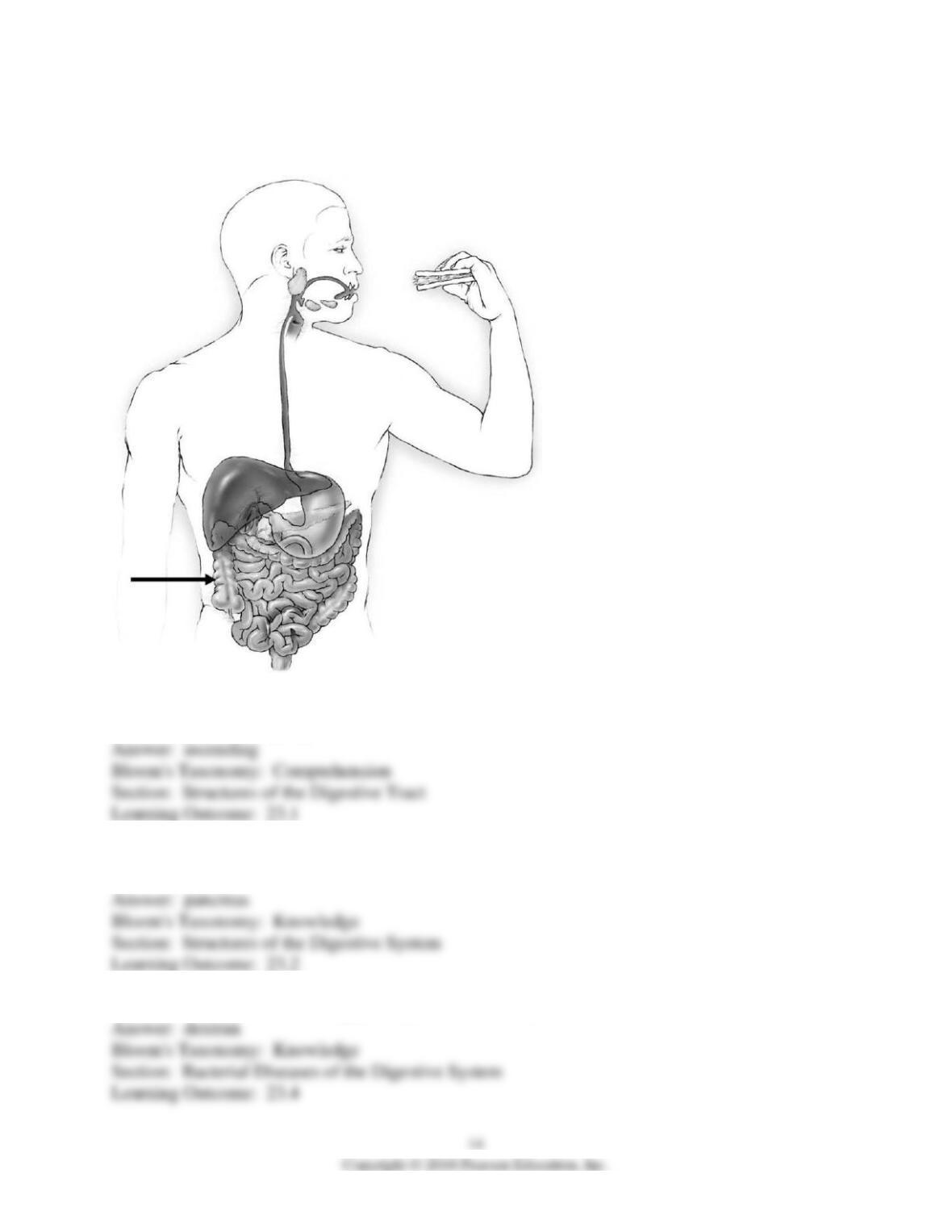
1)
The portion of the gastrointestinal tract indicated by the arrow is the
(ascending/descending/sigmoid/transverse) colon.
2) The (liver/pancreas/villus) is the accessory organ responsible for producing digestive enzymes
active in the small intestine.
3) Production of (acid/dextran/glycocalyces) allows Streptococcus mutans to colonize the mouth.
4) Plaque and tartar provide an environment for the growth of
(Lactobacillus/Porphyromonas/Streptococcus) leading to periodontitis.
5) A diarrhea called “rice-water” stools is diagnostic of
(campylobacteriosis/cholera/shigellosis/typhoid).
6) Jaundice is a frequent sign of inflammation of the (colon/liver/pancreas).
7) Isolation of Gram-positive (bacilli/cocci/vibrios) from food suspected of being the source of
an outbreak of diarrhea indicates the disease is the result of bacterial intoxication.
8) The form of infection with Entamoeba histolytica that is frequently asymptomatic is known as
(extraintestinal/dysentery/luminal) amebiasis.
9) Staphylococcus aureus produces (endotoxin/enterotoxin/toxin B) to cause intoxication.
10) The larval stage of pinworms is found in (cows/fish/humans).
11) The accumulation of plaque can lead to the development of (abscesses/caries/ulcers) in the
mouth.
12) Helicobacter pylori colonizes the (mouth/liver/stomach/intestine) and can cause severe
inflammation and tissue erosion.
13) Escherichia coli O157:H7 produces (cholera/Shiga/Staphylococcal)-like toxin, which
inhibits protein synthesis, kills cells, and can result in death of the infected individual.
14) A painful creeping ulcerating lesion on or near the lips is the result of infection with
(corona/herpes/mumps) virus.
15) Infection with (hepatitis/norovirus/rotavirus) is a common cause of viral gastroenteritis in
adults.
23.4 Essay Questions
1) There are vaccines to prevent infectious hepatitis and serum hepatitis, but none to prevent
chronic hepatitis. Discuss why this is so.
2) Explain how Helicobacter pylori is able to resist the unfavorable environment of the stomach
in order to cause disease.
3) List and describe three virulence factors associated with bacteria that cause gastroenteritis.
4) List and compare the three types of amebiasis.
5) Explain the role of the intestinal microbiota in the maintenance of health.