39) Cigarette smoking ________.
A) is responsible for about one in five deaths of Americans every year
B) accounts for 80—90% of all cases of lung cancer
C) can affect the health of nonsmokers through secondhand smoke
D) all of the above
40) Why do cigarette smokers cough more than most people do?
A) The tar in cigarette smoke tends to make alveoli stick closed. Coughing opens them.
B) Coughing is the respiratory system’s attempt to clear itself of the thick mucus that is produced
in response to smoke exposure.
C) Cigarette smoking partially paralyzes the lungs; coughing exchanges the resultant “dead air.”
D) Coughing stimulates blood flow to the lungs.
41) Which of the following best describes the pathway an oxygen molecule would take through
the human circulatory system?
A) systemic tissues → alveoli → pulmonary vein → pulmonary capillaries → systemic
capillaries → left ventricle → left atrium → aorta → systemic arteries
B) alveoli → pulmonary capillaries → pulmonary vein → left atrium → left ventricle → aorta →
systemic arteries → systemic capillaries → systemic tissues
C) alveoli → pulmonary capillaries → pulmonary artery → right atrium → right ventricle →
pulmonary vein → systemic arteries → systemic capillaries → systemic tissues
D) alveoli → pulmonary vein → pulmonary capillaries → systemic capillaries → left atrium →
left ventricle → aorta → systemic arteries → systemic tissues
42) The cardiovascular system of a mouse works like that of a human. A mouse is moved from
sea level (low altitude) to the top of a mountain (high altitude). How could this mouse’s
cardiovascular system maintain a similar rate of oxygen delivery to its tissues now that the
mouse is at the top of the mountain?
A) Decrease breathing rate.
B) Decrease heart rate.
C) Increase the depth of ventilation.
D) Increase lung pressure.
43) The Antarctic icefishes are the only known vertebrates to lack hemoglobin. Which of the
following would be LEAST likely to alter gas transport from the environment to an icefish’s
cells?
A) higher oceanic temperatures from global warming
B) higher concentrations of carbon monoxide in the water from pollution
C) higher concentrations of carbon dioxide in the water from pollution
D) an injury that reduces the surface area of gills
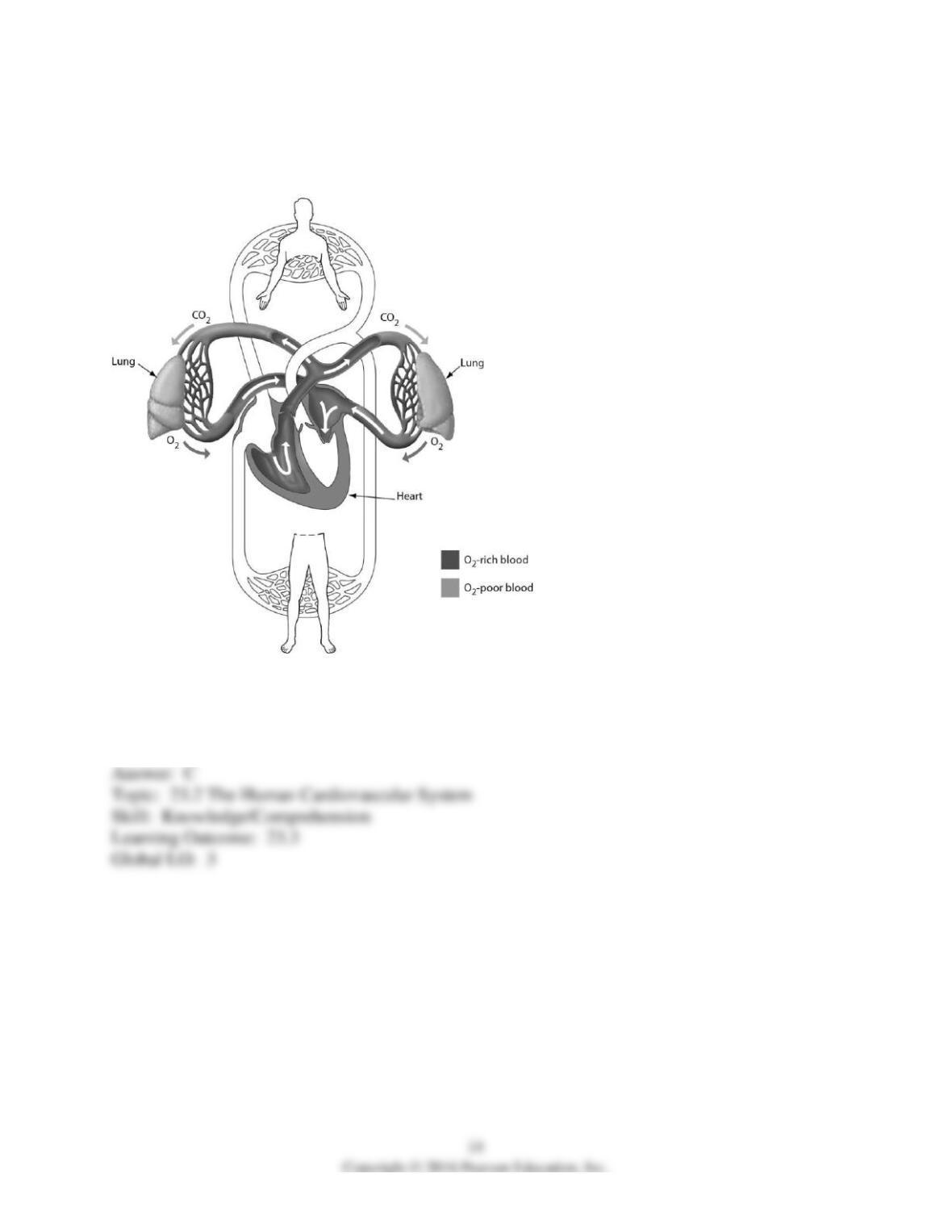
23.2 Art Questions
1) The following figure illustrates ________.
A) diastolic blood pressure
B) systolic blood pressure
C) the pulmonary circuit
D) the systemic circuit
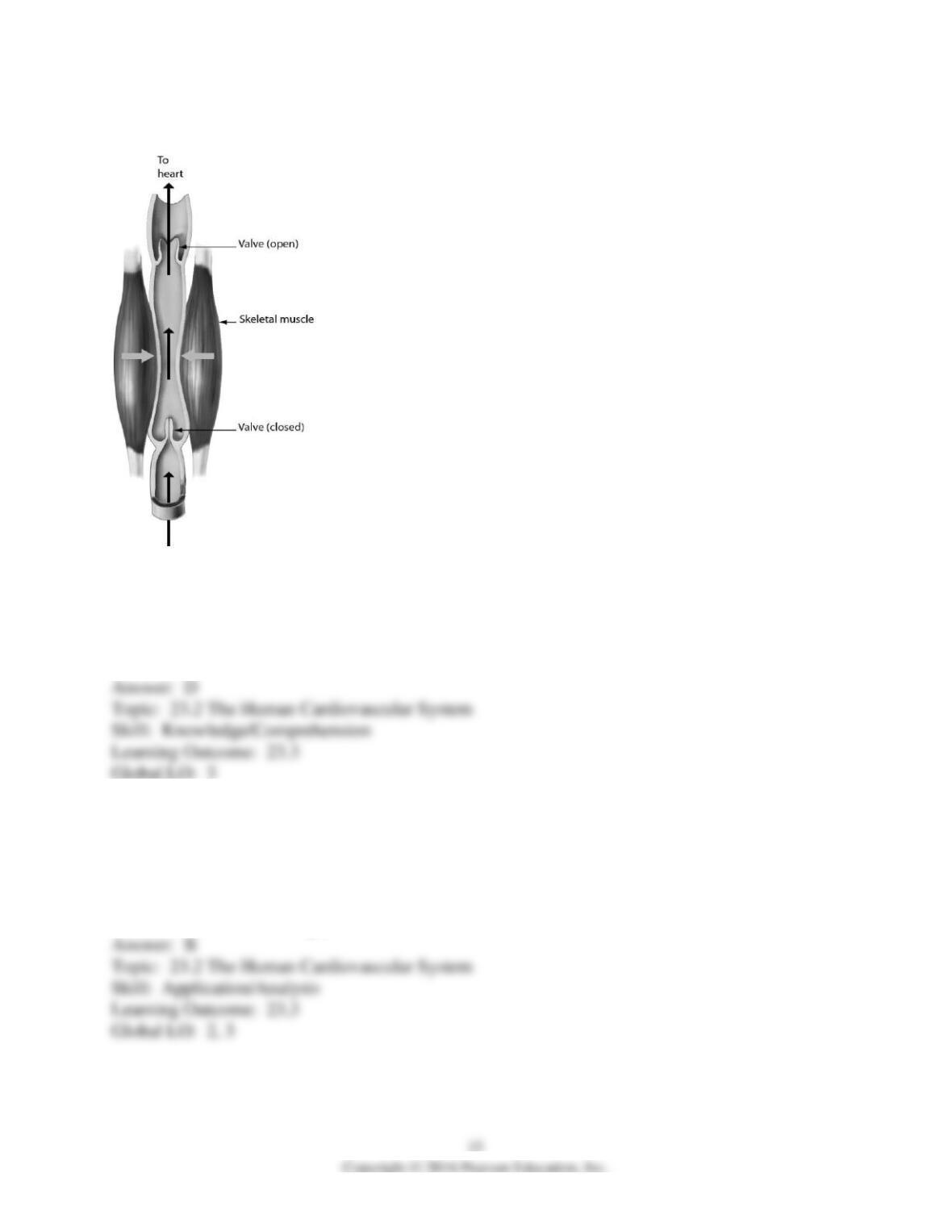
Please refer to the following art to answer the following questions.
2) The one-way flow of blood in veins is maintained by ________.
A) blood pressure
B) muscles pressing against the veins
C) their thick walls
D) valves
3) In varicose veins, the one-way flow of blood in veins is disrupted, which can cause swelling
and blood clots. What might help return the blood flow in these veins to normal?
A) Reduce physical activity.
B) Raise legs above the level of the heart when resting.
C) Remove valves from varicose veins.
D) Stand or sit still for long periods of time.
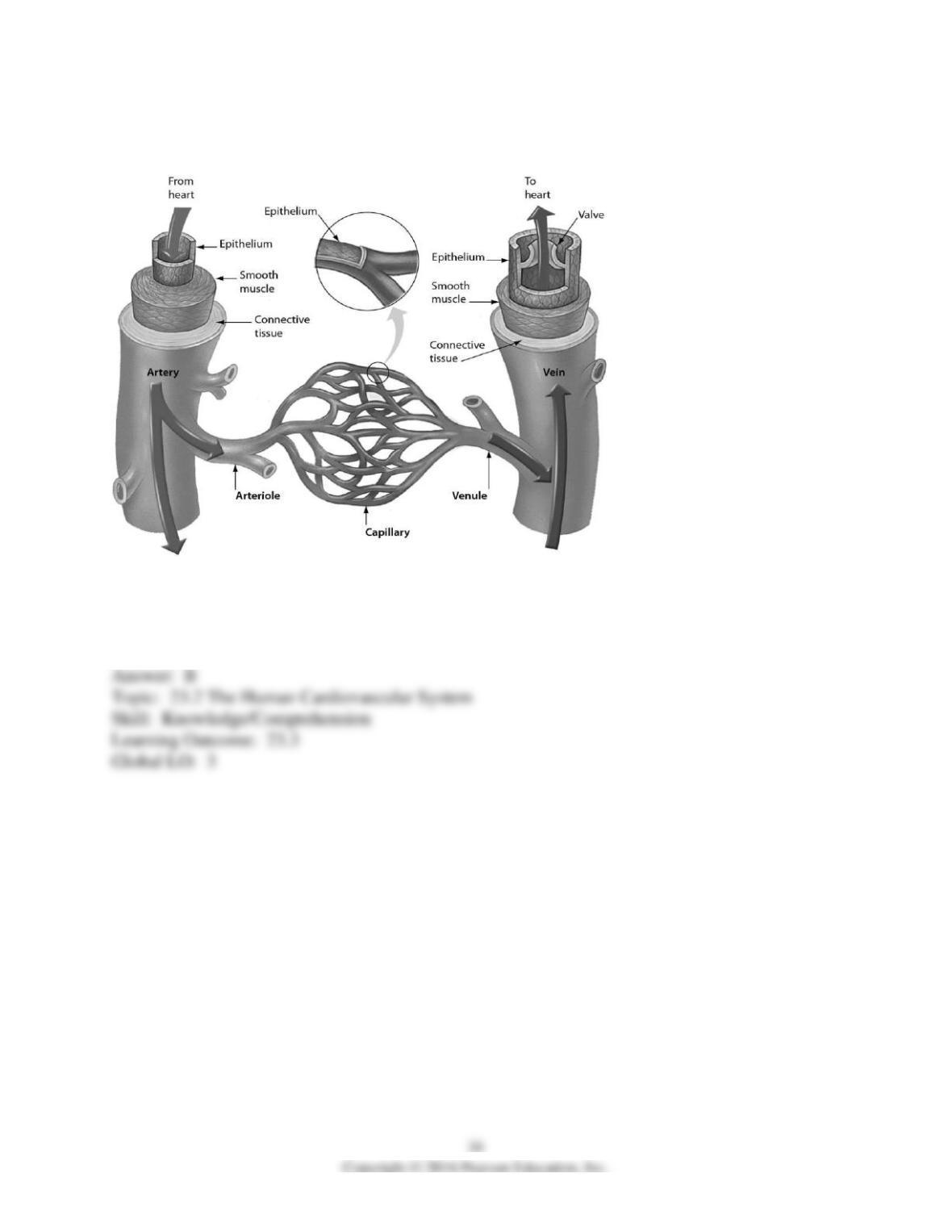
4) Examine the structure of blood vessels in the following figure. Which one of the following has
the structure best suited to chemical exchange between the blood and tissues?
A) venule
B) capillary
C) arteriole
D) artery
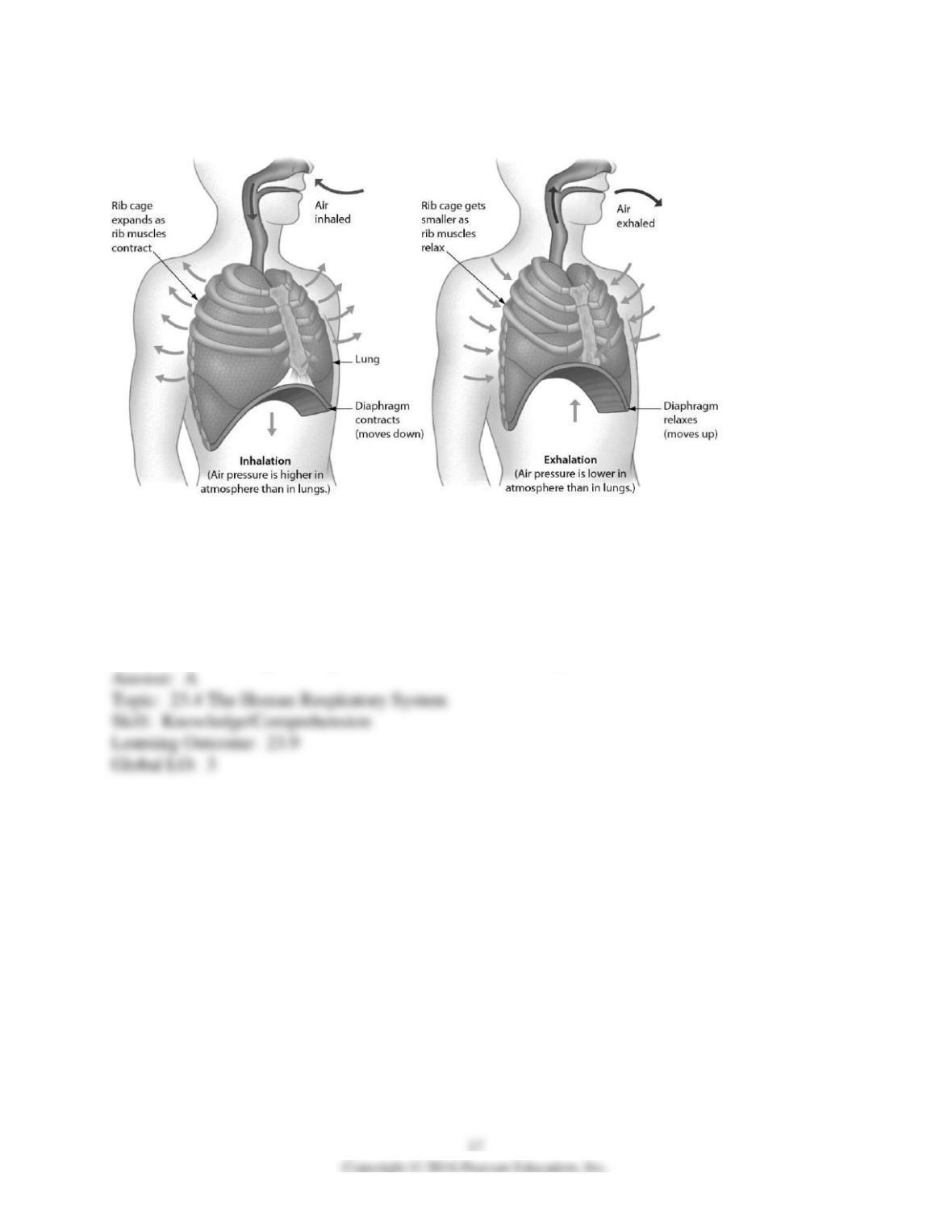
5) Examine the figure shown. During negative pressure breathing, ________.
A) the diaphragm moves downward and the rib muscles contract, increasing the size of the chest
cavity and decreasing the air pressure within the chest cavity
B) the nasal cavities expand and the diaphragm relaxes
C) the diaphragm and rib muscles contract, decreasing the size of the chest cavity and increasing
the pressure within the chest cavity
D) the diaphragm moves downward and the rib muscles relax, increasing the size of the chest
cavity and decreasing the air pressure within the chest cavity
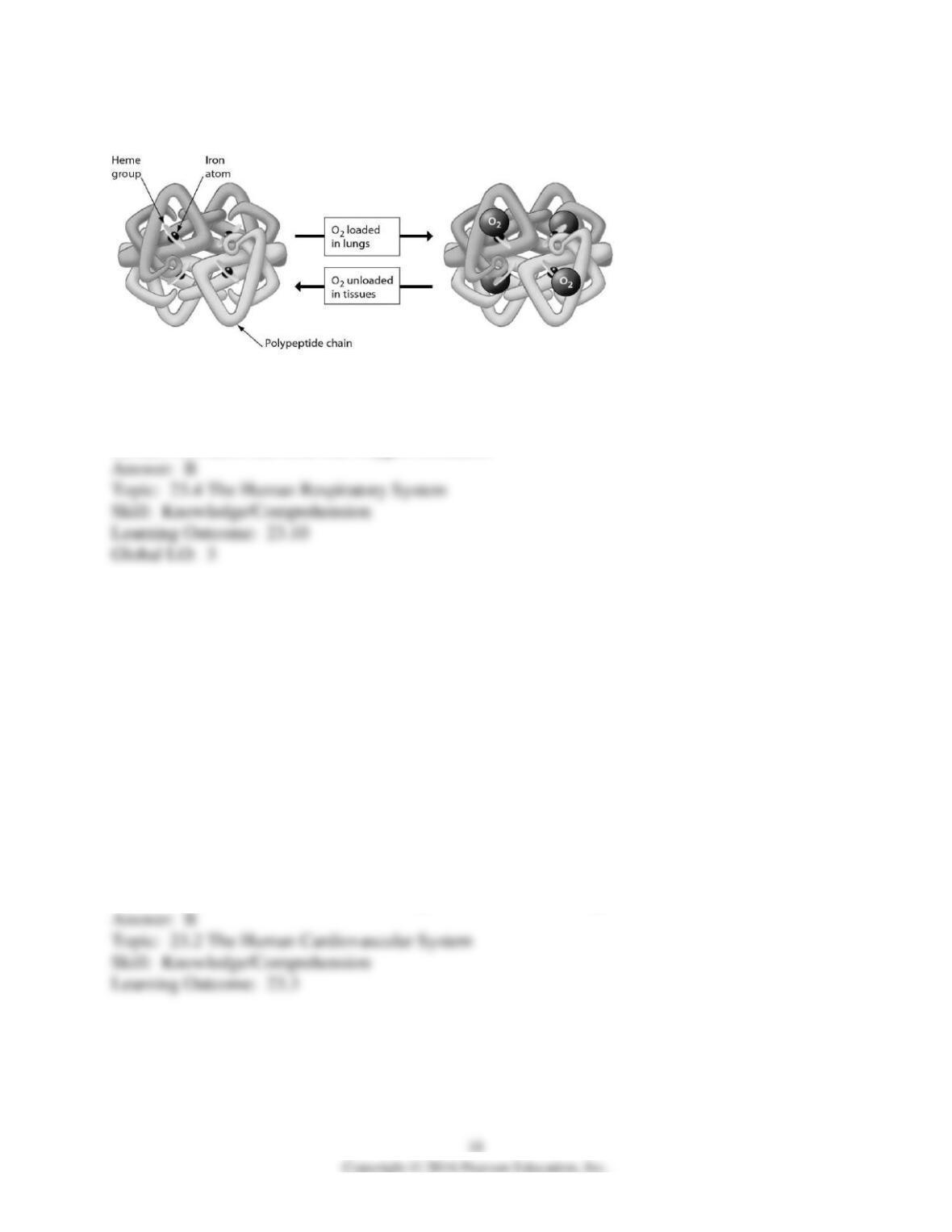
6) The figure below shows that ________.
A) hemoglobin can bind to either oxygen or carbon dioxide
B) a hemoglobin molecule can bind up to four molecules of oxygen
C) a red blood cell contains four hemoglobin molecules
D) each iron atom can bind four oxygen molecules
23.3 Scenario Questions
Read the following scenario to answer the following questions.
Blood flowing away from the heart is under tremendous pressure, able to travel to just about any
portion of the body. However, blood pressure drops considerably as it moves away from the
heart. When blood finally reaches capillaries, the blood pressure drops to nearly zero. Therefore,
when a person is standing, blood returning from the feet is not moved back towards the heart by
contractions of the heart.
1) Blood is propelled back to the heart by ________.
A) rhythmic contractions of muscles in the walls of veins and the action of one-way valves
B) skeletal muscle contractions around veins and the action of one-way valves
C) the negative pressure of the heart pulling blood into the empty chambers
D) the natural flow of blood into ever-larger blood vessels leading to the heart
2) A scientist claimed that students might get better scores on written exams if they wiggle their
legs frequently while taking an exam. This could work (but it is not better than studying) because
wiggling legs might ________.
A) propel more blood from the legs back to the heart, increasing oxygen flow to the brain
B) add more oxygen to the blood that is returning to the heart
C) shake out more of the carbon dioxide that lingers in the blood returning to the heart
D) break up blood clots in the legs, which slow the movement of blood back to the heart
3) Because of the changes in blood pressure through the circulatory system, the best way to feel a
pulse is by pressing a finger against ________.
A) a vein
B) a capillary
C) an artery
D) either an artery or a vein
Read the following scenario to answer the following questions.
In sickle cell disease (SCD), a mutation in hemoglobin causes deoxygenated hemoglobin to stick
together in long chains, which in turn distorts red blood cells into an elongated, sickle (crescent)
shape.
4) In a person with SCD, where would red blood cells with a sickle shape be LEAST likely to be
found?
A) pulmonary arteries
B) pulmonary veins
C) right atrium
D) right ventricle
5) Red blood cells with a sickle shape can block circulation in small blood vessels. Which blood
vessels are most likely to become blocked by sickle cells?
A) veins
B) arteries
C) arterioles
D) capillaries
Read the following scenario to answer the following questions.
Yawning is a reflexive action that is often associated with sleepiness. When a person yawns, the
mouth opens, and a longer than normal breath of air is inhaled, followed by a longer than normal
exhalation. Hypothesizing that yawning has a regulatory mechanism similar to breathing,
scientists conducted an experiment on college students to test the effect of ambient carbon
dioxide levels on yawning.
6) The structure where the respiratory and digestive systems meet expands during a yawn. What
is the name of this structure?
A) bronchus
B) larynx
C) pharynx
D) trachea
7) When a person exhales to complete a yawn, what happens?
A) The rib muscles contract.
B) The diaphragm contracts.
C) The rib muscles act in the same way that they do in an inhalation.
D) The diaphragm relaxes.
8) If yawning has a regulatory mechanism similar to breathing, then which of the following is
TRUE?
A) Athletes should yawn more when exercising compared to when they are not exercising.
B) Tibetan mountaineers yawn more when they are walking compared to when they are standing
still.
C) People adapted to lower altitudes should yawn the same amount when they are at high
altitudes.
D) Athletes who have trained at high altitudes should inhale a greater volume of air when
yawning compared to those who have trained only at low altitudes.
9) The scientists investigated carbon dioxide levels in their experiment because high carbon
dioxide levels in the ________ signal control centers in the brain to increase rate and depth of
inhalations and exhalations.
A) alveoli
B) blood
C) heart muscle
D) pharynx
10) To graph their results, the scientists would plot the ________.
A) number of yawns on the x-axis
B) dependent variable on the x-axis
C) level of carbon dioxide on the x-axis
D) age of college students on the x-axis
11) Which of the following would be considered support for the hypothesis tested by the
scientists?
A) College students produce more carbon dioxide when they yawn more frequently.
B) College students yawn with the same frequency regardless of carbon dioxide levels.
C) College students yawn more when they are in lecture, compared to when they are in lab.
D) College students yawn more when they are exposed to higher levels of carbon dioxide.
12) The scientists found that the level of carbon dioxide in the air did not cause college students
to yawn more frequently. What other experiment could they conduct to confirm that they should
reject the hypothesis that yawning is regulated in the same way as breathing?
A) Test the effect of hemoglobin amounts on the frequency of yawning.
B) Test the effect of exercise levels on the frequency of yawning.
C) Test the effect of carbon monoxide (CO) levels on the frequency of yawning.
D) Test the effect of diet on the frequency of yawning.