Use the following information to answer the question(s) below.
In 1983 a population of dark-eyed junco birds became established on the campus of the
University of California, San Diego (UCSD), which is located many miles from the junco’s
normal habitat in the mixed-coniferous temperate forests in the mountains. Juncos have white
outer tail feathers that the males display during aggressive interactions and during courtship
displays. Males with more white in their tail are more likely to win aggressive interactions, and
females prefer to mate with males with more white in their tails. Females have less white in their
tails than do males, and display it less often. (Pamela J. Yeh. 2004. Rapid evolution of a sexually
selected trait following population establishment in a novel habitat. Evolution 58[1]:166-74.)
34) Refer to the paragraph on dark-eyed junco birds. The UCSD campus male junco population
tails were, on average, 36% white, whereas the tails of males from nearby mountain populations
averaged 40-45% white. If this observed trait difference were due to a difference in the original
colonizing population, it would most likely be due to _____.
A) mutations in the UCSD population
B) gene flow between populations
C) a genetic bottleneck
D) a founder effect
35) Refer to the paragraph on dark-eyed junco birds. The UCSD campus male junco population
tails are about 36% white, whereas the tails of males from nearby mountain populations are
about 40-45% white. The founding stock of UCSD birds was likely from the nearby mountain
populations because some of those birds overwinter on the UCSD campus each year. Population
sizes on the UCSD campus have been reasonably large, and there are significant habitat
differences between the UCSD campus and the mountain coniferous forests; UCSD campus has
a more open environment (making birds more visible) and a lower junco density (decreasing
intraspecific competition) than that in the mountain forests. Given this information, which of the
following evolutionary mechanisms do you think is most likely responsible for the difference
between the UCSD and mountain populations?
A) natural selection
B) genetic drift
C) gene flow
D) mutation
36) The Dunkers are a religious group that moved from Germany to Pennsylvania in the mid-
1700s. They do not marry with members outside their own immediate community. Today, the
Dunkers are genetically unique and differ in gene frequencies, at many loci, from all other
populations including those in their original homeland. Which of the following likely explains
the genetic uniqueness of this population?
A) population bottleneck and Hardy-Weinberg equilibrium
B) heterozygote advantage and stabilizing selection
C) mutation and natural selection
D) founder effect and genetic drift
37) An earthquake decimates a ground-squirrel population, killing 98% of the squirrels. The
surviving population happens to have broader stripes, on average, than the initial population. If
broadness of stripes is genetically determined, what effect has the ground-squirrel population
experienced during the earthquake?
A) directional selection
B) disruptive selection
C) a founder event
D) a genetic bottleneck
38) Which of the following is the most predictable outcome of increased gene flow between two
populations?
A) lower average fitness in both populations
B) higher average fitness in both populations
C) increased genetic difference between the two populations
D) decreased genetic difference between the two populations

39) In 1986, a nuclear power accident in Chernobyl, USSR (now Ukraine), led to high radiation
levels for miles surrounding the plant. The high levels of radiation caused elevated mutation
rates in the surviving organisms, and evolutionary biologists have been studying rodent
populations in the Chernobyl area ever since. Based on your understanding of evolutionary
mechanisms, which of the following most likely occurred in the rodent populations following the
accident?
A) Mutations caused major changes in rodent physiology over time.
B) Mutation led to increased genetic variation.
C) Mutation caused genetic drift and decreased fitness.
D) Mutation caused the fixation of new alleles.
40) Over time, the movement of people on Earth has steadily increased. This has altered the
course of human evolution by increasing _____.
A) nonrandom mating
B) geographic isolation
C) genetic drift
D) gene flow
41) You are maintaining a small population of fruit flies in the laboratory by transferring the flies
to a new culture bottle after each generation. After several generations, you notice that the
viability of the flies has decreased greatly. Recognizing that small population size is likely to be
linked to decreased viability, the best way to reverse this trend is to _____.
A) cross your flies with flies from another lab
B) reduce the number of flies that you transfer at each generation
C) transfer only the largest flies
D) change the temperature at which you rear the flies
42) The inability of organisms to evolve anything that could be an advantage reflects _____.
A) the limits of historical constraints
B) the inability to compromise
C) the consequences of random mutations
D) the consequences of inbreeding

43) Which of the following is a fitness trade-off (compromise)?
A) In some hornbill species, the male helps seal the female in a tree with her nest until the young
are ready to fledge.
B) Hummingbirds are the best pollinators of certain flowers, but bees are the best pollinators for
orchids.
C) The strong, thick beak of a woodpecker helps it find insects in trees.
D) Turtle shells provide protection but are heavy and burdensome when moving.
Use the following description to answer the question(s) below.
On the Bahamian island of Andros, mosquitofish populations live in various, now-isolated,
freshwater ponds that were once united. Currently, some predator-rich ponds have mosquitofish
that can swim in short, fast bursts; other predator-poor ponds have mosquitofish that can swim
continuously for a long time. When placed together in the same body of water, the two kinds of
female mosquitofish exhibit exclusive breeding preferences.
44) If one builds a canal linking a predator-rich pond to a predator-poor pond, then what type(s)
of selection should subsequently be most expected among the mosquitofish in the original
predator-rich pond, and what type(s) should be most expected among the mosquitofish in the
formerly predator-poor pond?
A) stabilizing selection; directional selection
B) stabilizing selection; stabilizing selection
C) less-intense directional selection; more-intense directional selection
D) less-intense disruptive selection; more-intense disruptive selection
Use the following information to answer the question(s) below.
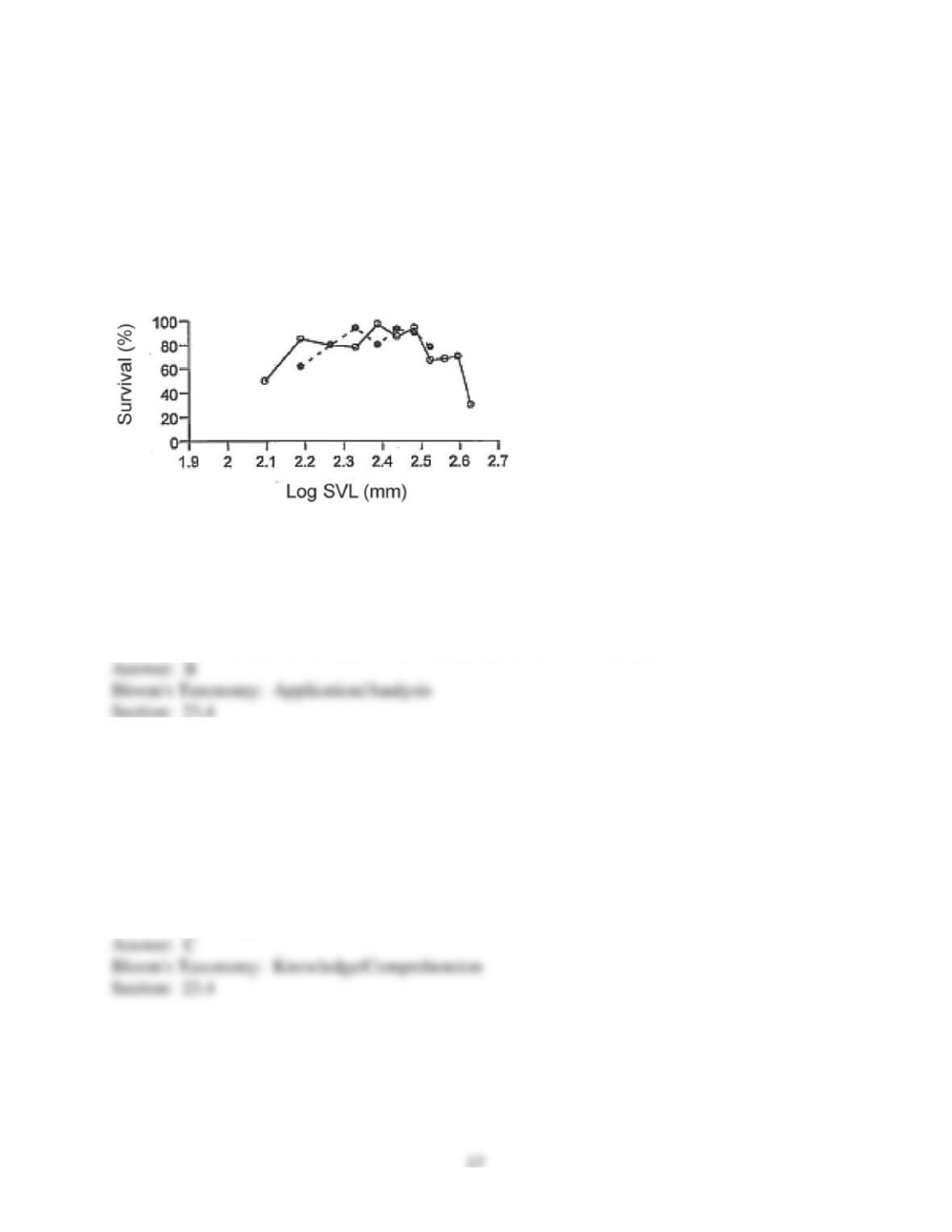
Martin Wikelski and L. Michael Romero (Body size, performance and fitness in Galápagos
marine iguanas, Integrative and Comparative Biology 43 [2003]:376-86) measured the snout-to–
vent (anus) length of Galápagos marine iguanas and observed the percent survival of different-
sized animals, all of the same age. The graph shows the log snout-vent length (SVL, a measure
of overall body size) plotted against the percent survival of these different size classes for males
and females.
45) Examine the figure above. What type of selection for body size appears to be occurring in
these marine iguanas?
A) directional selection
B) stabilizing selection
C) disruptive selection
D) You cannot determine the type of selection from the above information.
46) Currently the only predators of Galápagos marine iguanas are Galápagos hawks. Iguana body
size is not correlated with risk of hawk predation, although small iguanas can sprint faster than
large iguanas. If predators (for example, cats) that preferably catch and eat slower iguanas are
introduced to the island, iguana body size is likely to _____ in the absence of other factors; the
iguanas would then be under _____ selection.
A) increase; directional
B) increase; disruptive
C) decrease; directional
D) decrease; disruptive
47) Three-spined stickleback fish (Gasterosteus aculeatus) show substantial heritable variation
in gill-raker length related to differences in their diets. Longer gill rakers appear to function
better for capturing open-water prey, while shorter gill rakers function better for capturing
shallow-water prey. Which of the following types of selection is most likely to be found in a
large lake (open water in the middle and shallow water around the sides) with a high density of
these fish?
A) directional selection
B) stabilizing selection
C) disruptive selection
D) sexual selection
48) A biologist doing a long-term study on a wild spider population observes increased variation
in silk thickness. Which of the following could the spider population be experiencing?
A) directional selection
B) stabilizing selection
C) disruptive selection
D) genetic drift
49) In some jacana species, males take care of the eggs and young, and females compete among
themselves for territories that contain one to several males. Female jacanas are significantly
larger than males. Which of these statements would you predict to be true of this bird species?
1. Male jacana fitness is primarily limited by ability to take care of eggs and raise young.
2. Female jacana fitness is limited by the number of males in her territory with which a female
mates.
3. Variation in reproductive success should be greater in male jacanas than in females.
4. Variation in reproductive success should be greater in female jacanas than in males.
5. Males and females have equal variation in reproductive success.
A) 1 and 3
B) 2 and 4
C) 1, 2, and 4
D) 5
50) The restriction enzymes of bacteria protect the bacteria from successful attack by
bacteriophages, whose genomes can be degraded by the restriction enzymes. The bacterial
genomes are not vulnerable to these restriction enzymes because bacterial DNA is methylated.
This situation selects for bacteriophages whose genomes are also methylated. As new strains of
resistant bacteriophages become more prevalent, this in turn selects for bacteria whose genomes
are not methylated and whose restriction enzymes instead degrade methylated DNA. The
outcome of the conflict between bacteria and bacteriophage at any point in time results from
_____.
A) frequency-dependent selection
B) evolutionary imbalance
C) heterozygote advantage
D) neutral variation
51) The restriction enzymes of bacteria protect the bacteria from successful attack by
bacteriophages, whose genomes can be degraded by the restriction enzymes. The bacterial
genomes are not vulnerable to these restriction enzymes because bacterial DNA is methylated.
This situation selects for bacteriophages whose genomes are also methylated. As new strains of
resistant bacteriophages become more prevalent, this in turn selects for bacteria whose genomes
are not methylated and whose restriction enzymes instead degrade methylated DNA. Over the
course of evolutionary time, what should occur?
A) Methylated DNA should become fixed in the gene pools of bacterial species.
B) Nonmethylated DNA should become fixed in the gene pools of bacteriophages.
C) Methylated DNA should become fixed in the gene pools of bacteriophages.
D) Methylated and nonmethylated strains should be maintained among both bacteria and
bacteriophages, with ratios that vary over time.
52) Arrange the following in order from most general to most specific.
1 natural selection
2. microevolution
3. intrasexual selection
4. evolution
5. sexual selection
A) 4, 1, 2, 3, 5
B) 4, 2, 1, 3, 5
C) 4, 2, 1, 5, 3
D) 1, 4, 2, 5, 3

53) Adult male humans generally have deeper voices than do adult female humans, which is the
direct result of higher levels of testosterone causing growth of the larynx. If the fossil records of
apes and humans alike show a trend toward decreasing larynx size in adult females and
increasing larynx size in adult males, then _____.
A) sexual dimorphism was evolving over time in these species
B) intrasexual selection seems to have occurred in both species
C) stabilizing selection was occurring in these species concerning larynx size
D) selection was acting more directly upon genotype than upon phenotype
54) Most Swiss starlings produce four to five eggs in each clutch. Starlings producing fewer or
more than this have reduced fitness. Which of the following terms best describes this situation?
A) directional selection
B) stabilizing selection
C) disruptive selection
D) sexual selection
55) When imbalances occur in the sex ratio of sexual species that have two sexes (that is, other
than a 50:50 ratio), the members of the minority sex often receive a greater proportion of care
and resources from parents than do the offspring of the majority sex. This is most clearly an
example of _____.
A) sexual selection
B) balancing selection
C) stabilizing selection
D) frequency-dependent selection
56) A proficient engineer can easily design skeletal structures that are more functional than those
currently found in the forelimbs of such diverse mammals as horses, whales, and bats. The actual
forelimbs of these mammals do not seem to be optimally arranged because _____.
A) natural selection has not had sufficient time to create the optimal design in each case, but will
do so given enough time
B) in many cases, phenotype is determined by genotype and the environment
C) though we may not consider the fit between the current skeletal arrangements and their
functions excellent, we should not doubt that natural selection ultimately produces the best
design
D) natural selection is generally limited to modifying structures that were present in previous
generations and in previous species
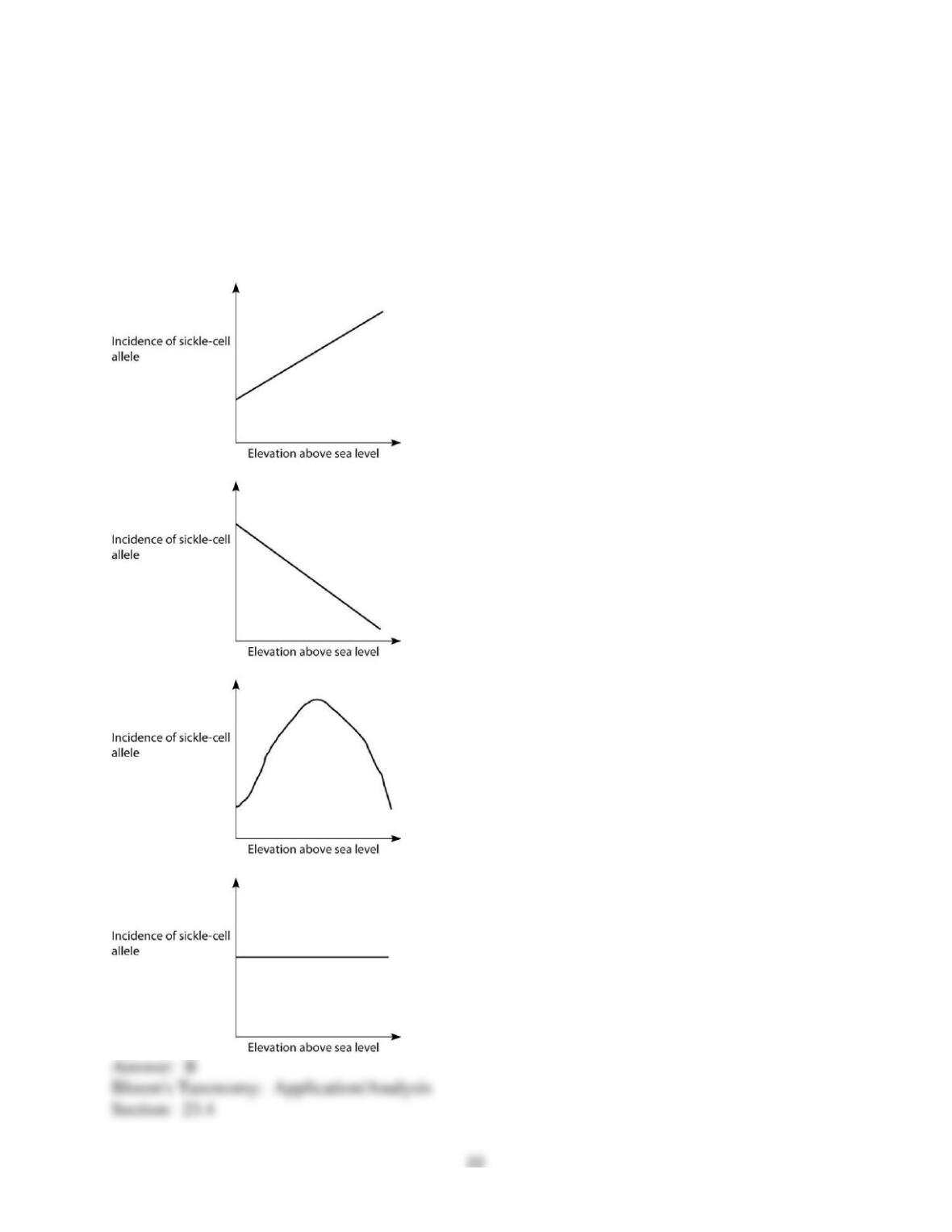
57) Anopheles mosquitoes, which carry the malaria parasite, cannot live above elevations of
5900 feet. In addition, oxygen availability decreases with higher altitude. Consider a hypothetical
human population that is adapted to life on the slopes of Mt. Kilimanjaro in Tanzania, a country
in equatorial Africa. Mt. Kilimanjaro’s base is about 2600 feet above sea level and its peak is
19,341 feet above sea level. If the incidence of the sickle-cell allele in the population is plotted
against altitude (feet above sea level), which of the following distributions is most likely,
assuming little migration of people up or down the mountain?
A)
B)
C)
D)
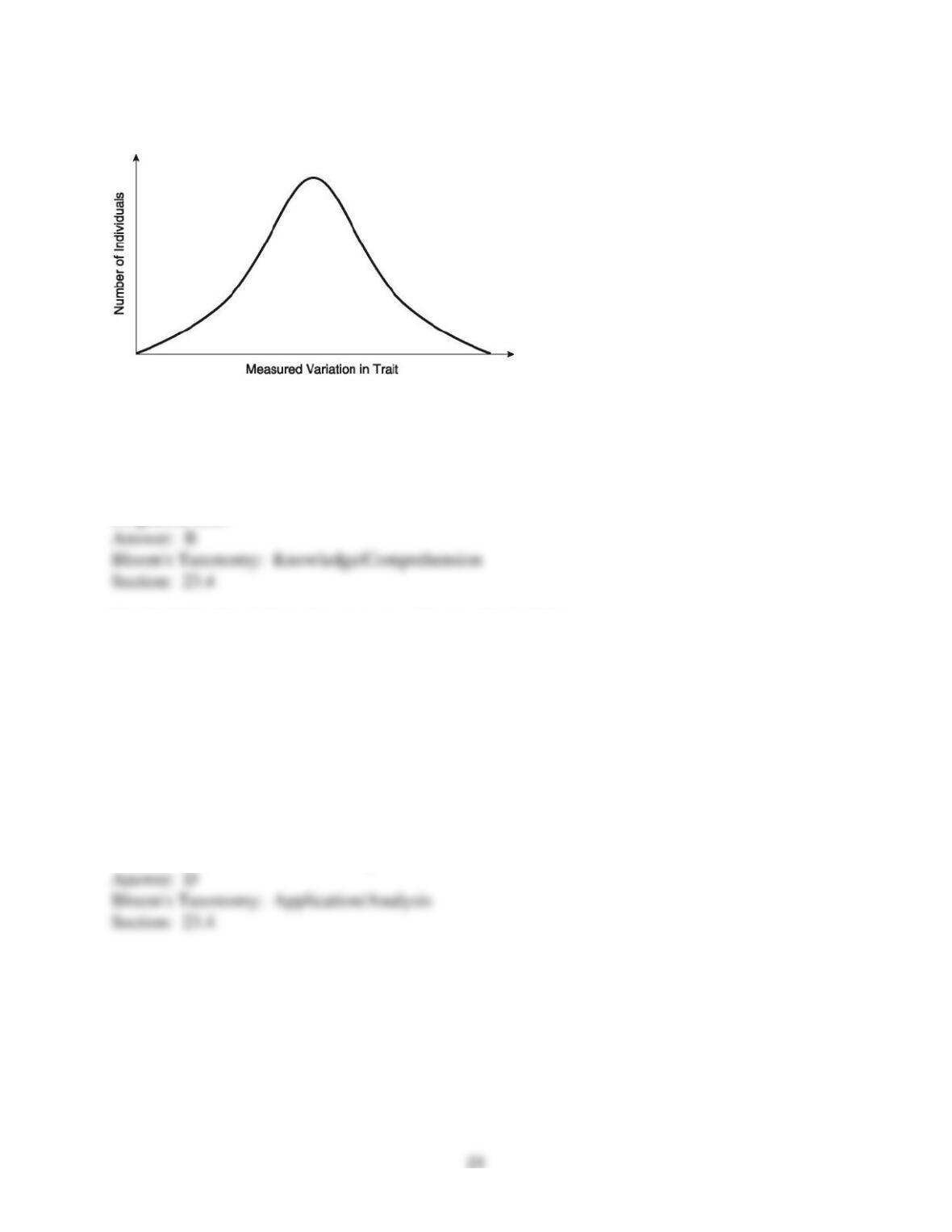
In a very large population, a quantitative trait has the following distribution pattern.
58) If there is no gene flow, the curve shifts to the left or to the right, and the population size
consequently increases over successive generations, which of the following is most likely
occurring?
A) immigration or emigration
B) directional selection
C) disruptive selection
D) genetic drift
Use the following information to answer the question(s) below.
In those parts of equatorial Africa where the malaria parasite is most common, the sickle-cell
allele constitutes 20% of the β hemoglobin alleles in the human gene pool.
59) In the United States, the parasite that causes malaria is not present, but African-Americans
whose ancestors were from equatorial Africa are present. What should be happening to the
sickle-cell allele in the United States, and what should be happening to it in equatorial Africa?
A) stabilizing selection; disruptive selection
B) disruptive selection; stabilizing selection
C) directional selection; disruptive selection
D) directional selection; stabilizing selection
60) Swine are vulnerable to infection by bird flu virus and human flu virus, which can both be
present in an individual pig at the same time. When this occurs, it is possible for genes from bird
flu virus and human flu virus to be combined. If the human flu virus contributes a gene for
Tamiflu resistance (Tamiflu is an antiviral drug) to the new virus, and if the new virus is
introduced to an environment lacking Tamiflu, then what is most likely to occur?
A) The new virus will maintain its Tamiflu-resistance gene, in case of future exposure to
Tamiflu.
B) The Tamiflu-resistance gene will undergo mutations that convert it into a gene that has a
useful function in this environment.
C) If the Tamiflu-resistance gene involves a cost, it will experience directional selection leading
to reduction in its frequency.
D) If the Tamiflu-resistance gene confers no benefit in the current environment, and has no cost,
the virus will increase in frequency.