
Campbell Biology, 10e (Reece)
Chapter 23 The Evolution of Populations
1) Which of the following is the best modern definition of evolution?
A) descent with modification
B) change in the number of genes in a population over time
C) survival of the fittest
D) inheritance of acquired characters
2) Which variable is likely to undergo the largest change in value resulting from a mutation that
introduces a new allele into a population at a locus for which all individuals formerly had been
fully homozygous?
A) average heterozygosity
B) nucleotide variability
C) geographic variability
D) average number of loci
3) Which statement about the beak size of finches on the island of Daphne Major during
prolonged drought is true?
A) Each bird evolved a deeper, stronger beak as the drought persisted.
B) Each bird’s survival was strongly influenced by the depth and strength of its beak as the
drought persisted.
C) Each bird that survived the drought produced only offspring with deeper, stronger beaks than
seen in the previous generation.
D) The frequency of the strong-beak alleles increased in each bird as the drought persisted.
4) Which statement about variation is true?
A) All phenotypic variation is the result of genotypic variation.
B) All genetic variation produces phenotypic variation.
C) All nucleotide variability results in neutral variation.
D) All new alleles are the result of nucleotide variability.

5) Rank the following one-base point mutations (from most likely to least likely) with respect to
their likelihood of affecting the structure of the corresponding polypeptide.
1. insertion mutation deep within an intron
2. substitution mutation at the third position of an exonic codon
3. substitution mutation at the second position of an exonic codon
4. deletion mutation within the first exon of the gene
A) 1, 2, 3, 4
B) 4, 3, 2, 1
C) 2, 1, 4, 3
D) 3, 1, 4, 2
6) Genetic variation _____.
A) is created by the direct action of natural selection
B) arises in response to changes in the environment
C) must be present in a population before natural selection can act upon the population
D) tends to be reduced by when diploid organisms produce gametes
The questions below refer to the following paragraph.
HIV’s genome of RNA includes the code for reverse transcriptase (RT), an enzyme that acts
early in infection to synthesize a DNA genome off of an RNA template. The HIV genome also
codes for protease (PR), an enzyme that acts later in infection by cutting long viral polyproteins
into smaller, functional proteins. Both RT and PR represent potential targets for antiretroviral
drugs. Drugs called nucleoside analogs (NA) act against RT, whereas drugs called protease
inhibitors (PI) act against PR.
7) Which of the following represents the treatment option most likely to avoid the evolution of
drug-resistant HIV (assuming no drug interactions or side effects)?
A) using a series of NAs, one at a time, and changed about once a week
B) using a single PI, but slowly increasing the dosage over the course of a week
C) using high doses of NA and a PI at the same time for a period not to exceed one day
D) using moderate doses of NA and two different PIs at the same time for several months

8) Every HIV particle contains two RNA molecules. If two genes from one RNA molecule
become detached and then, as a unit, get attached to one end of the other RNA molecule within a
single HIV particle, which of these is true?
A) There are now fewer genes within the viral particle.
B) There are now more genes within the viral particle.
C) A point substitution mutation has occurred in the retroviral genome.
D) One of the RNA molecules has experienced gene duplication as the result of translocation.
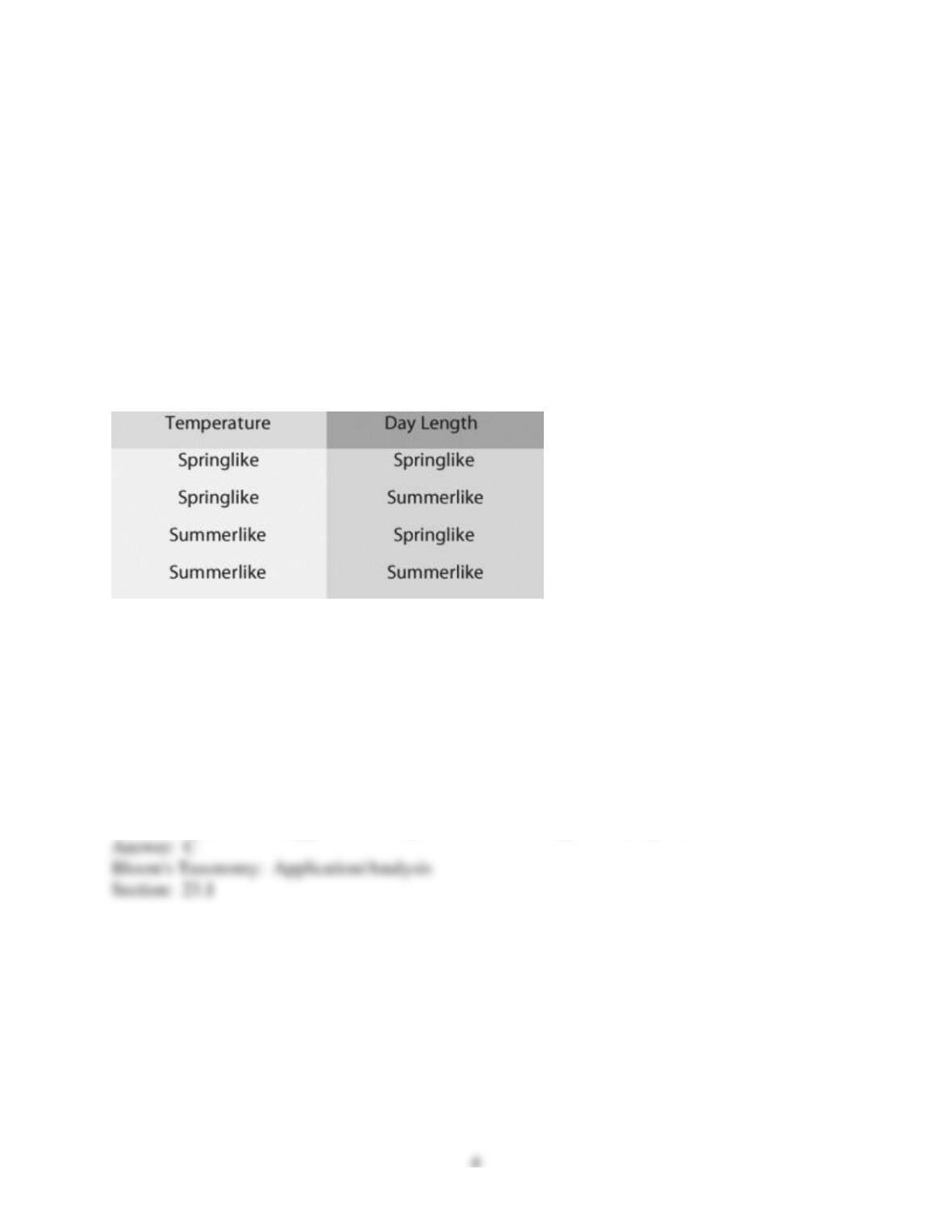
The following experiment is used for the corresponding question(s).
A researcher discovered a species of moth that lays its eggs on oak trees. Eggs are laid at two
distinct times of the year: early in spring when the oak trees are flowering and in midsummer
when flowering is past. Caterpillars from eggs that hatch in spring feed on oak flowers and look
like oak flowers. But caterpillars that hatch in summer feed on oak leaves and look like oak
twigs.
How does the same population of moths produce such different-looking caterpillars on the same
trees? To answer this question, the biologist caught many female moths from the same
population and collected their eggs. He put at least one egg from each female into eight identical
cups. The eggs hatched, and at least two larvae from each female were maintained in one of the
four temperature and light conditions listed below.
In each of the four environments, one of the caterpillars was fed oak flowers, the other oak
leaves. Thus, there were a total of eight treatment groups (4 environments × 2 diets).
9) Refer to the accompanying figure. Which one of the following is NOT a plausible hypothesis
to explain the differences in caterpillar appearance observed in this population?
A) The longer day lengths of summer trigger the development of twig-like caterpillars.
B) The cooler temperatures of spring trigger the development of flowerlike caterpillars.
C) Differences in air pressure, due to differences in elevation, trigger the development of
different types of caterpillars.
D) Differences in diet trigger the development of different types of caterpillars.

10) Refer to the accompanying figure. In every case, caterpillars that feed on oak flowers look
like oak flowers. In every case, caterpillars that were raised on oak leaves looked like twigs.
These results support which of the following hypotheses?
A) The longer day lengths of summer trigger the development of twig-like caterpillars.
B) Differences in air pressure, due to elevation, trigger the development of different types of
caterpillars.
C) Differences in diet trigger the development of different types of caterpillars.
D) The differences are genetic. A female will either produce all flowerlike caterpillars or all
twig-like caterpillars.
11) Refer to the accompanying figure. Recall that eggs from the same female were exposed to
each of the eight treatments used. This aspect of the experimental design tested which of the
following hypotheses?
A) The longer day lengths of summer trigger the development of twig-like caterpillars.
B) Differences in air pressure, due to elevation, trigger the development of different types of
caterpillars.
C) Differences in diet trigger the development of different types of caterpillars.
D) The differences are genetic. A female will either produce all flowerlike caterpillars or all
twig-like caterpillars.
12) Cystic fibrosis is a genetic disorder in homozygous recessives that causes death during the
teenage years. If 9 in 10,000 newborn babies have the disease, what are the expected frequencies
of the dominant (A1) and recessive (A2) alleles according to the Hardy-Weinberg model?
A) f(A1) = 0.9997, f(A2) = 0.0003
B) f(A1) = 0.9800, f(A2) = 0.0200
C) f(A1) = 0.9700, f(A2) = 0.0300
D) f(A1) = 0.9604, f(A2) = 0.0392

13) Suppose 64% of a remote mountain village can taste phenylthiocarbamide (PTC) and must,
therefore, have at least one copy of the dominant PTC taster allele. If this population conforms to
Hardy-Weinberg expectations for this gene, what percentage of the population must be
heterozygous for this trait?
A) 16%
B) 32%
C) 40%
D) 48%
14) For biologists studying a large flatworm population in the lab, which Hardy-Weinberg
condition is most difficult to meet?
A) no selection
B) no genetic drift
C) no gene flow
D) no mutation
15) For a biologist studying a small fish population in the lab, which Hardy-Weinberg condition
is easiest to meet?
A) no selection
B) no genetic drift
C) no gene flow
D) no mutation

Use the following information to answer the question(s) below.
Researchers studying a small milkweed population note that some plants produce a toxin and
other plants do not. They identify the gene responsible for toxin production. The dominant allele
(T) codes for an enzyme that makes the toxin, and the recessive allele (t) codes for a
nonfunctional enzyme that cannot produce the toxin. Heterozygotes produce an intermediate
amount of toxin. The genotypes of all individuals in the population are determined (see chart)
and used to determine the actual allele frequencies in the population.
16) Refer to the figure above. Is this population in Hardy-Weinberg equilibrium?
A) Yes.
B) No; there are more heterozygotes than expected.
C) No; there are more homozygotes than expected.
D) More information is needed to answer this question.
17) If, on average, 46% of the loci in a species’ gene pool are heterozygous, then the average
homozygosity of the species should be _____.
A) 23%
B) 46%
C) 54%
D) 92%
18) The higher the proportion of loci that are “fixed” in a population, the lower are that
population’s _____.
A) nucleotide variability
B) chromosome number
C) average heterozygosity
D) nucleotide variability and average heterozygosity

19) Whenever diploid populations are in Hardy-Weinberg equilibrium at a particular locus,
_____.
A) the allele’s frequency should not change from one generation to the next
B) natural selection, gene flow, and genetic drift are acting equally to change an allele’s
frequency
C) two alleles are present in equal proportions
D) individuals within the population are evolving
20) In the formula for determining a population’s genotype frequencies, the “2” in the term 2pq is
necessary because _____.
A) the population is diploid
B) heterozygotes can come about in two ways
C) the population is doubling in number
D) heterozygotes have two alleles
21) In the formula for determining a population’s genotype frequencies, the “pq” in the term 2pq
is necessary because _____.
A) the population is diploid
B) heterozygotes can come about in two ways
C) the population is doubling in number
D) heterozygotes have two alleles
22) In a Hardy-Weinberg population with two alleles, A and a, that are in equilibrium, the
frequency of the allele a is 0.3. What is the frequency of individuals that are homozygous for this
allele?
A) 0.09
B) 0.49
C) 0.9
D) 9.0

23) In a Hardy-Weinberg population with two alleles, A and a, that are in equilibrium, the
frequency of allele a is 0.2. What is the frequency of individuals that are heterozygous for this
allele?
A) 0.020
B) 0.04
C) 0.16
D) 0.32
24) In a Hardy-Weinberg population with two alleles, A and a, that are in equilibrium, the
frequency of allele a is 0.1. What is the frequency of individuals with AA genotype?
A) 0.20
B) 0.32
C) 0.42
D) 0.81
25) You sample a population of butterflies and find that 56% are heterozygous at a particular
locus. What should be the frequency of the recessive allele in this population?
A) 0.08
B) 0.09
C) 0.70
D) Allele frequency cannot be determined from this information.
26) In peas, a gene controls flower color such that R = purple and r = white. In an isolated pea
patch, there are 36 purple-flowering plants and 64 white-flowering plants. Assuming Hardy-
Weinberg equilibrium, what is the value of q for this population?
A) 0.36
B) 0.64
C) 0.75
D) 0.80

Use the following information to answer the question(s) below.
A large population of laboratory animals has been allowed to breed randomly for a number of
generations. After several generations, 25% of the animals display a recessive trait (aa), the same
percentage as at the beginning of the breeding program. The rest of the animals show the
dominant phenotype, with heterozygotes indistinguishable from the homozygous dominants.
27) What is the most reasonable conclusion that can be drawn from the fact that the frequency of
the recessive trait (aa) has not changed over time?
A) The two phenotypes are about equally adaptive under laboratory conditions.
B) The genotype AA is lethal.
C) There has been a high rate of mutation of allele A to allele a.
D) There has been sexual selection favoring allele a.
28) What is the estimated frequency of allele A in the gene pool?
A) 0.25
B) 0.50
C) 0.75
D) 0.125
29) What proportion of the population is probably heterozygous (Aa) for this trait?
A) 0.05
B) 0.25
C) 0.50
D) 0.75
30) Mutation is the only evolutionary mechanism that _____.
A) does little to change allele frequencies
B) is more important in eukaryotes than in prokaryotes
C) happens in all populations
D) has no effect on genetic variation
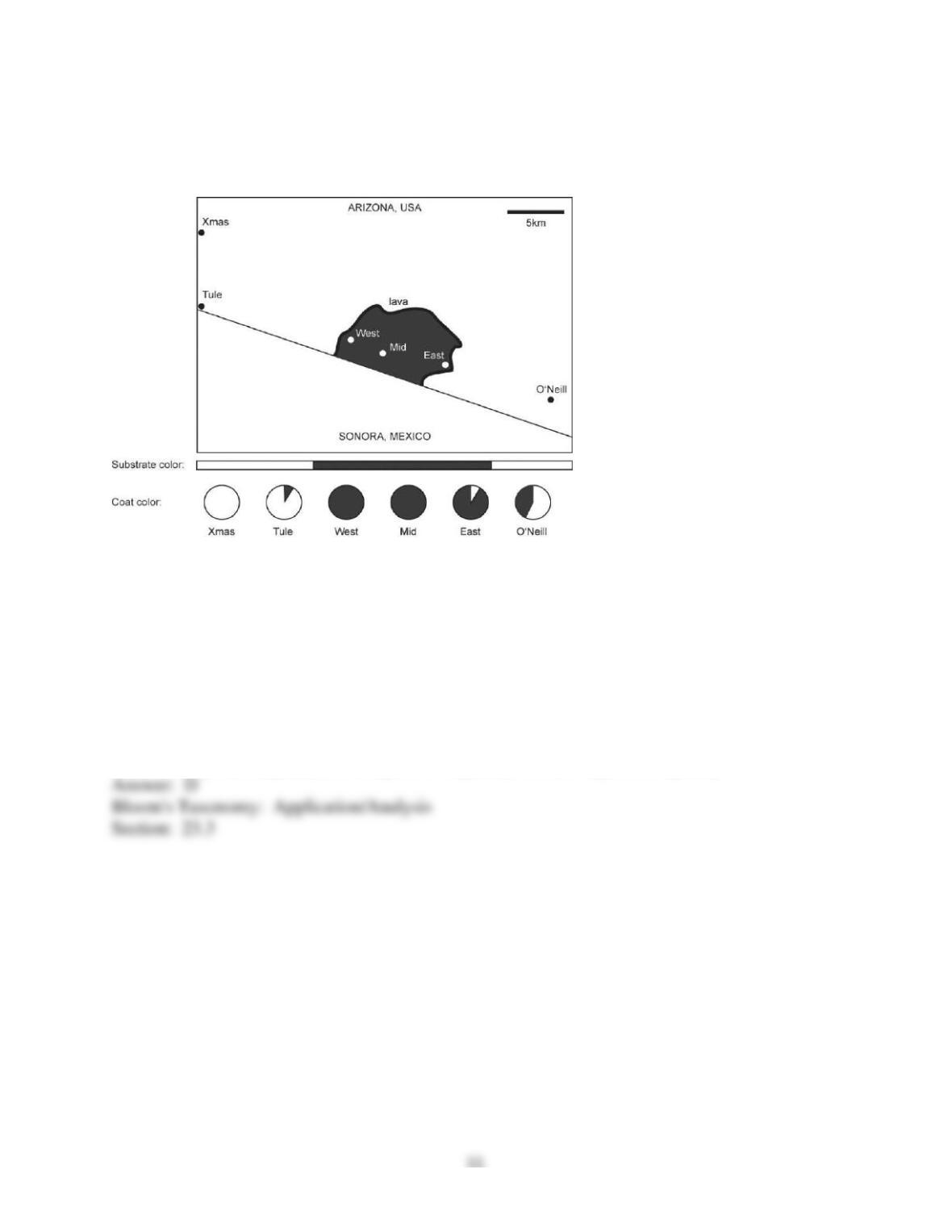
The following question(s) are based on information in Hopi E. Hoekstra, Kristen E. Drumm, and
Michael W. Nachman, “Ecological Genetics of Adaptive Color Polymorphism in Pocket Mice:
Geographic Variation in Selected and Neutral Genes,” Evolution 58(6), 2004: 1329-41.
31) The figure above shows the distribution of pocket-mouse coat colors in several Arizona
populations found either on light-colored granite substrate or on dark volcanic rock (dark
substrate). The Melanocortin-1 receptor (Mc1r) alleles, D and d, differ by four amino acids. Mice
with DD and Dd genotypes have dark coats, whereas mice with the dd genotype are light
colored. What sort of genotype frequencies might you expect to find in the Xmas, Mid, and
O’Neill populations?
A) Xmas-high DD frequency; Mid-high Dd frequency, O’Neill-high dd frequency
B) Xmas-high Dd frequency; Mid-high DD frequency, O’Neill-high dd frequency
C) Xmas-high dd frequency; Mid-high Dd frequency, O’Neill-high DD frequency
D) Xmas-high dd frequency; Mid-high DD frequency, O’Neill-high Dd frequency
32) Refer to the figure above. In their investigation of natural selection on Mc1r alleles (the gene
that determines coat color) in Arizona pocket mice, Hoekstra et al. determined the frequency of
the D and d alleles in each population. They also determined the frequency of alleles for two
neutral mitochondrial DNA genes (genes that do not affect and are not linked to coat color). Why
did the researchers include the mitochondrial DNA genes as part of their experimental design?
A) Allele change for the neutral mitochondrial genes serves as an experimental group and gives
information on any general background genetic difference among these populations.
B) Allele change for the neutral mitochondrial genes serves as a control and determines coat–
color differences among these populations.
C) Allele change for the neutral mitochondrial genes serves as an experimental group and gives
information on coat-color differences among these populations.
D) Allele change for the neutral mitochondrial genes serves as a control and gives information
on any general background genetic difference among these populations.
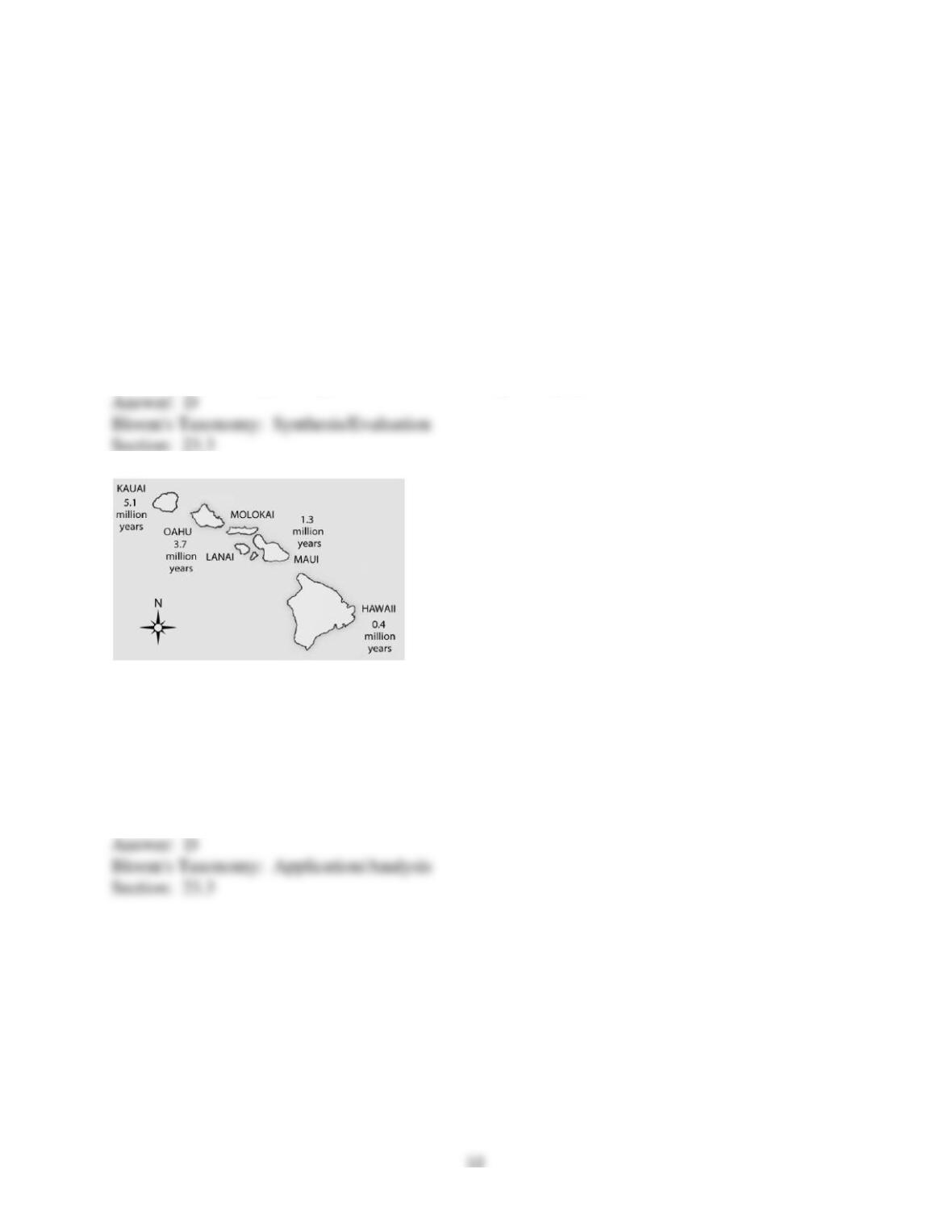
33) Soon after the island of Hawaii rose above the sea surface (somewhat less than one million
years ago), the evolution of life on this new island should have been most strongly influenced by
_____.
A) a genetic bottleneck
B) sexual selection
C) habitat differentiation
D) the founder effect