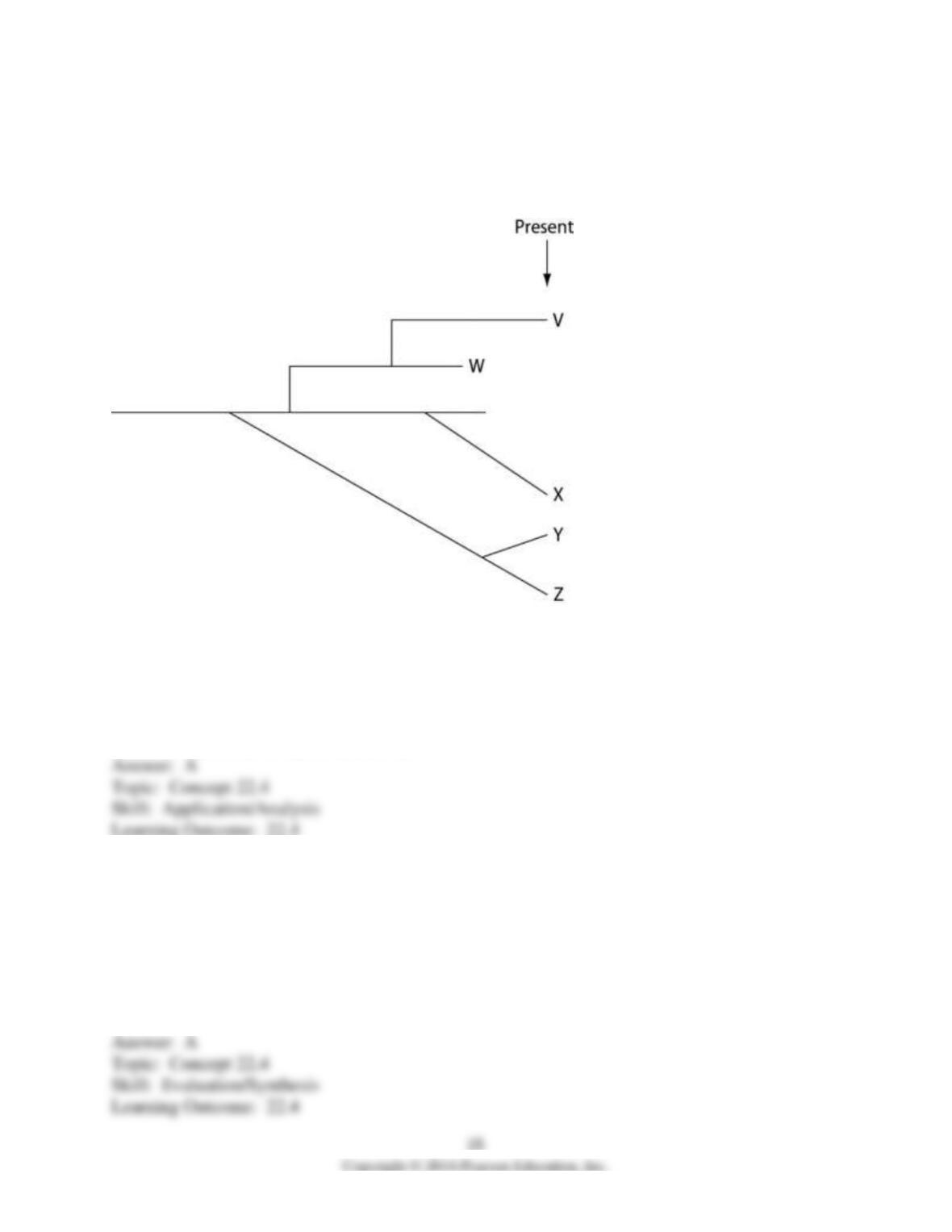
The following question(s) refer to the evolutionary tree in Figure 22.4, whose horizontal axis
represents time (present time is on the far right) and whose vertical axis represents
morphological change.
Figure 22.4
8) Which species is most closely related to species W?
A) V is most closely related to species W.
B) X is most closely related to species W.
C) Y and Z are equally closely related to W.
D) It is not possible to say from this tree.
9) Which species is least expected to have a good record of transitional fossils; in other words,
which species’ fossils, if present at all, are expected only in relatively superficial (that is,
shallow) strata?
A) V
B) W
C) X
D) Y
E) Z
10) Which of these five species originated earliest and appeared suddenly in the fossil record?
A) V
B) W
C) X
D) Y
E) Z
11) Which conclusion can be drawn from this evolutionary tree?
A) Gradualistic speciation and speciation involving punctuated equilibrium are mutually
exclusive concepts.
B) Eldredge and Gould would deny that the lineages labeled X, Y, and Z could represent true
species.
C) Assuming that the tip of each line represents a species, there are five extant (that is, not
extinct) species resulting from the earliest common ancestor.
D) A single clade (that is, a group of species that share a common ancestor) can exhibit both
gradualism and punctuated equilibrium.
12) Which of these five species is the extant (that is, not extinct) species that is most closely
related to species X, and why is this so?
A) V; shared a common ancestor with X most recently
B) W; shared a common ancestor with X most recently
C) Y; arose before X
D) Z; shared a common ancestor with X
13)
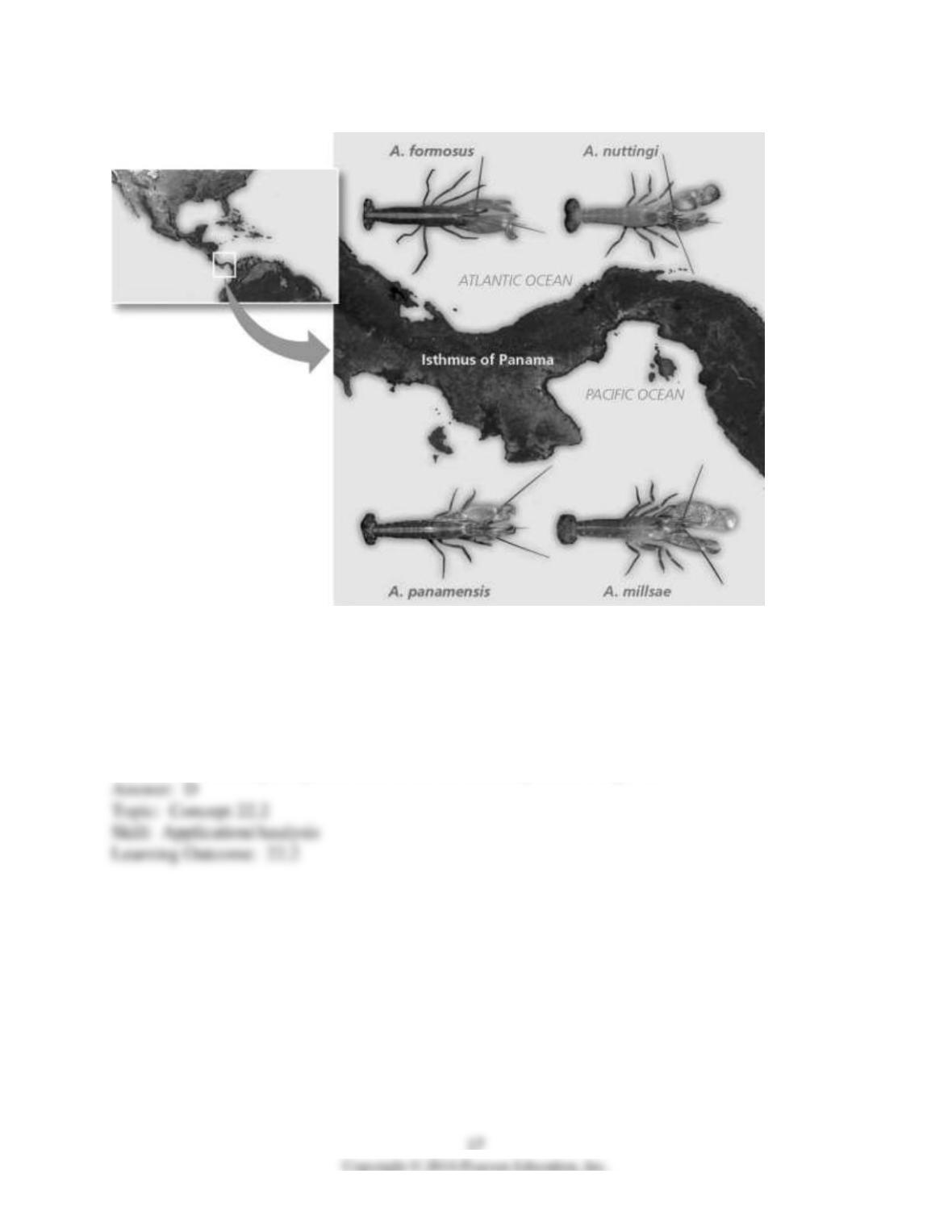
Figure 22.5
Which of the following is evidence for allopatric speciation by the formation of the Isthmus of
Panama?
A) One species of the sister species lives on the Pacific side.
B) Genetic analyses indicate time of origin.
C) Sister species diverge first.
D) Coordination of geological evidence demonstrated species divergence.
14)
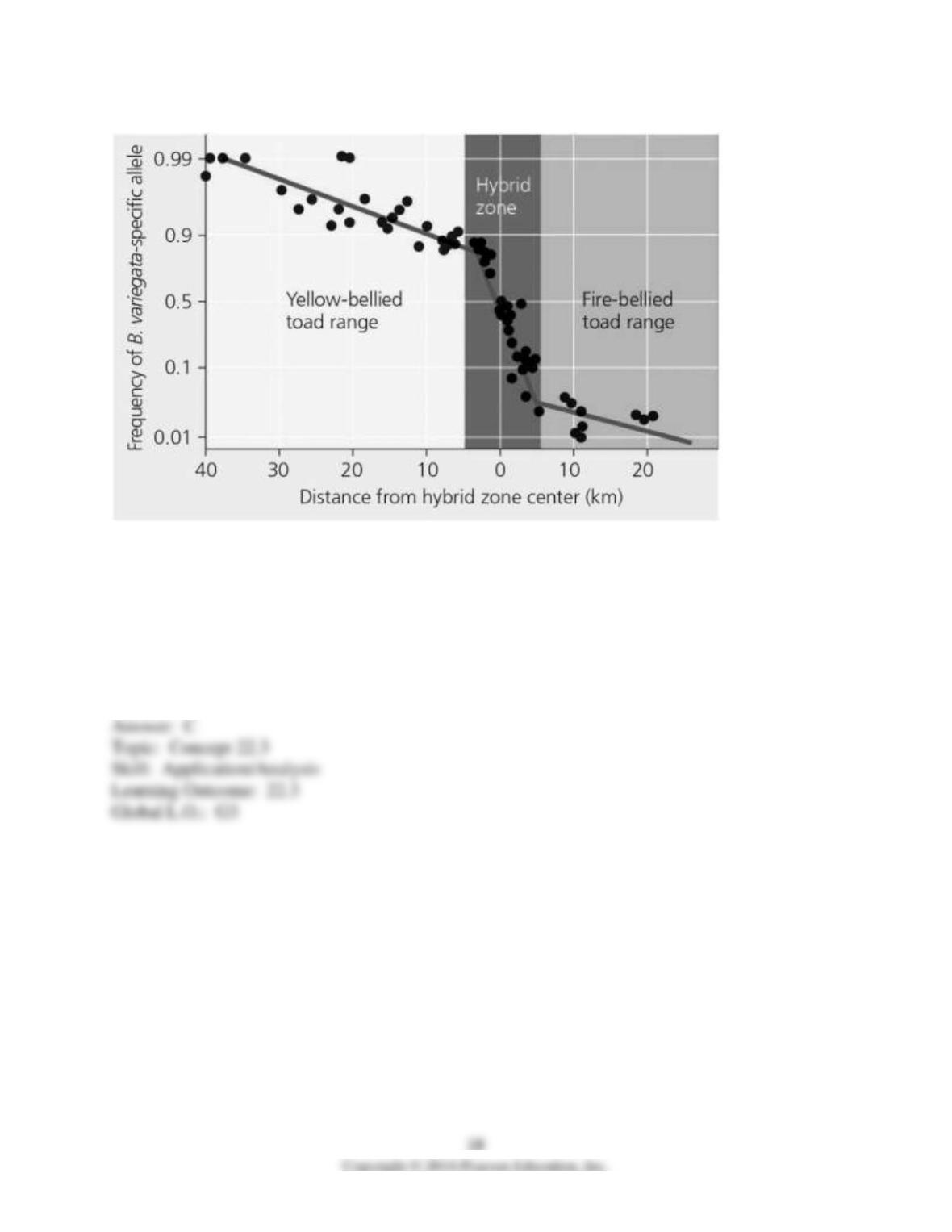
Figure 22.6
A hybrid zone is indicated by plotting the frequency of the yellow-belly allele across the distance
from the center of the hybrid zone. What is the gene frequency of the fire-bellied toad 20 km
from the hybrid zone center?
A) 1
B) 0
C) 0.1
D) 10
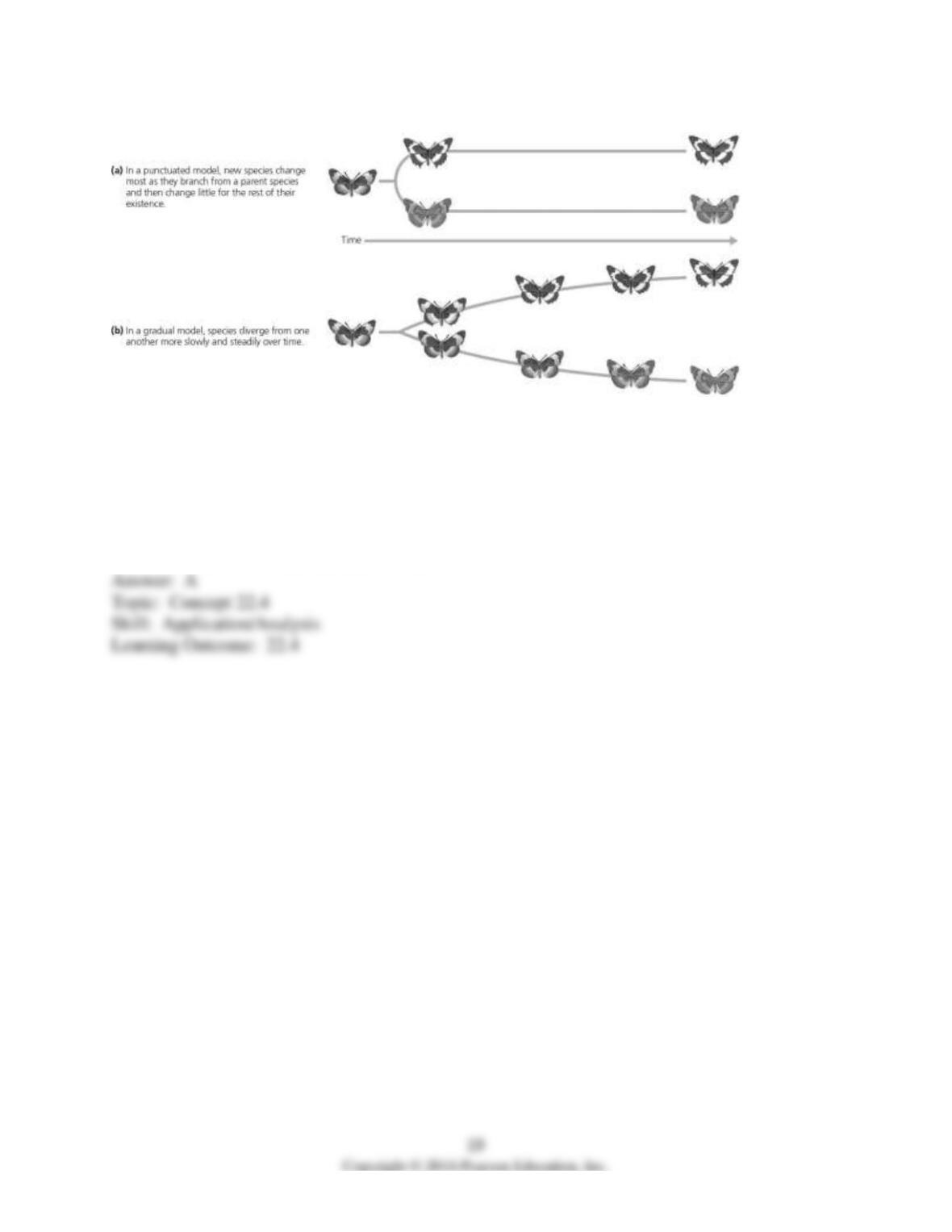
15)
Figure 22.7
Two models for the speed of speciation are based on patterns in the fossil record. Which of the
following statements describes the gradual model of evolution?
A) Species steadily diverge from one another.
B) New species change suddenly.
C) Periods of stasis are punctuated by change.
D) There is absence of intermediate fossils.
22.3 Scenario Questions
Please use the following information to answer the question(s) below.
On the volcanic, equatorial West African island of Sao Tomé, two species of fruit fly exist.
Drosophila yakuba inhabits the island’s lowlands and is also found on the African mainland,
located about 200 miles away. At higher elevations, and only on Sao Tomé, is found the very
closely related Drosophila santomea. The two species can hybridize, though male hybrids are
sterile. A hybrid zone exists at middle elevations, though hybrids there are greatly outnumbered
by D. santomea. Studies of the two species’ nuclear genomes reveal that D. yakuba on the island
is more closely related to mainland D. yakuba than to D. santomea (2n = 4 in both species). Sao
Tomé rose from the Atlantic Ocean about 14 million years ago.
1) Which of the following reduces gene flow between the gene pools of the two species on Sao
Tomé, despite the existence of hybrids?
A) hybrid breakdown
B) hybrid inviability
C) hybrid sterility
D) temporal isolation
E) a geographic barrier
2) If a speciation event occurred on Sao Tomé, producing D. santomea from a parent colony of
D. yakuba, then which of the following terms applies (apply)?
I. macroevolution
II allopatric speciation
III. sympatric speciation
A) I only
B) II only
C) I and II
D) I and III
3) Using only the information provided in the paragraph, which of the following is the best initial
hypothesis for how D. santomea descended from D. yakuba?
A) geographic isolation
B) autopolyploidy
C) habitat differentiation
D) sexual selection
E) allopolyploidy
4) You find a plant that is larger than others in your wheat field. When you examine the
chromosomes of this plant during cell division, you observe that the cells have double
chromosome numbers of the other wheat plants. You conclude that this is an autopolyploid plant
representing a new biological species in your wheat field when you observe
A) fertile tetrapods produced by self-pollinating.
B) production of hybrid organisms.
C) allopolyploids interbreeding with parents.
D) ancestral sterile plants.
5) The observation that island D. yakuba are more closely related to mainland D. yakuba than
island D. yakuba are to D. santomea is best explained by proposing that D. santomea
A) descended from a now-extinct non-African fruit fly.
B) arrived on the island before D. yakuba.
C) descended from a single colony of D. yakuba, which had been introduced from elsewhere,
with no subsequent colonization events.
D) descended from an original colony of D. yakuba, of which there are no surviving members..
22
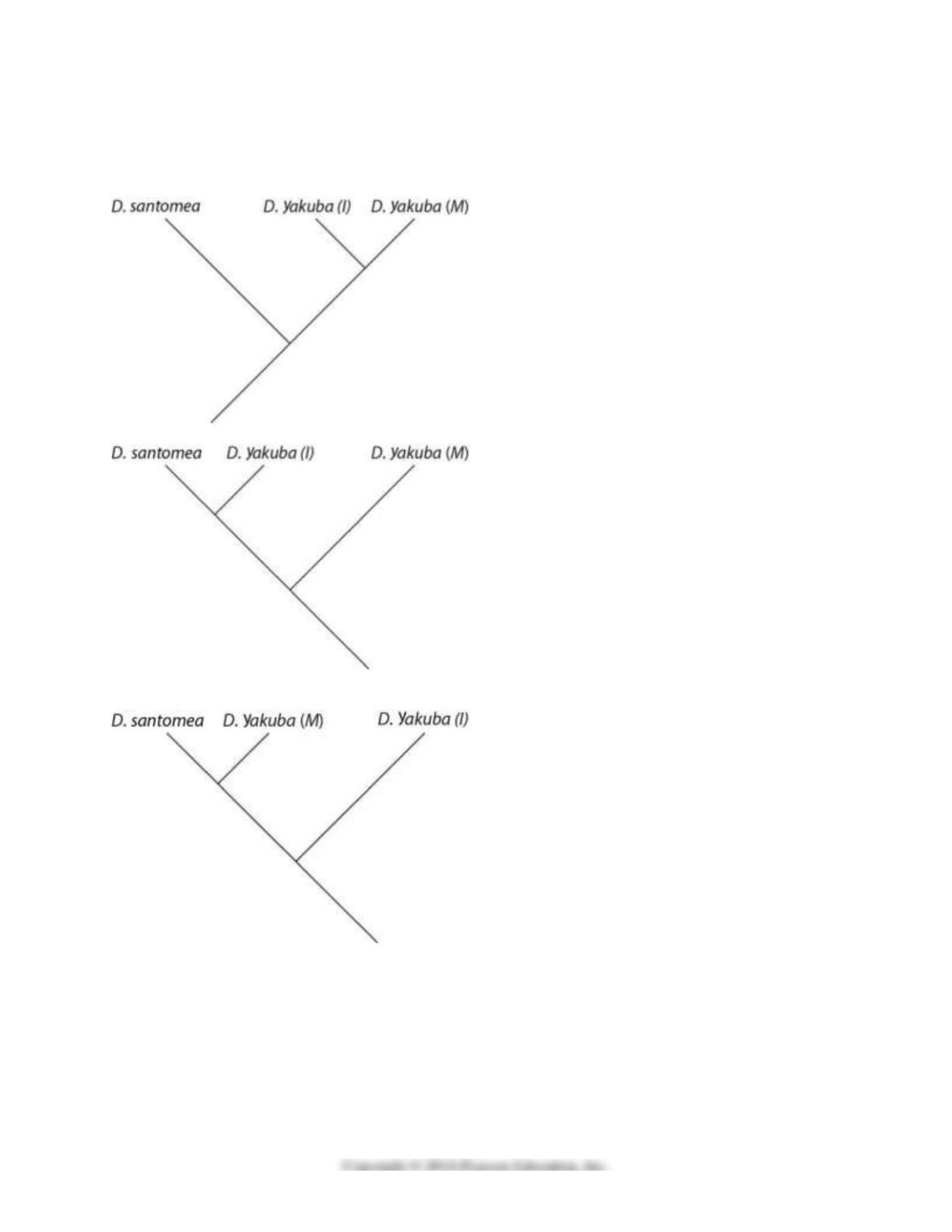
6) Which of these evolutionary trees represents the situation described in the previous
paragraph? (Note: D. yakuba (I) represents the island population, and D. yakuba (M) represents
the mainland population.)
A)
B)
C)
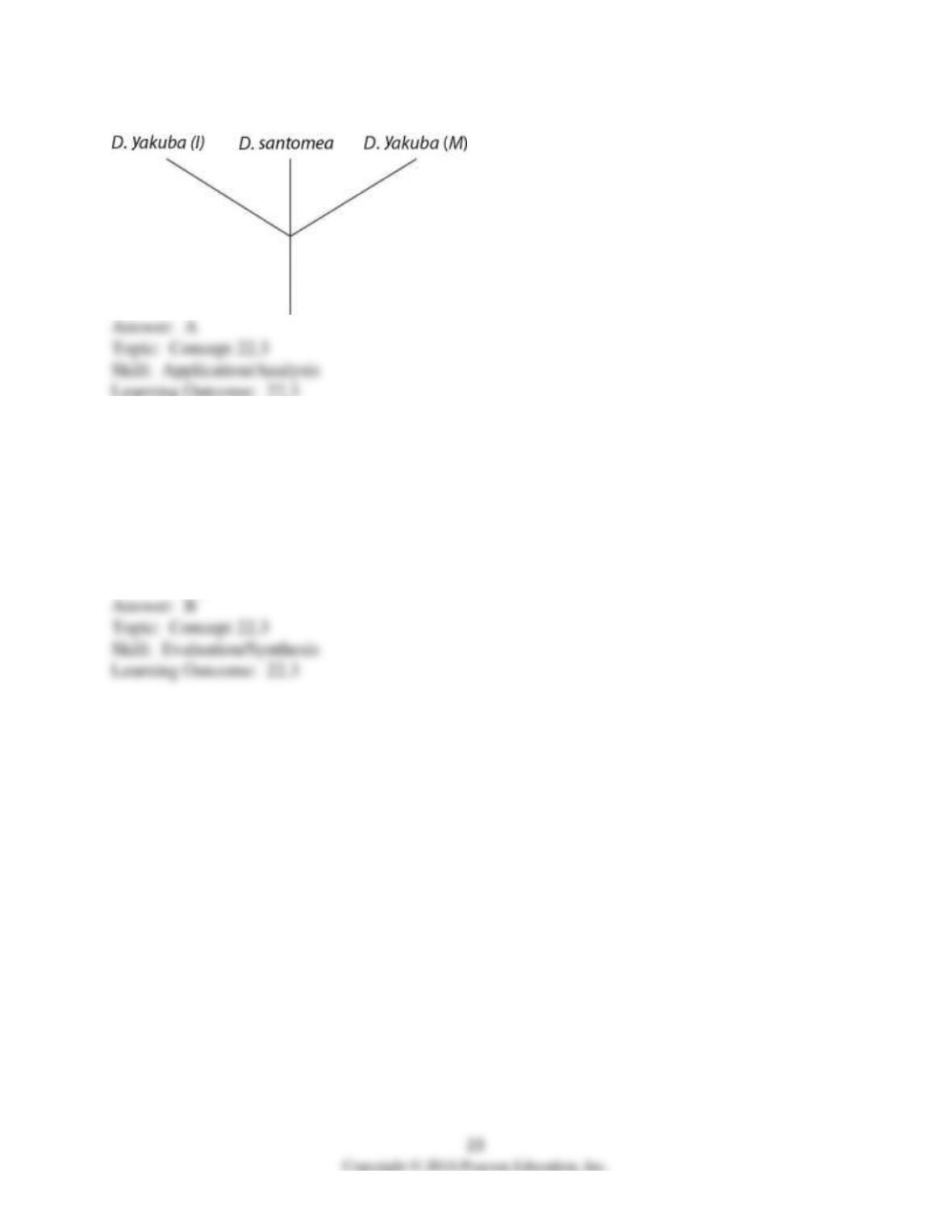
D)
7) If the low number of hybrid flies in the hybrid zone, relative to the number of D. santomea
flies there, is due to the fact that hybrids are poorly adapted to conditions in the hybrid zone, and
if fewer hybrid flies are produced with the passage of time, these conditions will most likely lead
to
A) fusion.
B) reinforcement.
C) stability.
D) further speciation events.
Please use the following information to answer the question(s) below.
On the Bahamian island of Andros, mosquitofish populations live in various, now-isolated,
freshwater ponds that were once united. Currently, some predator-rich ponds have mosquitofish
that can swim in short, fast bursts; other predator-poor ponds have mosquitofish that can swim
continuously for a long time. When placed together in the same body of water, the two kinds of
female mosquitofish exhibit exclusive breeding preferences.
8) Which type of reproductive isolation operates to keep the mosquitofish isolated, even when
fish from different ponds are reunited in the same body of water?
A) behavioral isolation
B) habitat isolation
C) temporal isolation
D) mechanical isolation
E) gametic isolation
9) Which two of the following have operated to increase divergence between mosquitofish
populations on Andros?
1. improved gene flow
2. bottleneck effect
3. sexual selection
4. founder effect
5. natural selection
A) 1 and 3
B) 2 and 3
C) 2 and 4
D) 3 and 4
E) 3 and 5
10) What is the best way to promote fusion between two related populations of mosquitofish, one
of which lives in a predator-rich pond, and the other of which lives in a predator-poor pond?
A) Build a canal linking the two ponds that permits free movement of mosquitofish, but not of
predators.
B) Transfer only female mosquitofish from a predator-rich pond to a predator-poor pond.
C) Perform a reciprocal transfer of females between predator-rich and predator-poor ponds.
D) Remove predators from a predator-rich pond and transfer them to a predator-poor pond.
11) If one builds a canal linking a predator-rich pond to a predator-poor pond, then what type of
selection should subsequently be most expected among the mosquitofish in the original predator-
rich pond, and what type should be most expected among the mosquitofish in the formerly
predator-poor pond?
A) stabilizing selection; directional selection
B) stabilizing selection; stabilizing selection
C) less-intense directional selection; more-intense directional selection
D) less-intense disruptive selection; more-intense disruptive selection
12) The predatory fish rely on visual cues and speed to capture mosquitofish. Mosquitofish rely
on speed and visual cues to avoid the predatory fish. Which adaptation(s) might help the
predators survive in ponds that are home to faster mosquitofish?
1. directional selection for increased speed
2. stabilizing selection for speed that matches that of the mosquitofish
3. change in hunting behavior that replaces reliance on visual cues with reliance on tactile cues
4. change in hunting behavior that eliminates speed in favor of better camouflage, which permits
an ambush strategy
A) 1 only
B) 2 only
C) either 1 or 3
D) 1, 3, or 4
13) In the ocean, on either side of the Isthmus of Panama, are 30 species of snapping shrimp;
some are shallow-water species, and others are adapted to deep water. There are 15 species on
the Pacific side and 15 different species on the Atlantic side. The Isthmus of Panama started
rising about 10 million years ago. The oceans were completely separated by the isthmus about 3
million years ago.
Why should deepwater shrimp on different sides of the isthmus have diverged from each other
earlier than shallow-water shrimp?
A) They have been geographically isolated from each other for a longer time.
B) Cold temperatures, associated with deep water, have accelerated the mutation rate, resulting
in faster divergence in deepwater shrimp.
C) The rise of the land bridge was accompanied by much volcanic activity. Volcanic ash
contains heavy metals, which are known mutagens. Ash fall caused high levels of heavy metals
in the ocean sediments underlying the deep water, resulting in accelerated mutation rates and
faster divergence in deepwater shrimp.
D) Fresh water entering the ocean from the canal is both less dense and cloudier than seawater.
The cloudy fresh water interferes with the ability of shallow-water shrimp to locate mating
partners, which reduces the frequency of mating, thereby slowing the introduction of genetic
variation.
22.4 End-of-Chapter Questions
1) The largest unit within which gene flow can readily occur is a
A) population.
B) species.
C) genus.
D) hybrid.
2) Males of different species of the fruit fly Drosophila that live in the same parts of the
Hawaiian Islands have different elaborate courtship rituals. These rituals involve fighting other
males and making stylized movements that attract females. What type of reproductive isolation
does this represent?
A) habitat isolation
B) temporal isolation
C) behavioral isolation
D) gametic isolation

3) According to the punctuated equilibria model,
A) natural selection is unimportant as a mechanism of evolution.
B) given enough time, most existing species will branch gradually into new species.
C) most evolution occurs in sympatric populations.
D) most new species accumulate their unique features relatively rapidly as they come into
existence, then change little for the rest of their duration as a species.
4) Bird guides once listed the myrtle warbler and Audubon’s warbler as distinct species.
Recently, these birds have been reclassified as eastern and western forms of a single species, the
yellow-rumped warbler. Which of the following pieces of evidence, if true, would be cause for
this reclassification?
A) The two forms interbreed often in nature, and their offspring survive and reproduce well.
B) The two forms live in similar habitats and have similar food requirements.
C) The two forms have many genes in common.
D) The two forms are very similar in coloration.
5) Which of the following factors would not contribute to allopatric speciation?
A) A population becomes geographically isolated from the parent population.
B) The separated population is small, and genetic drift occurs.
C) The isolated population is exposed to different selection pressures than the ancestral
population.
D) Gene flow between the two populations is extensive.
6) Plant species A has a diploid number of 12. Plant species B has a diploid number of 16. A new
species, C, arises as an allopolyploid from A and B. The diploid number for species C would
probably be
A) 14.
B) 16.
C) 28.
D) 56.