Campbell Biology in Focus, 2e (Urry)
Chapter 22 The Origin of Species
22.1 Multiple-Choice Questions
1) Which of the following statements about species, as defined by the biological species concept,
is (are) correct?
I. Biological species are defined by reproductive isolation.
II. Biological species are the models used for grouping extinct forms of life.
III. The biological species is the largest unit of population in which successful interbreeding is
possible.
A) I and II
B) I and III
C) II and III
D) I, II, and III
2) There is still some controversy among biologists about whether Neanderthals should be placed
within the same species as modern humans or into a separate species of their own. Most DNA
sequence data analyzed so far indicate that there was probably little or no gene flow between
Neanderthals and Homo sapiens. Which species concept is most applicable in this example?
A) phylogenetic
B) ecological
C) morphological
D) biological
3) You are confronted with a box of preserved grasshoppers of various species that are new to
science and have not been described. Your assignment is to separate them into species. There is
no accompanying information as to where or when they were collected. Which species concept
will you have to use?
A) biological
B) phylogenetic
C) ecological
D) morphological
4) Two species of frogs belonging to the same genus occasionally mate, but the offspring fail to
develop and hatch. What is the mechanism for keeping the two frog species separate?
A) the postzygotic barrier called hybrid inviability
B) the postzygotic barrier called hybrid breakdown
C) the prezygotic barrier called hybrid sterility
D) the prezygotic barrier gametic isolation
5) Dogs (Canis lupus familiaris) and gray wolves (Canis lupus) can interbreed to produce viable,
fertile offspring. These species shared a common ancestor recently (in geologic time) and have a
high degree of genetic similarity, although their anatomies vary widely. Judging from this
evidence, which two species concepts are most likely to place dogs and wolves together into a
single species?
A) ecological and phylogenetic
B) morphological and phylogenetic
C) biological and morphological
D) biological and phylogenetic
6) Which of the following statements about speciation is correct?
A) The goal of natural selection is speciation.
B) Natural selection chooses the reproductive barriers for populations.
C) It always takes millions of years for speciation to occur.
D) Speciation is a basis for understanding macroevolution.
7) Which of the following criteria used in classification is the most easily evaluated by the
observer?
A) morphology
B) biochemistry
C) physiology
D) DNA sequence
8) A species is a member of a group called a population,
A) whose members have the ability to interbreed and produce viable, fertile offspring.
B) whose members have the ability to interbreed but do not produce viable offspring.
C) which are reproductively incompatible.
D) which are distinct biological species that live in the same area.
9) Which of the following reproductive types of isolation illustrates postzygotic barriers?
A) habitat isolation
B) mechanical isolation
C) temporal isolation
D) hybrid breakdown
10) The phylogenetic species concept defines a species as
A) the smallest group of individuals that share a common ancestor.
B) an ecological niche, interacting with living and nonliving parts of their environment.
C) a body shape and other structural features.
D) a reproductive isolation.
11) Which species concept occurs in the presence of gene flow?
A) morphological
B) biological
C) ecological
D) phylogenetic
12) Rocky Mountain juniper (Juniperus scopulorum) and one-seeded juniper (J. monosperma)
have overlapping ranges. If pollen grains (which contain sperm cells) from one species are
unable to germinate and make pollen tubes on female ovules (which contain egg cells) of the
other species, then which of these terms are applicable?
1. sympatric species
2. prezygotic isolation
3. postzygotic isolation
4. allopatric species
5. habitat isolation
6. reduced hybrid fertility
A) 1 and 2
B) 2 and 4
C) 1, 3, and 6
D) 2, 4, and 5
E) 1, 2, 5, and 6
13) In a hypothetical situation, a certain species of flea feeds only on pronghorn antelopes. In
rangelands of the western United States, pronghorns and cattle often associate with one another.
If some of these fleas develop a strong preference for cattle blood and mate only with other fleas
that prefer cattle blood, then over time which of these should occur, if the host mammal can be
considered as the fleas’ habitat?
1. reproductive isolation
2. sympatric speciation
3. habitat isolation
4. prezygotic barriers
A) 1 only
B) 2 and 3
C) 1, 2, and 3
D) 2, 3, and 4
E) 1 through 4
14) Among known plant species, which of these are the two most commonly occurring
phenomena that have led to the origin of new species?
1. allopatric speciation
2. sympatric speciation
3. sexual selection
4. polyploidy
A) 1 and 3
B) 1 and 4
C) 2 and 3
D) 2 and 4
15) The origin of a new plant species by hybridization, coupled with accidents during cell
division, is an example of
A) allopatric speciation.
B) sympatric speciation.
C) autopolyploidy.
D) habitat selection.
16) The most likely explanation for the high rate of sympatric speciation that apparently existed
among the cichlids of Lake Victoria in the past is
A) sexual selection.
B) habitat differentiation.
C) polyploidy.
D) pollution.
E) introduction of a new predator.
17) More species are found on subdivided areas due to
A) geographic isolation.
B) absence of geographic isolation.
C) gene flow.
D) gene drift.
18) After geographic separation, what process would be the last step before reproductive
isolation?
A) gene pool divergence
B) mutation
C) natural selection
D) genetic drift
19) How can reproductive barriers form between sympatric populations while their members stay
in contact with them?
A) increased gene flow
B) increased polyploidy
C) decreased habitat differentiation
D) decreased sexual selection
20) Which of the following descriptions of polyploidy indicate speciation?
A) An accident during cell division results in an extra set of chromosomes.
B) An individual has more than two chromosome sets from a single species.
C) Two different species interbreed and produce hybrid offspring.
D) Allopolyploids mate with each other but cannot interbreed with parent species.
21) Which one of the following choices describes an advantage of the biological species
concept?
A) lack of methodology to evaluate fossil reproduction
B) does not apply to organisms that reproduce asexually
C) overemphasizes absence of gene flow
D) describes speciation by the evolution of reproductive isolation
22) “Conventional wisdom holds that the development of separate species happens quickly, most
often when populations become separated by a geographical barrier.” This is called ________
speciation. “Even if these groups meet again and manage to mate before diverging too far from
one another, their offspring will be unfit and die out.” This is described as hybrid ________.
A) sympatric; viability
B) allopatric; fertility
C) sympatric; breakdown
D) allopatric; breakdown
23) Which of these phrases describes a stable hybrid zone?
A) obstacle to gene flow
B) reduced hybrid viability
C) reduced hybrid fertility
D) continued production of hybrid individuals
24) Which mechanism would reverse speciation?
A) increased gene flow
B) gene pools of the two species becoming increasingly different
C) increased ability of females to discriminate mates
D) decreased production of hybrids
25) Sexual selection in cichlids occurs by female mate choice and results in reproductive
isolation when
A) subpopulations exploit a habitat not used by the parent population.
B) under normal light, each species prefers males of their own species.
C) all species have extra sets of chromosomes.
D) under orange light, each species prefers orange mates.
26) A hybrid zone is properly defined as
A) an area where two closely related species’ ranges overlap.
B) an area where mating occurs between members of two closely related species, producing
viable offspring.
C) a zone that features a gradual change in species composition where two neighboring
ecosystems border each other.
D) a zone that includes the intermediate portion of a cline.
E) an area where members of two closely related species intermingle, but experience no gene
flow.
27) Which of these should decline in hybrid zones where reinforcement is occurring?
A) gene flow between distinct gene pools
B) speciation
C) the genetic distinctness of two gene pools
D) mutation rate
E) hybrid sterility
28) The most likely explanation for the recent decline in cichlid species diversity in Lake
Victoria is
A) reinforcement.
B) fusion.
C) stability.
D) geographic isolation.
29) A narrow hybrid zone separates the toad species Bombina bombina and Bombina variegata.
What is true of those alleles that are unique to the parental species?
A) Such alleles should be absent.
B) Their allele frequency should be nearly the same as the allele frequencies in toad populations
distant from the hybrid zone.
C) The alleles’ heterozygosity should be higher among the hybrid toads there.
D) Their allele frequency on one edge of the hybrid zone should be roughly equal to their
frequency on the opposite edge of the hybrid zone.
30) Which of the following activities occurs first in order to begin speciation?
A) single gene change
B) formation of mechanical barrier to reproduction
C) postzygotic hybrid sterility in Drosophila
D) interruption of gene flow between two populations
31) Mechanism of macroevolution works by
A) multiple acts of speciation on an ancestral organism.
B) continuation of gene flow between populations.
C) weakening of barriers to reproductive isolation.
D) appearing in the fossil record of species with similar morphologies.
32) Rocky Mountain juniper (Juniperus scopulorum) and one-seeded juniper (J. monosperma)
have overlapping ranges. If pollen grains (which contain sperm cells) from one species are
unable to germinate and make pollen tubes on female ovules (which contain egg cells) of the
other species, then which of these terms is applicable?
A) behavioral isolation
B) mechanical isolation
C) hybrid breakdown
D) reduced hybrid viability
33) Speciation
A) occurs at such a slow pace that no one has ever observed the emergence of new species.
B) occurs only by the accumulation of genetic change over vast expanses of time.
C) must begin with the geographic isolation of a small, frontier population.
D) occurs when one species splits into two or more species.
22.2 Art Questions
Please use the following information to answer the question(s) below.
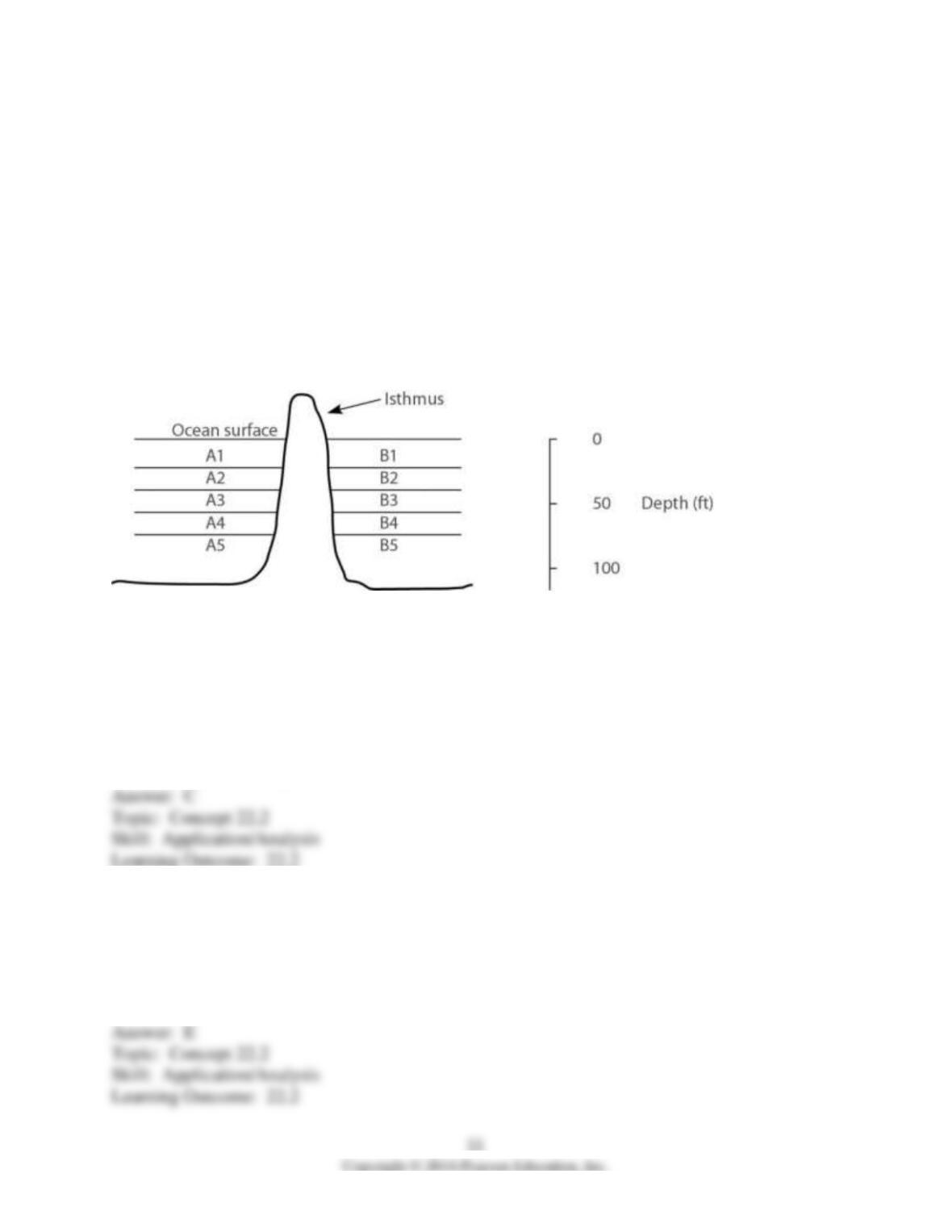
In the ocean, on either side of the Isthmus of Panama, are 30 species of snapping shrimp; some
are shallow-water species, and others are adapted to deep water. There are 15 species on the
Pacific side and 15 different species on the Atlantic side. The Isthmus of Panama started rising
about 10 million years ago.
In Figure 22.1, the isthmus separates the Pacific Ocean on the left (side A) from the Atlantic
Ocean on the right (side B). The seawater on either side of the isthmus is separated into five
depth habitats (1-5), with 1 being the shallowest.
Figure 22.1
1) In which habitat should one find snapping shrimp most closely related to shrimp that live in
habitat A4?
A) A3
B) A5
C) B4
D) either A3 or A5
E) any species from any one of the side A habitats
2) Which of these habitats is likely to harbor the youngest species?
A) A5
B) B4
C) A3
D) B2
E) A1
3) Which habitats should harbor snapping shrimp species with the greatest degree of genetic
divergence from each other?
A) A1 and A5
B) A1 and B5
C) B5 and B1
D) A5 and B5
E) Both A1/A5 and B1/B5 should have the greatest, but equal amounts of, genetic divergence.
4) Which factor is most important for explaining why there are equal numbers of snapping
shrimp species on either side of the isthmus?
A) the relative shortness of time they have been separated
B) the depth of the ocean
C) the number of actual depth habitats between the surface and the sea floor
D) the elevation of the isthmus above sea level
E) the depth of the canal
5) There are currently two large, permanent bridges that span the Panama Canal. The bridges are
about 8 miles apart. If snapping shrimp avoid swimming at night and avoid swimming under
shadows, then what do these bridges represent for the snapping shrimp?
A) sources of refuge
B) geographic barriers
C) sources of a hybrid zone between the two bridges
D) sources for increased gene flow
6) The Panama Canal was completed in 1914, and its depth is about 50 feet. After 1914,
snapping shrimp species from which habitats should be most likely to form hybrids as the result
of the canal?
A) A5 and B5
B) A3 and B3
C) A1 and B1
D) either A1 and A2 or B1 and B2
E) A1-A3 and B1-B3 have equal likelihoods of harboring snapping shrimp species that can
hybridize.
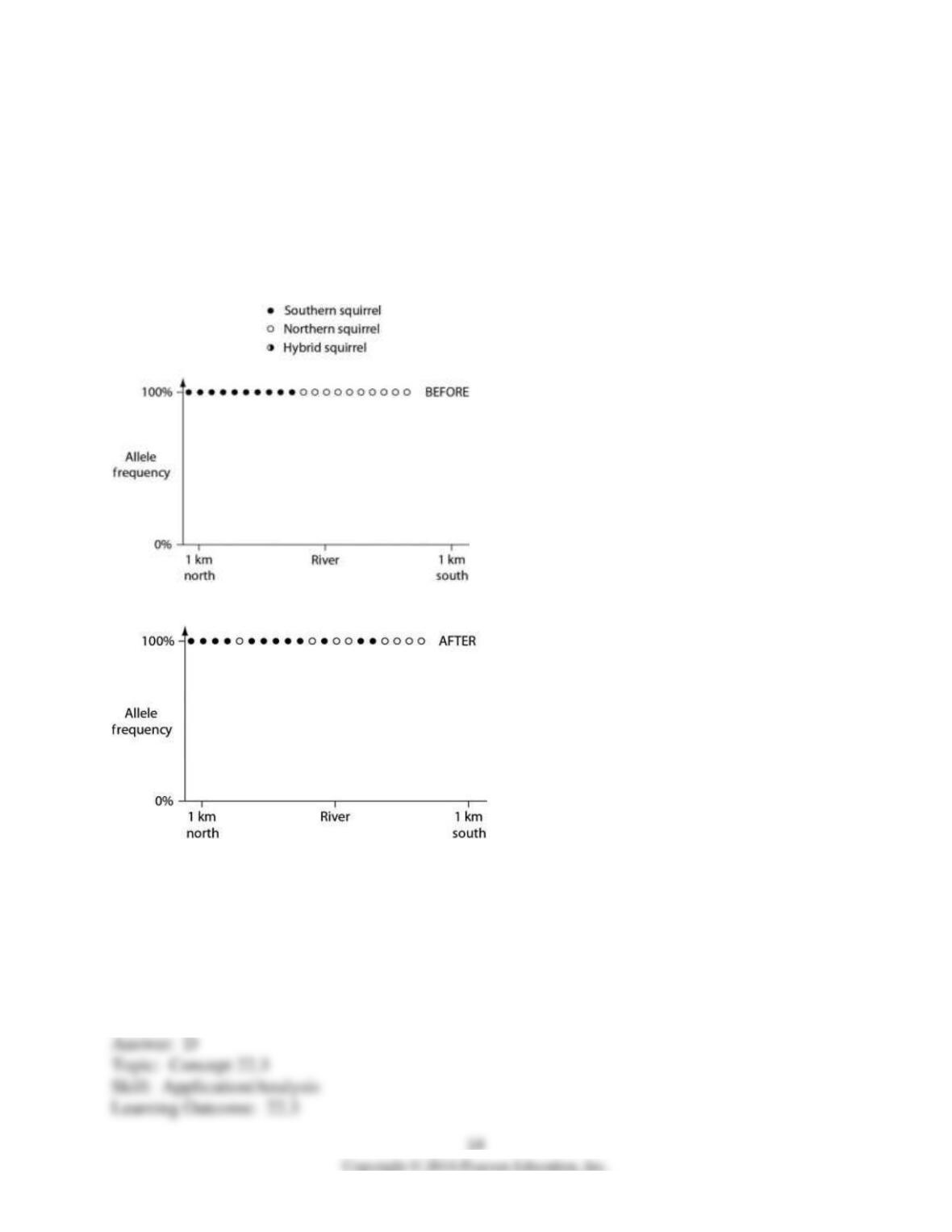
7) In a hypothetical situation, the National Park Service, which administers Grand Canyon
National Park in Arizona, builds a footbridge over the Colorado River at the bottom of the
canyon. The footbridge permits migration to occur between populations of two closely related
antelope squirrels. Previously, one type of squirrel had been restricted to the terrain south of the
river, and the other type had been restricted to terrain on the north side of the river. Immediately
before and 10 years after the bridge’s completion, researchers collected 10 antelope squirrels
from both sides of the river, took blood samples, and collected frequencies of alleles unique to
the two types of antelope squirrels (see the graphs in Figures 22.2 and 22.3).
Figure 22.2
Figure 22.3
The data in these graphs indicate that
A) a hybrid zone was established after the completion of the bridge.
B) there was no migration between the two squirrel populations after the bridge was completed.
C) gene flow occurred from one type of squirrel into the gene pool of the other type of squirrel.
D) two-way migration of squirrels occurred across the bridge, but without hybridization.
E) some northern squirrels migrated south, but no southern squirrels migrated north across the
bridge.