
Chapter 22 The Light Reactions
Matching Questions
Use the following to answer questions 1-10:
Choose the correct answer from the list below. Not all of the answers will be used.
a) 960 nm
b) magnesium
c) ATP synthase
d) chloroplasts
e) thylakoids
f) copper
g) β-carotene
h) 680 nm
i) FAD
j) chlorophyll a
k) ferredoxin b
l) resonance energy transfer
1.
____________ This is where photosynthesis takes place.
2.
____________ These membranous structures in a chloroplast are stacked, flattened disks.
Ans: e
3.
____________ This is the principal photoreceptor in chloroplasts of green plants.
Section: 22.2
4.
____________ Chlorophyll a contains this ion in the center of the tetrapyrole.
Section: 22.2
5.
Section: 22.3
____________ Plastocyanin requires this cofactor for activity.
6.
Section: 22.3
____________ This is the prosthetic group of ferredoxin-NADP+ reductase.
Ans: d

Chapter 22 The Light Reactions
2
7.
____________ This is another name for the CF1–CF0 complex.
8.
____________ This is one of the accessory pigments in plants.
Ans: g
Section: 22.2
9.
____________ This electron carrier of photosystem I is an iron-sulfur protein.
Ans: k
Section: 22.3
10.
Ans: h
Section: 22.3
____________ Photosystem II responds to wavelengths shorter than this value.
Fill–in-the-Blank Questions
11.
The inner membrane of a chloroplast surrounds a space called the .
Ans: stroma Section: 22.1
12.
The process in which a positive charge forms on one molecule by the loss of a photoexcited
electron, and a negative charge forms on another by the gain of an electron is referred to as .
Ans: photoinduced charge separation Section: 22.2
13.
is the receptor of excited electrons from P680.
Ans: Pheophytin Section: 22.3
14.
P700 is the pigment reaction center for .
Ans: photosystem I Section: 22.3
15.
The manganese center of photosystem II converts to .
Ans: H2O; O2 Section: 22.3
16.
Electrons flow from photosystem I to photosystem II through the complex.
Ans: cytochrome bf Section: 22.3
17.
In the light reactions of photosynthesis, the cooperation between photosystem I and photosystem
II creates a flow of electrons from H2O to .
Ans: NADP+ Section: 22.3
18.
The light-induced electron transfer in photosynthesis results in the transfer of into the
thylakoid lumen.
Ans: c
Section: 22.4

Chapter 22 The Light Reactions
3
19.
In ATP is generated without the concomitant formation of NADPH.
20.
The transfer of excitation energy from one molecule to one nearby through electromagnetic
interactions is called .
Ans: resonance energy transfer Section: 22.4
Multiple-Choice Questions
21.
How is light used in photosynthesis?
A)
Light is necessary to make the chlorophyll green, so the pigment can transmit electrons.
B)
Light is used to generate high-energy electrons with great reducing potential.
C)
Light provides heat energy for the chloroplasts.
D)
Light is absorbed by oxygen, which is converted into water.
E)
None of the above.
Ans: B Section: Introduction
22.
Stacked and unstacked regions of the thylakoid are arranged such that
A)
photosystem I is located in the unstacked regions.
B)
photosystem II is located in the stacked region.
C)
ATP synthase occurs mainly in unstacked regions.
D)
A and C.
E)
A, B, and C.
Ans: E Section: 22.4
23.
How many chloroplasts does a typical plant cell have?
A) 1−100 B) 200−500 C) >1000 D) 500−800 E) None of the above.
Ans: A Section: 22.1
24.
Light absorbed by a chlorophyll a causes
A)
an electron to move from the photon to the chlorophyll.
B)
an electron to move from ground state to an excited state.
C)
an electron to move to a neighboring water molecule.
D)
an electron to move from chlorophyll to ADP.
E)
None of the above.
Ans: B Section: 22.2
25.
In the overall stoichiometry of light reactions, eight photos of light generate
A)
4 NADPH.
D)
B and C.
B)
4 NADH.
E)
A, B, and C.
C)
3 ATP.
Ans: C Section: 22.4
Ans: cyclic photophosphorylation Section: 22.4

Chapter 22 The Light Reactions
4
26.
The D1 and D2 subunits of photosystem II
A)
span the thylakoid membrane.
B)
are similar to each other.
C)
are homologous to the L and M chains of the bacterial center.
D)
A and C.
E)
A, B, and C.
27.
Light absorption induces electron transfer from P680 to
A)
pheophytin.
D)
chlorophyll PP.
B)
QH2.
E)
None of the above.
C)
cytochrome c.
Ans: A Section: 22.3
28.
What is the original source of electrons used to neutralize the special pair in photosystem II?
A)
reduced cytochrome bf
B)
NADH
C)
H2O
D)
membrane lipids
E)
ferredoxin
Ans: C Section: 22.3
29.
Complete the following reaction for photosystem I:
Pc(Cu+) + Fdox + light →
A)
Pc(Cu+) + Fdox + light → Pc (Cu+) + (Cu+) Fdred
B)
Pc(Cu+) + Fdox + light → Pc (Cu2+) + Fdred
C)
Pc(Cu+) + Fdox + light → Pc + Fdred(Cu2+)
D)
Pc(Cu+) + Fdox + light → Pc– (Cu3+) + Fdred
E)
None of the above.
Ans: B Section: 22.3
30.
The pathway of electron flow from H2O to NADP+ in photosynthesis is referred to as
A)
cooperative special pairs.
D)
photophosphorylation.
B)
photorespiration.
E)
None of the above.
C)
the Z scheme of photosynthesis.
Ans: C Section: 22.3
31.
How many protons are transferred into the thylakoid lumen after absorption of four photons?
A) 2 B) 12 C) 18 D) 4 E) 8
Ans: B Section: 22.4
32.
Which of the following is/are light harvesting molecules?
A)
vitamin D
B)
carotenoids
C)
chlorophyll b
D)
plastocyanin
E)
B and C.
Ans: E Section: 22.3

Chapter 22 The Light Reactions
5
33.
Use the information in table 20.1 to answer the following question.
Let us consider the overall light reaction in photosynthesis.
NADP+ + H2O → NADPH + ½O2 + H+
Determine E ˊ0 for this reaction
A)
-0.50 V
B)
+0.50 V
C)
-1.14 V
D)
+1.14 V
34.
Determine the ΔG⁰ˊ for this reaction: NADP+ + H2O → NADPH + ½O2 + H+
A)
96.5 kJ/mol
B)
–96.5 kJ/mol
C)
50.18 kJ/mol
D)
–220..02 kJ/mol
E)
220.02 kJ/mol
Ans: E Section: 22.
35.
What evidence exists to support an endosymbiotic event for the formation of a chloroplast? The
DNA of the chloroplast and the cyanobacterium
A)
is arranged in operons.
B)
is linear.
C)
has multiple start sites for DNA replication.
D)
encodes all chloroplast proteins.
E)
contains both chlorophyll and mitochondrial genes.
Ans: A Section: 22.1
36.
What is the implication of the difference in permeability of the mitochondrial membrane vs. the
thylakoid membrane to Mg2+ and Cl–?
A)
The thylakoid membrane is less permeable to Mg+, Cl-, and H+ and therefore more energy
is needed to pump protons across the membrane.
B)
The mitochondrial membrane, being permeable to Mg2+ and Cl– means that electron flow
only occurs with transport of 1 Mg2+ and one Cl–.
C)
The thylakoid membrane, being permeable to Mg2+ and Cl– means that electron flow only
occurs with transport of 1 Mg2+ and one Cl–.
D)
The mitochondrial membrane, being permeable to Mg2+ and Cl– means that although
protons are pumped across the membrane, no membrane potential is generated.
E)
The thylakoid membrane, being permeable to Mg2+ and Cl– means that although protons
are pumped across the membrane, no membrane potential is generated.
Ans: E Section: 22.4
Short-Answer Questions
37.
Write out the reaction for photosynthetic production of carbohydrates and oxygen.
CO2 + H2O + light → (CH2O)n + O2
Section: Introduction
E)
-0.26 V
Ans: C Section: 22.4
Chapter 22 The Light Reactions
6
38.
Humans do not produce energy by photosynthesis. Why, then, is this process critical to our
survival?
39.
How is a chloroplast similar to a mitochondrion?
have arisen from a symbiotic event.
Section: 22.1
40.
Why are chlorophylls good candidates for photoreceptors?
receives.
Section: 22.2
41.
How is energy transferred from a photoreceptor molecule to photosystem II?
photosystem II.
Section: 22.2
42.
Write the overall reaction of photosystem II.
(Q: plastoquinone, QH2: platoquinol)
Section: 22.3
43.
What are the likely reasons that manganese evolved as the ion used in photosystem II?
form strong bonds to oxygen-containing molecules.
Section: 22.3
44.
Describe the process of cyclic photophosphorylation.
generated by this pathway.
Section: 22.4
45.
Give the overall net equation as catalyzed by the “Z scheme” of photosynthesis.
Ans:
2 H2O + 2 NADP+ +10 H+ → O2 + 2 NADPH + 12H+
Section: 22.4
our survival.
Section: Introduction
Chapter 22 The Light Reactions
7
46.
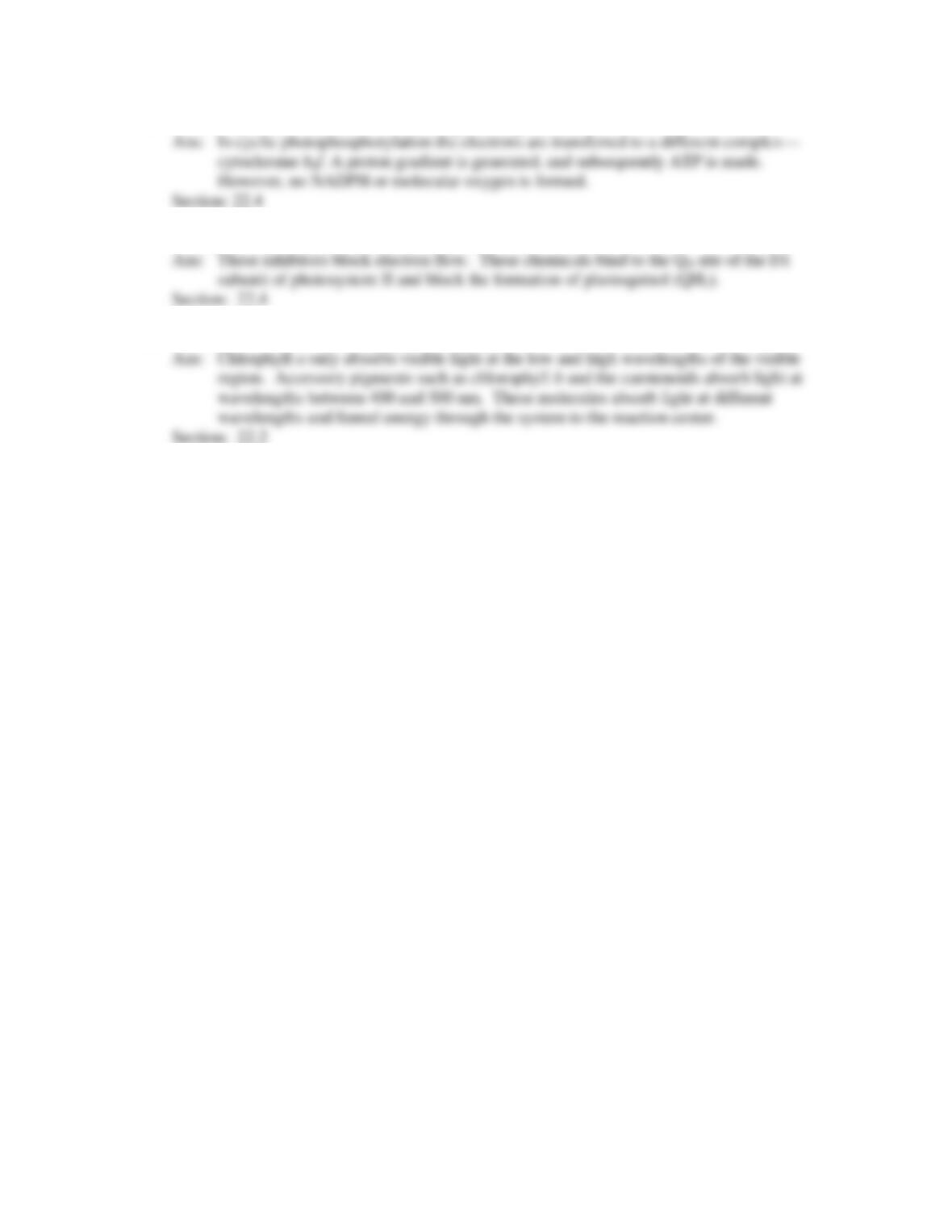
Describe the path of electrons in photosystem I.
47.
Treatment of chloroplasts with KCN inhibits photophosphorylation, presumably at the level of
plastocyanin. Predict the effect of KCN on a plant’s ability to perform cyclic
photophosphorylation.
the cytochrome b6f complex rather than to NADP+. Each electron then flows back through
to plastocyanin, then cyclic photophosphorylation will also be inhibited.
Section: 22.3
Chapter 22 The Light Reactions
8
48.
How is it possible to make ATP without generating NADPH?
49.
How do herbicides such as diuron or atrazine work?
subunit of photosystem II and block the formation of plastoquinol (QH2).
50.
What is the role of accessory pigments in photosynthesis?
wavelengths and funnel energy through the system to the reaction center.
However, no NADPH or molecular oxygen is formed.