
1
Campbell Essential Biology, 6e (Simon/Dickey/Hogan/Reece)
Chapter 21 Unifying Concepts of Animal Structure and Function
Chapter 21 Learning Outcomes
21 Biology and Society: An Avoidable Tragedy
21.1. Explain how a person keeps from overheating when exercising strenuously, and how
these functions fail when heat exhaustion occurs.
21.1 The Structural Organization of Animals
21.2. Define and compare anatomy and physiology and explain why the two are usually
studied together.
21.3. Define tissues, organs, and organ systems and describe the relationships among them.
21.4. Describe the four main categories of animal tissues, noting examples of each, and
distinguishing between their structures and functions.
21.2 Exchanges with the External Environment
21.5. Explain why every organism is an open system, and how an animal’s size and shape
affect how it exchanges energy and materials with its surrounding environment.
21.3 Regulating the Internal Environment
21.6. Define “homeostasis” and how it is regulated, and illustrate with examples of
homeostasis and its regulation within the human body.
21.7. Define “thermoregulation” and describe adaptations in humans and other animals that aid
in thermoregulation.
21.8. Define “osmoregulation” and describe adaptations for osmoregulation in different
environments.
21 Evolution Connection: Adaptations for Thermoregulation
21.9. Define “thermoregulation” and describe adaptations in humans and other animals that aid
in thermoregulation.
Global learning outcomes
1. Demonstrate an understanding of the principles of scientific inquiry.
2. Demonstrate the ability to think critically and employ critical-thinking skills.
3. Read and interpret models, graphs, and data.
4. Demonstrate the quantitative skills needed to succeed in biology.
5. Demonstrate an understanding of the impact of science on society.
6. Evaluate the credibility of scientific information from various sources.
7. Demonstrate the ability to make connections between concepts across biology.
8. Communicate effectively in writing.
9. Apply the scientific method to interpret information and draw conclusions.
21.1 Multiple Choice Questions
1) If a person is suffering from heat stroke, which organ system is failing?
A) skeletal system
B) digestive system
C) nervous system
D) circulatory system
2) In animals, individual cells are grouped into ________.
A) organs
B) tissues
C) organisms
D) organ systems
3) A physiologist is a biologist who studies the ________.
A) structure of living things
B) structure of body parts
C) evolution of animals
D) function of body parts
4) Bone is a type of ________.
A) connective tissue
B) epithelial tissue
C) extracellular matrix
D) adipose tissue
5) A main function of most types of epithelial tissue is ________.
A) sensation
B) support
C) covering surfaces
D) absorption
6) Connective tissue is different from the other major tissue types in that ________.
A) it is made up of cells
B) the cells are sparsely scattered through an extracellular matrix
C) it is not made up of cells
D) it is found only in humans
7) Which one of the following types of tissue stores fat in the body?
A) cartilage
B) bone
C) adipose tissue
D) fibrous connective tissue
8) What kind of connective tissue has a matrix that is strong and flexible?
A) bone
B) adipose tissue
C) loose connective tissue
D) cartilage
9) Which of the following is the most common type of connective tissue in the typical human
body?
A) fibrous connective tissue
B) adipose tissue
C) loose connective tissue
D) bone
10) Which is the most abundant kind of tissue in most animals?
A) connective
B) epithelial
C) blood
D) muscle
11) Which of the following is TRUE of a typical skeletal muscle?
A) It is found in the walls of organs such as the digestive tract.
B) Its fibers do not have a striped appearance under the microscope.
C) It can be enlarged by exercise.
D) It is only found in heart tissue.
12) Which of the following generally makes skeletal muscle different from both smooth and
cardiac muscle?
A) Skeletal muscles are made of cells called “fibers.”
B) Skeletal muscle cannot be contracted voluntarily.
C) Skeletal muscle can be contracted voluntarily.
D) Skeletal muscle cells have nuclei.
13) Involuntary muscle includes ________.
A) skeletal muscle only
B) smooth muscle only
C) smooth muscle and cardiac muscle
D) smooth muscle, cardiac muscle, and some skeletal muscle
14) Which type of tissue forms an electrical communication system within the body?
A) nervous
B) blood
C) connective
D) muscle
15) The basic unit of nervous tissue is the ________.
A) dendrite
B) axon
C) neuron
D) brain
16) Which of the following is NOT a true statement about organs?
A) An organ represents a higher level of structure than the tissues composing it.
B) An organ consists of several tissues.
C) An organ can carry out only the functions of its component tissues.
D) An organ consists of many cells.
17) The fact that every organism continuously exchanges chemicals and energy with its
surroundings indicates that organisms ________.
A) are open systems
B) are closed systems
C) have tightly controlled thermoregulation
D) osmoregulate
18) Imagine an invertebrate that lives in an estuary where salinity varies cyclically with the tides.
If this animal practices homeostasis with respect to the salt concentration of its body fluids, its
salt concentration will show ________.
A) no fluctuations
B) slight, continuous fluctuations
C) a more concentrated state than the surrounding water at all times
D a more diluted state than the surrounding water at all times
19) Homeostasis ________.
A) is the maintenance of an unchanging internal state
B) is a pathological condition
C) is the maintenance of a relatively stable internal environment
D) is the way the internal environment influences the external environment
20) The vertebrate kidney helps to keep the acidity of the body fluids constant by varying the
amount of hydrogen ions (H+) it secretes into the urine. You can confidently predict that this
aspect of kidney function, like other mechanisms of homeostasis, will be controlled by
________.
A) a negative feedback mechanism
B) nerve impulses from the brain
C) a hormone produced in the brain
D) a hormone produced in the kidney itself
21) Which of the following is most likely to be responsible if, when your blood sugar level rose,
the level went back down?
A) the use of the sugar for energy by your cells
B) a homeostatic mechanism based on negative feedback
C) type 2 diabetes
D) a homeostatic mechanism based on positive feedback
22) Most homeostatic mechanisms depend on ________.
A) positive and negative feedback
B) negative feedback
C) predictable environmental conditions
D) predictable internal conditions
23) Which of the following animals is an ectotherm?
A) human
B) parrot
C) spiny lobster
D) field mouse
24) Which of the following animals is generating (producing) body heat to warm itself?
A) a beetle that absorbs solar radiation
B) a moth that shivers its wings before flight
C) a lizard that lies on a warm rock
D) a turtle that moves to a warm, shallow part of a pond
25) When body temperature is too low, which of the following occurs?
A) Blood vessels in the skin constrict.
B) Muscles relax.
C) Sweat glands are activated.
D) Blood vessels at the body surface dilate and fill with blood.
26) Which of the following is a physiological response that takes place in many animals when
they get too hot?
A) slowing of the heart rate
B) constriction of blood vessels in the skin
C) contraction of muscles
D) increased blood flow to the skin
27) Which of the following statements apply to freshwater fish?
A) They lose water by osmosis.
B) The concentration of solutes in their internal fluids is lower than in the surrounding water.
C) They pump out ions via the gills.
D) They produce dilute urine.
28) Which of the following is a source of water loss in humans?
I) urination
II) defecation
III) breathing
A) I
B) II
C) III
D) I, II, and III
29) Which of the following is a function of the kidneys?
I) elimination of urea
II) reabsorption of valuable solutes
III) reabsorbing water
A) I
B) II
C) III
D) all of the above
30) Reabsorption is the movement of substances from the ________ to the ________.
A) blood… nephron
B) filtrate… blood
C) kidney… urinary bladder
D) blood… filtrate
31) Secretion is the movement of substances from the ________ to the ________.
A) nephron… blood
B) filtrate… blood
C) kidney… urinary bladder
D) blood… filtrate
32) Excretion is the movement of substances from the ________ to the ________.
A) filtrate… blood
B) kidney… urinary bladder
C) blood… filtrate
D) kidneys… outside
33) Which process describes the forcing of water and other small molecules from the blood into
a kidney tubule?
A) absorption
B) filtration
C) secretion
D) excretion
34) A diuretic is a substance that ________.
A) promotes sweating
B) regulates the contraction of cardiac muscle
C) inhibits urinary water loss
D) promotes urinary water loss
35) In humans, goosebumps are a vestige of a mammalian adaptation related to ________.
A) thermoregulation
B) water conservation
C) osmoregulation
D) positive feedback
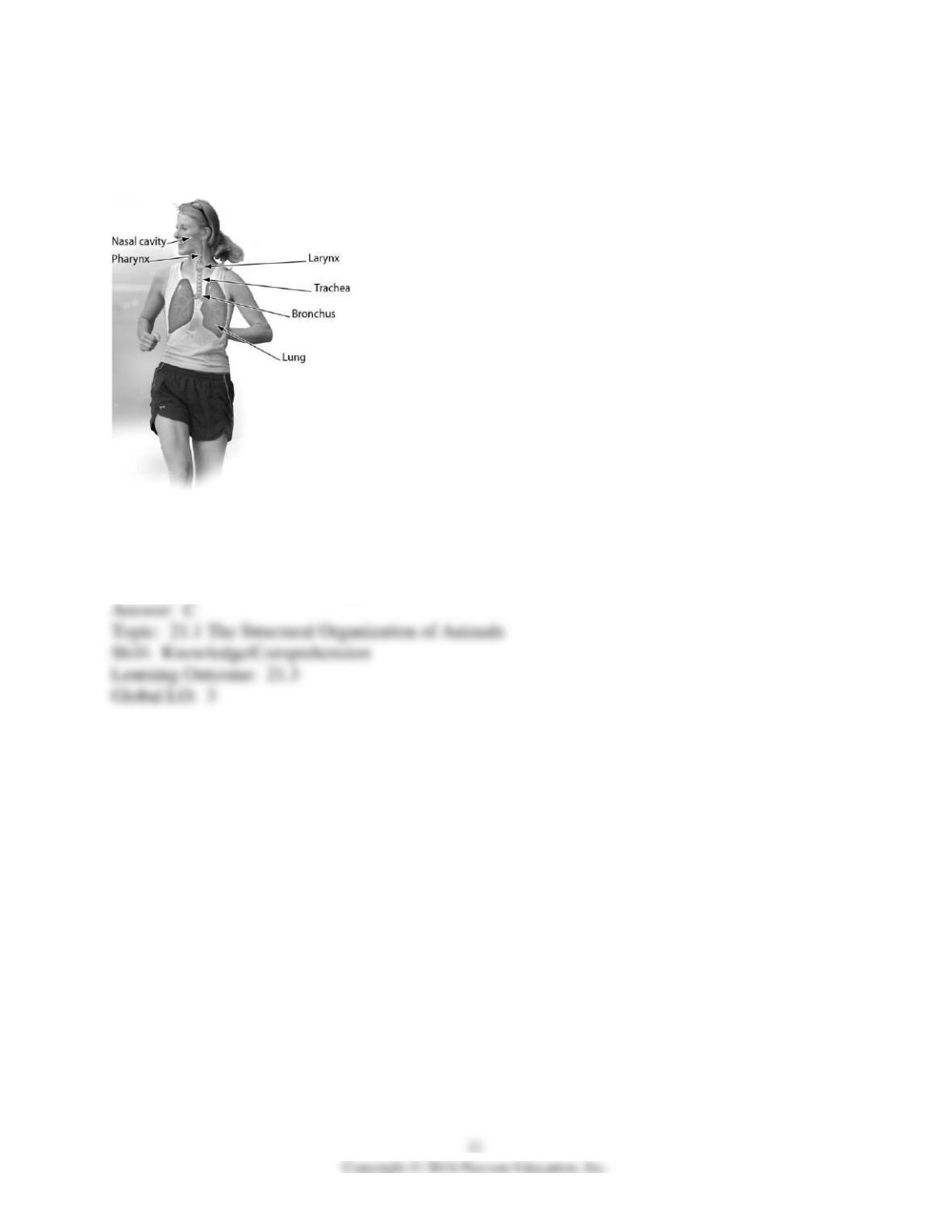
21.2 Art Questions
1) One function of this organ system is ________.
A) thermoregulation
B) excretion
C) exchange of gases between the blood and air
D) transport of substances throughout the body
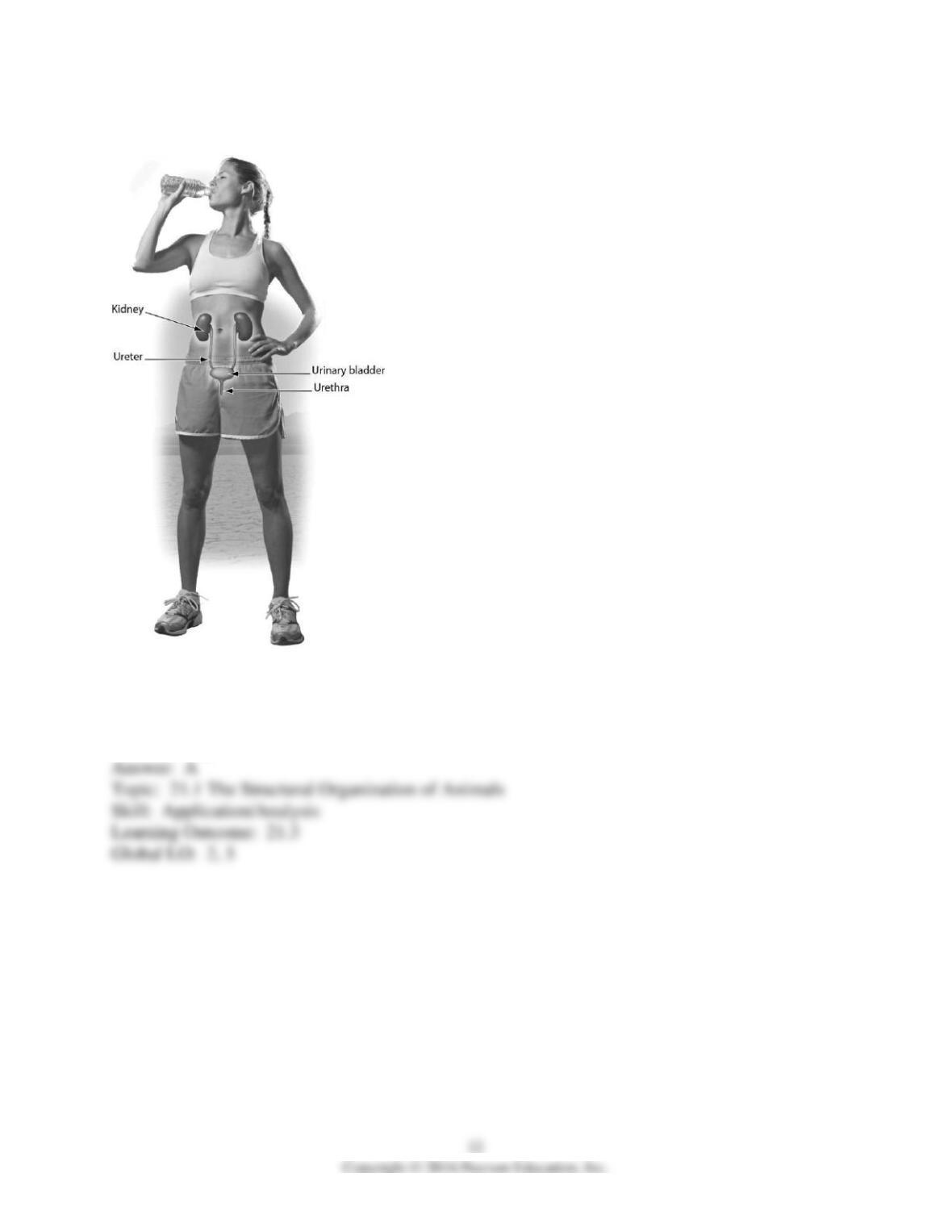
2) One function of this organ system is ________.
A) excretion of urea
B) production of gametes
C) protection of the body
D) thermoregulation
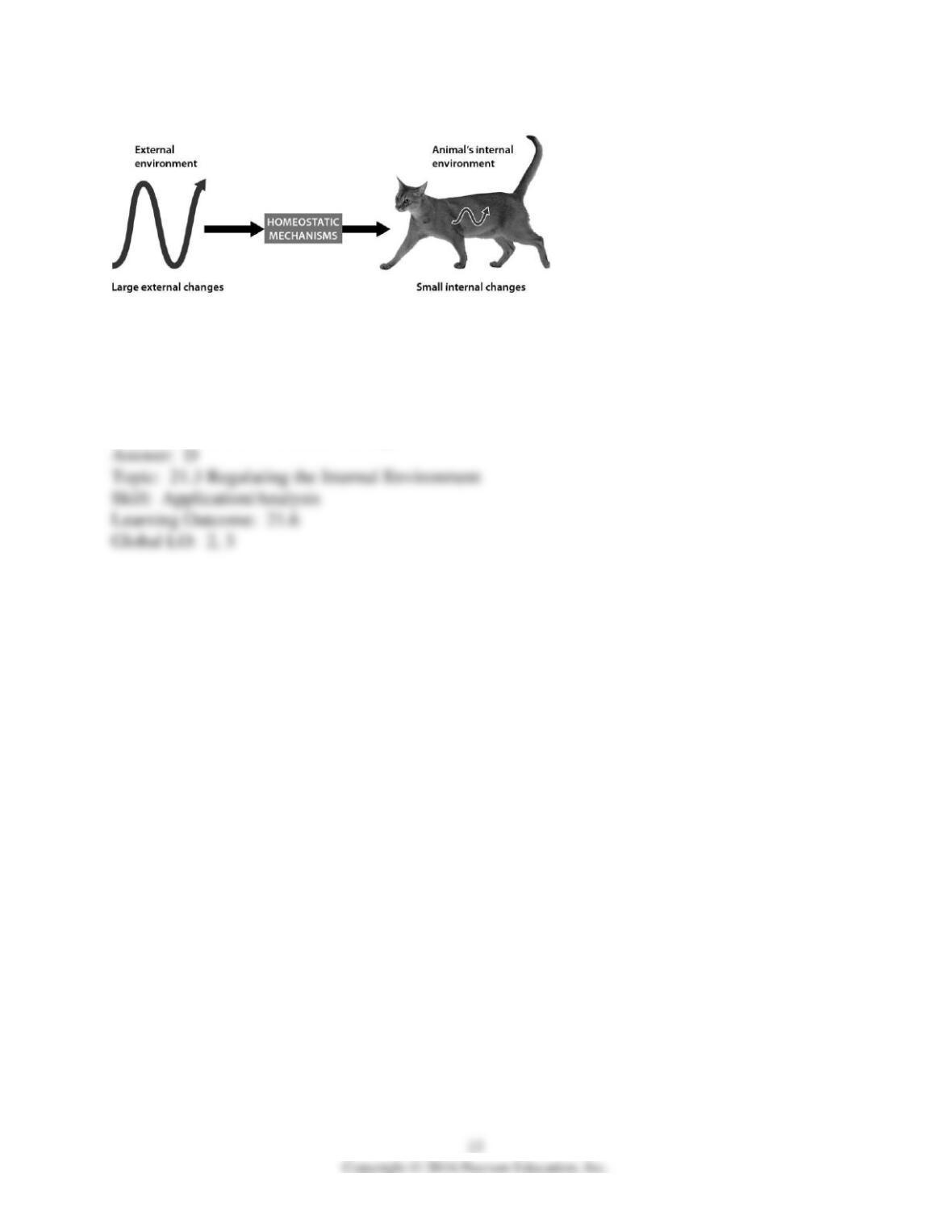
3) The figure below shows that ________.
A) homeostatic mechanisms allow cats to sense their external environments
B) homeostatic mechanisms allow cats to use their internal conditions to affect their external
environments
C) cats experience no variations in their internal conditions
D) homeostatic mechanisms allow cats to maintain relatively constant internal conditions even
when the external environment changes
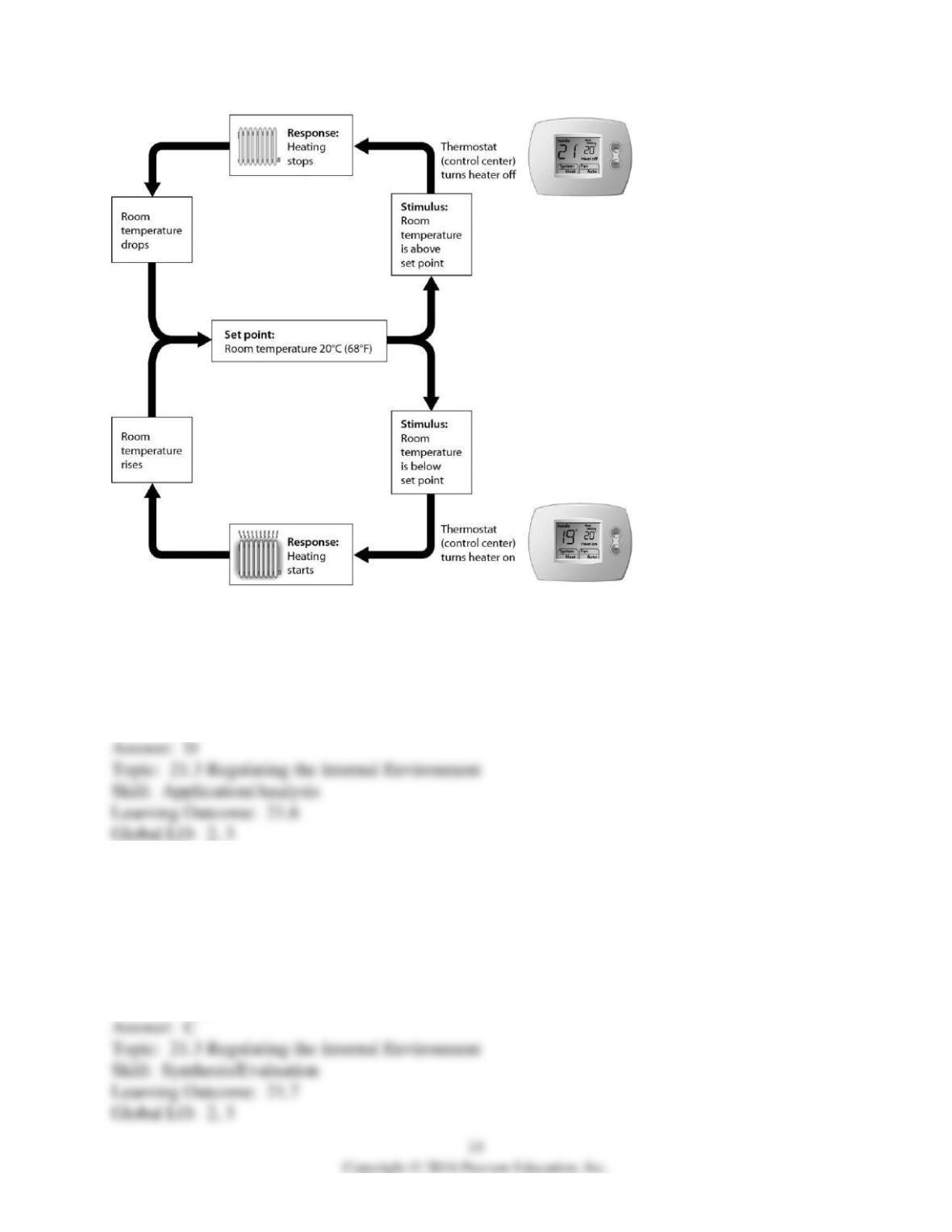
4) Examine the figure above that shows negative feedback in a thermostat. If the room becomes
too warm, the next thing that will occur is ________.
A) heating stops
B) the set point decreases
C) the room cools
D) the heater is turned off
5) Compare how temperature is regulated in a room with a thermostat with how
thermoregulation works in the human body. What is most analogous to “Heating starts” (i.e., heat
is produced) for the human body?
A) Blood vessels constrict near the surface.
B) The person puts on more clothes.
C) Metabolic rate increases.
D) Sweat is produced.
21.3 Scenario Questions
Use the following information to answer the following questions.
The dune-burrowing spider Seothyra species lives in the Namib Desert on the southwestern coast
of Africa. These spiders build silk-lined burrows with a sticky silk mat at the entrance to trap
insect prey. While foraging during the day, the spider remains concealed in its burrow and
shielded from direct sunlight when prey are not present. When insect prey become entangled in
the sticky silk mat, the spider will run out of its burrow and capture the prey insects.
During the day, environmental temperatures vary from 17 to 73°C (63-164°F). If a spider is
forced to remain outside of its burrow, it shows signs of thermal stress at 49°C. When spiders are
unrestrained, they spend more time waiting inside their burrows to keep their internal
temperatures below 49°C, even when surface temperatures are above 65°C. In addition, spiders
respond more quickly to prey stimuli during the hottest times of the day and capture prey in
significantly less time when surface temperatures are above 49°C. The captured arthropods
(prey) tend to succumb more quickly to hot surface temperatures; they are more lethargic and
struggle less when captured at the high temperature ranges.
1) Based on the information in the paragraphs, spiders are ________.
A) ectotherms
B) endotherms
C) sometimes ectotherms and sometimes endotherms
D) neither ectotherms nor endotherms
2) When foraging spiders are too hot, they retreat into their burrows. What type of feedback
system does this indicate?
A) hormonal feedback
B) positive feedback
C) negative feedback
D) positive and negative feedback
3) When spiders show signs of thermal stress, this is an indication that they are unable to
________.
A) move
B) function
C) osmoregulate
D) thermoregulate
To study the effect of ambient (environmental) temperature on the metabolic rate of animals, a
scientist takes a small animal and puts it in a sealed chamber with oxygen. The scientist
measures the amount of oxygen used by the animal at different temperatures. The temperatures
selected are those that the animal normally encounters in nature. The data from this experiment
are in the table below.
Day Temperature (°C) Oxygen consumption [mL O2/(min × g0.75)]
1 10 43
2 15 30
3 20 22
4 25 16
5 30 16
6 35 16
7 40 25
8 45 32
4) The thermoregulatory strategy of the animal studied by the scientist is most likely to be
________.
A) an ectotherm
B) an endotherm
C) one that cannot thermoregulate
D) one that primarily uses behavior to regulate temperature
5) To communicate the results of the experiment best, how should the scientist graph the data?
A) Use a bar graph with oxygen consumption on the x-axis and temperature on the y-axis.
B) Use a line graph with day on the x-axis and temperature on the y-axis.
C) Use a line graph with temperature on the x-axis and oxygen consumption on the y-axis.
D) Use a bar graph with temperature on the x-axis and oxygen consumption on the y-axis.
6) At high temperatures this animal loses water rapidly. To prevent dehydration, this animal’s
nephrons should ________.
A) increase reabsorption
B) decrease reabsorption
C) increase secretion
D) decrease secretion
7) The scientist studies a second animal whose oxygen consumption rises as temperature
increases. The thermoregulatory strategy of the second animal is most likely to be ________.
A) an ectotherm
B) an endotherm
C) one that cannot osmoregulate
D) one that primarily uses metabolism to regulate temperature
8) What best describes the regulatory mechanism described in the scenario?
A) negative feedback
B) positive feedback
C) thermoregulation
D) natural selection
9) Oxytocin controls the contractions of the uterus. Of which type of tissue is the uterus
composed?
A) nervous tissue
B) skeletal muscle
C) smooth muscle
D) epithelium