
Chapter 21 Rickettsias, Chlamydias, Spirochetes, and Vibrios
21.1 Multiple Choice Questions
1) Which of the following bacteria is responsible for the most common bacterial gastroenteritis
in the United States, usually accompanied by frequent, bloody diarrhea?
A) Borrelia recurrentis
B) Campylobacter jejuni
C) Chlamydophila pneumoniae
D) Vibrio cholerae
E) Vibrio vulnificus
2) The rash of spotted fever rickettsiosis is the result of
A) capillary damage.
B) infection of skin cells.
C) allergic reaction to the vector.
D) production of a toxin that causes inflammation.
E) infection of sebaceous glands.
3) Shortly after returning from a trip to several continents, a young man experiences episodes
of fever, chills, muscle aches, and headache that recur at irregular intervals. The young man
reports carrying only a large backpack and commonly staying in hostels along the way while
traveling. Which of the following diseases is he likely to have?
A) anaplasmosis
B) scrub typhus
C) louse-borne relapsing fever
D) Lyme disease
E) yaws

4) What type of cell does Ehrlichia chaffeensis infect in humans?
A) capillary endothelial cells
B) B lymphocytes
C) neutrophils
D) monocytes
E) eosinophils
5) Which of the following is the CORRECT pairing of rickettsial pathogen and vector?
A) R. rickettsia; flea
B) R typhi; tick
C) R prowazekii; louse
D) R. typhi; mite
E) R rickettsia; louse
6) Transovarian transmission is a process in which
A) a pathogen infects the ovaries of the host.
B) a pathogen is transmitted to the host when the host ingests contaminated eggs.
C) an infected female vector transmits the pathogen to the eggs forming in its ovaries.
D) the pathogen is transmitted from an infected male to a healthy female during mating.
E) the pathogen is spread from one host to the next by unprotected sexual intercourse.
7) Rickettsiosis is caused by Rickettsia rickettsii, a pathogen that
A) produces powerful exotoxins.
B) provokes a severe immune response.
C) interferes with the host cell’s Krebs cycle.
D) infects the lining of blood vessels and leads to leaking of plasma into tissue.
E) lyses the host’s cells.

8) Red mites (chiggers) spread ________ among both humans and rodents.
A) Borrelia recurrentis
B) Orientia tsutsugamushi
C) Rickettsia rickettsii
D) Ehrlichia chaffeensis
E) Rickettsia typhi
9) Rickettsia prowazekii is transmitted by
A) mites of the genus Leptotrombidium.
B) the rat flea Xenopsylla cheopis.
C) the human body louse Pediculus humanus.
D) the dog tick Dermacentor.
E) the cat flea Ctenocephalides felis.
10) Which of the following statements regarding Ehrlichia is FALSE?
A) It usually causes a spotted rash similar to Rocky Mountain spotted fever.
B) The organism reproduces inside the host’s phagosomes.
C) It is transmitted by ticks.
D) It is an emerging infectious disease.
E) It has three stages: elementary body, initial body, and morula.
11) People living in the northeastern United States are more at risk for exposure to which of the
following rickettsias?
A) Rickettsia rickettsii
B) Rickettsia typhi
C) Ehrlichia chaffeensis
D) Orientia tsutsugamushi
E) Rickettsia prowazekii

12) Which of the following diseases is considered an emerging disease because it was unknown
before 1987?
A) anaplasmosis
B) Brill-Zinsser disease
C) murine typhus
D) Rocky Mountain spotted fever
E) lymphogranuloma venereum
13) Which of the following microorganisms have been referred to as energy parasites?
A) rickettsias
B) vibrios
C) chlamydias
D) spirochetes
E) Borrelia
14) The endosomes of cells infected with chlamydia are filled up with the form known as
A) elementary bodies.
B) reticulate bodies.
C) inclusion bodies.
D) initial bodies.
E) morula.
15) Which of the following pairs is MISMATCHED?
A) elementary bodies; dormant infectious form
B) reticulate bodies; actively replicate in endosomes
C) elementary bodies; small cocci
D) reticulate bodies; dormant infectious stage
E) inclusion bodies; RB filled endosomes
16) Which of the following is the cause of the STD known as lymphogranuloma venereum?
A) Neisseria gonorrhoeae
B) Haemophilus ducreyi
C) Chlamydia trachomatis
D) Treponema pallidum
E) Chlamydophila psittaci
17) Which of the following is an intracellular parasite of humans that usually causes a mild
pneumonia?
A) Anaplasma phagocytophilium
B) Chlamydophila pneumoniae
C) Chlamydophila psittaci
D) Ehrlichia chaffeensis
E) Rickettsia typhi
18) Among adults Chlamydia trachomatis is an STD, but among children who are not sexually
active, it can cause ocular infections which may be spread
A) by flies.
B) in saliva.
C) on hands.
D) on hands or by flies.
E) by contact with saliva or blood.
19) The sexually transmitted invasive form of chlamydia
A) never infects the baby of an infected mother during birth.
B) is symptomatic in 85% of infected females.
C) is caused by the LGV strain of Chlamydia trachomatis.
D) is easily differentiated from gonorrhea.
E) does not recur because of the immune response the host produces against reinfection.
20) Which of the following statements regarding trachoma is FALSE?
A) It is the leading cause of nontraumatic blindness in humans.
B) It is most often a disease of adults who suffer from sexually transmitted chlamydia.
C) It leads to corneal scarring.
D) It first infects the conjunctiva and kills cells there.
E) Infants may contract the disease while passing through an infected birth canal.
21) Sexually transmitted chlamydia is similar to infection with Yersinia pestis in that they both
can produce
A) urethritis.
B) pelvic inflammatory disease in females.
C) conjunctivitis.
D) buboes.
E) pneumonia.
22) People who handle birds infected with ________ may develop pneumonia-like disease.
A) Chlamydophila pneumonia
B) Chlamydophila psittaci
C) Chlamydia trachomatis
D) Ehrlichia chaffeensis
E) Orientia tsutsugamushi
23) Which of the following is TRUE of spirochetes?
A) They are peritrichous.
B) They are Gram-positive.
C) They are able to penetrate a host’s tissues.
D) They are obligate intracellular organisms.
E) They are pleomorphic.

24) Which of the following is the correct sequence for stages of Ehrlichia development in
infected host cells?
A) initial body, morula, elementary body
B) morula, elementary body, initial body
C) initial body, elementary body, morula
D) elementary body, initial body, morula
E) morula, initial body, morula, elementary body
25) Which of the following is a zoonosis caused by a spirochete?
A) bejel
B) leptospirosis
C) pinta
D) syphilis
E) yaws
26) Treponema pallidum can be transmitted
A) by contact with infected fomites.
B) through sexual intercourse.
C) from an infected mother to her unborn child.
D) both by contact with infected fomites and through sexual intercourse.
E) both through sexual intercourse and from an infected mother to her unborn child.
27) Which of the following statements concerning the causative agent of syphilis is TRUE?
A) It is a large helically coiled bacterium motile by means of endoflagella.
B) It is an intracellular parasite.
C) It is a non-motile comma-shaped bacterium.
D) It is a large bacillus with peritrichous flagella.
E) It is pleomorphic and motile by means of gliding motility.
28) The typical lesion of primary syphilis is
A) purulent sore throat.
B) a generalized rash.
C) the development of buboes in the lymph nodes at the site of infection.
D) a painless reddened lesion called a chancre at the site of infection.
E) gummas in bones, in nervous tissues, or on the skin.
29) The Ixodes tick can infect humans with Borrelia burgdorferi during which stage(s) of its
life cycle?
A) only as a larva
B) only as a nymph
C) only as an adult
D) either as a nymph or an adult
E) either as a larva or a nymph
30) The signs and symptoms of infection with Helicobacter pylori are the result of
A) damage to the lining of blood vessels by H. pylori.
B) invasion by H. pylori into the mucosa of the large intestine.
C) invasion by H. pylori into the mucosa of the stomach.
D) the production of exotoxins by H. pylori in the intestines.
E) the production of toxins by H. pylori in contaminated food.
31) What characteristic of Borrelia burgdorferi makes it an unusual bacterium?
A) It is a Gram-negative bacterium that lacks an LPS layer.
B) It is a spirochete that is motile.
C) It causes damage to multiple organ systems.
D) Transovarian transmission of the pathogen is rare.
E) It is transmitted by an arthropod vector.
32) How can Leptospira interrogans be distinguished from other spirochetes?
A) It stains purple with the Gram stain.
B) One end of the bacterium looks like a question mark.
C) It is highly motile.
D) It can be found in multiple locations in the body.
E) It cannot be cultured on laboratory media.
33) What characteristic does Vibrio share with Salmonella?
A) Both have O polysaccharide antigens.
B) Both are oxidase positive.
C) Both have polar flagella.
D) Both have similar shape.
E) Both are spread primarily by fecal contamination.
34) The most important virulence factor of Vibrio cholerae is
A) the presence of two axial flagella.
B) the fact that it is oxidase positive.
C) its ability to survive in fresh water.
D) its ability to produce a potent exotoxin.
E) its ability to live in estuarine and marine environments all over the world.
35) A young woman who was recently hiking in the mountains and discovered a tick on her
torso has a fever that came on quite suddenly. She has no rash, but she develops leukopenia.
Which of the following diseases is she most likely to have contracted?
A) anaplasmosis
B) Lyme disease
C) relapsing fever
D) Rocky Mountain spotted fever
E) scrub typhus
36) Which of the following causes pinta, a skin disease primarily of children, in which
spirochetes are detectable in specimens from the lesions?
A) Borrelia recurrentis
B) Leptospira interrogans
C) Treponema carateum
D) Treponema pallidum pertenue
E) Treponema pallidum pallidum
37)
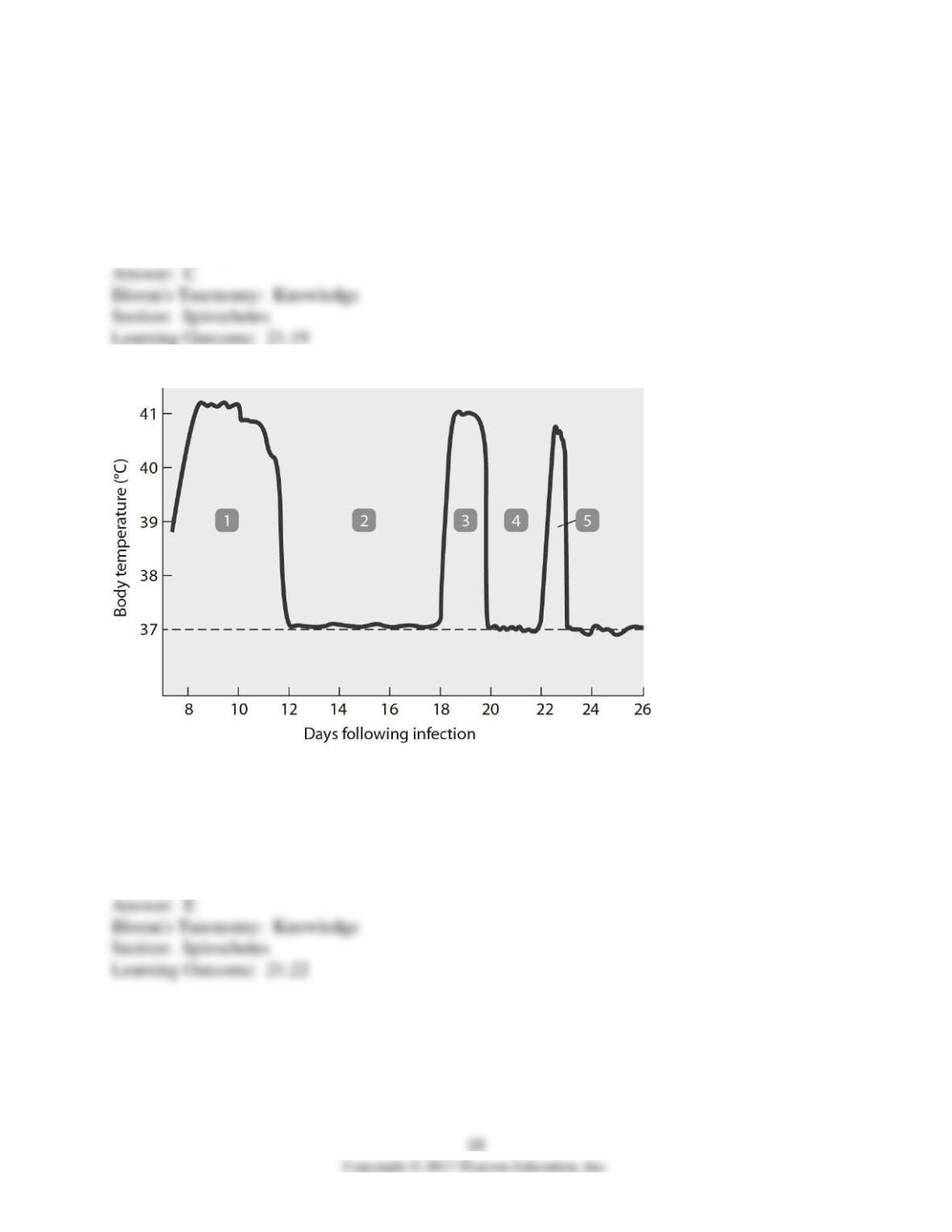
The pattern of fever shown in Figure 21.1 is most commonly seen with
A) yaws.
B) Lyme disease.
C) lymphogranuloma venereum.
D) syphilis.
E) relapsing fever.
38) Epidemic typhus, spread by lice, is caused by
A) Chlamydophila pneumonia.
B) Chlamydophila psittaci.
C) Ehrlichia caffeensis.
D) Rickettsia prowazekii.
E) Rickettsia typhi.
39) The intracellular parasite ________ infects cells of the conjunctiva and mucous membranes
throughout the body.
A) Anaplasma phagocytophilium
B) Chlamydia trachomatis
C) Orientia tsutsugamushi
D) Ehrlichia caffeensis
E) Helicobacter pylori
40) The bacterium ________ is a common cause of bacterial gastroenteritis contracted from
contaminated food, especially poultry.
A) Campylobacter jejuni
B) Helicobacter pylori
C) Vibrio cholerae
D) Leptospira interrogans
E) Vibrio parahaemolyticus
41) Ornithosis, caused by ________, is usually a pneumonia-like disease but can sometimes
lead to hepatitis or endocarditis.
A) Chlamydia trachomatis
B) Chlamydophila pneumoniae
C) Chlamydophila psittaci
D) Rickettsia prowazekii
E) Orientia tsutsugamushi

42) The STD characterized by three distinctly different symptomatic stages is the result of
infection with
A) Chlamydia trachomatis.
B) Leptospira interrogans.
C) Treponema carateum.
D) Treponema pallidum pallidum.
E) Treponema pallidum pertenue.
43) Infection with ________ may result in peptic ulcers and stomach cancer.
A) Campylobacter jejuni
B) Helicobacter pylori
C) Borrelia recurrentis
D) Vibrio parahaemolyticus
E) Rickettsia rickettsii
44) A gastroenteritis which usually resolves in 72 hours is contracted from eating shellfish
contaminated with
A) Campylobacter jejuni.
B) Ehrlichia caffeensis.
C) Helicobacter pylori.
D) Vibrio cholera.
E) Vibrio parahaemolyticus.
45) Infection with ________ produces symptoms similar to RMSF, except for the rash, making
it difficult to diagnose.
A) Anaplasma phagocytophilium
B) Chlamydophila psittaci
C) Chlamydia trachomatis
D) Treponema carateum
E) Vibrio vulnificus
21.2 True/False Questions
1) Chlamydia trachomatis produces a dormant, resistant stage for transmission from one host to
another.
2) All of the rickettsias are spread by transovarian transfer.
3) Campylobacter gastroenteritis is usually caused by ingestion of contaminated poultry.
4) Vibrio vulnificus causes septicemia that is self-limiting and rarely fatal.
5) A positive urease test in cultures from gastric secretions provides preliminary identification
of Helicobacter pylori.
6) All stages of Ixodes, the vector for Lyme disease, may feed on humans.
7) Small doses of antimicrobial agents are very effective in treating the late stages of Borrelia
infection because most of the symptoms result from immune responses.
8) Cholera toxin causes intestinal cells to secrete large amounts of electrolytes, resulting in a
very watery diarrhea.
9) An expanding rash that resembles a bull’s-eye is a characteristic of secondary syphilis.
10) Humans are the only hosts of Rickettsia rickettsii.
21.3 Short Answer Questions
1) A distinctive feature of Rocky Mountain Spotted Fever (RMSF) rash is that is appears on the
(limbs/face/palms) as well as the trunk.
2) If the mother has (chlamydia/syphilis/yaws) at the time of birth, the pathogen can infect the
newborn’s eyes and may cause blindness.
3) The zoonosis known as RMSF is the result of infection with Rickettsia
(prowazekii/rickettsii/typhi).
4) The (body louse/cat flea/dog tick) is the primary vector of epidemic typhus.
5) Contamination of eating utensils from oral lesions spreads (bejel/pinta/yaws) among children
in impoverished areas of the world.
6) A disease of birds that can be transmitted to humans is
(campylobacteriosis/Lyme/ornithosis).
7) The infectious form of chlamydia is the (elementary/initial/inclusion) body.
8) Helicobacter pylori produces (cytotoxin/hyaluronidase/urease), a unique virulence factor
important to colonizing the digestive system.
9) The reservoir for Orientia tsutsugamushi is (humans/mites/rodents).
10) The characteristic lesion for tertiary syphilis is the presence of
(gummas/necrosis/granulomas) in bones, in nervous tissue, or on the skin.
11) Untreated syphilis may persist in a latent state for (months/years/decades) before
manifesting as tertiary syphilis.
12) Borrelia burgdorferi is an unusual bacterium that lacks iron-containing enzymes and
proteins and causes (Brill-Zinser/Lyme/RMSF) disease in humans.
13) Louse-borne relapsing fever is caused by a spirochete known as Borrelia
(burgdorferi/recurrentis/interrogans), which is capable of frequently changing its antigenic
surface components.
14) Leptospira interrogans exits the body in (feces/aerosols/urine).
15) The normal habitat for Vibrio cholerae is (humans/animals/water).
21.4 Essay Questions
1) A patient was admitted to the emergency department suffering from severe diarrhea that had
lasted a couple of days. There had already been significant weight loss. On examination, his
stool was very watery with white bits of mucus and little odor. What pathogen is likely causing
this condition, and how does it cause disease?
2) Explain why modern treatment of a peptic ulcer includes administering an antibacterial
agent. Discuss the cause.
3) Relapsing fever is characterized by recurring episodes of fever and septicemia separated by
symptom-free intervals. What causes this pattern?
4) Compare and contrast the pathogenesis of the sexually transmitted diseases chlamydia and
syphilis.
5) Explain what is meant by describing chlamydias as “energy parasites.”