
Microbiology with Diseases by Body System, 5e (Bauman)
Chapter 21 Microbial Cardiovascular and Systemic Diseases
21.1 Multiple Choice Questions
1) Which of the following vessels carries blood from the heart to the rest of the body?
A) the aorta
B) the superior vena cava
C) the inferior vena cava
D) the pulmonary arteries
E) capillaries
2) The chambers and valves of the heart are lined by the
A) pericardium.
B) myocardium.
C) endocardium.
D) erythrocytes.
E) vena cava.
3) Blood returning from circulation through the body first enters the
A) left ventricle.
B) right atrium.
C) right ventricle.
D) pulmonary vein.
E) left atrium.

4) A blood sample from a patient is examined on a microscope. Bacterial cells are detected in the
sample. The patient has
A) bacteremia.
B) lymphangitis.
C) toxemia.
D) lipidemia.
E) viremia.
5) Infection of the lymphatic vessels is known as
A) disseminated intravascular coagulation.
B) bacteremia.
C) lymphangitis.
D) petechiae.
E) recurrent fever.
6) Toxic shock syndrome (TSS) is associated with
A) Pseudomonas aeruginosa.
B) Staphylococcus aureus.
C) Streptococcus pyogenes.
D) Neisseria meningitidis.
E) both Staphylococcus aureus and Streptococcus pyogenes.
7) A person is brought to the emergency room with constant high fever, extensive edema, low
blood pressure, and petechiae. From which of the following may the person be suffering?
A) septicemia
B) plague
C) Lyme disease
D) brucellosis
E) infectious mononucleosis

8) Disseminated intravascular coagulation (DIC) is a complication resulting from the
A) release of cytotoxins.
B) triggering of the complement system.
C) attachment of bacterial cells to the endocardium.
D) release of heme from damaged RBCs.
E) release of lipid A from dying Gram-negative bacteria.
9) Vegetations are associated with which of the following disease processes?
A) septicemia
B) endocarditis
C) tularemia
D) plague
E) toxoplasmosis
10) Unprotected contact with the bodily fluids of an infected animal may result in
A) African sleeping sickness.
B) brucellosis.
C) blackwater fever.
D) Lyme disease.
E) toxoplasmosis.
11) The chief diagnostic sign of brucellosis is
A) petechiae.
B) jaundice.
C) “bull’s eye” rash.
D) fever which recurs at 24 hour intervals.
E) fever which cycles every 72 hours.

12) Which of the following is/are a reservoir for Francisella tularensis?
A) rabbits
B) ticks
C) humans
D) rabbits and ticks
E) humans, rabbits and ticks
13) Fever, difficulty breathing, extreme fatigue, and elevated heart rate are characteristic of
A) Bang’s disease.
B) ehrlichiosis.
C) infectious mononucleosis.
D) plague.
E) endocarditis.
14) The normal habitat of ________ is rodents, but humans bitten by fleas carrying the pathogen
have fever, severely inflamed lymph nodes, and headache. Later, areas of black, necrotic tissue
may develop.
A) Clostridium perfringens
B) Yersinia pestis
C) Francisella tularensis
D) Borrelia burgdorferi
E) Toxoplasma gondii
15) Which of the following is characteristic of Yersinia pestis infections?
A) petechiae
B) a “bull’s-eye” rash
C) jaundice
D) arthritis
E) buboes
16) How does Borrelia burgdorferi evade the body’s defenses?
A) It has a polysaccharide capsule.
B) It has manganese-containing enzymes.
C) It is capable of antigenic variation.
D) It has a polysaccharide capsule and antiphagocytic proteins.
E) It is capable of antigenic variation and has manganese-containing enzymes.
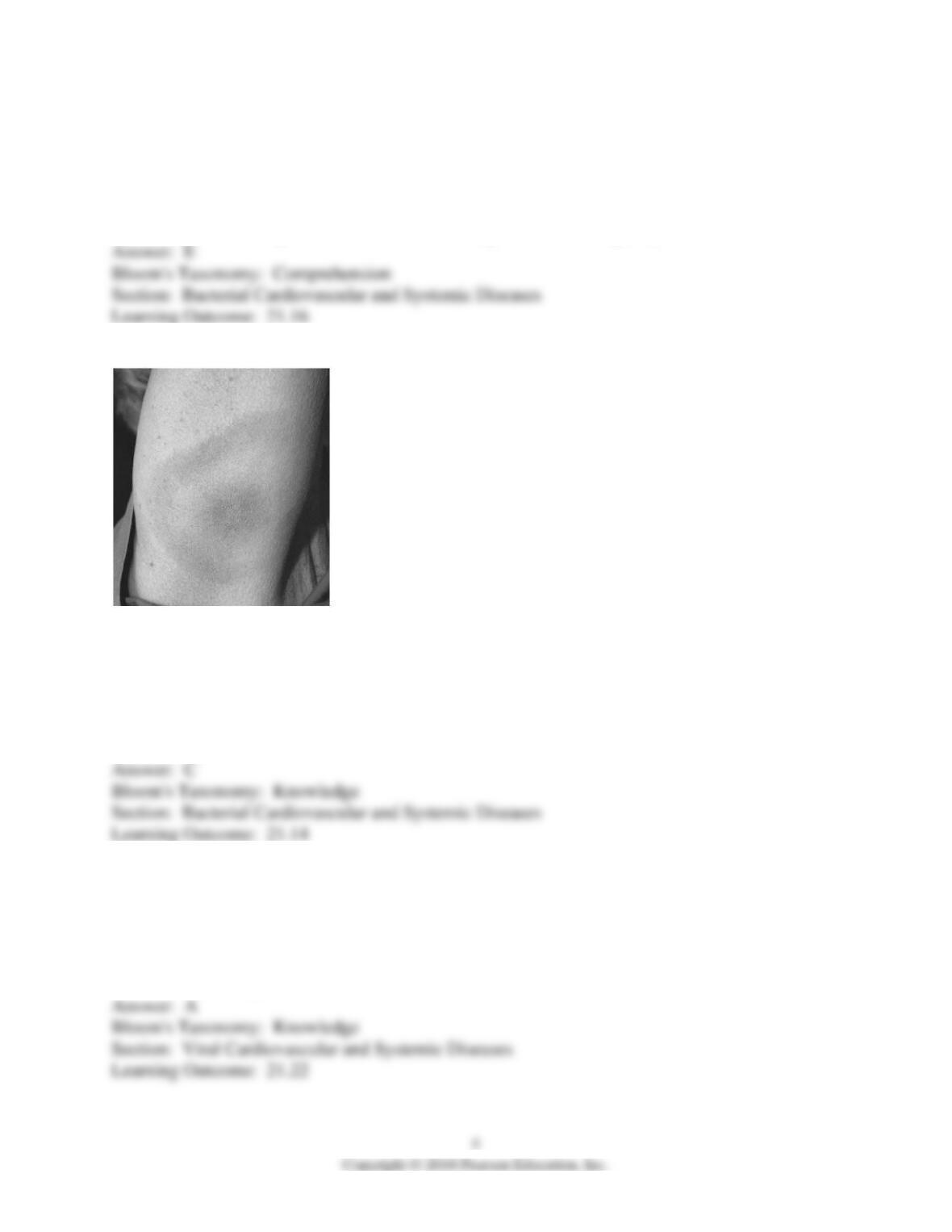
17)
The appearance of this rash is characteristic of infections with which of the following?
A) Francisella tularensis
B) dengue virus
C) Borrelia burgdorferi
D) Epstein-Barr virus
E) Yersinia pestis
18) Primary infection with Epstein-Barr virus is known as
A) infectious mononucleosis.
B) Burkitt’s lymphoma.
C) Hodgkin’s lymphoma.
D) chronic fatigue syndrome.
E) oral hairy leukoplakia.
19) Epstein-Barr virus infections are typically asymptomatic in ________ because of incomplete
development of adaptive immunity.
A) the elderly
B) AIDS patients
C) adolescents
D) adults
E) young children
20) A few days of fever with vomiting followed by high fever, jaundice, and “black vomit” are
characteristic of
A) malaria.
B) dengue fever.
C) Chagas’ disease.
D) yellow fever.
E) schistosomiasis.
21) Cycles of fever, chills, anemia and headache along with passage of dark colored urine are the
symptoms of infection with
A) yellow fever virus.
B) P. vivax.
C) P. ovale.
D) P. falciparum.
E) dengue virus.
22) Schizogony is an important aspect of which of the following pathogens?
A) Yersinia pestis
B) Plasmodium species
C) Toxoplasma gondii
D) Trypanosoma cruzi
E) Schistosoma mansoni

23) Dengue hemorrhagic fever is the result of
A) an immediate immune reaction to the initial infection with dengue virus.
B) an antibody-antigen complex reaction.
C) a hyperimmune response to reinfection with dengue virus.
D) an autoimmune disease.
E) the chronic carrier state associated with dengue virus infection.
24) A young woman develops a fever after a recent trip to a Caribbean island. She also
experiences severe headache and pain “in the bones.” After a few days, she also develops a rash.
Which of the following did she most likely contract?
A) yellow fever virus
B) dengue virus
C) malaria
D) Toxoplasma
E) Chagas’ disease
25) Which of the following is/are transmitted by Aedes mosquitoes?
A) dengue fever
B) yellow fever
C) malaria
D) both dengue fever and yellow fever
E) dengue fever, yellow fever, and malaria

26) A large number of people in an African village become ill a couple of weeks after sharing a
feast of stew made from the meat of jungle animals. They initially have fever, headache and
fatigue, and develop petechiae. Most then experience bloody diarrhea and vomiting, and a few
days later begin bleeding from the mouth and eyes. What is the most likely preliminary
diagnosis?
A) dengue hemorrhagic fever
B) ebola hemorrhagic fever
C) yellow fever
D) malaria
E) African trypanosomiasis
27) Which of the following is known to be teratogenic?
A) Epstein-Barr virus
B) cytomegalovirus
C) Plasmodium
D) Borrelia
E) dengue virus
28) Depletion of clotting proteins from the serum leads to the uncontrollable hemorrhaging seen
in ________ infections.
A) yellow fever virus
B) malaria
C) dengue virus
D) Ebola virus
E) Epstein-Barr virus
29) Plasmodium species reproduce sexually in
A) birds.
B) Aedes mosquitoes.
C) Ixodes ticks.
D) humans.
E) Anopheles mosquitoes.
30) Which of the following is the infective form of Trypanosoma cruzi?
A) epimastigotes
B) trypomastigotes
C) pseudocysts
D) amastigotes
E) miricidia
31) Plasmodium falciparum produces proteins that cause ________ in addition to the anemia due
to erythrocyte destruction.
A) DIC
B) toxemia
C) black vomit
D) capillary damage
E) damage to the heart muscle
32) Which of the following diseases is a major problem for AIDS patients?
A) Chagas’ disease
B) toxoplasmosis
C) hemorrhagic fevers
D) Lyme disease
E) brucellosis
33) Which of the following statements concerning Toxoplasma infection is CORRECT?
A) It is a rare infection.
B) It is transmitted by biting insects.
C) It is typically contracted by eating undercooked meat.
D) Freshwater snails are intermediate hosts.
E) In most individuals, the infection results in lasting damage to the heart.
34) Lyme disease becomes chronic because
A) Borrelia changes its surface antigens frequently.
B) Borrelia can lie dormant in liver cells.
C) the bacterium resists phagocytosis.
D) Borrelia is an intracellular parasite of erythrocytes.
E) the bacterium resists phagocytosis and “hides” erythrocytes.
35) Infection with Schistosoma species is acquired by
A) mosquito bite.
B) tick bite.
C) eating undercooked meat.
D) eating undercooked fish.
E) wading or swimming in fresh water.
36) Another name for brucellosis is ________ fever.
A) blackwater
B) yellow
C) snail
D) rabbit
E) undulant

37) The normal hosts for Ebola viruses are probably
A) birds.
B) cats.
C) rodents.
D) bats.
E) humans.
38) An indication of infection with Human herpesvirus 4 is
A) “swimmer’s itch.”
B) “bull’s eye” rash.
C) a bubo.
D) high fever and sore throat.
E) an ulcerating sore.
39) Which of the following diseases is currently vaccine-preventable in humans?
A) schistosomiasis
B) malaria
C) Lyme disease
D) plague
E) yellow fever
40) A young man living in the Southeastern U.S. is an avid outdoorsman and has a history of tick
bites. Blood tests show that he has leukopenia.. He may have contracted
A) brucellosis.
B) tularemia.
C) Lyme disease.
D) ehrlichiosis.
E) Chagas’ disease.
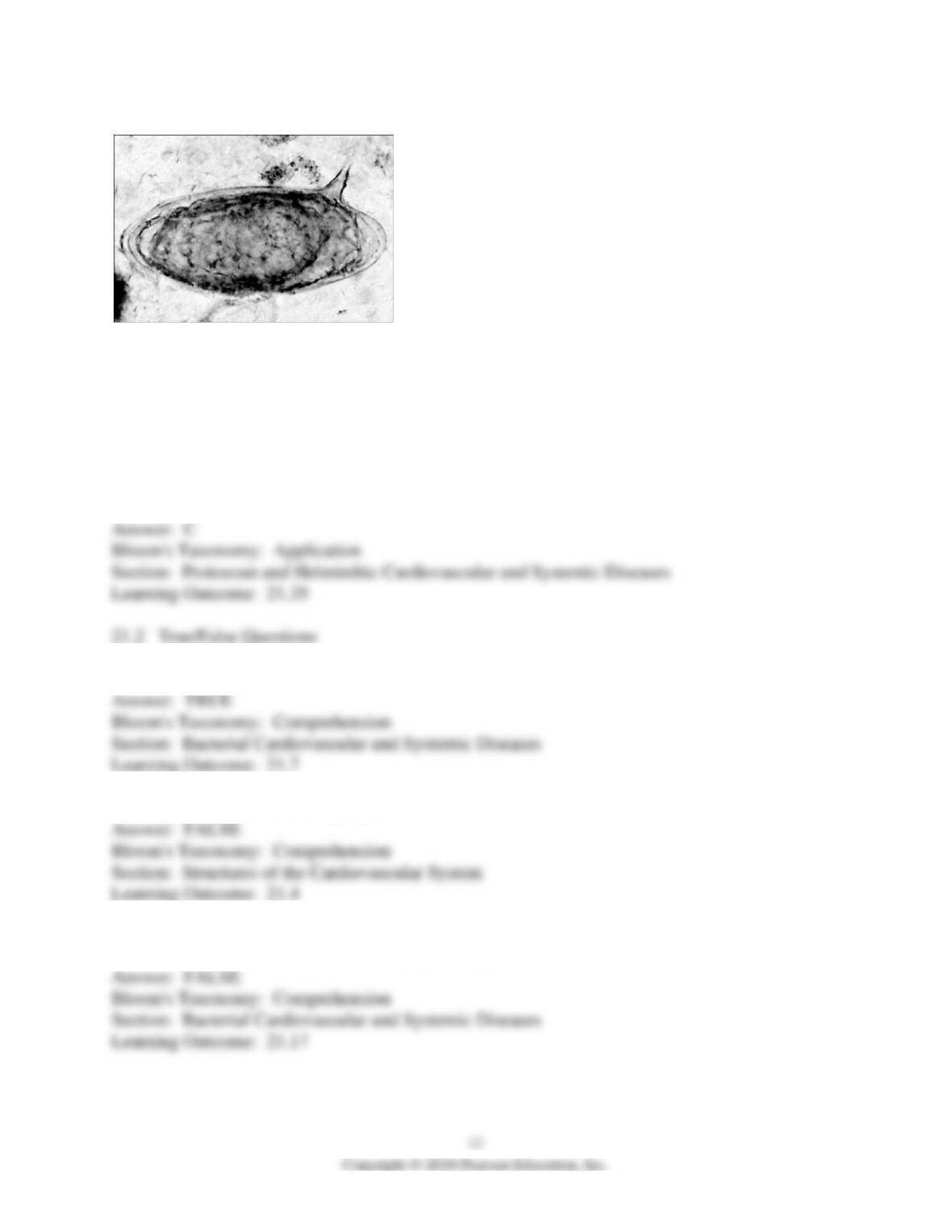
41)
A person reports to a clinic complaining of fever and abdominal pain. The abdomen is swollen,
and blood tests indicate kidney damage. A stool sample is examined under a microscope and
found to contain the egg shown in the figure. The indications are consistent with infection with
A) Plasmodium falciparum.
B) Anaplasma phagocytophilium.
C) Schistosoma mansoni.
D) Toxoplasma gondii.
E) Trypanosoma cruzi.
1) Lipid A can cause septic shock.
2) Lymph is produced in the lymph nodes.
3) Small doses of antimicrobial drugs are effective in treatment of the late stages of Borrelia
infection because the microbe is extremely susceptible.
4) The terms “bacteremia” and “septicemia” are synonymous.
5) Patients with occult septicemia are asymptomatic.
6) The three developmental stages of Ehrlichia are the elementary body, the initial body, and the
morula.
7) Human herpesvirus 4 is better known as cytomegalovirus.
8) Both bubonic and pneumonic plague cause the formation of buboes and tissue necrosis of the
extremities.
9) Cytomegalovirus may be latent for years and reactivate when immunosuppression occurs.
10) People with genes for a form of hemoglobin known as hemoglobin C are at risk of fatal
malaria disease.
21.3 Short Answer Questions
1) The release of bacterial toxins into the blood leads to (bacteremia/septicemia/toxemia).
2) Blood returns to the heart from the lungs through the pulmonary (arteries/veins/valves).
3) When bacteria in the bloodstream invade the bones, this leads to a painful condition called
(endocarditis/osteomyelitis/lymphangitis).
4) Anaplasma primarily infects (erythrocytes/monocytes/neutrophils).
5) The zoonosis known as (ehrlichiosis/plague/tularemia) is transmitted to humans by fleas.
6) One of the factors leading to the initial characterization of Lyme disease in 1975 was the
greater-than-expected incidence of (arthritis/osteomyelitis/mononucleosis) among children.
7) It is the (larvae/nymph/adult) stage of the tick genus Ixodes that most often transmits Lyme
disease to humans.
8) Epstein-Barr virus causes the cells it infects to become immortal because it suppresses
(apoptosis/cytolysis/oncogenesis).
9) Cytomegalovirus infection of the retina is now treated with
(interferon/fomivirsen/ganciclovir), the first antisense RNA drug.
10) Yellow fever is named for the (anemia/jaundice/vomiting) it typically causes.
11) The intermediate host for Schistosoma mansoni is a (mosquito/tick/snail).
12) The Ebola and Marburg viruses are the sole members of the
(Flaviviridae/Filoviridae/Herpesviridae) family, named for their unusual filamentous form. (Be
sure to use proper form.)
13) Plasmodium (gametocytes/merozoites/sporozoites) reproduce by schizogony in humans.
14) The final stage of Chagas’ disease is typically fatal because the parasite infects cells of the
(blood/heart/liver).
15) True bugs in the genus (Aedes/Ixodes/Triatoma) transmit Chagas’ disease. (Be sure to use
proper nomenclature form.)
21.4 Essay Questions
1) Explain the difference between bacteremia and septicemia, and describe some of the factors
that can lead to septicemia.
2) Compare and contrast bubonic and pneumonic plague.
3) List and describe the three stages of malaria, paying attention to the various forms of the
protozoan parasite present in each stage of the disease.
4) Compare and contrast dengue hemorrhagic fever and Ebola hemorrhagic fever. Discuss both
the pathogens and the pathology.
5) How does the age of the infected individual play a role in the development of Epstein-Barr
virus (HHV-4) infections such as infectious mononucleosis?