Campbell Biology in Focus, 2e (Urry)
Chapter 21 The Evolution of Populations
21.1 Multiple-Choice Questions
1) If, on average, 46% of the loci in a species’ gene pool are heterozygous, then the average
homozygosity of the species should be
A) 23%.
B) 46%.
C) 54%.
D) There is not enough information to say.
2) Which statement about the beak size of finches on the island of Daphne Major during
prolonged drought is true?
A) Each bird evolved a deeper, stronger beak as the drought persisted.
B) Each bird’s survival was strongly influenced by the depth and strength of its beak as the
drought persisted.
C) Each bird that survived the drought produced only offspring with deeper, stronger beaks than
seen in the previous generation.
D) The frequency of the strong-beak alleles increased in each bird as the drought persisted.
3) Which of the following is a true statement concerning genetic variation?
A) It is created by the direct action of natural selection.
B) It arises in response to changes in the environment.
C) It must be present in a population before natural selection can act upon the population.
D) It tends to be reduced by the processes involved when diploid organisms produce gametes.
E) A population that has a higher average heterozygosity has less genetic variation than one with
a lower average heterozygosity.
4) How did Mendel’s model of inheritance help explain Darwin’s theory of natural selection?
A) by observations of individuals differences in traits
B) by proposing mechanism of how organisms transmit discrete heritable units
C) by explaining natural selection of genetic differences
D) by leading to evolutionary change
5) How can genetic variation at the whole gene level (gene variability) be quantified?
A) by the average percentage of loci that are heterozygous
B) by the average percentage of loci that are homozygous
C) by nucleotide variability
D) by the differences in noncoding DNA
6) Why don’t similar genotypes always produce the same phenotype?
A) Phenotype is the product of many environmental influences.
B) Parents alter their phenotypes and pass on this phenotype to progeny.
C) Animals display different phenotypes dependent on diet, not genotype.
D) Genetic variants of ADH enzyme produce the same phenotype.
7) Which of the following describes a mechanism for generating more genes?
A) translocation
B) duplication
C) meiosis
D) gametogenesis
8) Which process in sexual reproduction results in diversity at the nucleotide level?
A) chromosome shuffling
B) chromosome crossover
C) independent assortment of chromosomes
D) random distribution of chromosomes
9) Whenever diploid populations are in Hardy-Weinberg equilibrium at a particular locus,
A) the allele’s frequency should not change from one generation to the next, but its
representation in homozygous and heterozygous genotypes may change.
B) natural selection, gene flow, and genetic drift are acting equally to change an allele’s
frequency.
C) this means that, at this locus, two alleles are present in equal proportions.
D) the population itself is not evolving, but individuals within the population may be evolving.
10) In the formula for determining a population’s genotype frequencies, the 2 in the term 2pq is
necessary because
A) the population is diploid.
B) heterozygotes can come about in two ways.
C) the population is doubling in number.
D) heterozygotes have two alleles.
11) In the formula for determining a population’s genotype frequencies, the pq in the term 2pq is
necessary because
A) the population is diploid.
B) heterozygotes can come about in two ways.
C) the population is doubling in number.
D) heterozygotes have two alleles.

12) In a Hardy-Weinberg population with two alleles, A and a, that are in equilibrium, the
frequency of the allele a is 0.3. What is the frequency of individuals that are homozygous for this
allele?
A) 0.09
B) 0.49
C) 0.9
D) 9.0
13) In peas, a gene controls flower color such that R = purple and r = white. In an isolated pea
patch, there are 36 purple-flowering plants and 64 white-flowering plants. Assuming Hardy-
Weinberg equilibrium, what is the value of q for this population?
A) 0.36
B) 0.64
C) 0.75
D) 0.80
14) Which statement about variation is true?
A) All phenotypic variation is the result of genotypic variation.
B) All genetic variation produces phenotypic variation.
C) All nucleotide variability results in neutral variation.
D) All new alleles are the result of nucleotide variability.
E) All geographic variation results from the existence of clines.
15) What is a population in biology?
A) when a group of individuals of the same species live in the same area and interbreed
B) when a group of individuals live in the same area and share resources
C) when a group of individuals of different species live in the same area
D) when closely related organisms share a low frequency of alleles
16) What is the Hardy-Weinberg equation?
A) an assessment of evolution at a particular locus
B) a determination of allele frequency
C) a determination of genotype frequency
D) an assessment of heterozygosity in a population
17) The frequency of individuals born in a population with PKU is q2. There is one PKU (q2)
birth per 10,000 births. The frequency of the recessive allele for PKU in this population is q =
0.01. The frequency of the dominant allele in this population is p = 1 — q = 0.99. What is the
frequency of carriers (2pq) in this population?
A) 1%
B) 2%
C) 3%
D) 4%
18) In evolution, which driving factor most consistently requires a small population as a
precondition for its occurrence?
A) mutation
B) nonrandom mating
C) genetic drift
D) natural selection
19) Evolution
A) must happen, due to organisms’ innate desire to survive.
B) must happen whenever a population is not well adapted to its environment.
C) can happen whenever any of the conditions for Hardy-Weinberg equilibrium are not met.
D) requires the operation of natural selection.
20) Over time, the movement of people on Earth has steadily increased. This has altered the
course of human evolution by increasing
A) nonrandom mating.
B) geographic isolation.
C) genetic drift.
D) gene flow.
21) If the original finches that had been blown over to the Galápagos Islands from South
America had already been genetically different from the parental population of South American
finches, even before adapting to the Galápagos, this would have been an example of
A) genetic drift.
B) the bottleneck effect.
C) the founder effect.
D) genetic drift and the founder effect.
22) Which of the following statements best summarizes evolution as it is viewed today?
A) It represents the result of selection for acquired characteristics.
B) It is synonymous with the process of gene flow.
C) It is the descent of humans from the present-day great apes.
D) It is the differential survival and reproduction of the most-fit phenotypes.
23) What is the founder effect?
A) a selection of the best-suited traits for the environment
B) a series of chance events that change allele frequency
C) when a few individuals become isolated from a larger population, and their gene pool differs
from that source population
D) a sudden change in the environment that reduces the size of the population
24) Which one of the genetic drift effects would limit natural selection?
A) allele frequencies change at random
B) loss of genetic variation
C) cause harmful alleles to be fixed
D) alter frequencies in small population
25) How can gene flow improve adaptation of population?
A) alleles mutate in different geographical areas
B) alleles increase in frequency in original population
C) beneficial alleles are transferred to a new population
D) allele frequencies decrease in new population
26) What is true of natural selection?
A) Natural selection is a random process.
B) Natural selection creates beneficial mutations.
C) The only way to eliminate harmful mutations is through natural selection.
D) Mutations occur at random; natural selection can preserve and distribute beneficial mutations.
27) What is the result of adaptive evolution?
A) formation of new genetic variants
B) sorting by natural selection
C) increase in frequency of alleles that provide reproductive advantage
D) survival of the fittest

28) Which of the following attributes has the least effect on the contribution an individual makes
to the gene pool of the next generation?
A) more efficient at obtaining food
B) produces more offspring
C) camouflages from predators
D) spars for mating privileges
29) The restriction enzymes of bacteria protect the bacteria from successful attack by
bacteriophages, whose genomes can be degraded by the restriction enzymes. The bacterial
genomes are not vulnerable to these restriction enzymes because bacterial DNA is methylated.
This situation selects for bacteriophages whose genomes are also methylated. As new strains of
resistant bacteriophages become more prevalent, this in turn selects for bacteria whose genomes
are not methylated and whose restriction enzymes instead degrade methylated DNA. The
outcome of the conflict between bacteria and bacteriophage at any point in time results from
A) frequency-dependent selection.
B) evolutionary imbalance.
C) heterozygote advantage.
D) neutral variation.
30) Sexual dimorphism is most often a result of
A) pansexual selection.
B) stabilizing selection.
C) intrasexual selection.
D) intersexual selection.
E) artificial selection.
31) Adult male humans generally have deeper voices than do adult female humans, which is the
direct result of higher levels of testosterone causing growth of the larynx. If the fossil records of
apes and humans alike show a trend toward decreasing larynx size in adult females and
increasing larynx size in adult males, then
A) sexual dimorphism was developing over time in these species.
B) intrasexual selection seems to have occurred.
C) stabilizing selection was occurring in these species concerning larynx size.
D) selection was acting more directly upon genotype than upon phenotype.
32) Which of the following is most likely to produce an African butterfly species in the wild
whose members have one pattern?
A) artificial selection
B) directional selection
C) stabilizing selection
D) disruptive selection
33) Most Swiss starlings produce four to five eggs in each clutch. Starlings producing fewer, or
more, than this have reduced fitness. Which of the following terms best describes this situation?
A) artificial selection
B) directional selection
C) stabilizing selection
D) disruptive selection
E) sexual selection
34) Heterozygote advantage should be most closely linked to which of the following?
A) sexual selection
B) stabilizing selection
C) random selection
D) directional selection
E) disruptive selection
35) In seedcracker finches from Cameroon, small- and large-billed birds specialize in cracking
soft and hard seeds, respectively. If long-term climatic change resulted in all seeds becoming
hard, what type of selection would then operate on the finch population?
A) disruptive selection
B) directional selection
C) stabilizing selection
D) No selection would operate because the population is in Hardy-Weinberg equilibrium.
36) The same gene that causes various coat patterns in wild and domesticated cats also causes a
cross-eyed condition in these cats, the cross-eyed condition being slightly maladaptive. In a
hypothetical environment, the coat pattern that is associated with crossed eyes is highly adaptive,
with the result that both the coat pattern and the cross-eyed condition increase in a feline
population over time. Which statement is supported by these observations?
A) Evolution is progressive and tends toward a more perfect population.
B) Phenotype is often the result of compromise.
C) Natural selection reduces the frequency of maladaptive genes in populations over the course
of time.
D) Polygenic inheritance is generally maladaptive, and should become less common in future
generations.

37) Identify the statement that describes the imperfection of natural selection.
A) Natural selection has not had sufficient time to create the optimal design in each case, but will
do so given enough time.
B) In many cases, phenotype is not merely determined by genotype, but by the environment as
well.
C) Though we may not consider the fit between the current skeletal arrangements and their
functions excellent, we should not doubt that natural selection ultimately produces the best
design.
D) Natural selection is generally limited to modifying structures that were present in previous
generations and in previous species.
21.2 Art Questions
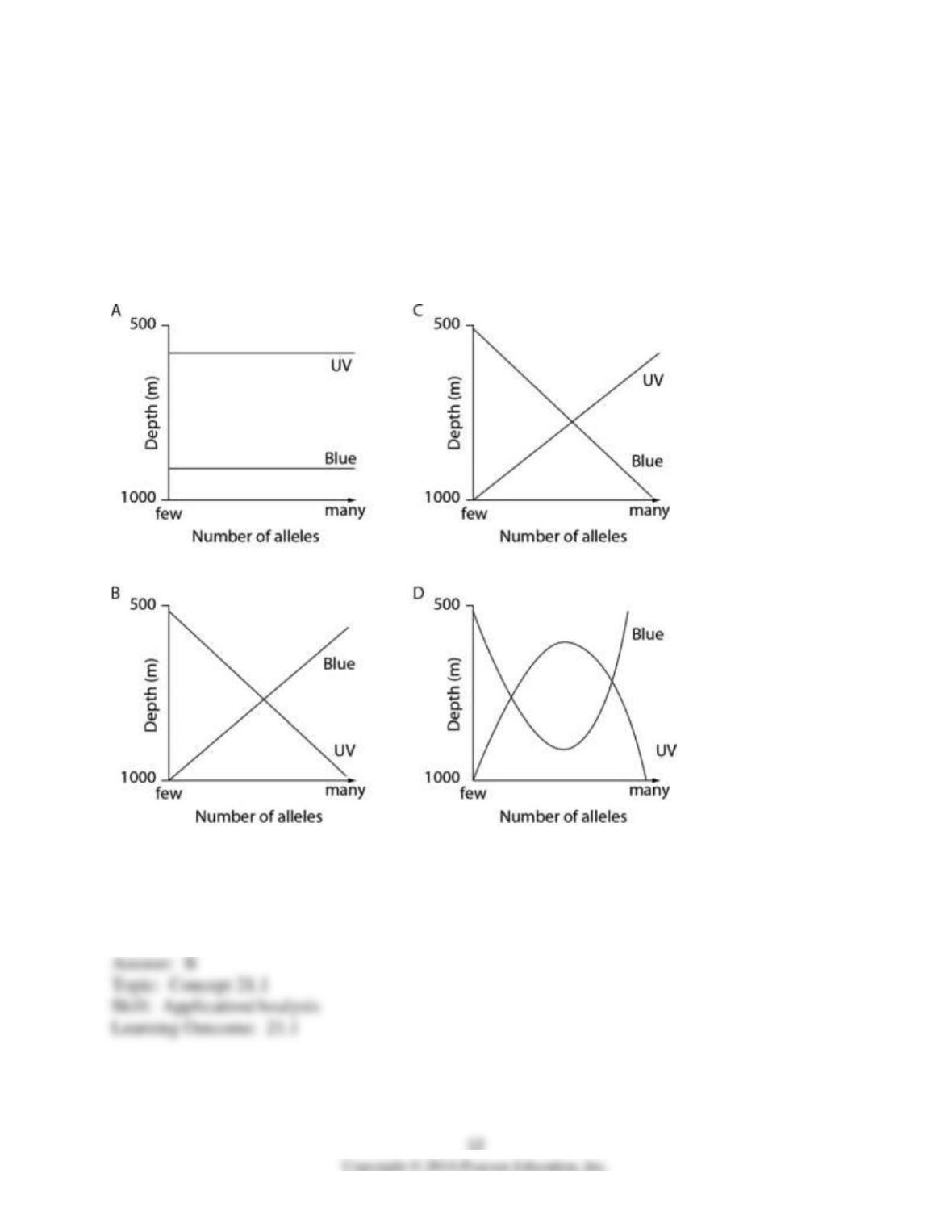
1) Blue light is a portion of the visible spectrum that penetrates deep into bodies of water.
Ultraviolet (UV) light, though, can penetrate even deeper. A gene within a population of marine
fish that inhabits depths from 500 m to 1,000 m has an allele for a photopigment that is sensitive
to UV light, and another allele for a photopigment that is sensitive to blue light. Which of the
graphs in Figure 21.1 best depicts the predicted distribution of these alleles within a population if
the fish that carry these alleles prefer to locate themselves where they can see best?
Figure 21.1
A) A
B) B
C) C
D) D
13
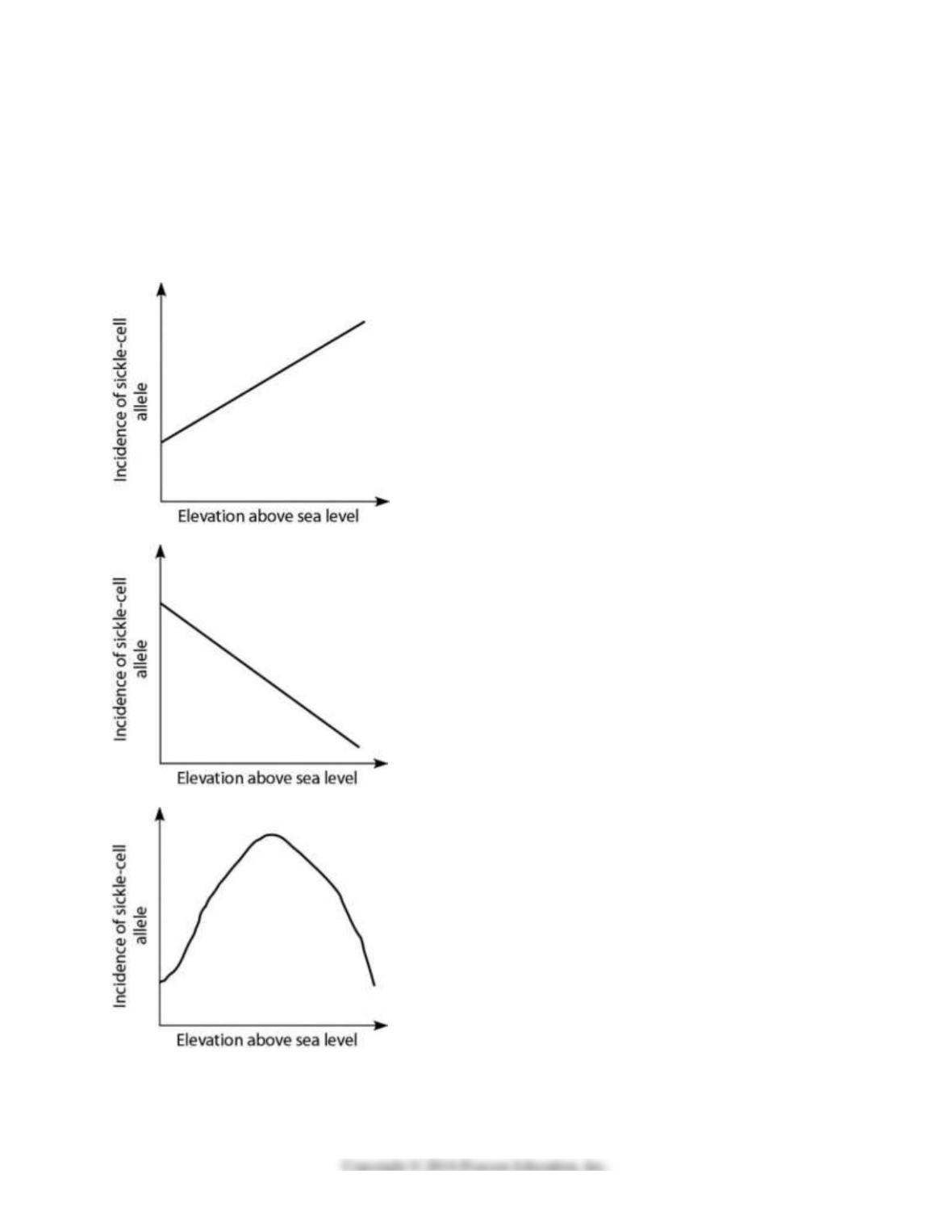
2) Anopheles mosquitoes, which carry the malaria parasite, cannot live above elevations of 5,900
feet. In addition, oxygen availability decreases with higher altitude. Consider a hypothetical
human population that is adapted to life on the slopes of Mt. Kilimanjaro in Tanzania, a country
in equatorial Africa. Mt. Kilimanjaro’s base is about 2,600 feet above sea level and its peak is
19,341 feet above sea level. If the incidence of the sickle-cell allele in the population is plotted
against altitude (feet above sea level), which of the following distributions is most likely,
assuming little migration of people up or down the mountain?
A)
B)
C)