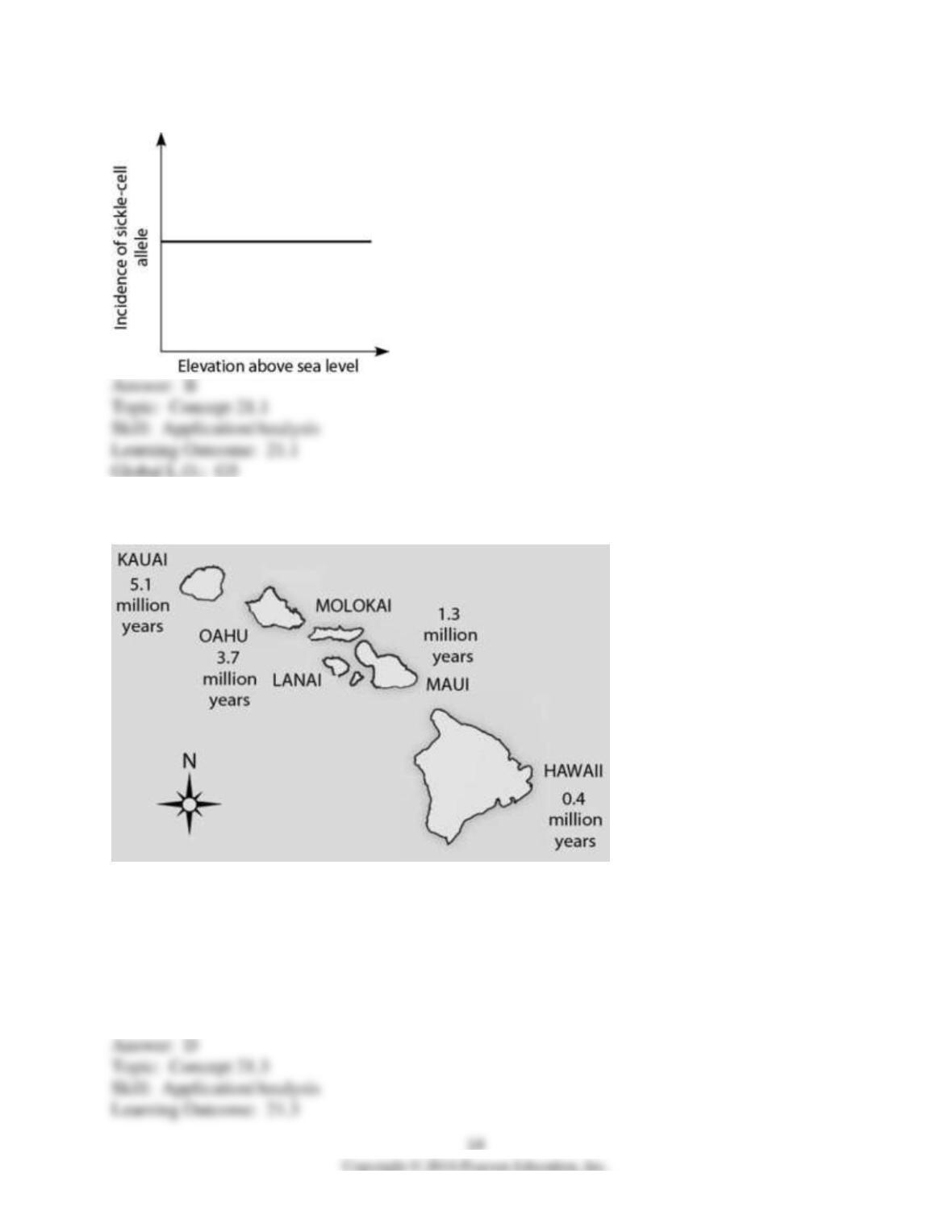
D)
3) Use Figure 21.2 to answer the following question.
Figure 21.2
Soon after the island of Hawaii rose above the sea surface (somewhat less than 1 million years
ago), the evolution of life on this new island should have been most strongly influenced by
A) genetic bottleneck.
B) sexual selection.
C) habitat differentiation.
D) founder effect.
4)
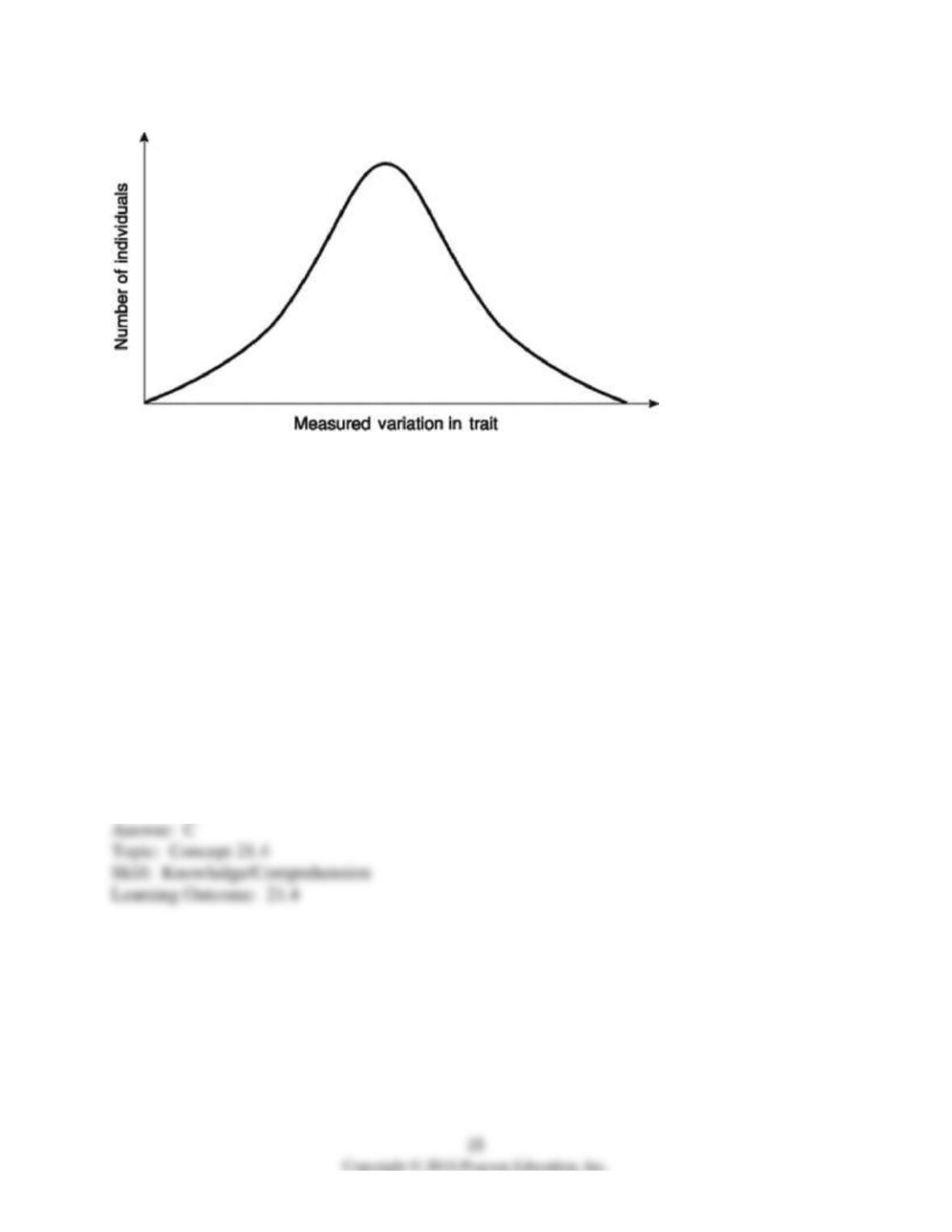
Figure 21.3
In a very large population, a quantitative trait has the distribution pattern shown in Figure 21.3. If
the curve in Figure 21.3 shifts to the left or to the right, there is no gene flow, and the population
size consequently increases over successive generations. Which of the following is (are)
probably occurring?
1. immigration or emigration
2. directional selection
3. adaptation
4. genetic drift
5. disruptive selection
A) 1 only
B) 4 only
C) 2 and 3
D) 4 and 5
E) 1, 2, and 3
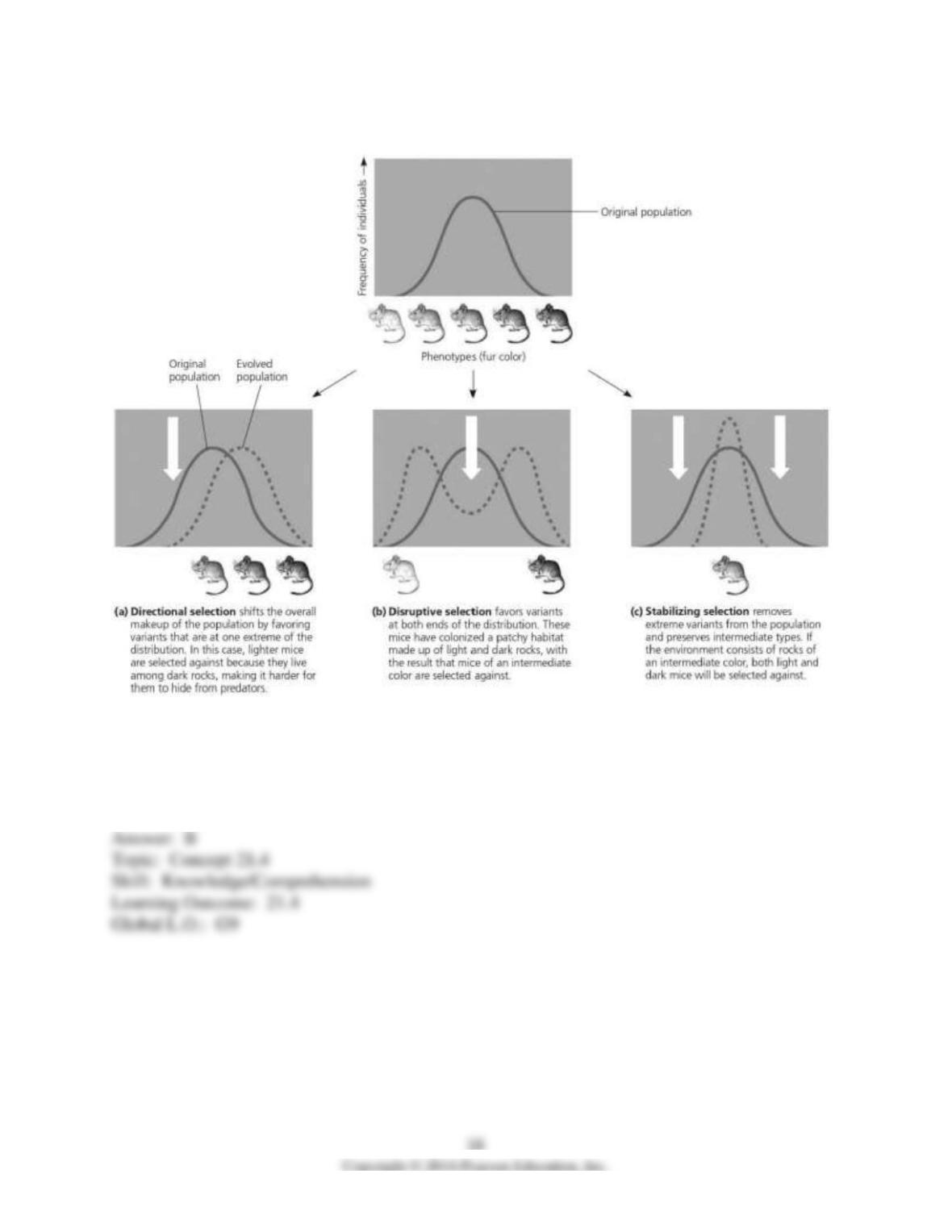
Please use the following information to answer the question(s) below.
5) Examining the figure, which type of selection has two peaks of frequency of individuals?
A) directional selection
B) disruptive selection
C) stabilizing selection
D) natural selection
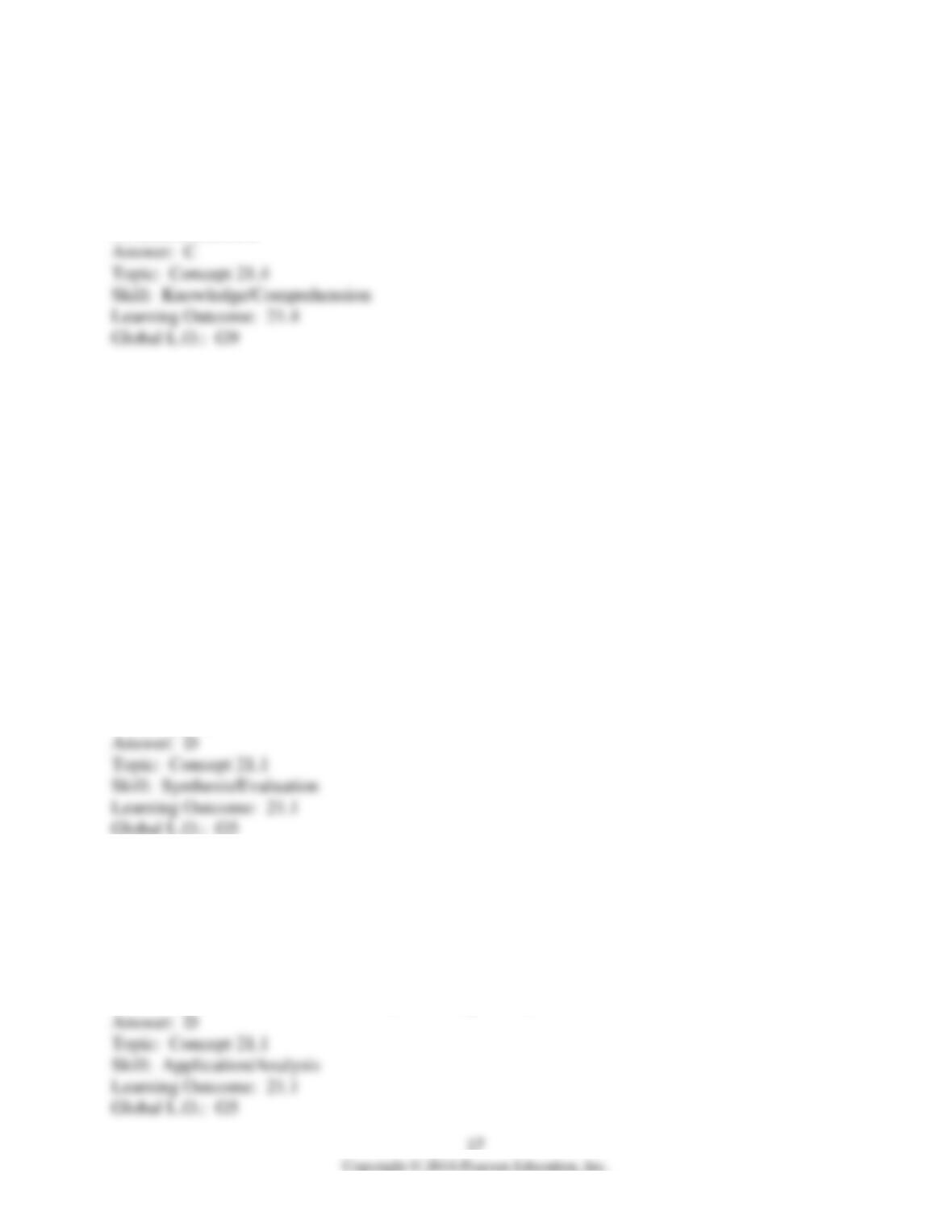
6) Examining the figure, which type of selection eliminates extreme frequency of individuals’
phenotype?
A) directional selection
B) disruptive selection
C) stabilizing selection
D) natural selection
21.3 Scenario Questions
Please use the following information to answer the question(s) below.
HIV’s genome of RNA includes the code for reverse transcriptase (RT), an enzyme that acts
early in infection to synthesize a DNA genome off of an RNA template. The HIV genome also
codes for protease (PR), an enzyme that acts later in infection by cutting long viral polyproteins
into smaller, functional proteins. Both RT and PR represent potential targets for antiretroviral
drugs. Drugs called nucleoside analogs (NA) act against RT, whereas drugs called protease
inhibitors (PI) act against PR.
1) Which of the following represents the treatment option most likely to avoid the production of
drug-resistant HIV (assuming no drug interactions or side effects)?
A) using a series of NAs, one at a time, and changed about once a week
B) using a single PI, but slowly increasing the dosage over the course of a week
C) using high doses of NA and a PI at the same time for a period not to exceed one day
D) using moderate doses of NA and two different PIs at the same time for several months
2) Every HIV particle contains two RNA molecules. If two genes from one RNA molecule
become detached and then, as a unit, get attached to one end of the other RNA molecule within a
single HIV particle, which of these is true?
A) There are now fewer genes within the viral particle.
B) There are now more genes within the viral particle.
C) A point substitution mutation has occurred in the retroviral genome.
D) One of the RNA molecules has experienced gene duplication as the result of translocation.
3) In a hypothetical population’s gene pool, an autosomal gene, which had previously been fixed,
undergoes a mutation that introduces a new allele, one inherited according to incomplete
dominance. Natural selection then causes stabilizing selection at this locus. Consequently, what
should happen over the course of many generations?
A) The proportions of both types of homozygote should decrease.
B) The proportion of the population that is heterozygous at this locus should remain constant.
C) The population’s average heterozygosity should decrease.
D) The two homozygotes should decrease at different rates.
Please use the following information to answer the question(s) below.
A large population of laboratory animals has been allowed to breed randomly for a number of
generations. After several generations, 25% of the animals display a recessive trait (aa), the same
percentage as at the beginning of the breeding program. The rest of the animals show the
dominant phenotype, with heterozygotes indistinguishable from the homozygous dominants.
4) What is the most reasonable conclusion that can be drawn from the fact that the frequency of
the recessive trait (aa) has not changed over time?
A) The population is undergoing genetic drift.
B) The two phenotypes are about equally adaptive under laboratory conditions.
C) The genotype AA is lethal.
D) There has been a high rate of mutation of allele A to allele a.
5) What is the estimated frequency of allele A in the gene pool?
A) 0.25
B) 0.50
C) 0.75
D) 0.125
6) What proportion of the population is probably heterozygous (Aa) for this trait?
A) 0.05
B) 0.25
C) 0.50
D) 0.75
Please use the following information to answer the question(s) below.
You are studying three populations of birds. Population A has 10 birds, of which 1 is brown (a
recessive trait) and 9 are red. Population B has 100 birds, of which 10 are brown. Population C
has 30 birds, and 3 of them are brown.
7) In which population would it be least likely that an accident would significantly alter the
frequency of the brown allele?
A) population A
B) population B
C) population C
D) They are all the same.
8) Which population is most likely to be subject to the bottleneck effect?
A) population A
B) population B
C) population C
D) They are all equally likely.
Please use the following information to answer the question(s) below.
In those parts of equatorial Africa where the malaria parasite is most common, the sickle-cell
allele constitutes 20% of the β hemoglobin alleles in the human gene pool.
9) With respect to the sickle-cell allele, what should be true of the β hemoglobin locus in U.S.
populations of African-Americans whose ancestors were from equatorial Africa?
1. The average heterozygosity at this locus should be decreasing over time.
2. There is an increasing heterozygote advantage at this locus.
3. Diploidy is helping to preserve the sickle-cell allele at this locus.
4. Frequency-dependent selection is helping to preserve the sickle-cell allele at this locus.
A) 1 only
B) 1 and 3
C) 2 and 3
D) 1, 2, and 3
E) 1, 2, and 4
10) Although selection is clearly present, if the ideal equilibrium of alleles existed, what should
be the proportion of heterozygous individuals in populations that live here?
A) 0.04
B) 0.16
C) 0.20
D) 0.32
E) 0.80
11) Again, if this population were in equilibrium and if the sickle-cell allele is recessive, what
proportion of the population should be susceptible to sickle-cell disease under typical conditions?
A) 0.04
B) 0.16
C) 0.20
D) 0.32
E) 0.80
12) Considering the overall human population of the U.S. mainland at the time when the slave
trade brought large numbers of people from equatorial Africa, what was primarily acting to
change the frequency of the sickle-cell allele in the overall U.S. population?
A) natural selection
B) gene flow
C) genetic drift
D) founder effect
E) Two of these responses are correct.
13) The sickle-cell allele is pleiotropic (i.e., it affects more than one phenotypic trait).
Specifically, this allele affects oxygen delivery to tissues and affects one’s susceptibility to
malaria. Under conditions of low atmospheric oxygen availability, individuals heterozygous for
this allele can experience life-threatening sickle-cell “crises.” Such individuals remain less
susceptible to malaria. Thus, pleiotropic genes/alleles such as this can help explain why
A) new advantageous alleles do not arise on demand.
B) evolution is limited by historical constraints.
C) adaptations are often compromises.
D) chance events can affect the evolutionary history of populations.
14) In the United States, the parasite that causes malaria is not present, but African-Americans
whose ancestors were from equatorial Africa are present. What should be happening to the
sickle-cell allele in the United States, and what should be happening to it in equatorial Africa?
A) stabilizing selection; disruptive selection
B) disruptive selection; stabilizing selection
C) disruptive selection; directional selection
D) directional selection; disruptive selection
Please use the following information to answer the question(s) below.
In the year 2500, five male space colonists and five female space colonists (all unrelated to each
other) settle on an uninhabited Earthlike planet in the Andromeda galaxy. The colonists and their
offspring randomly mate for generations. All 10 of the original colonists had free earlobes, and 2
were heterozygous for that trait. The allele for free earlobes is dominant to the allele for attached
earlobes.
15) Which of these is closest to the allele frequency in the founding population?
A) 0.1 a, 0.9 A
B) 0.2 a, 0.8 A
C) 0.5 a, 0.5 A
D) 0.8 a, 0.2 A
E) 0.4 a, 0.6 A
16) If one assumes that Hardy-Weinberg equilibrium applies to the population of colonists on
this planet, about how many people will have attached earlobes when the planet’s population
reaches 10,000?
A) 100
B) 400
C) 800
D) 1,000
E) 10,000
17) If four of the original colonists died before they produced offspring, the ratios of genotypes
could be quite different in the subsequent generations. This would be an example of
A) diploidy.
B) gene flow.
C) genetic drift.
D) disruptive selection.
E) stabilizing selection.
18) You are maintaining a small population of fruit flies in the laboratory by transferring the flies
to a new culture bottle after each generation. After several generations, you notice that the
viability of the flies has decreased greatly. Recognizing that small population size is likely to be
linked to decreased viability, the best way to reverse this trend is to
A) cross your flies with flies from another lab.
B) reduce the number of flies that you transfer at each generation.
C) transfer only the largest flies.
D) change the temperature at which you rear the flies.
E) shock the flies with a brief treatment of heat or cold to make them more hardy.
19) Swine are vulnerable to infection by bird flu virus and human flu virus, which can both be
present in an individual pig at the same time. When this occurs, it is possible for genes from bird
flu virus and human flu virus to be combined. If the human flu virus contributes a gene for
Tamiflu resistance (Tamiflu is an antiviral drug) to the new virus, and if the new virus is
introduced to an environment lacking Tamiflu, then what is most likely to occur?
A) The new virus will maintain its Tamiflu-resistance gene, just in case of future exposure to
Tamiflu.
B) The Tamiflu-resistance gene will undergo mutations that convert it into a gene that has a
useful function in this environment.
C) If the Tamiflu-resistance gene involves a cost, it will experience directional selection leading
to reduction in its frequency.
D) If the Tamiflu-resistance gene confers no benefit in the current environment and has no cost,
the virus will become dormant until Tamiflu is present.
20) “Until the agricultural revolution 10,000 years ago, people used to live in small populations
with little gene flow between them. That is the best situation for rapid evolution,” said Sewall
Wright, one of the founders of population genetics.This conclusion on gene flow conflicts with
Hardy-Weinberg equilibrium, which states that no gene flow means
A) natural selection.
B) no genetic drift.
C) no random mating.
D) no evolution.
21) Mountains also have an unmatched power to drive human evolution. Starting tens of
thousands of years ago, people moved to high altitudes, and there they experienced natural
selection that has reworked their biology. In Tibet, for example, people have broader arteries and
capillaries. In the Andes, they can dissolve more oxygen into their blood. These different traits of
people who live in high altitudes illustrate
A) stabilizing evolution.
B) sexual selection.
C) adaptive evolution.
D) directional selection.
21.4 End-of-Chapter Questions
1) Natural selection changes allele frequencies because some ________ survive and reproduce
more successfully than others.
A) alleles
B) loci
C) species
D) individuals
2) No two people are genetically identical, except for identical twins. The main source of genetic
variation among human individuals is
A) new mutations that occurred in the preceding generation.
B) genetic drift.
C) the reshuffling of alleles in sexual reproduction.
D) environmental effects.
3) Sparrows with average-sized wings survive severe storms better than those with longer or
shorter wings, illustrating
A) the bottleneck effect.
B) disruptive selection.
C) frequency-dependent selection.
D) stabilizing selection.
4) If the nucleotide variability of a locus equals 0%, what is the gene variability and number of
alleles at that locus?
A) gene variability = 0%; number of alleles = 0
B) gene variability = 0%; number of alleles = 1
C) gene variability = 0%; number of alleles = 2
D) gene variability > 0%; number of alleles = 2
5) There are 25 individuals in population 1, all with genotype AA, and there are 40 individuals in
population 2, all with genotype aa. Assume that these populations are located far from each other
and that their environmental conditions are very similar. Based on the information given here,
the observed genetic variation most likely resulted from
A) genetic drift.
B) gene flow.
C) nonrandom mating.
D) directional selection.
6) A fruit fly population has a gene with two alleles, A1 and A2. Tests show that 70% of the
gametes produced in the population contain the A1 allele. If the population is in Hardy-Weinberg
equilibrium, what proportion of the flies carry both A1 and A2?
A) 0.7
B) 0.49
C) 0.42
D) 0.21