5) From Figure 20.2, which other event occurred closest in time to the divergence of gorillas
from the lineage that led to humans and chimpanzees?
A) the divergence of chimpanzees and humans
B) the divergence of Dryopithecus and Ouranopithecus
C) the divergence of gibbons and siamangs
D) could be either the divergence of chimpanzees and humans or that of Dryopithecus and
Ouranopithecus
E) could be either the divergence of chimpanzees and humans or that of gibbons and siamangs
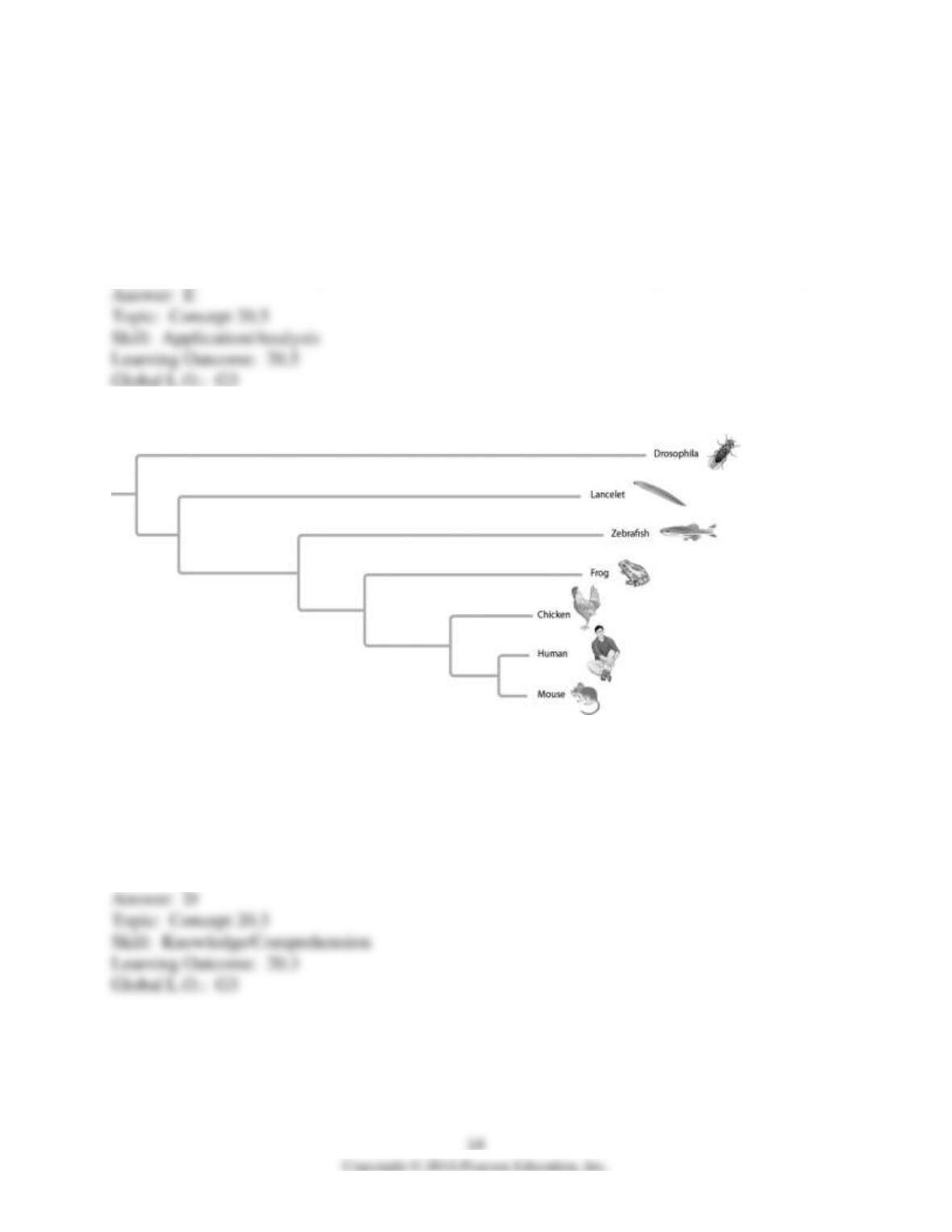
6)
Figure 20.3
In Figure 20.3, phylogeny branch lengths represent genetic changes. Which organism on the tree
has undergone the most genetic changes since divergence from common ancestor?
A) mouse
B) human
C) chicken
D) Drosophila
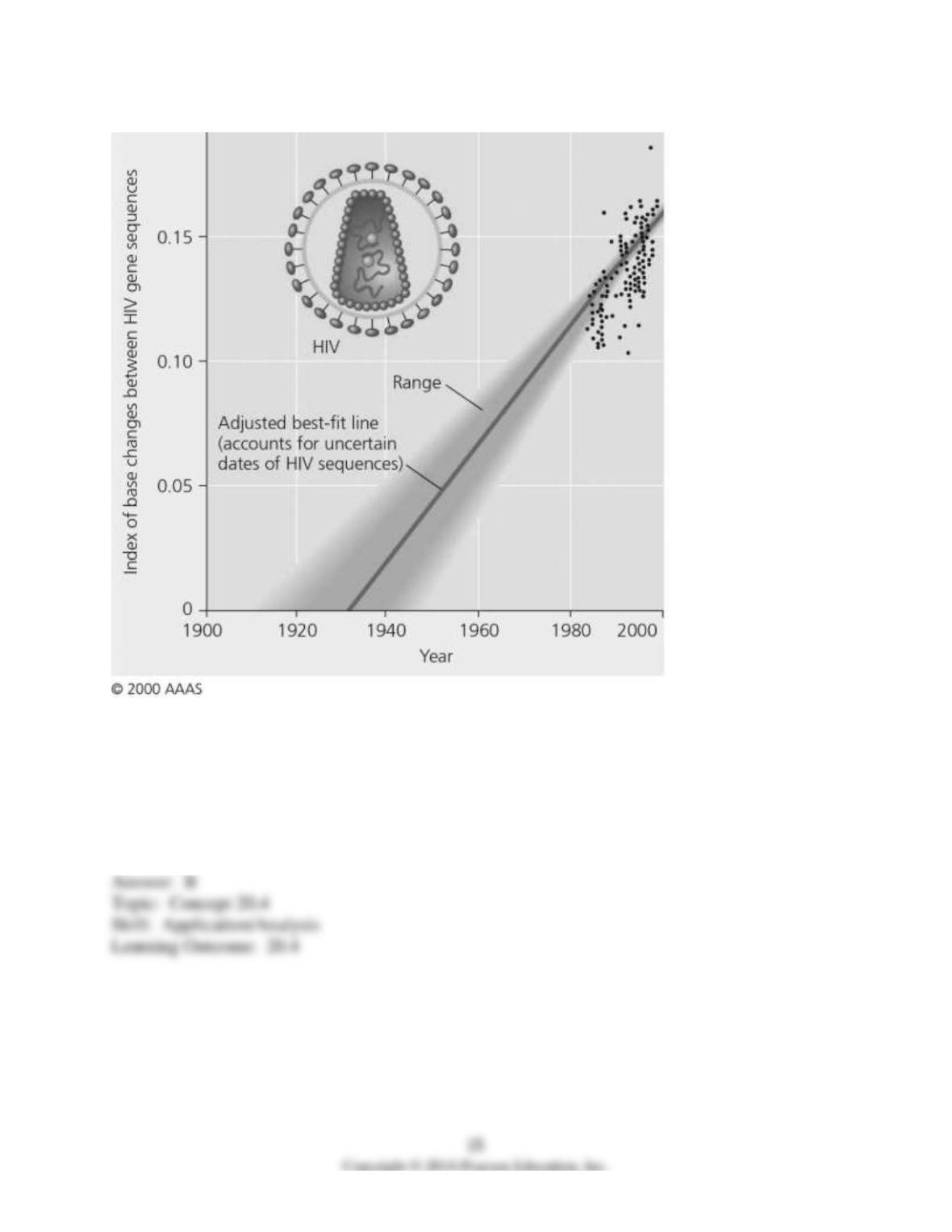
7)
Figure 20.4
Extrapolating backward in time using the molecular clock indicates that the HIV-1 M strain
originated around
A) 1920.
B) 1930.
C) 1950.
D) 1960.
20.3 Scenario Questions
Please use the following information to answer the question(s) below.
Traditionally, zoologists have placed birds in their own class, Aves. More recently, molecular
evidence has shown that birds are more closely related to reptiles than their anatomy reveals.
Genetically, birds are more closely related to crocodiles than crocodiles are to turtles. Thus, bird
anatomy has become highly modified as they have adapted to flight, without their genes having
undergone nearly as much change.
1) Taxonomically, what should be done with the birds?
A) The traditional stance is correct. Such dramatic morphological change as undergone by birds
indicates that birds should be placed in their own order, separate from the reptiles.
B) Birds should be reclassified, and their new taxon should be the subclass Aves. Genetic
similarity trumps morphological dissimilarity in cases where morphological traits are
uninformative.
C) The rest of the reptiles should be reclassified as a subclass within the class Aves.
D) The classification scheme should remain the same because of historical precedence.
2) Scientists discovered a fossil in China that belongs to a previously unknown species of an
obscure group of small dinosaurs, related to primitive birds such as the famous Archaeopteryx. It
had feathers, but they seemed too insubstantial to be useful in flight. Then the scientists said they
recognized the unusually long, rodlike bone extending from each of the two wrists: curving
structures possibly supporting an aerodynamic membrane. These scientists are grouping the
found fossil with birds based on ________ structures.
A) analogous
B) homologous
C) molecular
D) derived
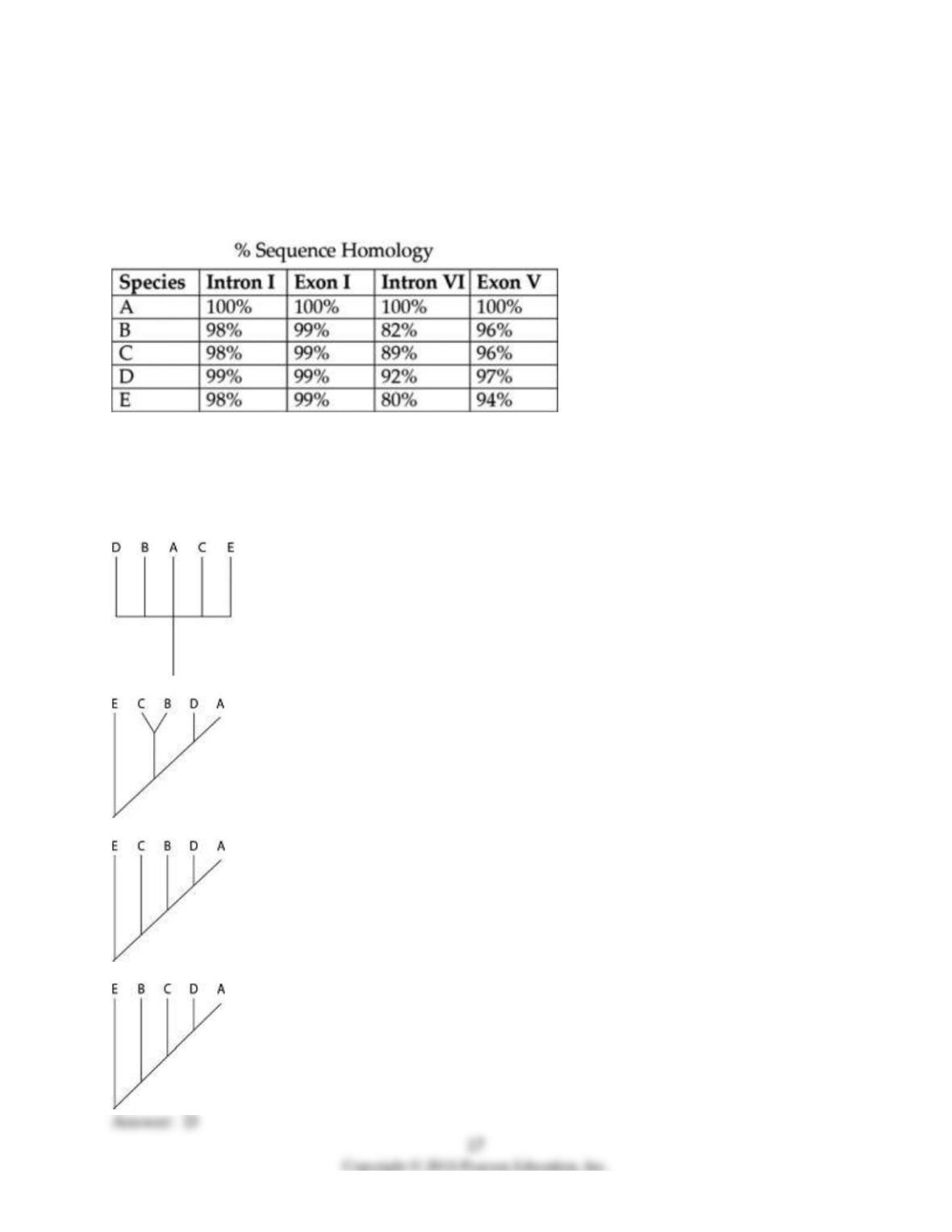
The next question(s) refer to Table 20.1, which compares the % sequence homology of four
different parts (two introns and two exons) of a gene that is found in five different eukaryotic
species. Each part is numbered to indicate its distance from the promoter (for example, intron I is
the one closest to the promoter). The data reported for species A were obtained by comparing
DNA from one member of species A to the DNA of another member of species A.
Table 20.1
3) Based on the tabular data, and assuming that time advances vertically, which cladogram (a
type of phylogenetic tree) is the most likely depiction of the evolutionary relationships among
these five species?
A)
B)
C)
D)
4) Regarding these sequence homology data, the principle of maximum parsimony would be
applicable in
A) distinguishing introns from exons.
B) determining degree of sequence homology.
C) selecting appropriate genes for comparison among species.
D) inferring evolutionary relatedness from the number of sequence differences.
5) Which of these four gene parts should allow the construction of the most accurate
phylogenetic tree, assuming that this is the only part of the gene that has acted as a reliable
molecular clock?
A) intron I
B) exon I
C) intron VI
D) exon V
Please use the following information to answer the question(s) below.
Traditionally, whales and hippopotamuses have been classified in different orders, the Cetacea
and the Artiodactyla, respectively. Recent molecular evidence, however, indicates that the
whales’ closest living relatives are the hippos. This has caused some zoologists to lump the two
orders together into a single clade, the Cetartiodactyla. There is no consensus on whether the
Cetartiodactyla should be accorded order status or superorder status. This is because it remains
unclear whether the whale lineage diverged from the lineage leading to the hippos before or after
the other members of the order Artiodactyla (pigs, camels, etc.) diverged (see Figure 20.5).
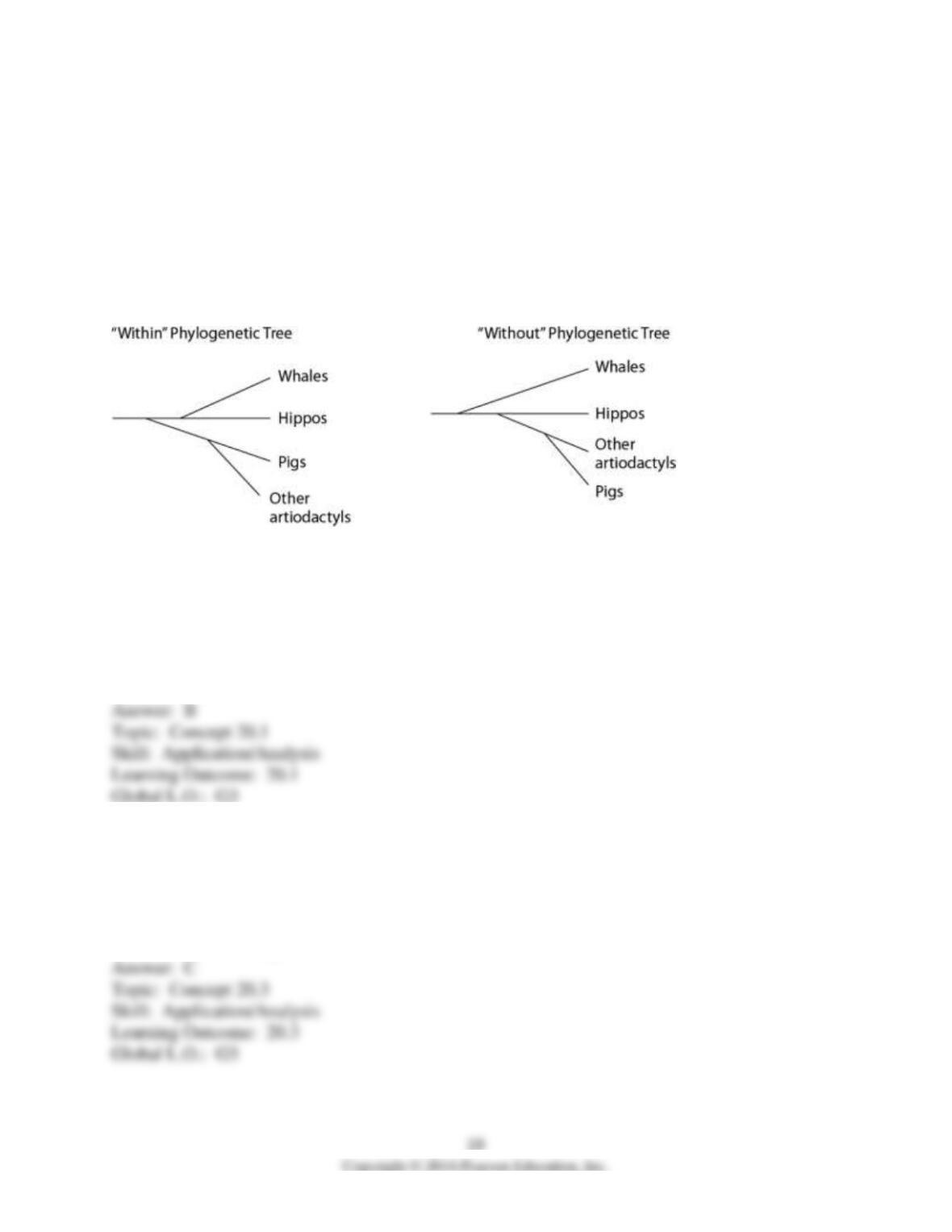
Figure 20.5
6) What can be properly inferred from Figure 20.5?
A) In the “without” tree, pigs are more distantly related to hippos than is depicted in the “within”
tree.
B) In the “without” tree, pigs are more closely related to hippos than are whales.
C) In the “within” tree, pigs are more closely related to whales than they are to hippos.
D) The “without” tree is more consistent with molecular evidence than is the “within” tree.
7) Placing whales and hippos in the same clade means that
A) these organisms are phenotypically more similar to each other than to any others shown on
the trees in Figure 20.5.
B) their morphological similarities are probably homoplasies.
C) they had a common ancestor.
D) all three of the responses are correct.
8) If it turns out that the whale lineage diverged from the lineage leading to hippos after the
divergence of the lineage leading to the pigs and other artiodactyls, and if the whales continue to
be classified in the order Cetacea, then what becomes true of the order Artiodactyla?
A) It becomes monophyletic.
B) It becomes paraphyletic.
C) It becomes polyphyletic.
D) It is incorporated into the order Cetacea.
9) If it turns out that the whale lineage diverged from the lineage leading to hippos after the
divergence of the lineage leading to the pigs and other artiodactyls, and if the whales continue to
be classified in the order Cetacea, then what becomes true of the taxon Cetartiodactyla?
A) It should be considered as one monophyletic superorder.
B) It should be considered a superorder that consists of two monophyletic orders.
C) It should be established as a paraphyletic order.
D) It should be thrown out or modified by taxonomists if classification is to reflect evolutionary
history.
10) One morphological feature of modern cetaceans is a vestigial pelvic girdle. If it is determined
that cetacean lineage diverged from the artiodactyls’ lineage after the divergence of pigs and
other artiodactyla, then what should be true of the vestigial pelvic girdle of cetaceans?
A) It should be considered a shared ancestral character of the cetartiodactyls.
B) It should be considered a shared derived character of the cetartiodactyls.
C) It should be considered a shared ancestral character of the cetaceans.
D) It should be considered a shared derived character of the cetaceans.
11) If cetaceans are determined to have diverged from the lineage leading to the artiodactyls
before the divergence of lineages leading to the modern artiodactyls (including hippos), then the
cetaceans can be considered
1. a sister order to the order Artiodactyla.
2. an ingroup of the order Artiodactyla.
3. the common ancestor of the order Artiodactyla.
A) 1 only
B) 3 only
C) 1 and 2
D) 1 and 3
12) It was once thought that cetaceans had evolved from an extinct group of mammals called the
mesonychids. If, in the future, it is determined that some organisms currently classified as
cetaceans did actually evolve from mesonychids, whereas other cetaceans evolved from
artiodactyl stock, then what will be true of the order Cetacea?
A) It will be paraphyletic.
B) It will be polyphyletic.
C) It will need to be modified if classification is to reflect evolutionary history.
D) A and C
E) B and C
20.4 End-of-Chapter Questions
1) In a comparison of birds and mammals, the condition of having four limbs is
A) a shared ancestral character.
B) a shared derived character.
C) a character useful for distinguishing birds from mammals.
D) an example of analogy rather than homology.
2) To apply parsimony to constructing a phylogenetic tree,
A) choose the tree that assumes all evolutionary changes are equally probable.
B) choose the tree in which the branch points are based on as many shared derived characters as
possible.
C) choose the tree that represents the fewest evolutionary changes, in either DNA sequences or
morphology.
D) choose the tree with the fewest branch points.
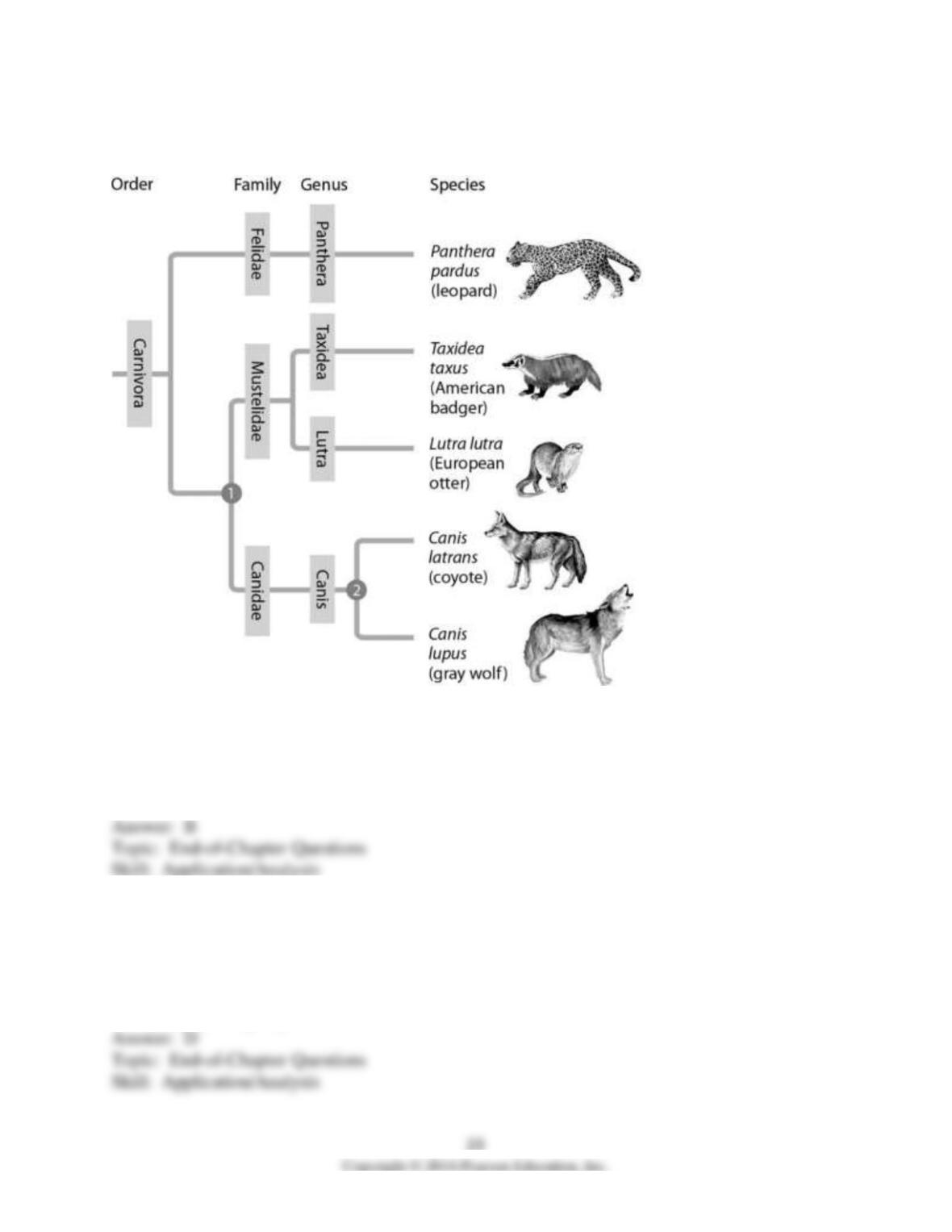
3) In figure shown below, which similarly inclusive taxon descended from the same common
ancestor as Canidae?
Figure 20.6
A) Felidae
B) Mustelidae
C) Carnivora
D) Lutra
4) Three living species X, Y, and Z share a common ancestor T, as do extinct species U and V. A
grouping that consists of species T, X, Y, and Z (but not U or V) makes up
A) a monophyletic taxon.
B) an ingroup, with species U as the outgroup.
C) a polyphyletic group.
D) a paraphyletic group.
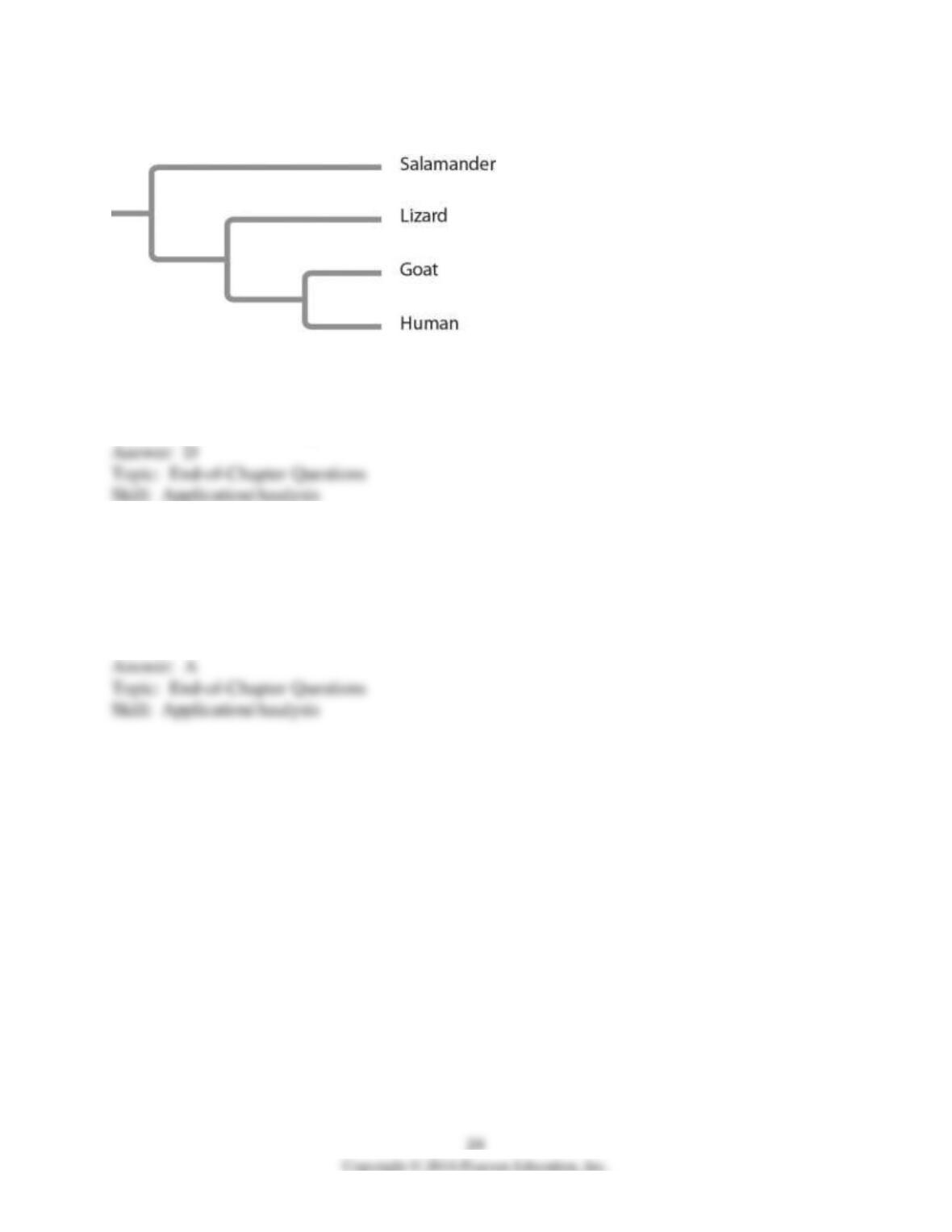
5) Based on the tree below, which statement is not correct?
A) The salamander lineage is a basal taxon.
B) Salamanders are a sister group to the group containing lizards, goats, and humans.
C) Salamanders are as closely related to goats as to humans.
D) Lizards are more closely related to salamanders than to humans.
6) If you were using cladistics to build a phylogenetic tree of cats, which of the following would
be the best outgroup?
A) wolf
B) domestic cat
C) frog
D) leopard
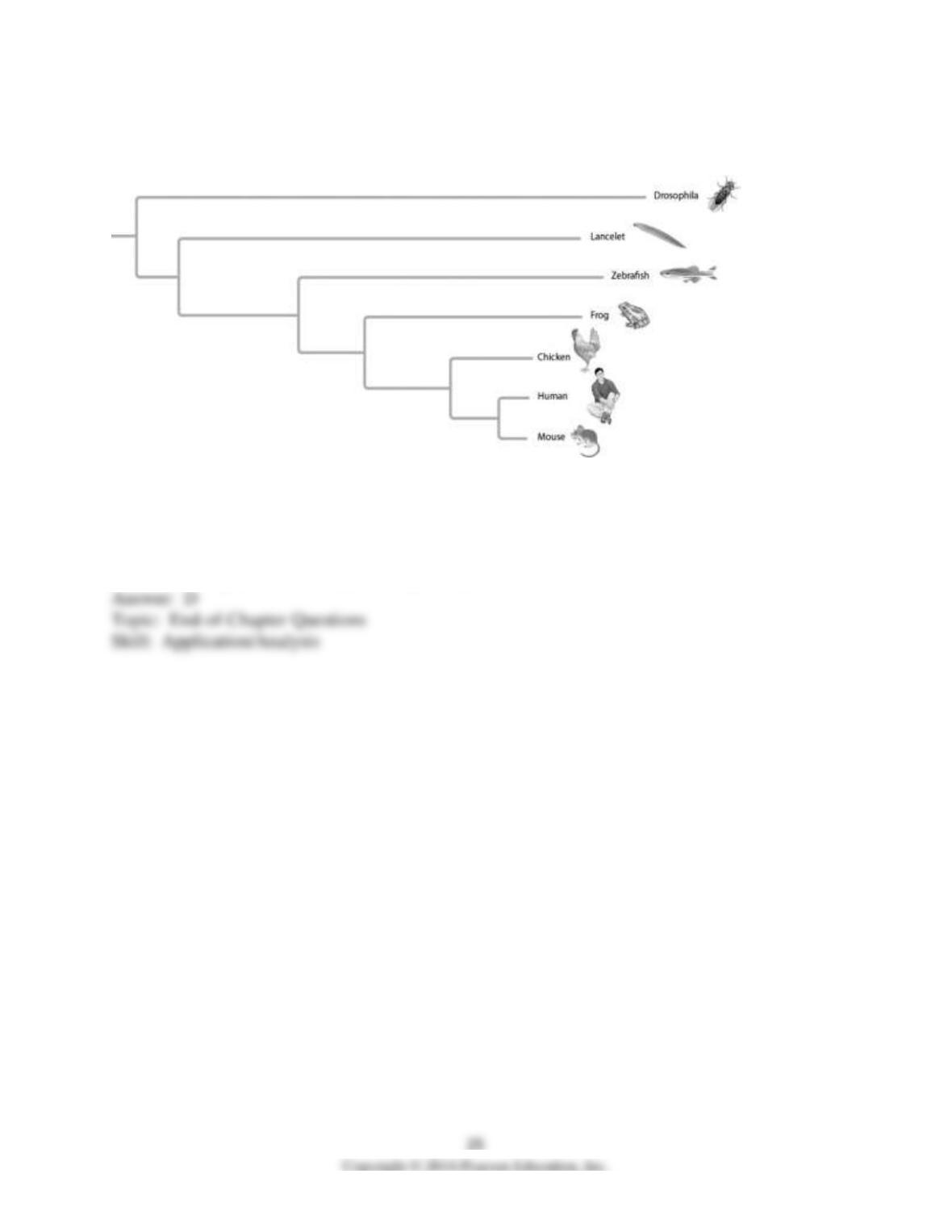
7) The relative lengths of the frog and mouse branches in the phylogenetic tree in the figure
given below indicate that
Figure 20.7
A) frogs evolved before mice.
B) mice evolved before frogs.
C) the homolog has evolved more rapidly in mice.
D) the homolog has evolved more slowly in mice.