Table 20.2
The following results were obtained from a disk-diffusion test for microbial susceptibility to
antibiotics. Staphylococcus aureus was the test organism.
Antibiotic Zone of Inhibition
A 3 mm
B 7 mm
C 0 mm
D 10 mm
33) In Table 20.2, the most effective antibiotic tested was
A) A.
B) B.
C) C.
D) D.
E) The answer cannot be determined based on the information provided.
34) In Table 20.2, the antibiotic that exhibited bactericidal action was
A) A.
B) B.
C) C.
D) D.
E) The answer cannot be determined based on the information provided.
35) In Table 20.2, which antibiotic would be most useful for treating a Salmonella infection?
A) A
B) B
C) C
D) D
E) The answer cannot be determined based on the information provided.
36) If you tested a 2nd strain of S. aureus with the same method and concentrations of drugs as
indicated in Table 20.2, but you found that the zone of inhibition caused by drug D had dropped
to 2 mm, what does this indicate?
A) The 2nd strain of bacteria is likely resistant to drug D.
B) The 2nd strain of bacteria is much more sensitive to drug D.
C) The experiment wasn’t conducted properly, and is giving inaccurate results.
D) There is no functional difference between how the 2 strains react to the drug.
37) Which of the following would be selective against the tubercle bacillus?
A) bacitracin – inhibits peptidoglycan synthesis
B) ethambutol – inhibits mycolic acid synthesis
C) streptogramin – inhibits protein synthesis
D) streptomycin – inhibits protein synthesis
E) vancomycin – inhibits peptidoglycan synthesis
38) In the presence of penicillin, a cell dies because
A) it lacks a cell wall.
B) it plasmolyzes.
C) it undergoes lysis.
D) it lacks a cell membrane.
E) its contents leak out.
39) Lamisil is an allylamine used to treat dermatomycoses. Lamisil’s method of action is similar
to that of
A) polymyxin B.
B) azole antibiotics.
C) echinocandins.
D) griseofulvin.
E) bacitracin.
40) Niclosamide prevents ATP generation in mitochondria. You would expect this drug to be
effective against
A) gram-negative bacteria.
B) gram-positive bacteria.
C) helminths.
D) Mycobacterium tuberculosis.
E) viruses.
41) Table 20.3
The following data were obtained from a broth dilution test:
Concentration of Antibiotic X Growth
2.0 μg/ml –
1.0 μg/ml –
0.5 μg/ml –
0.25 μg/ml +
0.125 μg/ml +
0 +
Bacteria from the 0.25 μg/ml tube were transferred to new growth media
containing antibiotic X with the following results:
Concentration of Antibiotic X Growth
2.0 μg/ml –
1.0 μg/ml +
0.5 μg/ml +
0.25μg/ml +
The data in Table 20.3 show that these bacteria
A) are pathogenic.
B) developed resistance to antibiotics.
C) were killed by 0.125 μg/ml of antibiotic X.
D) were killed by 0.5 μg/ml of antibiotic X.
E) were resistant to 1.0 μg/ml at the start of the experiment.
42) Which of the following statements about drugs that competitively inhibit DNA polymerase
or RNA polymerase is FALSE?
A) They can potentially cause mutations.
B) They are used against viral infections.
C) They can affect host cell DNA synthesis.
D) They cause cellular plasmolysis.
E) They interfere with protein synthesis.
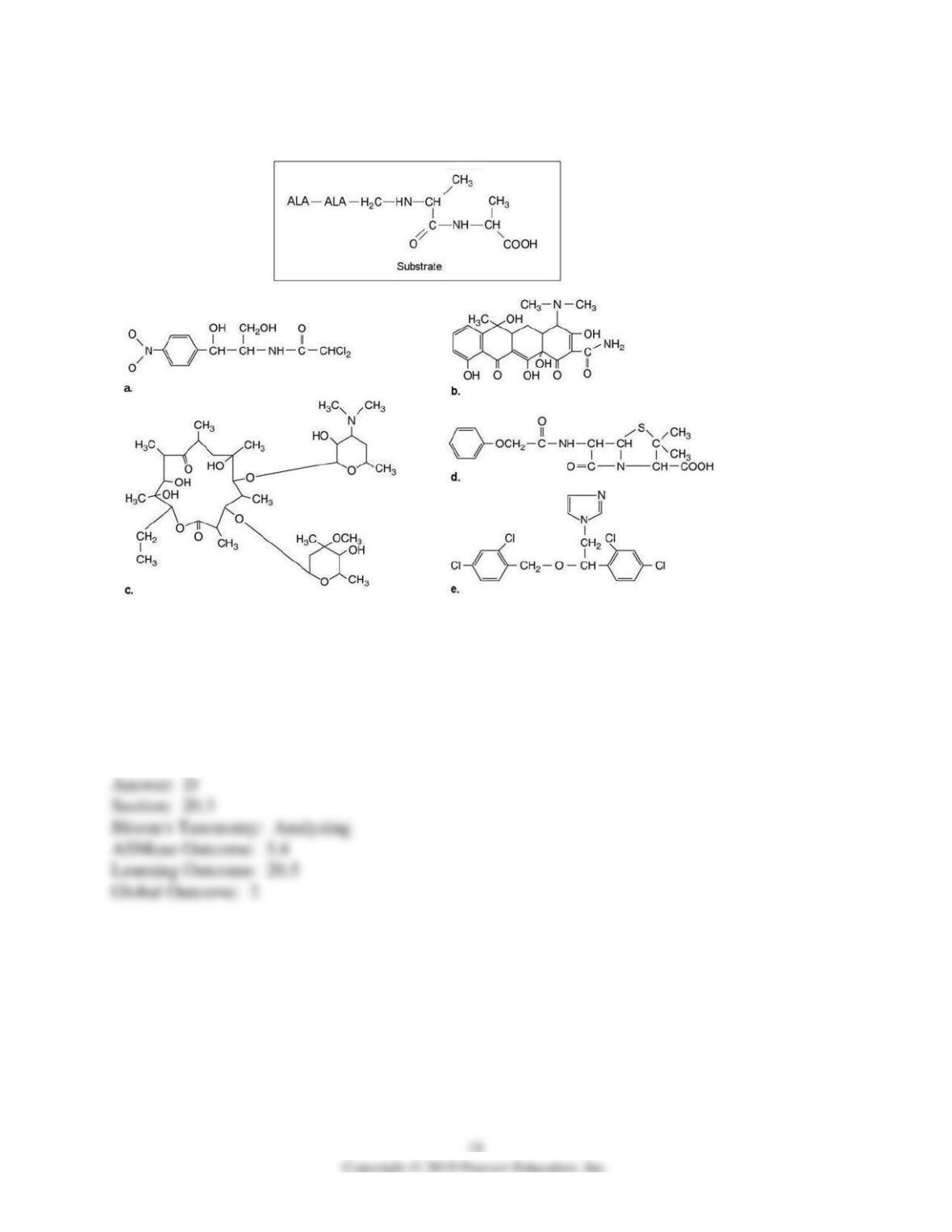
43) Figure 20.3
The substrate for transpeptidase used to synthesize peptidoglycan is shown in Figure 20.3.
Which of the drugs shown would inhibit peptidoglycan synthesis?
A) a
B) b
C) c
D) d
E) e
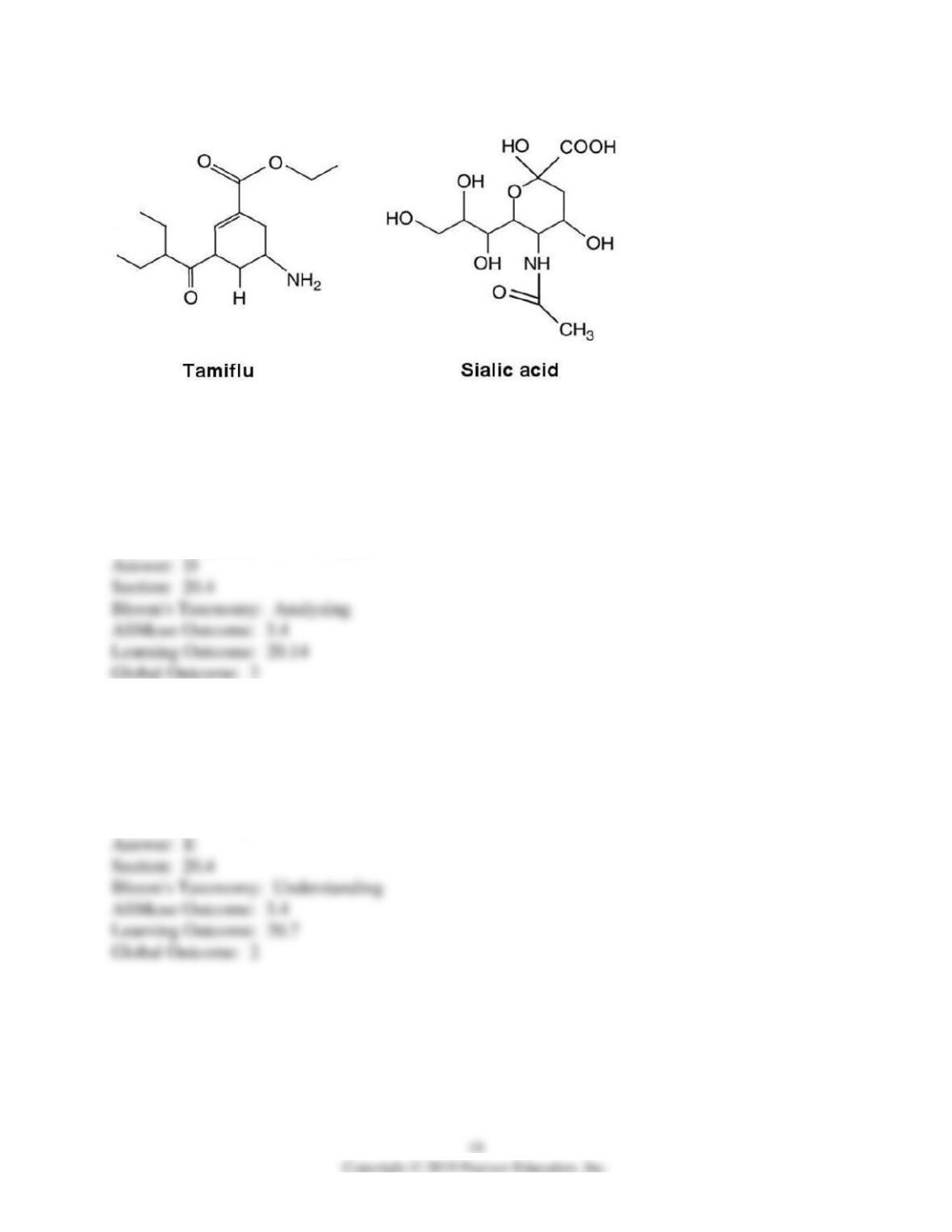
44) Figure 20.4
The structures of the influenza drug Tamiflu and sialic acid, the substrate for influenza virus’s
neuramidase, are shown in Figure 20.4. What is the method of action of Tamiflu?
A) inhibits cell wall synthesis
B) inhibits plasma membrane synthesis
C) inhibits synthesis of neuramidase
D) competitive inhibition
E) prevents synthesis of virus spikes
45) Which of the following does NOT affect eukaryotic cells?
A) antiprotozoan drugs
B) antihelminthic drugs
C) antifungal drugs
D) nucleotide analogs
E) semisynthetic penicillins
46) Mebendazole is used to treat cestode infections. It interferes with microtubule formation;
therefore, it would NOT affect
A) bacteria.
B) fungi.
C) helminths.
D) human cells.
E) protozoa.
47) Which of the following antibiotics causes misreading of mRNA?
A) aminoglycoside – changes shape of 30S units
B) chloramphenicol – inhibits peptide bonds at 50S subunit
C) oxazolidinone – prevents formation of 70S ribosome
D) streptogamin – prevents release of peptide from 70S ribosome
E) tetracyclines – bind with 30S subunit
48) The antibiotic actinomycin D binds between adjacent G-C pairs, thus interfering with
A) transcription.
B) translation.
C) cellular respiration.
D) plasma membrane function.
E) peptide bond formation.
49) Use of antibiotics in animal feed leads to antibiotic-resistant bacteria because
A) bacteria from other animals replace those killed by the antibiotics.
B) the few surviving bacteria that are affected by the antibiotics develop immunity to the
antibiotics, which they pass on to their progeny.
C) the antibiotics cause new mutations to occur in the surviving bacteria, which results in
resistance to antibiotics.
D) the antibiotics kill susceptible bacteria, but the few that are naturally resistant live and
reproduce, and their progeny repopulate the host animal.
E) the antibiotics persist in soil and water.
50) Which one of the following anti-protozoan drugs was a traditional Chinese medicine for
controlling fevers, but which has also exhibited useful anti-malarial properties?
A) Quinacrine
B) Metronidazole
C) Miltefosine
D) Mebendazole
E) Artemisinin
20.2 True/False Questions
1) An antibiotic that attacks the LPS layer would be expected to have a broad spectrum of
activity, effective against Gram negative and Gram positive cells.
2) PABA serves as the competitive inhibitor in the action of sulfanilamides.
3) Undergrowth of fungi after antibiotic use is commonly referred to as a superinfection.
4) Due to its target, rifamycins such as rifampin can be effective over a broad spectrum.
5) Both trimethoprim and sulfamethoxazole inhibit reactions along the same metabolic pathway.
6) Penicillin and streptomycin are commonly used in synergism because they display the same
mode of action.
7) Only microbes produce antimicrobial peptides.
8) Community-acquired MRSA is typically less virulent than healthcare-associated MRSA.
9) Antiviral drugs target viral processes that occur during viral infection.
10) Phage therapy has been used in the past as an effective, common antiviral treatment.
20.3 Essay Questions
1) Explain why penicillin was called the “miracle drug” when it was first used in the 1940s.
2) Penicillin does not directly kill bacteria. Why, then, is it considered to be bacteriocidal?
3) Explain the difficulties in developing antiviral drugs against DNA viruses, when compared to
RNA viruses.
4) Can you determine both MIC and MBC from an E-test? Explain.
5) An official from an international health agency predicts that if all countries enacted legislation
to only sell antibiotics with a prescription, then the rate of antibiotic resistant would “grind to a
halt.” Do you agree? Explain.