CHAPTER 20
Cancer
Questions
20-1 Identify the two errors in this statement: “Cells from a benign lung tumor that has
metastasized to the liver no longer make any lung-specific proteins.”
20-2 Carcinogenesis requires that a single cell or one of its descendents undergo a
series of rare genetic and epigenetic changes that permanently alter the expression
of at least five to eight genes. Thus, it is not surprising that many cancer cells
assayed in cell culture dishes were found to have a very high rate of mutagenesis.
A. What are three systems that are often defective in cancer cells whose role
is to ensure the integrity of the genome?
B. The increased mutation rate speeds cancer progression by increasing the
likelihood that a cell will acquire additional properties that contribute to
carcinogenesis. Name four of the eight typical properties of cancer cells.
C. UV and ionizing radiation are known to cause cancer because they are
mutagens that damage DNA. How, then, are the many anticancer therapies
that act by damaging DNA, including ionizing radiation and many drugs,
so effective at shrinking tumors?
D. Are these therapies more or less effective on cancer stem cells than cancer
transit amplifying cells? Explain.
20-3 You are an epidemiologist trying to understand why the incidence of breast cancer
is unusually high in Marin County, California, a community in which large
proportions of residents (both women and men) have advanced educational
degrees and high-paying jobs.
A. List five critical questions that you must include on a questionnaire given
to residents of Marin County and, as a control, to residents of other
counties in the USA.
B. Would you expect an elevated incidence of breast cancer to correlate more
closely with socioeconomic status or with exposure to industrial
chemicals?
20-4 Figure Q20-4 shows a signaling pathway that is turned on inappropriately in many
human cancers. The key proteins and their positive or negative influences on each
other are shown.
A. Both PTEN and Akt are cancer-critical genes. Which is a tumor
suppressor? Which is a proto-oncogene?
B. The pathway contains additional cancer-critical genes. Name a potential
proto-oncogene and a potential tumor suppressor in this pathway.
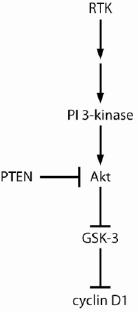
C. Is it likely that more than one of these pathway components will be
mutated in a single tumor? Explain.
D. If many tumors were found to contain two mutations in this pathway, what
hypothesis would it suggest?
Figure Q20-4
20-5 Loss of a tumor suppressor gene usually promotes cancer only if both copies are
defective.
A. If a person inherits two functional copies of the gene, will the frequency of
mutation of the second copy be higher or lower than the frequency of
mutation of the first copy? Explain by describing the mechanisms by
which the gene can be mutated.
B. You determine by immunoblotting that a tumor lacks a specific tumor
suppressor protein. Then you sequence the regulatory and coding regions
of the corresponding tumor suppressor gene and find that one copy has a
premature stop codon near the beginning of the gene and the other copy
contains no mutations. What is the most likely mechanism that prevents
the production or accumulation of protein from the unmutated copy?
20-6 The p53 gene may be the most important gene preventing human cancer. This
gene is mutated in about half of all cancers (and the pathway in which it
participates is mutated in essentially all cancers).
A. We can envisage two mechanisms to increase the amount of p53 protein
when it is suddenly needed. First, transcription and translation of the p53
gene might be low in the absence of a stimulus and markedly increased
after stimulation. Second, transcription and translation of the p53 gene
might be high at all times, but the protein amount is normally low as a
result of proteolytic degradation; after stimulation, degradation is inhibited
and consequently the protein amount increases. The latter mechanism is
actually used by cells. Suggest the most important advantage of this
mechanism.
B. List two of the four major classes of stimuli that evoke increased p53
amounts in normal human cells.

C. A defect in p53 increases the likelihood of amplification of proto-
oncogenes and loss of tumor suppressor genes. Describe the two ways in
which p53 normally works to prevent these outcomes. Describe the
sequence of steps that can lead to these outcomes in the absence of p53.
20-7 Common side effects of anticancer chemotherapy include nausea, diarrhea, hair
loss, dry skin, anemia, reduced immune system function, and increased frequency
of bruising and bleeding.
A. Although many of the best chemotherapy drugs successfully kill most
tumor cells, they often cause side effects by killing normal epithelial cells
and fail to kill cancer stem cells. How does the mode of action of these
drugs cause these two problems?
B. Describe a strategy for developing drugs with fewer side effects.
20-8 You work for a pharmaceutical company that is developing new anticancer drugs.
In clinical trials with a new potential treatment for stomach cancer, you find that
your drug is effective at eliminating all signs of the cancer in 20% of the patients
tested but is completely ineffectual in the remaining 80%. Will you abandon
development of the drug on the basis of these results? What data will you collect
to inform your decision?
Answers