
Chapter 20 Pathogenic Gram-Negative Cocci and Bacilli
20.1 Multiple Choice Questions
1) Which of the following are virulence factors contributing the pathogenicity of Neisseria
species?
A) hemolysin
B) fimbriae
C) a capsule
D) exotoxins
E) both a capsule and fimbriae
2) Lipid A causes which of the following symptoms?
A) hemorrhaging
B) fever
C) disseminated intravascular coagulation (DIC)
D) fever and disseminated intravascular coagulation (DIC)
E) fever and hemorrhaging
3) Neisseria gonorrhoeae infection in men is
A) usually asymptomatic.
B) only symptomatic in advanced stages of disease.
C) an acute painful infection with pus discharge.
D) symptomatic in about 50% of the population, causing mild urethritis.
E) usually a bladder infection.
4) Which of the following statements about Neisseria gonorrhoeae is FALSE?
A) It causes disease in humans only.
B) The gonococci stick to epithelial cells via fimbriae and capsules.
C) The gonococci secrete a protease that destroys secretory IgA.
D) The gonococci induce lasting immunity.
E) Infected women are often asymptomatic.
5) Among the areas of the female genital tract, which of the following is NOT colonized by
Neisseria gonorrhoeae?
A) the vagina
B) the cervix
C) the uterus
D) the Fallopian tubes
E) the pelvic organs
6) The major damage caused by Neisseria meningitidis is a result of
A) its invasion into the central nervous system.
B) its presence in the respiratory tract of 40% of healthy individuals.
C) its ability to be transmitted by droplets among people who live in close contact.
D) the release of lipid A into the tissues, triggering severe inflammation and DIC.
E) the fact that it can survive in cells after phagocytosis.
7) Which of the following is diagnostic for Neisseria meningitidis?
A) the presence of Gram-negative diplococci in CSF phagocytes
B) a catalase positive reaction
C) the presence of lipid A
D) the lack of lipooligosaccharide
E) the presence of white blood cells in the CSF
8) Members of the Enterobacteriaceae can be distinguished from each other by
A) the presence or absence of the enzyme oxidase.
B) the ability to ferment lactose.
C) motility.
D) both motility and the presence or absence of the enzyme oxidase.
E) both motility and the ability to ferment lactose.
9) What virulence factor(s) do all Gram-negative bacteria share?
A) proteases that destroy IgA antibodies
B) fimbriae
C) lipid A
D) a glycocalyx
E) both fimbriae and a glycocalyx
10) Which of the following statements regarding Neisseria meningitidis is FALSE?
A) There are vaccines available to prevent infection with all strains.
B) Up to 40% of the population are carriers.
C) Humans are the only natural carriers.
D) Transmission is via respiratory droplets.
E) It often causes meningitis.
11) A lung specimen from a pneumonia patient contains Gram-negative bacilli. Laboratory test
results on the bacteria show they are nonmotile coliforms with a thick capsule. Which pathogen
is the likely cause of the pneumonia?
A) Escherichia coli
B) Enterobacter
C) Hafnia
D) Klebsiella
E) Serratia
12) Which of the following coliforms is the most common cause of non-nosocomial urinary
tract infections?
A) Escherichia coli
B) Serratia marcescens
C) Proteus mirabilis
D) Klebsiella pneumoniae
E) Enterobacter
13) What biochemical test is used to distinguish between the Enterobacteriaceae and the
Pasteurellaceae?
A) lactose fermentation
B) oxidase test
C) motility
D) pigment production
E) Gram stain
14) Which of the following pairs is MISMATCHED?
A) coliform Enterobacteriaceae; rapid lactose fermenters
B) noncoliform opportunistic Enterobacteriaceae; Proteus, Morganella
C) coliform Enterobacteriaceae; opportunistic pathogens
D) nonpathogenic Enterobacteriaceae; Salmonella, Shigella
E) noncoliform Enterobacteriaceae; non-lactose-fermenters
15) A virulence factor common to many members of the Enterobacteriaceae which permits
them to deliver harmful proteins directly to cells is
A) fimbriae.
B) a glycocalyx.
C) type III secretion system.
D) pili.
E) porins.
16) Salmonella and Shigella, both causes of diarrhea, can be distinguished by which of the
following tests?
A) lactose fermentation
B) oxidase test
C) motility
D) urease test
E) pigment production
17) What is the causative pathogen for bubonic and pneumonic plague?
A) Yersinia pestis
B) Yersinia enterocolitica
C) Yersinia pseudotuberculosis
D) Salmonella enterica
E) Salmonella flexneri
18) Which of the following bacteria requires heme for its growth?
A) Salmonella
B) Shigella
C) Yersinia
D) Haemophilus
E) Bordetella
19) The small, oxidase positive nonmotile bacterium ________ is part of the normal microbiota
of dogs, but bites can lead to infection in humans.
A) Pasteurella
B) Hafnia
C) Salmonella
D) Enterobacter
E) Yersina
20) Which of the following statements concerning Pasteurella is FALSE?
A) It is oxidase positive.
B) It is nonmotile.
C) Humans are typically infected via animal bites.
D) It is fastidious in its growth and must be cultivated on blood or chocolate agar.
E) It is very resistant to a wide variety of antibacterial drugs including fluoroquinolones.
21) Cat scratch disease is caused by
A) Bartonella bacilliformis.
B) Bartonella henselae.
C) Bartonella quintana.
D) Bartonella peliosis.
E) Bartonella angiomatosis.
22) Bordetella pertussis causes disease by
A) the development of pneumonia.
B) interfering with the action of the ciliated epithelial cells of the trachea.
C) suppressing the production of mucus by the respiratory lining.
D) forming a pseudomembrane that obstructs the larynx.
E) irritating the diaphragm, which leads to severe coughing attacks.
23) Resistance of Pseudomonas to a wide range of antibacterial agents is partly due to its
A) production of exoenzyme S.
B) use of the Entner-Doudoroff pathway as its major means of catabolizing glucose.
C) ability to utilize a wide range of organic and nitrogen sources.
D) ability to metabolize many drugs.
E) lack of special requirements for growth.
24) Which of the following diseases can be prevented by vaccination?
A) typhoid fever
B) salmonellosis
C) cat scratch disease
D) gonorrhea
E) chancroid
25) Legionnaires’ disease is diagnosed by
A) the microbe’s characteristic growth on common laboratory media.
B) the microbe’s staining properties under the microscope.
C) serological diagnostic procedures.
D) the clinical symptoms in infected patients.
E) the microbe’s sensitivity to all antimicrobial agents.
26) What is the significance of the infective body formed by Coxiella bacteria, intracellular
parasites that cause a zoonosis in humans?
A) It uses actin filaments to move from cell to cell.
B) It is a resistant stage similar to an endospore.
C) It can grow in extracellular fluid for short periods of time.
D) It is only produced when Coxiella is in a tick.
E) It is a fragile stage found only inside cells.
27) What is the causative pathogen of Q fever?
A) Bacteroides fragilis
B) Prevotella
C) Coxiella burnetii
D) Moraxella catarrhalis
E) Acinetobacter
28) How do Prevotella differ from Bacteroides?
A) Prevotella are sensitive to bile.
B) Prevotella are anaerobic.
C) Prevotella are pleomorphic bacilli.
D) Prevotella are found in the intestinal, respiratory, and urinary tracts.
E) Prevotella possess antiphagocytic capsules.
29) Which of the following toxins produced by Bordetella pertussis results in the accumulation
of excess mucus in the trachea?
A) pertussis toxin
B) adenylate cyclase toxin
C) tracheal cytotoxin
D) both adenylate cyclase toxin and tracheal cytotoxin
E) both pertussis toxin and adenylate cyclase toxin
30) Hemolytic uremic syndrome is caused by
A) Escherichia coli O157:H7.
B) Serratia marcescens.
C) Proteus mirabilis.
D) Bacteroides fragilis.
E) Salmonella typhi.
31) A cystic fibrosis patient develops a severe respiratory infection that resists treatment with
standard antibiotics. A specimen from the lungs is greenish in color and contains aerobic motile
Gram-negative bacilli. The patient is probably infected with
A) Bordetella pertussis.
B) Burkholderia cepacia.
C) Klebsiella pneumoniae.
D) Pseudomonas aeruginosa.
E) Serratia marcescens.
32) What is the characteristic lesion of Yersinia pestis?
A) a bubo
B) a chancroid
C) a soft chancre
D) petechiae
E) oozing abscesses in the intestinal wall
33) What is the antimicrobial agent of choice for treating Bacteroides infections?
A) erythromycin
B) tetracycline
C) metronidazole
D) cephalosporin
E) bacitracin
34) Important members of the intestinal microbiota are the strictly anaerobic
A) Enterobacter.
B) Bacteroides.
C) Pseudomonas.
D) Bordetella.
E) Legionella.
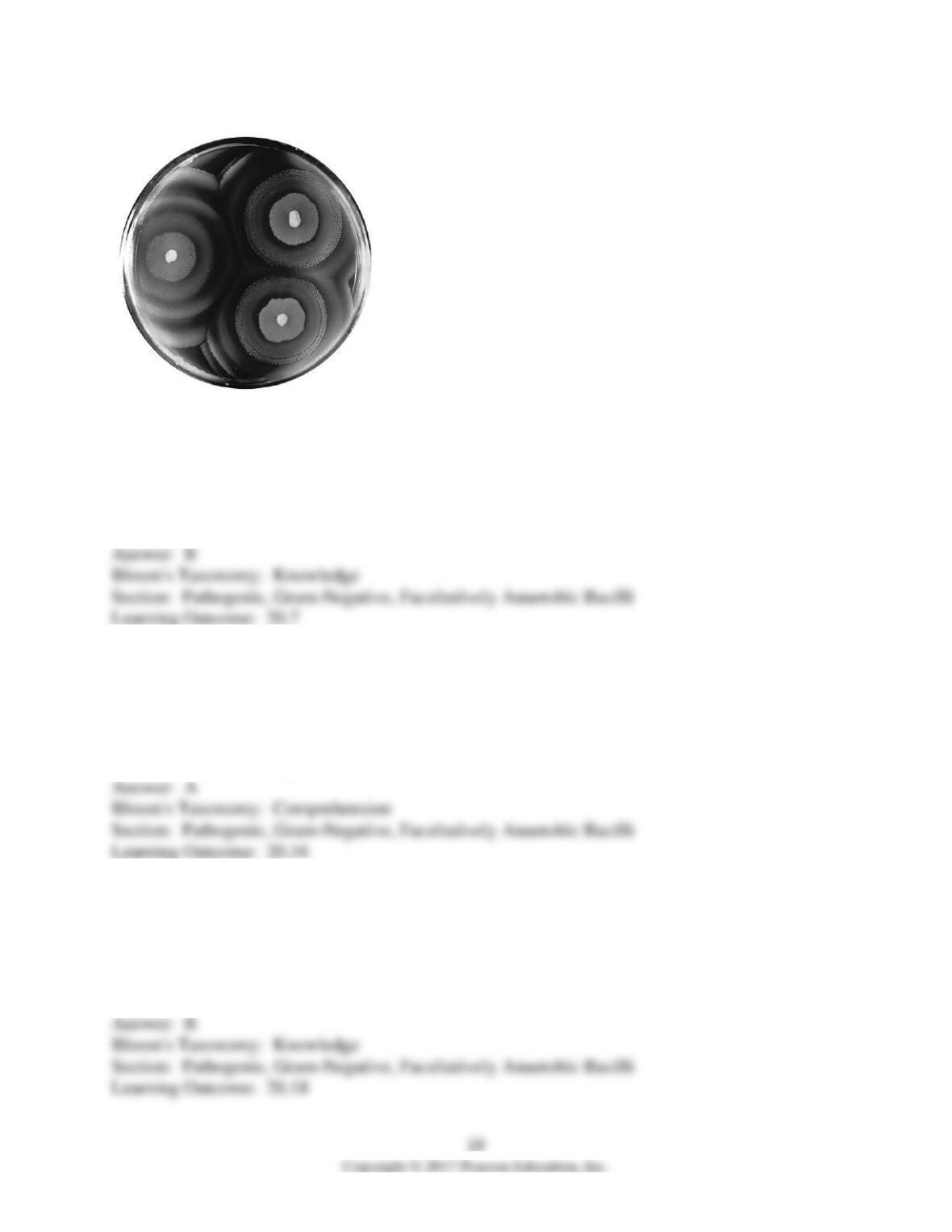
35)
The growth pattern in Figure 20.1 is characteristic of which organism?
A) Klebsiella
B) Proteus
C) Pseudomonas
D) Salmonella
E) Shigella
36) How is pneumonic plague transmitted?
A) inhalation of respiratory aerosols from a person infected with Yersinia pestis
B) bite of a flea carrying Yersinia pestis
C) fomite contact
D) contact with the blood of a person infected with Yersinia pestis
E) bite of a tick carrying Yersinia pestis
37) A lesion called ________ is a characteristic of an infection with Haemophilus ducreyi.
A) a bubo
B) a chancroid or soft chancre
C) an eschar
D) ophthalmia neonatorum
E) petechiae
38) Urinary tract infections with ________ are frequently complicated by the formation of
kidney stones.
A) Escherichia coli
B) Bacteroides species
C) Proteus mirabilis
D) Klebsiella pneumoniae
E) Salmonella species
39) Infection with ________ usually produces acute upper respiratory disease but may cause
meningitis in infants 3-18 months old.
A) Klebsiella pneumoniae
B) Francisella tularensis
C) Coxiella burnetii
D) Haemophilus influenzae
E) Hafnia species
40) Undiagnosed or untreated infections with Neisseria gonorrhoeae can progress to
A) bubonic plague.
B) meningococcal meningitis.
C) trench fever.
D) pelvic inflammatory disease (PID).
E) Q fever.
41) Which of the following is the result of inhalation of aerosols of fresh water containing a
bacterial parasite of protozoa?
A) acute bacterial meningitis
B) meningococcal meningitis
C) Q fever
D) pertussis
E) Legionnaires’ disease
42) Which of the following diseases is transmitted by the bite of human body lice?
A) bubonic plague
B) tularemia
C) Pontiac fever
D) trench fever
E) brucellosis
43) Inhaling aerosols of dried bodily fluids from infected animals may result in
A) tularemia.
B) salmonellosis.
C) Q fever.
D) hemolytic uremic syndrome.
E) both tularemia and Q fever.
44) Humans infected with Brucella species develop ________ characterized by fever, chills,
sweating, muscle aches, and headache.
A) rabbit fever
B) undulant fever
C) trench fever
D) Q fever
E) cat scratch fever
45) Aerobic bacteria in the genus ________ are important environmental decomposers, able to
digest herbicides like Agent Orange and polychlorinated biphenyls (PCBs).
A) Burkholderia
B) Coxiella
C) Pseudomonas
D) Prevotella
E) Hafnia
20.2 True/False Questions
1) Serratia marcescens can be identified by its distinctive blue-green pigment pyocyanin.
2) Humans are the sole hosts of Salmonella enterica subtype Typhi (formerly S. typhi).
3) Lipid A causes disseminated intravenous coagulation (DIC).
4) Enterobacteriaceae are rarely pathogenic.
5) Gonococcal infections result in lifelong immunity against Neisseria gonorrhoeae.
6) After a week of asymptomatic infection with Bordetella pertussis, the patient has cold-like
(catarrhal) symptoms for a week or two followed by a period of severe paroxysmal episodes of
coughing that leave the patient anoxic and fatigued.
7) Shiga toxin kills cells by preventing protein synthesis.
8) MacConkey agar is selective for Haemophilus influenzae.
9) Haemophilus ducreyi is transmitted by sexual contact.
10) Pseudomonas aeruginosa is a true pathogen with a long list of virulence factors.
11) Coxiella burnetii is transmitted to humans mainly via the bite of infected tick vectors.
12) Neisseria meningitidis is able to survive inside macrophages and be transported throughout
the body in them.
1) Coliforms are distinguished from noncoliforms by their ability to ferment
(glucose/citrate/lactose).
2) Neisseria is distinguished from many other Gram-negative pathogens by being
(catalase/oxidase/dismutase) positive.
3) Because of the existence of (acute/asymptomatic/passive) carriers, the eradication of
meningococcal disease is unlikely.
4) An effective vaccine is available to prevent (gonorrhea/salmonellosis/typhoid).
5) Unlike other Gram-negative opportunistic bacilli, Bacteroides are
(aerotolerant/facultative/strict) anaerobes.
6) When a UTI spreads to the kidneys it is called (cystitis/pyelonephritis/urethritis).
7) The pleomorphic bacterium (Coxiella/Legionella/Francisella) is an intracellular parasite that
can lead to respiratory disease when inhaled in aerosols from freshwater sources.
8) Pneumonia caused by Klebsiella pneumoniae often involves the destruction of
(alveoli/macrophages/epithelium) and the production of bloody sputum.
9) The true pathogen (Salmonella/Shigella/Yersinia) is a noncoliform, nonmotile, oxidase-
negative member of the Enterobacteriaceae that does not produce hydrogen sulfide.
10) Members of the Enterobacteriaceae produce toxins known as
(enterotoxins/hemolysins/siderophores) to capture iron for their use.
11) Of the three diseases caused by Yersinia pestis, only (bubonic/black/pneumonic) plague is
communicable between humans.
12) Cat scratch disease is caused by Bartonella (bacilliformis/henselae/quintana).
13) The zoonosis (brucellosis/bartonellosis/tularemia) can be acquired by humans in a variety
of ways, including insect bites and ingestion of infected animals.
14) Bordetella pertussis produces (adenylate cyclase/dermonecrotic/pertussis) toxin which
disrupts blood supply to respiratory tissues.
15) People can reduce the chances of contracting rabbit fever by avoiding rabbits, muskrats,
and (fleas/lice/ticks).
20.4 Essay Questions
1) Compare and contrast meningococcal meningitis and meningitis caused by Haemophilus,
including etiologic agents, pathology, and epidemiology.
2) Why is treatment with antimicrobial drugs NOT encouraged in patients with diarrhea caused
by enteric bacteria?
3) Compare and contrast Yersinia pestis and Francisella tularensis with respect to clinical
manifestations, mechanisms of transmission, reservoirs, and pathogenesis.
4) How does Salmonella grow in host cells? How does it differ from Shigella?
5) Among the variety of virulence factors possessed by pathogenic enteric bacteria, which ones
allow them to evade the immune surveillance of its host?