Microbiology with Diseases by Body System, 5e (Bauman)
Chapter 20 Microbial Diseases of the Nervous System and Eyes
20.1 Multiple Choice Questions
1) Voluntary muscle control is one of functions of the
A) cerebellum.
B) cerebrum.
C) spinal cord.
D) brain stem.
E) meninges.
2) Functions of the meninges include
A) support for the brain and spinal cord.
B) transmission of signals from the peripheral nervous system.
C) protection from external shock.
D) production of neurotransmitters.
E) support for the brain and spinal cord and protection from external shock.
3) The optic nerves are an example of which of the following?
A) motor nerves
B) spinal nerves
C) mixed nerves
D) synaptic nerves
E) sensory nerves
4) Cerebrospinal fluid circulates in the ________ to deliver nutrients to the brain and spinal cord.
A) dura mater
B) arachnoid villi
C) cranial sinuses
D) subarachnoid space
E) pia mater
5) Some microbes gain access to the normally axenic central nervous system by
A) damaging the blood-brain barrier.
B) axonal transport from infected peripheral neurons.
C) infecting macrophages which subsequently enter the CNS.
D) infecting lymph nodes in the cranium.
E) either damaging the blood-brain barrier or by axonal transport from infected peripheral
neurons.
6) Encephalitis is an infection of
A) the brain.
B) the meninges.
C) neurons of the peripheral nervous system.
D) the eye.
E) the cauda equina.
7) The Gram-negative diplococcus ________ is resistant to phagocytosis and releases Lipid A to
cause inflammation.
A) Clostridium botulinum
B) Haemophilus influenza
C) Streptococcus agalactiae
D) Neisseria meningitidis
E) Listeria monocytogenes
8) The Gram-positive diplococcus ________ is commonly found in the pharynx but may invade
the central nervous system inside cells where it survives after endocytosis.
A) Streptococcus agalactiae
B) Listeria monocytogenes
C) Haemophilus influenzae
D) Neisseria meningitidis
E) Streptococcus pneumoniae
9) The pleomorphic bacterium ________ is an obligate parasite due to its requirement for NAD+
and heme.
A) Neisseria meningitidis
B) Streptococcus pneumoniae
C) Listeria monocytogenes
D) Haemophilus influenzae
E) Streptococcus agalactiae
10) Newborns exposed to the Gram-positive bacterium ________ during vaginal birth are at risk
of developing neonatal meningitis.
A) Streptococcus agalactiae
B) Listeria monocytogenes
C) Haemophilus influenzae
D) Neisseria meningitidis
E) Streptococcus pneumoniae
11) Contaminated food is the source of ________, which causes meningitis in the elderly and
susceptible persons.
A) Neisseria meningitidis
B) Streptococcus agalactiae
C) Haemophilus influenzae
D) Listeria monocytogenes
E) Streptococcus pneumoniae
12) Bacterial agents of meningitis which can survive phagocytosis include
A) Neisseria meningitidis.
B) Streptococcus pneumoniae.
C) Mycobacterium leprae.
D) both Neisseria meningitidis and Streptococcus pneumoniae.
E) Neisseria meningitidis, Streptococcus pneumoniae and Mycobacterium leprae.
13) The type of bacterial meningitis that becomes epidemic among young adults is caused by
A) Streptococcus agalactiae.
B) Streptococcus pneumoniae.
C) Haemophilus influenzae.
D) Neisseria meningitidis.
E) Listeria monocytogenes.
14) Which of the following is TRUE of foodborne botulism?
A) It is an intoxication disorder.
B) It is not a life-threatening infection even when left untreated.
C) Large amounts of bacteria must be consumed to produce disease.
D) Normal food preparation methods can prevent it.
E) An effective vaccine is available.
15) Botulism toxin disrupts motor control by
A) blocking the release of acetylcholine by motor neurons.
B) causing demyelination of motor neurons.
C) blocking inhibitory signals to motor neurons.
D) killing motor neurons.
E) blocking acetylcholine receptors on muscle cells.
16) How does tetanospasmin affect motor control?
A) It blocks the secretion of acetylcholine into the synaptic cleft.
B) It blocks the release of inhibitory neurotransmitters in the CNS.
C) It triggers the endocytosis of skeletal muscle cells.
D) It induces nervous system proteins to fold into abnormal shapes.
E) It is a pyrogenic toxin.
17) A baby arrives at an emergency room suffering from violent muscles spasms and difficulty
breathing. The baby’s body is so rigid a proper exam is difficult, but the staff note the baby is
only a few weeks old and the umbilicus has not healed properly. The signs are consistent with
which of the following diseases?
A) infant botulism
B) acute bacterial meningitis
C) tetanus
D) rabies
E) listeriosis
18) Tetanus vaccine contains
A) antibodies against Clostridium tetani.
B) inactivated Clostridium tetani endospores.
C) antibodies against Clostridium tetani endospores.
D) fragments of Clostridium tetani cell walls.
E) inactivated tetanospasmin.
19) The highly destructive form of Hansen’s disease is the result of
A) poor immune response to Mycobacterium leprae.
B) autoimmune disease triggered by Mycobacteriu leprae.
C) intracellular infection with Clostridium botulinum.
D) poor immune response to Streptococcus agalactiae.
E) infection with rabies virus.
20) Which of the following diseases is the result of a bacterial infection of peripheral nerves?
A) botulism
B) acute bacterial meningitis
C) Hansen’s disease
D) tetanus
E) rabies
21) Listeria monocytogenes pathogenesis is directly related to its ability to
A) produce a powerful toxin.
B) form endospores.
C) produce a polysaccharide capsule.
D) live and reproduce inside its host’s cells.
E) resist most antimicrobial agents.
22) Which of the following causes of viral meningitis is transmitted by the fecal-oral route?
A) Eastern equine encephalitis virus
B) California encephalitis virus
C) West Nile virus
D) echovirus
E) rabies
23) Viral meningitis is also called “aseptic meningitis”
A) to indicate no bacteria are involved.
B) because it is frequently a nosocomial infection.
C) since it is treatable with antiviral medications.
D) because it is vaccine-preventable.
E) to distinguish it from encephalitis.
24) The least common type of polio is
A) nonparalytic polio.
B) an asymptomatic infection.
C) minor polio.
D) paralytic polio.
E) postpolio syndrome.
25) Slow deterioration of muscle function occurring over many years occurs in
A) West Nile encephalitis.
B) postpolio syndrome.
C) African sleeping sickness.
D) minor polio.
E) leprosy.
26) Poliovirus is most often transmitted via
A) contaminated water.
B) household pets.
C) mosquitoes.
D) droplets.
E) endospores.
27) Which of the following statements concerning rabies is FALSE?
A) It is caused by an ssRNA virus.
B) Transmission is usually via a bite from a rabid animal.
C) Treatment includes vaccination.
D) Bats are the source of most cases of rabies in humans.
E) All mammals can serve as a reservoir for the disease.
28) Which of the following nervous system diseases is treated with both passive and active
immunization?
A) arboviral encephalitis
B) botulism
C) primary amebic meningoencephalopathy
D) rabies
E) West Nile encephalitis
29) The normal hosts for St. Louis encephalitis virus are
A) birds.
B) small mammals.
C) horses.
D) humans.
E) horses and humans.
30) The disease known as cryptococcal meningitis
A) begins as a lung infection.
B) is caused by a Gram-negative coccus.
C) results from exposure to bird droppings.
D) is transmitted in respiratory aerosols.
E) results from exposure to bird droppings and begins as a lung infection.
31) African sleeping sickness is fatal if not treated because the parasite
A) evades destruction by the immune system by changing surface antigens.
B) produces a toxin which binds irreversibly to neurons.
C) is an intracellular parasite in RBC’s, where they are not detected by the immune system.
D) reproduces so fast there is no time for an immune response to develop.
E) produces a non-immunogenic toxin the immune system cannot neutralize.
32) An intracellular parasite primarily transmitted as an STD is the agent of ________, which
may cause enough damage to result in blindness.
A) primary amebic meningoencephalopathy
B) trachoma
C) rabies
D) tetanus
E) cryptococcal meningitis
33) Variant Creutzfeldt-Jakob disease can be prevented by avoiding
A) contact with mosquitoes.
B) contaminated waterways.
C) consumption of contaminated meat.
D) contact with bird droppings.
E) consumption of undercooked meat.
34) Nasal or ocular contact with water containing ________ may result in primary amebic
meningoencephalitis.
A) Acanthamoeba
B) Naegleria
C) Trypanosoma brucei
D) both Acanthomoeba and Naegleria
E) Acanthamoeba, Naegleria and Trypanosoma brucei
35) Which of the following is classified as a spongiform encephalopathy?
A) botulism
B) variant Creutzfeldt-Jakob disease
C) Hansen’s disease
D) arboviral encephalitis
E) African sleeping sickness
36) A child is brought to the hospital with high fever and headache. During examination a stiff
neck is noted. What sign indicates the child has viral meningitis instead of bacterial meningitis?
A) blood in the CSF.
B) cloudy CSF.
C) paralysis.
D) clear CSF.
E) peripheral nerve pain.
37) The condition known as “pinkeye” may be the result of infection with
A) Haemophilus influenzae.
B) Trypanosoma brucei.
C) Acanthamoeba.
D) Clostridium botulinum.
E) Chlamydia trachomatis.
38) A child is brought to the hospital with a high fever, nausea, and vomiting, and complaining
of headache. The cerebrospinal fluid collected by spinal tap is cloudy and contains spherical cells
which stain Gram-positive. These signs and symptoms are consistent with
A) primary amebic encephalitis caused by Naegleria.
B) cryptococcal meningitis due to infection with Cryptococcus neoformans.
C) bacterial meningitis probably due to Streptococcus.
D) tetanus resulting from infection with Clostridium botulinum.
E) aseptic meningitis from infection with Neisseria meningitidis.
39) A young man is experiencing fever and severe headaches, and is having difficulty staying
awake. He reports having spent time in Africa on a missionary trip several months ago. Recently
he spent time in a park where he went swimming in the lake and was bitten by a bat he attempted
to catch. His cerebrospinal fluid is nearly clear, and contains long, slender, mobile cells. This
description indicates infection with
A) Acanthamoeba.
B) an enterovirus.
C) rabies virus.
D) Neisseria meningitidis.
E) Trypanosoma brucei.
40) One summer, bird watchers and zookeepers in a major city notice that more birds than usual
are dying. At the same time reports of human encephalitis cases increase sharply. The
cerebrospinal fluid of human patients is clear. Similar enveloped RNA virus particles are
detected in samples from both birds and humans. Which of the following might be responsible
for this outbreak?
A) an arbovirus
B) coxsackie A virus
C) Cryptococcus neoformans
D) Neisseria meningitidis
E) rabies virus
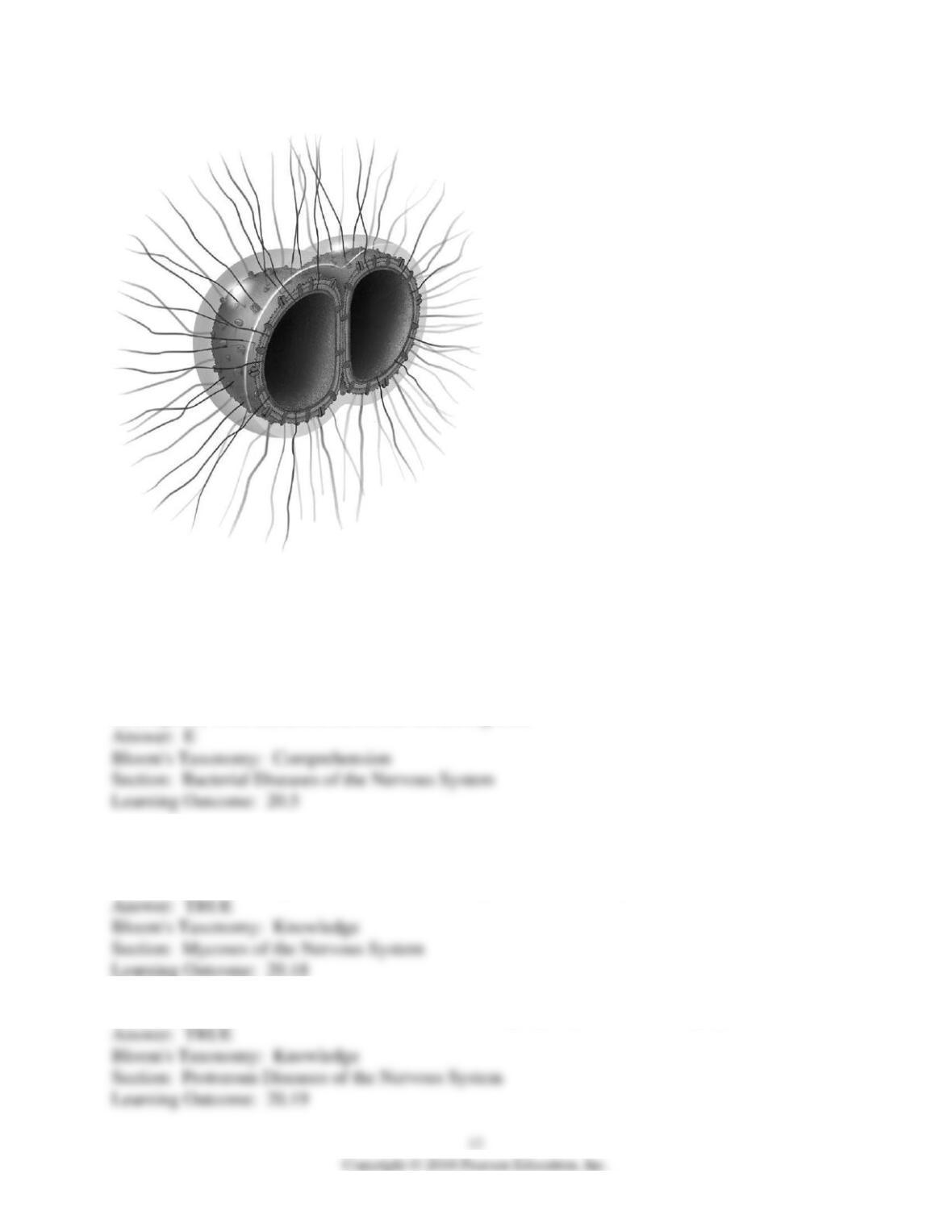
41)
The illustration is of a Gram-negative bacterium frequently responsible for meningitis. What
virulence factor(s) of the bacterium is/are illustrated?
A) a capsule
B) fimbriae
C) a membrane containing LOS
D) a capsule and fimbriae
E) a capsule, fimbriae, and a membrane containing LOS
20.2 True/False Questions
1) Cryptococcal meningitis can affect both healthy and immunocompromised individuals.
2) Trypanosoma brucei is transmitted to animals and people by a bloodsucking fly.
3) Rabies is a rare zoonosis in humans but common in many other species of mammal.
4) Fungi rarely infect the central nervous system.
5) All arboviruses are members of the same virus family.
6) Horses and humans are considered “dead-end” hosts for arboviruses.
7) Rodents are a major reservoir for rabies.
8) Viral meningitis is usually more serious than bacterial meningitis.
9) Tetanospasmin blocks the release of stimulatory neurotransmitters.
10) Clostridium botulinum can grow in the intestinal tracts of both infants and adults.
20.3 Short Answer Questions
1) The only natural hosts for infection with the microbe Mycobacterium leprae are humans and
(armadillos/birds/pigs).
2) Infant botulism is the result of (inhalation/ingestion/inoculation) of bacterial endospores.
3) The neurotoxins of Clostridium botulinum produce (paralysis/spasms/weakness) by interfering
with acetylcholine secretion.
4) The form of botulism known as (foodborne/infant/wound) is an intoxication disorder.
5) West Nile virus is transmitted by (food/mosquitoes/water).
6) Children in the United States are vaccinated with the (IPV/OPV/PEP) to prevent polio. (Use
all uppercase in your answer.)
7) A diagnostic indicator of bacterial meningitis is (clear/milky/dark) cerebrospinal fluid (CSF).
8) The presence of (cocci/diplococci/coccobacilli/streptococci) in the CSF is consistent with
infection with Listeria monocytogenes. (Describe the appearance of the cells.)
9) Small subcutaneous hemorrhages called (granulations/macules/petechiae) are sometimes
present in cases of meningitis.
10) The normal habitat for Naegleria is (birds/mammals/water).
11) Negri bodies are a characteristic microscopic finding in the diagnosis of
(encephalitis/leprosy/rabies).
12) The (eyes/intestines/lungs) are the initial site of infection with Cryptococcus neoformans.
13) The presence of the pathogen in the blood called (bacteremia/parasitemia/viremia) is a
defining feature of African sleeping sickness.
14) Spongiform encephalopathy diseases develop as a result of infection with
(parasites/prions/rabies).
15) The condition called (conjunctivitis/keratitis/trachoma) is the result of infection of the
cornea.
20.4 Essay Questions
1) Compare and contrast the pathogenicity of Clostridium botulinum and Clostridium tetani,
including mechanisms of action of their toxins and disease manifestations.
2) Discuss the two types of poliovirus vaccines available, including the advantages and
disadvantages of each.
3) Compare and contrast African sleeping sickness and primary amebic meningoencephalopathy.
4) Describe the pathogenesis associated with Trypanosoma brucei that makes it nearly
impossible for infected individuals to become immune to the pathogen.
5) A one-year-old child is brought to the hospital with high fever and limited range of motion of
the head. The child frequently rubs her head. A recent history is not immediately available due to
a language barrier on the part of the parent. The attending physician suspects meningitis and
orders a sample of CFS be collected. Describe the various diagnoses possible based on the results
with the CSF.