
1
Campbell Essential Biology, 6e (Simon/Dickey/Hogan/Reece)
Chapter 20 Communities and Ecosystems
Chapter 20 Learning Outcomes
20 Biology and Society: Why Biodiversity Matters
20.1. Define biodiversity and explain why it matters. Describe the important economic roles of
natural or near-natural ecosystems.
20.1 The Loss of Biodiversity
20.2. Describe the three levels of biological diversity, and describe the four main factors
responsible for the loss of biodiversity.
20.2 Community Ecology
20.3. Define and give an example of a community, an ecological niche, and the competitive
exclusion principle.
20.4. Define the types of helpful (+/+) and harmful (+/-) (-/-) interspecific interactions;
describe examples of each; and describe the adaptations derived from these relationships.
20.5. Define and list examples roles of organisms in a food chain or a food web, explaining
how their position influences biological magnification.
20.6. Describe the components of species diversity, and how the interactions between species
can maintain species diversity.
20.7. Describe the types and effects of disturbances in communities, and define and distinguish
between the processes of primary and secondary succession that follow a disturbance.
20.3 Ecosystem Ecology
20.8. Compare the processes of energy flow and chemical cycling as they relate to ecosystem
dynamics, and explain how the input of energy is related to the structure and function of
the pyramid of production.
20.9. Describe the biogeochemical cycles; distinguish between the biotic and abiotic
components of them; and describe how humans have altered them.
20.4 Conservation and Restoration Biology
20.10. Define conservation biology and restoration ecology, and describe the approaches that
they use to accomplish their goals.
20.11. Define landscape ecology, and explain how landscapes influence biodiversity.
20 Evolution Connection: Can Biophilia Save Biodiversity?
20.12 Describe the concept and significance of biophilia.
Global Learning Outcomes
1. Demonstrate an understanding of the principles of scientific inquiry.
2. Demonstrate the ability to think critically and employ critical-thinking skills.
3. Read and interpret models, graphs, and data.
4. Demonstrate the quantitative skills needed to succeed in biology.
5. Demonstrate an understanding of the impact of science on society.
6. Evaluate the credibility of scientific information from various sources.
7. Demonstrate the ability to make connections between concepts across biology.
8. Communicate effectively in writing.
9. Apply the scientific method to interpret information and draw conclusions.
20.1 Multiple Choice Questions
1) The present rate of species loss ________.
A) suggests that about 25% of all plant and animal species may be extinct by the end of the
century
B) is about the same as it has been during the last 100,000 years
C) is as much as 100 times higher than at any time in the last 100,000 years
D) is slower than in recent years because of conservation efforts
2) The single greatest threat to biodiversity comes from ________.
A) habitat destruction and fragmentation
B) invasive species
C) overexploitation
D) pollution
3) Several years ago, I was crossing the border from Canada to the United States and I had a bag
of Washington State apples with me. The customs officer at the border would not let me take the
apples with me into the United States (and I really hated the idea of getting rid of a bag of
perfectly good apples). Why did the customs officer refuse to allow me to cross the border with
my apples?
A) Washington State apples are considered an endangered fruit.
B) Apples grown in the United States for export may be contaminated with DDT.
C) There may have been a species that was not native to the United States hitching a ride on my
apples.
D) Economics: If I couldn’t bring the apples in with me, I would have to buy my apples from a
store in the United States.

4) An example of a mutualism, or +/+ relationship, is ________.
A) the relationship between corals and unicellular algae
B) cryptic coloration in frogs
C) herbivory
D) the relationship between Virginia’s warblers and orange-crowned warblers, which use some
of the same resources
5) Populations of two coexisting species are both tertiary consumers in a community. What
relationship may exist between these two organisms?
A) predation
B) mutualism
C) competition
D) succession
6) As a result of a severe disturbance, a community will ________.
A) not be repopulated
B) be replaced by organisms in random order
C) not change
D) undergo succession
7) Organisms that consume producers are ________.
A) detritivores
B) decomposers
C) primary consumers
D) producers
8) In the food chain grass → antelope → human → lion, the antelope is ________.
A) both an herbivore and a secondary consumer
B) both a producer and a primary consumer
C) both an herbivore and a primary consumer
D) a secondary consumer only
9) In the food chain grass → antelope → human → lion, the human is a ________.
A) tertiary consumer
B) secondary consumer
C) primary consumer
D) producer
10) Small fishes that eat zooplankton are ________.
A) primary consumers
B) producers
C) tertiary consumers
D) secondary consumers
11) Which of these convert organic matter to inorganic matter by breaking down dead
organisms?
A) producers
B) detritivores
C) decomposers
D) primary consumers

12) Most decomposers are ________.
A) plants and fungi
B) bacteria and plants
C) fungi and prokaryotes
D) animals
13) Bears eat berries, humans, and large fish; large fish eat smaller fish and insects; humans eat
bears, large fish, and berries; Venus flytraps eat insects. The scenario described here is an
example of ________.
A) an ecosystem
B) parasitism
C) a food web
D) a food chain
14) Herbivory is an example of a ________ interaction.
A) +/+
B) -/-
C) 0/+
D) +/-
15) In order to assess the species diversity of a community, you would need to know the number
of different species present as well as ________.
A) the number of trophic levels in the community
B) the intensity of interspecific competition in the community
C) the fraction of these species that are plants
D) the relative abundance of the different species
16) In Yellowstone National Park, wolves were hunted to extinction in the 1920s. A current
restoration project has reintroduced wolves to Yellowstone National Park. Predict the response
of the Yellowstone ecological community if wolves are a keystone species.
A) Species richness should decrease.
B) The relative abundances of each species should become more unequal.
C) Species diversity should decrease.
D) Species richness should increase, and the relative abundances of each species should be about
equal.
17) Two lakes have the same number of species. Most of the fish in Lake 1 are of a single
species, with a few individuals each for the remaining species. Lake 2, on the other hand, has
about equal numbers of each species. Which lake has higher species diversity?
A) Lake 1
B) Lake 2
C) They are equally diverse.
D) The number and relative abundance of species are not related to diversity.
18) What is one way in which energy flow differs from chemical cycling?
A) Energy flow is unidirectional; chemical elements can be recycled.
B) Energy can enter but cannot leave an ecosystem; chemical elements can leave but cannot
enter an ecosystem.
C) Energy flows from lower to higher trophic levels; chemicals cycle from higher to lower
trophic levels.
D) Energy can both enter and leave an ecosystem; chemical elements always remain within a
single ecosystem.
19) Approximately what percentage of the visible light that reaches Earth’s producers is
converted to chemical energy?
A) 10%
B) 0.1%
C) 1%
D) 0.01%
20) Biomass is the total amount of ________ an ecosystem.
A) organic matter tied up in the consumers of
B) organic matter tied up in the producers of
C) chemical elements recycled by the detritivores of
D) living organic material in
21) The rate at which an ecosystem’s producers convert solar energy to chemical energy stored in
biomass is called ________.
A) energy flow
B) chemical cycle
C) primary productivity
D) trophic structure
22) On average, what percentage of the energy in one trophic level becomes incorporated into
the next higher trophic level?
A) 10%
B) 30%
C) 50%
D) 90%
23) Which type of ecosystem has low primary production but nonetheless contributes a large
proportion of Earth’s total net primary production?
A) tropical rain forest
B) coral reef
C) open ocean
D) desert
24) Why are most food chains limited to three to five trophic levels?
A) The higher the trophic level, the larger the organism; the larger the organism, the less likely it
will be prey.
B) The nutritional quality of existing biomass decreases with increasing trophic level.
C) Most ecosystems have insufficient space to support the increased number of organisms that
more trophic levels would require.
D) There is insufficient energy to support more trophic levels.
25) Besides the atmosphere, abiotic reservoirs of carbon dioxide include ________.
A) fossil fuels and dissolved carbon compounds in the oceans
B) rocks and dissolved carbon compounds in the oceans
C) fossil fuels only
D) rocks only
26) The atmosphere is approximately 80% ________ gas.
A) CO2
B) H2O
C) CH4
D) N2

27) Plants can most readily utilize the ________ form of nitrogen.
A) nitrous oxide
B) N2
C) amino
D) nitrate
28) Which of these organisms convert atmospheric nitrogen gas to a form that can be utilized by
plants?
A) bacteria
B) protists
C) animals
D) fungi
29) ________ convert nitrogen from nitrates to N2.
A) Nitrifying bacteria
B) Nitrogen-fixing bacteria living in the soil
C) Denitrifying bacteria
D) Nitrogen-fixing bacteria living in the root nodules of legumes
30) The major abiotic reservoir for phosphorus is ________.
A) the oceans
B) the atmosphere
C) rock
D) dead organic matter

31) With regard to nutrient pollution in aquatic ecosystems, when is the worst time to apply
fertilizer to your lawn?
A) when it is raining, or is about to rain
B) when it is cold, or is about to get cold
C) at the same time you apply pesticides
D) at night
32) The primary goal of conservation biology is to ________.
A) catalog species
B) maximize the land set aside for wildlife
C) integrate human culture back into nature
D) counter the loss of biodiversity
33) Modern conservation science increasingly aims at ________.
A) protecting federally listed endangered species
B) countering pollution
C) sustaining entire ecosystems
D) maintaining genetic diversity within species
34) Species found in only one place on Earth are called ________ species.
A) hot spot
B) exotic
C) keystone
D) endemic

35) Small areas that have a large number of endangered and threatened species are referred to as
________.
A) biologically magnified
B) endemic environments
C) biodiverse environments
D) biodiversity hot spots
36) A regional assemblage of interacting ecosystems is a ________.
A) community
B) landscape
C) movement corridor
D) hot spot
37) Landscape ecology ________.
A) is the application of ecological principles to the study of land-use patterns
B) focuses primarily on how to restore human-altered ecological systems
C) deals primarily with ecosystems in urban settings
D) deals with the study of the ranges of different species
38) A movement corridor ________.
A) is a path used by migratory animals when they move to their winter habitats
B) is the path most commonly used by an animal within its home range
C) connects otherwise isolated patches of quality habitat for a species
D) is a natural component of the environment

39) Movement corridors are ________.
A) always created by humans
B) found only along stream sides
C) not harmful, but are beneficial because they allow for dispersal
D) harmful because they allow for the spread of disease and beneficial because they allow for
dispersal
40) Sustainable development ________.
I) will require making difficult decisions regarding the environment and lifestyle
II) must be achieved if the human species is to survive
III) will require global, multinational cooperation
A) I only
B) II only
C) III only
D) I, II, and III
41) E. O. Wilson coined the term ________ for our innate appreciation of wild environments and
living organisms.
A) bioremediation
B) bioethics
C) biophilia
D) biophobia

42) One problem with eradicating invasive species is that sometimes the disturbed area is unable
to be colonized by native species. For example, in forests where the invasive plant garlic mustard
has been removed, native plants and animals do not recolonize because they are extinct in that
patch of forest. How should restoration ecologists increase species diversity and recover
ecosystem function?
A) Introduce tertiary consumers.
B) Develop movement corridors for primary producers.
C) Develop movement corridors for species with similar niches.
D) Eliminate keystone species.
43) What is the estimated annual value of ecosystem services?
A) $1 billion
B) $33 trillion
C) $33 billion
D) $1 trillion
20.2 Art Questions
Please refer to the following art to answer the following questions.
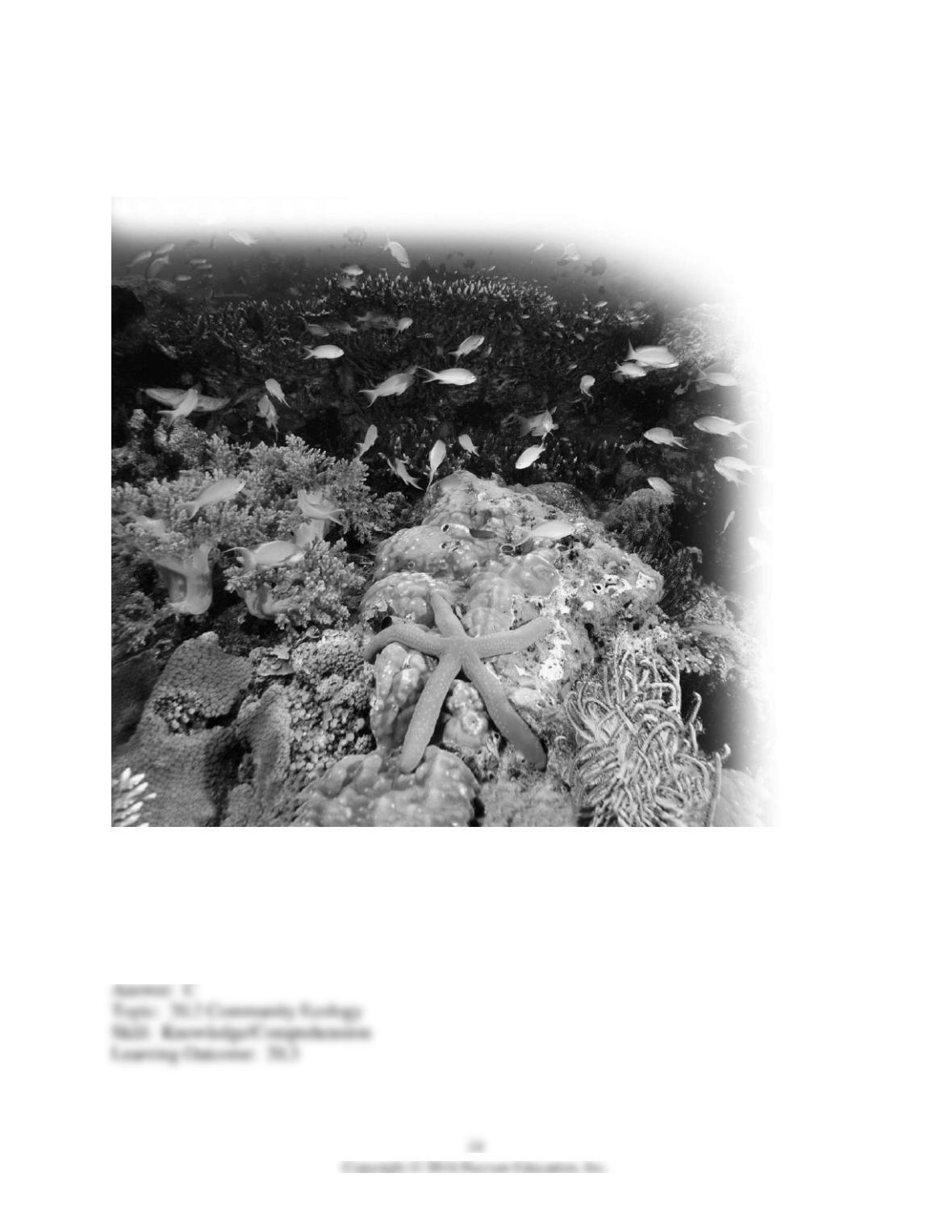
1) Refer to the accompanying figure. All of the living components of the coral reef represent a(n)
________.
A) population
B) species
C) community
D) ecosystem
2) In the ecosystem shown above, a toxin that accumulates in body tissues would have the largest
effect on ________.
A) corals that obtain their food from photosynthesizing dinoflagellates
B) herbivorous shrimp
C) fish that eat shrimp and other invertebrates
D) The toxin would affect all of these equally.
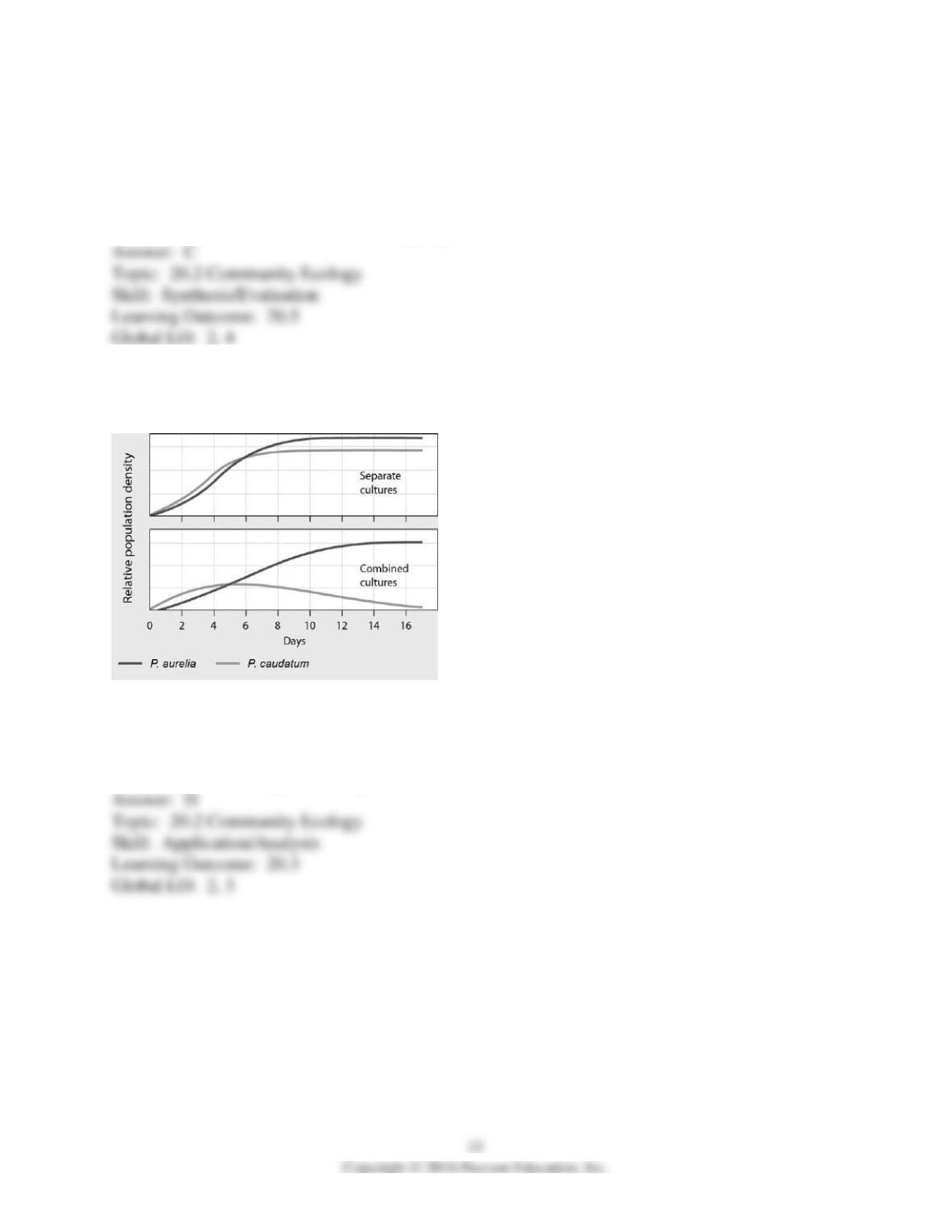
3) The figure below shows the growth curves of two populations of Paramecium, P. aurelia and
P. caudatum. From the data, we can conclude that ________.
A) the ecological niches of the two species are very different
B) P. aurelia is a predator of P. caudatum
C) P. aurelia and P. caudatum have a mutualistic relationship
D) P. aurelia is the superior competitor in this habitat
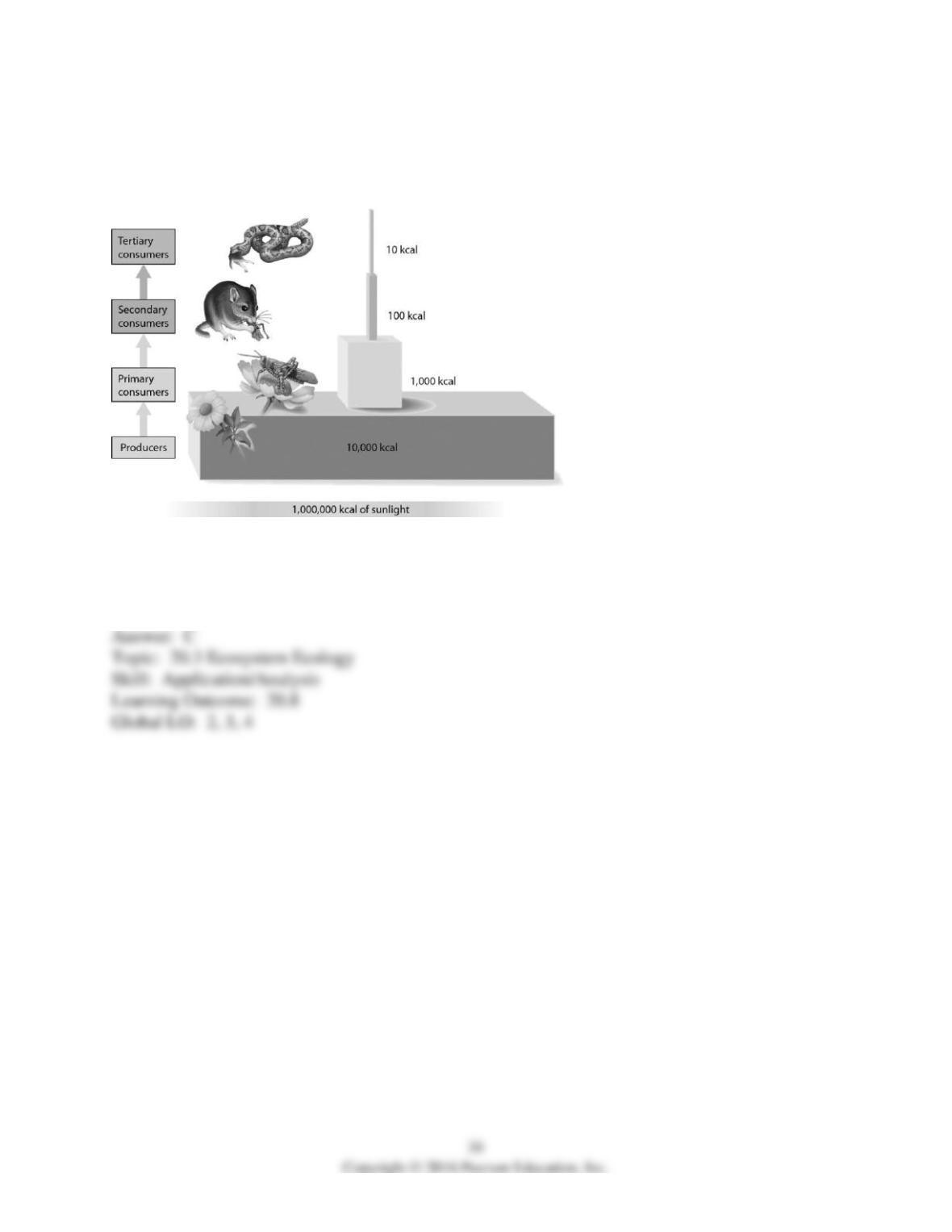
4) Refer to the following figure. If there were an additional trophic level that consisted of
organisms that prey on snakes, about how much energy would be available to organisms at that
trophic level?
A) 100 kcal
B) 90%
C) 1 kcal
D) 10 kcal

20.3 Scenario Questions
Use the following information to answer the following questions.
Malaria is an infectious disease caused by a unicellular eukaryotic organism belonging to the
genus Plasmodium. These eukaryotic organisms are transmitted from one person to another by
the female Anopheles mosquito when it feeds on human blood. Within humans, the Plasmodium
species destroy red blood cells and, without effective treatment, serious infections can lead to
death. Currently, more than 400 million people are afflicted with malaria and between 1 and 3
million people die from it each year. Historically, a chemical compound called quinine has been
used in developing effective drugs against malaria. In its natural environment, quinine is
produced by certain trees native to South America. This chemical is synthesized in the outer
layer of tree trunks and acts as an herbivore deterrent.
1) Based on the relationship between Plasmodium spp. and humans, Plasmodium would be
considered ________.
A) parasites
B) hosts
C) producers
D) carnivores
2) Humans, mosquitoes, and Plasmodium together would be considered a(n) ________.
A) population
B) community
C) ecosystem
D) population and community
3) Despite being used for many years, quinine-based drugs have not led to the eradication of
malaria and currently there are parasites that are resistant to the compound. Which of the
following were likely important in the development of this resistance to quinine?
A) natural selection
B) mutualism
C) interspecific competition
D) biological magnification
Use the following information to answer the following questions.
In East Java, Indonesia, a mud volcano has been erupting since 2006. One controversial
hypothesis is that the mud volcano in East Java is erupting because a gas mining company was
drilling a deep hole nearby. When a mud volcano erupts, hot water deep below the earth’s surface
mixes with various minerals, and this mud spews out over the surface of the earth. The hot mud
flow destroys organismal habitats, including the homes and livelihoods of people.
4) When the mud volcano stops erupting, the disturbed area will be colonized by a variety of
species. This process of colonization is called ________.
A) biological magnification
B) species diversity
C) ecological succession
D) disturbance
5) When the mud volcano stops erupting, colonization of the disturbed area would be ________.
A) primary succession if there is no biomass inside the area
B) primary succession if primary production relies on plants that survived the disturbance
C) secondary succession if there are no biotic components of the carbon cycle
D) secondary succession if there is no organic matter in the area