
Campbell Biology, 10e (Reece)
Chapter 20 DNA Tools and Biotechnology
1) Bacterial cells protect their own DNA from restriction enzymes (endonucleases) by _____.
A) adding methyl groups to adenines and cytosines
B) using DNA ligase to seal the bacterial DNA into a closed circle
C) adding histones to protect the double-stranded DNA
D) forming “sticky ends” of bacterial DNA to prevent the enzyme (endonuclease) from attaching
2) What is the most logical sequence of steps for splicing foreign DNA into a plasmid and
inserting the plasmid into a bacterium?
I. Transform bacteria with a recombinant DNA molecule.
II. Cut the plasmid DNA using restriction enzymes (endonucleases).
III. Extract plasmid DNA from bacterial cells.
IV. Hydrogen-bond the plasmid DNA to nonplasmid DNA fragments.
V. Use ligase to seal plasmid DNA to nonplasmid DNA.
A) II, III, V, IV, I
B) III, II, IV, V, I
C) III, IV, V, I, II
D) IV, V, I, II, III
3) A principal problem with inserting an unmodified mammalian gene into a plasmid and then
getting that gene expressed in bacteria is that _____.
A) prokaryotes use a different genetic code from that of eukaryotes
B) bacteria translate only mRNAs that have multiple messages
C) bacteria cannot remove eukaryotic introns
D) bacterial RNA polymerase cannot make RNA complementary to mammalian DNA
4) Yeast cells are frequently used as hosts for cloning because they _____.
A) easily form colonies
B) can remove exons from mRNA
C) do not have plasmids
D) are eukaryotic cells

5) Sequencing an entire genome, such as that of C. elegans, a nematode, is most important
because _____.
A) it allows researchers to use the sequence to build a “better” nematode, which is resistant to
disease
B) it allows research on a group of organisms we do not usually care much about
C) a sequence that is found to have a particular function in the nematode is likely to have a
closely related function in vertebrates
D) a sequence that is found to have no introns in the nematode genome is likely to have acquired
the introns from higher organisms
6) To introduce a particular piece of DNA into an animal cell, such as that of a mouse, you
would most likely be successful with which of the following methods?
A) electroporation followed by recombination
B) introducing a plasmid into the cell
C) infecting the mouse cell with a Ti plasmid
D) transcription and translation
7) Why is it so important to be able to amplify DNA fragments when studying genes?
A) Before amplification, DNA fragments are likely to bind to RNA and no longer be able to be
analyzed.
B) A gene may represent only a millionth of the cell’s DNA.
C) Restriction enzymes (endonucleases) cut DNA into fragments that are too small.
D) A clone requires multiple copies of each gene per clone.
8) Pax-6 is a gene that is involved in eye formation in many invertebrates, such as Drosophila.
Pax-6 is also found in vertebrates. A Pax-6 gene from a mouse can be expressed in a fly and the
protein (PAX-6) leads to a compound fly eye. This information suggests which of the following?
A) Pax-6 genes are identical in nucleotide sequence.
B) PAX-6 proteins have identical amino acid sequences.
C) Pax-6 is highly conserved and shows shared evolutionary ancestry.
D) PAX-6 proteins are different for formation of different kinds of eyes.

9) The reason for using Taq polymerase for PCR is that _____.
A) it is heat stable and can withstand the heating step of PCR
B) only minute amounts are needed for each cycle of PCR
C) it binds more readily than other polymerases to the primers
D) it has regions that are complementary to the primers
Use the figure below to answer the following question.
10) Which enzyme was used to produce the molecule in the figure above?
A) ligase
B) a restriction enzyme (endonuclease)
C) RNA polymerase
D) DNA polymerase
4
Use the figure below to answer the following question.
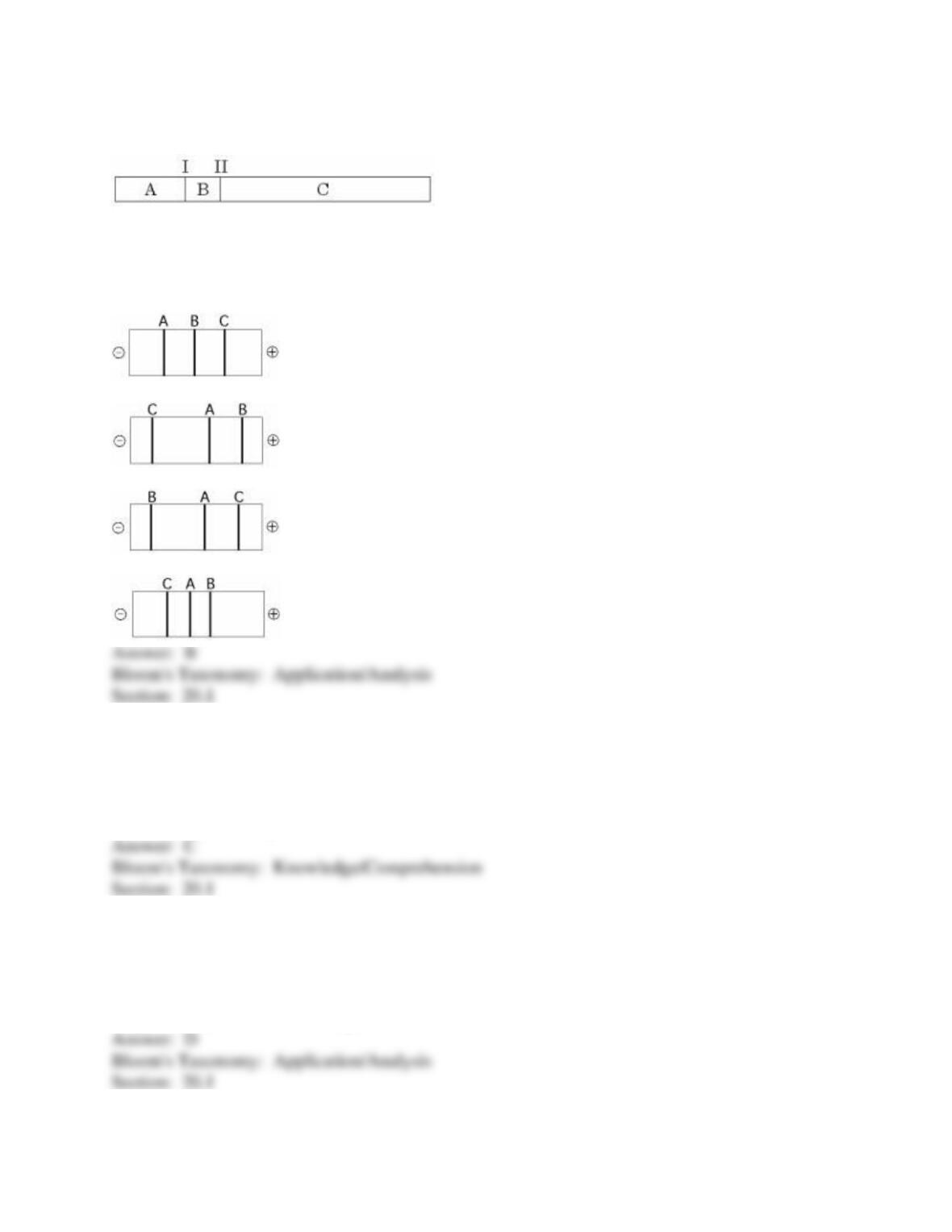
11) The segment of DNA shown in the figure above has restriction sites I and II, which create
restriction fragments A, B, and C. Which of the gels produced by electrophoresis shown below
best represents the separation and identity of these fragments?
A)
B)
C)
D)
12) A laboratory might use dideoxyribonucleotides to _____.
A) separate DNA fragments
B) produce cDNA from mRNA
C) sequence a DNA fragment
D) visualize DNA expression
13) Many identical copies of genes cloned in bacteria are produced as a result of _____.
A) plasmid replication
B) bacterial cell replication
C) transformation
D) plasmid and bacterial cell replication
14) Which of the following sequences is most likely to be cut by a restriction enzyme?

A) AATTCT
TTAAGA
B) AATATT
TTATAA
C) AAAATT
TTTTAA
D) ACTACT
TGATGA
15) What information is critical to the success of polymerase chain reaction (PCR) itself?
A) The DNA sequence of the ends of the DNA to be amplified must be known.
B) The complete DNA sequence of the DNA to be amplified must be known.
C) The sequence of restriction-enzyme recognition sites in the DNA to be amplified must be
known.
D) The sequence of restriction-enzyme recognition sites in the DNA to be amplified and in the
plasmid where the amplified DNA fragment will be cloned must be known.
16) Which of the following is in the correct order for one cycle of polymerase chain reaction
(PCR)?
A) Denature DNA; add fresh enzyme; anneal primers; add dNTPs; extend primers.
B) Anneal primers; denature DNA; extend primers.
C) Extend primers; anneal primers; denature DNA.
D) Denature DNA; anneal primers; extend primers.
17) The final step in a Sanger DNA sequencing reaction is to run the DNA fragments on a gel.
What purpose does this serve?
A) It adds ddNTP to the end of each DNA fragment.
B) It changes the length of the DNA fragments.
C) It separates DNA fragments based on their charge.
D) It separates DNA fragments generated during the sequencing reaction based on one-
nucleotide differences in their size.

18) DNA sequencing has transformed our understanding of genes, genomes and evolution.
Which of the following statements comparing two common sequencing techniques, the chain
termination method and next generation sequencing is TRUE?
A) The chain termination method is faster and more efficient, so it is used to generate large-scale
sequences, while next generation synthesis is used for routine, small-scale jobs.
B) The chain termination method employs the polymerase chain reaction, but next generation
sequencing does not.
C) In the chain termination method, the order of bases is detected by fluorescently labeling each
dideoxy-nucleotide in a different color, while next generation sequencing determines the order of
bases by detecting the release of PPi during the formation of the phosphodiester bond.
D) Next generation sequencing employs electrophoresis, but the chain termination method does
not.
19) A gene that contains introns can be made shorter (but remain functional) for genetic
engineering purposes by using _____.
A) a restriction enzyme (endonuclease) to cut the gene into shorter pieces
B) reverse transcriptase to reconstruct the gene from its mRNA
C) DNA polymerase to reconstruct the gene from its polypeptide product
D) DNA ligase to put together fragments of the DNA that code for a particular polypeptide
20) Which of the following is required to make complementary DNA (cDNA) from RNA?
A) restriction enzymes (endonucleases)
B) gene cloning
C) DNA ligase
D) reverse transcriptase
21) DNA microarrays have made a huge impact on genomic studies because they _____.
A) can be used to eliminate the function of any gene in the genome
B) can be used to introduce entire genomes into bacterial cells
C) allow the expression of many or even all of the genes in the genome to be compared at once
D) allow physical maps of the genome to be assembled in a very short time

22) RNAi methodology uses double-stranded pieces of RNA to trigger breakdown of a specific
mRNA or inhibit its translation. For which of the following might this technique be useful?
A) to decrease the production from a harmful mutated gene
B) to destroy an unwanted allele in a homozygous individual
C) to form a knockout organism that will not pass the deleted sequence to its progeny
D) to raise the concentration of a desired protein
23) A researcher has used in vitro mutagenesis to mutate a cloned gene and then has reinserted
the mutated gene into a cell. To have the mutated sequence disable the function of the gene, what
must then occur?
A) recombination resulting in replacement of the wild type with the mutated gene
B) use of a microarray to verify continued expression of the original gene
C) replication of the cloned gene using a bacterial plasmid
D) transcription of the cloned gene using a BAC
24) Silencing of selected genes is often done using RNA interference (RNAi). Which of the
following questions would NOT be answered with this process?
A) What is the function of gene 432 in a particular species of annelid?
B) What will happen in a particular insect’s digestion if gene 173 is not able to be translated?
C) Is gene HA292 expressed in individuals for a disorder in humans?
D) Will the disabling of this gene in Drosophila and in a mouse cause similar results?
25) In large scale, genome-wide association studies in humans we look for _____.
A) lengthy sequences that might be shared by most members of a population
B) SNPs where one allele is found more often in persons with a particular disorder than in
healthy controls
C) SNPs where one allele is found in families with particular introns sequence
D) SNPs where one allele is found in two or more adjacent genes

26) For a particular microarray assay (DNA chip), cDNA has been made from the mRNAs of a
dozen patients’ breast tumor biopsies. The researchers will be looking for _____.
A) a particular gene that is amplified in all or most of the patient samples
B) a pattern of fluorescence that indicates which cells are over proliferating
C) a pattern shared among some or all of the samples that indicates gene expression differing
from control samples
D) a group of cDNAs that match those in non-breast cancer control samples from the same
population
27) Imagine that you compare two DNA sequences found in the same location on homologous
chromosomes. On one of the homologs, the sequence is AACTACGA. On the other homolog,
the sequence is AACTTCGA. Within a population, you discover that each of these sequences is
common. These sequences _____.
A) contain an SNP that may be useful for genetic mapping
B) identify a protein-coding region of a gene
C) cause disease
D) do none of the listed actions
28) Which of the following uses labeled probes to visualize the expression of genes in whole
tissues and organisms?
A) RT-PCR
B) in situ hybridization
C) DNA microarrays
D) RNA interference
29) Which of the following is most like the formation of identical twins?
A) cell cloning
B) therapeutic cloning
C) use of adult stem cells
D) organismal cloning

30) In 1997, Dolly the sheep was cloned. Which of the following processes was used?
A) replication and dedifferentiation of adult stem cells from sheep bone marrow
B) separation of an early stage sheep blastula into separate cells, one of which was incubated in a
surrogate ewe
C) fusion of an adult cell’s nucleus with an enucleated sheep egg, followed by incubation in a
surrogate
D) isolation of stem cells from a lamb embryo and production of a zygote equivalent
31) Which of the following problems with animal cloning might result in premature death of the
clones?
A) use of pluripotent instead of totipotent stem cells
B) use of nuclear DNA as well as mtDNA
C) abnormal gene regulation due to variant methylation
D) the indefinite replication of totipotent stem cells
32) Reproductive cloning of human embryos is generally considered unethical. However, on the
subject of therapeutic cloning there is a wider divergence of opinion. Which of the following is a
likely explanation?
A) The use of adult stem cells is likely to produce more cell types than the use of embryonic
stem cells.
B) Cloning to produce embryonic stem cells may lead to great medical benefits for many.
C) Cloning to produce stem cells relies on a different initial procedure than reproductive cloning.
D) A clone that lives until the blastocyst stage does not yet have human DNA.
33) Which of the following is true of embryonic stem cells but not of adult stem cells?
A) They normally differentiate into only eggs and sperm.
B) They can give rise to all cell types in the organism.
C) They can continue to reproduce for an indefinite period.
D) One aim of using them is to provide cells for repair of diseased tissue.

34) A researcher is using adult stem cells and comparing them to other adult cells from the same
tissue. Which of the following is a likely finding?
A) The cells from the two sources exhibit different patterns of DNA methylation.
B) Adult stem cells have more DNA nucleotides than their counterparts.
C) The two kinds of cells have virtually identical gene expression patterns in microarrays.
D) The nonstem cells have fewer repressed genes.
35) In animals, what is the difference between reproductive cloning and therapeutic cloning?
A) Reproductive cloning uses totipotent cells, whereas therapeutic cloning does not.
B) Reproductive cloning uses embryonic stem cells, whereas therapeutic cloning does not.
C) Therapeutic cloning uses nuclei of adult cells transplanted into enucleated nonfertilized eggs.
D) Therapeutic cloning supplies cells for repair of diseased or injured organs.
36) The first cloned cat, called Carbon Copy, was a calico, but she looked significantly different
from her female parent because _____.
A) the cloning was done poorly and it was likely that some contaminating cat DNA became part
of Carbon Copy’s genome
B) fur color genes in cats is determined by differential acetylation patterns
C) cloned animals have been found to have a higher frequency of transposon activation
D) X inactivation in the embryo is random and produces different patterns
37) In recent times, it has been shown that adult cells can be induced to become pluripotent stem
cells (iPS). To make this conversion, what has been done to the adult cells?
A) A retrovirus is used to introduce four specific regulatory genes.
B) The adult stem cells must be fused with embryonic cells.
C) Cytoplasm from embryonic cells is injected into the adult cells.
D) The nucleus of an embryonic cell is used to replace the nucleus of an adult cell.

38) Let us suppose that someone is successful at producing induced pluripotent stem cells (iPS)
for replacement of pancreatic insulin-producing cells for people with type 1 diabetes. Which of
the following could still be problems?
I. the possibility that, once introduced into the patient, the iPS cells produce nonpancreatic cells
II. the failure of the iPS cells to take up residence in the pancreas
III. the inability of the iPS cells to respond to appropriate regulatory signals
A) I only
B) II only
C) III only
D) I, II, and III
39) Genetically engineered plants _____.
A) are more difficult to develop than genetically engineered animals
B) include transgenic rice plants that can grow in water of high salinity
C) are used in research but not yet in commercial agricultural production
D) are banned throughout the world
40) Scientists developed a set of guidelines to address the safety of DNA technology. Which of
the following is one of the adopted safety measures?
A) Microorganisms used in recombinant DNA experiments are genetically crippled to ensure
that they cannot survive outside of the laboratory.
B) Genetically modified organisms are not allowed to be part of our food supply.
C) Transgenic plants are engineered so that the plant genes cannot hybridize.
D) Experiments involving HIV or other potentially dangerous viruses have been banned.
41) Which of the following is one of the technical reasons why gene therapy is problematic?
A) Most cells with an engineered gene do not produce gene product.
B) Cells with transferred genes are unlikely to replicate.
C) Transferred genes may not have appropriately controlled activity.
D) mRNA from transferred genes cannot be translated.

42) One possible use of transgenic plants is in the production of human proteins, such as
vaccines. Which of the following is a possible hindrance that must be overcome?
A) prevention of transmission of plant allergens to the vaccine recipients
B) prevention of vaccine-containing plants being consumed by insects
C) use of plant cells to translate non-plant-derived mRNA
D) inability of the human digestive system to accept plant-derived protein
43) What characteristic of short tandem repeats (STRs) DNA makes it useful for DNA
fingerprinting?
A) The number of repeats varies widely from person to person or animal to animal.
B) The sequence of DNA that is repeated varies significantly from individual to individual.
C) The sequence variation is acted upon differently by natural selection in different
environments.
D) Every racial and ethnic group has inherited different short tandem repeats.
44) Transgenic mice are useful to human researchers because they _____.
A) can be valuable animal models of human disease
B) are essential for mapping human genes
C) are now used in place of bacteria for cloning human genes
D) were instrumental in pinpointing the location of the huntingtin gene
45) Gene therapy requires _____.
A) knowledge and availability of the normal allele of the defective gene
B) the ability to introduce the normal allele into the patient
C) the ability to express the introduced gene at the correct level, time, and tissue site within the
patient
D) knowledge and availability of the normal allele of the defective gene, an ability to introduce
the normal allele into the patient, and an ability to express the introduced gene at the correct
level, and time, and tissue site within the patient

46) For applications in gene therapy, what is the most favorable characteristic of retroviruses?
A) Retroviruses have an RNA genome.
B) Retroviruses possess reverse transcriptase.
C) DNA copies of retroviral genomes become integrated into the genome of the infected cell.
D) Retroviruses mutate often.
47) Using retroviral vectors for gene therapy might increase the patient’s risk of developing
cancer because they might _____.
A) introduce proteins from the virus
B) not express the genes that were introduced into a patient’s cells
C) not integrate their recombinant DNA into the patient’s genome
D) integrate recombinant DNA into the genome in ways that misregulate the expression of genes
at or near the site of integration
48) In the form of gene therapy used successfully for severe combined immunodeficiency
syndrome (SCID)-X1, the genetic engineering of human cells is done by _____.
A) injecting engineered viruses into the patient’s bloodstream
B) injecting engineered viruses into the patient’s bone marrow
C) treating a relative’s cultured bone marrow cells with genetically engineered viruses and then
injecting these cells into the patient’s bone marrow
D) isolating the patient’s bone marrow cells, infecting them with genetically engineered viruses,
and injecting them back into the patient’s bone marrow
49) One predicted aspect of climate change is that climates, including precipitation and
temperature, over most of the Earth will become more variable. Which of the following is a good
crop genetic engineering strategy if this is true?
A) Only plant crops that are genetically engineered.
B) Genetically engineer most crops to withstand very long droughts.
C) Genetically engineer several genotypes within single crop types.
D) Genetically engineer the fastest growing crops possible.

50) Plasmids are used as vectors in plant and bacterial genetic engineering. However, there is a
major difference in the fate of genes introduced into bacteria on most bacterial plasmids and into
plants on tumor-inducing (Ti) plasmids. What is this difference?
A) In bacteria, genes are stably expressed; in plants, gene expression is always lost quickly.
B) Gene expression tends to decrease rapidly and unpredictably in bacteria; gene expression is
much more stable in plants.
C) Bacterial plasmids are circular DNAs; Ti plasmid DNA is linear.
D) Bacterial plasmids and the genes they carry usually are not integrated into the chromosome;
Ti plasmids and the genes they carry are integrated into the chromosome.
51) In an experiment, DNA from the linear form of the bacteriophage Lambda was cut into
fragments using the restriction enzyme Hind III. Restriction enzymes are isolated from bacteria
and cut DNA in specific locations. Hind III cuts the Lambda DNA between the adenine
nucleotides on the complimentary strands in a specific sequence, as indicated in the diagram,
producing eight different size fragments. These fragments are then separated with an electrical
current based on size after the DNA fragments are placed in a porous gel, a process called gel
electrophoresis.
cut site
↓
5’ A A G C T T 3’
3’ T T C G A A 5’
↑
cut site
Select an observation that best describes a correct aspect of the two processes of restriction
digest and gel electrophoresis:
A) When separated on a gel, the pattern of DNA bands will be characteristic of those cut with
Hind III, different restriction enzymes will not produce these same fragments.
B) The sequence AAGCTT is found eight times in the Lambda genome and the restriction
enzyme Hind III finds each location.
C) If an electrical current is not used, eight separate DNA bands would be visible, but they
would not be separated as much as when an electrical current is used.
D) Only the restriction enzyme Hind III can be used to cut Lambda DNA since restriction
enzymes are specific to the type of DNA they can cut.

52) Organisms share many conserved core processes and features, including transcription and
translation using a uniform genetic code. Scientists have used these shared processes and features
in biotechnology. For example, for the process of some transformations, a plasmid is constructed
when a eukaryotic gene of interest is added with an antibiotic resistant gene such beta-lactamase,
which is used for ampicillin resistance. This plasmid is then inserted into a prokaryotic bacterial
cell, such as E-coli, through a transformation process that leads to the production of the product
protein from the eukaryotic organism. To culture the bacteria and obtain the protein product, the
bacteria must grow.
Select the appropriate condition to determine if the plasmid has entered the E-coli bacterial cell.
A) Nutrient broth to which no antibiotic has been added.
B) Water to which ampicillin has been added.
C) Nutrient broth to which ampicillin has been added.
D) Nutrient broth to which other resistant bacteria have been added.