
70) The molar mass of water is 18 g/mol. What is the molarity of 1 liter of pure water? (Hint:
One liter of pure water has a mass of 1 kg.)
A) 55.6 M
B) 18 M
C) 37 M
D) 0.66 M
E) 1.0 M
71) You have a freshly prepared 1 M solution of glucose in water. You carefully pour out a 100-
mL sample of that solution. How many glucose molecules are included in that 100-mL sample?
A) 6.02 × 10²³
B) 3.01 × 10²³
C) 6.02 × 1024
D) 12.04 × 10²³
E) 6.02 × 10²²
72) A strong acid like HCl
A) dissociates completely in an aqueous solution.
B) increases the pH when added to an aqueous solution.
C) reacts with strong bases to create a buffered solution.
D) is a strong buffer at low pH.
E) is a strong buffer at high pH.

73) Which of the following dissociates completely in aqueous solution and is therefore
considered to be a strong base (alkali)?
A) NaCl
B) HCl
C) NH3
D) H2CO3
E) NaOH
74) A 0.01 M solution of a substance has a pH of 2. What can you conclude about this
substance?
A) It is a strong acid that ionizes completely in water.
B) It is a strong base that ionizes completely in water.
C) It is a weak acid.
D) It is a weak base.
E) It is a buffer.
75) A solution contains 0.0000001(10-7) moles of hydroxyl ions (OH–) per liter. Which of the
following best describes this solution?
A) acidic: H+ acceptor
B) basic: H+ acceptor
C) acidic: H+ donor
D) basic: H+ donor
E) neutral

23
76) What is the pH of a solution with a hydroxyl ion (OH–) concentration of 10-12 M?
A) pH 2
B) pH 4
C) pH 10
D) pH 12
E) pH 14
77) What is the pH of a 1-millimolar NaOH solution?
A) pH 3
B) pH 8
C) pH 9
D) pH 10
E) pH 11
78) Which of the following solutions would require the greatest amount of base to be added to
bring the solution to neutral pH?
A) gastric juice at pH 2
B) vinegar at pH 3
C) tomato juice at pH 4
D) black coffee at pH 5
E) household bleach at pH 12
79) What is the hydrogen ion (H+) concentration of a solution of pH 8?
A) 8 M
B) 8 × 10⁻⁶ M
C) 0.01 M
D) 10-8 M
E) 10-6 M

24
80) What is the hydroxyl ion (OH–) concentration of a solution of pH 8?
A) 8 M
B) 8 × 10⁻⁶ M
C) 0.01 M
D) 10-8 M
E) 10-6 M
81) If the pH of a solution is increased from pH 5 to pH 7, it means that the
A) concentration of H+ is twice (2×) what it was at pH 5.
B) concentration of H+ is one-half (1/2) what it was at pH 5.
C) concentration of OH– is 100 times greater than what it was at pH 5.
D) concentration of OH– is one-hundredth (0.01×) what it was at pH 5.
E) concentration of H+ is 100 times greater than what it was at pH 5.
82) If the pH of a solution is decreased from pH 8 to pH 6, it means that the
A) concentration of H+ is twice (2×) what it was at pH 8.
B) concentration of H+ is one-half (1/2) what it was at pH 8.
C) concentration of OH– is 100 times greater than what it was at pH 8.
D) concentration of OH– is one-hundredth (0.01×) what it was at pH 8.
E) concentration of H+ is one-hundredth (0.01×) what it was at pH 8.
83) One liter of a solution of pH 4 has how many more hydrogen ions (H+) than 1 L of a solution
of pH 9?
A) 4 times more
B) 16 times more
C) 40,000 times more
D) 10,000 times more
E) 100,000 times more

84) One liter of a solution of pH 8 has how many more hydroxyl ions (OH–) than 1 L of a
solution of pH 4?
A) 5 times more
B) 32 times more
C) 50,000 times more
D) 10,000 times more
E) 100,000 times more
85) Which of the following statements about buffer solutions is true?
A) They maintain a constant pH when bases are added to them but not when acids are added to
them.
B) They maintain a constant pH when acids are added to them but not when bases are added to
them.
C) They maintain a relatively constant pH of approximately 7 when either acids or bases are
added to them.
D) They maintain a relatively constant pH when either acids or bases are added to them.
E) They are found only in living systems and biological fluids.
86) Buffers are substances that help resist shifts in pH by
A) releasing H+ to a solution when acids are added.
B) accepting OH– to a solution when bases are added.
C) releasing OH– to a solution when bases are added.
D) accepting H+ from a solution when acids are added.
E) accepting OH– from a solution when acids are added.

87) Carbonic acid (H2CO3) serves as a buffer in human blood. Carbonic acid is a weak acid that
dissociates into a bicarbonate ion (HCO3–) and a hydrogen ion (H+). Thus,
H2CO3 ↔ HCO3– + H+
A decrease in blood pH would result in
A) a decrease in the concentration of H2CO3 and an increase in the concentration of HCO3–.
B) a decrease in the concentrations of H2CO3 and HCO3–.
C) an increase in the concentration of H2CO3 and a decrease in the concentration of HCO3–.
D) an increase in the concentrations of H2CO3 and HCO3–.
E) an increase in the concentrations of H2CO3, HCO3–, and OH–.
88) One of the buffers that contributes to pH stability in human blood is carbonic acid (H2CO3).
Carbonic acid is a weak acid that, when placed in an aqueous solution, dissociates into a
bicarbonate ion (HCO3–) and a hydrogen ion (H+). Thus,
H2CO3 ↔ HCO3– + H+
If the pH of the blood increases, one would expect
A) a decrease in the concentration of H2CO3 and an increase in the concentration of HCO3–.
B) an increase in the concentration of H2CO3 and a decrease in the concentration of HCO3–.
C) a decrease in the concentration of HCO3– and an increase in the concentration of H+.
D) an increase in the concentration of HCO3– and a decrease in the concentration of OH–.
E) a decrease in the concentration of HCO3– and an increase in the concentration of both H2CO3
and H+.

89) If acid rain has lowered the pH of a particular lake to pH 4.0, which of the following
statements about this lake is true?
A) The hydrogen ion concentration is 1 × 10⁻¹⁰ moles per liter of lake water.
B) The hydrogen ion concentration is 4.0 moles per liter of lake water.
C) The hydrogen ion concentration is 1 × 10⁴ moles per liter of lake water.
D) The hydroxyl ion concentration is 1 × 10⁻¹⁰ moles per liter of lake water.
E) The hydroxyl ion concentration is 1 × 10⁻⁴ moles per liter of lake water.
90) Research indicates that acid precipitation can damage marine corals by
A) buffering ocean waters.
B) decreasing the H+ concentration in oceans.
C) increasing the OH– concentration in oceans.
D) decreasing the concentration of carbonate ions in oceans.
E) decreasing the calcium ion concentration in oceans.
91) Approximately what percentage of human-generated atmospheric CO2 is absorbed by the
oceans?
A) 1%
B) 5%
C) 25%
D) 60%
E) 95%
28
92) CO2 absorbed by the oceans combines with water to form H2CO3. Which of the following
will result from increasing the concentration of H2CO3 in the oceans?
A) Ocean pH will be stabilized by the buffering capacity of H2CO3.
B) Ocean pH will increase.
C) Ocean pH will decrease.
D) The concentration of carbonate ions (CO32-) in the ocean will increase.
E) The concentration of bicarbonate ions (HCO3–) in the ocean will decrease.
93) Consider two solutions: solution X has a pH of 4; solution Y has a pH of 7. From this
information, we can reasonably conclude that
A) solution Y has no free hydrogen ions (H+) because the solution is neutral.
B) the concentration of hydrogen ions in solution X is 30 times greater than the concentration of
hydrogen ions in solution Y.
C) the concentration of hydrogen ions in solution Y is 1,000 times greater than the concentration
of hydrogen ions in solution X.
D) the concentration of hydrogen ions in solution X is 3 times greater than the concentration of
hydrogen ions in solution Y.
E) the concentration of hydrogen ions in solution X is 1,000 times greater than the concentration
of hydrogen ions in solution Y.
94) Carbon dioxide (CO2) is readily soluble in water, according to the equation CO2 + H2O ↔
H2CO3. Carbonic acid (H2CO3) is a weak acid. Respiring cells release CO2 into the
bloodstream. What will be the effect on the pH of blood as that blood first comes in contact with
respiring cells?
A) Blood pH will decrease slightly.
B) Blood pH will increase slightly.
C) Blood pH will remain unchanged.
D) Blood pH will first increase, then decrease as CO2 combines with hemoglobin.

95) A beaker contains 100 mL of NaOH solution at pH = 13. A technician carefully pours into
the beaker 10 mL of HCl at pH = 1. Which of the following statements correctly describes the
results of this mixing?
A) The concentration of Na+ ion will rise.
B) The concentration of Cl– ion will be 0.1 M.
C) The concentration of undissociated H2O molecules will remain unchanged.
D) The pH of the beaker’s contents will be neutral.
E) The pH of the beaker’s contents will decrease.
96) An equal volume (5 mL) of vinegar from a freshly opened bottle is added to each of the
following solutions. After complete mixing, which of the mixtures will have the highest pH?
A) 100 mL of pure water
B) 100 mL of freshly brewed coffee
C) 100 mL of household cleanser containing 0.5 M ammonia
D) 100 mL of freshly squeezed lemon juice
E) 100 mL of tomato juice
97) An equal volume (5 mL) of milk of magnesia from a freshly opened bottle is added to each
of the following solutions. After complete mixing, which of the mixtures will have the lowest
pH?
A) 100 mL of pure water
B) 100 mL of freshly brewed coffee
C) 100 mL of household cleanser containing 0.5 M ammonia
D) 100 mL of freshly squeezed lemon juice
E) 100 mL of household cleanser containing 0.5 M bleach
98) Increased atmospheric CO2 concentrations will have what effect on seawater?
A) Seawater will become more acidic, and bicarbonate concentrations will decrease.
B) Seawater will become more alkaline, and carbonate concentrations will decrease.
C) There will be no change in the pH of seawater because carbonate will turn to bicarbonate.
D) Seawater will become more acidic, and carbonate concentrations will decrease.
E) Seawater will become more acidic, and carbonate concentrations will increase.
99) How would acidification of seawater affect marine organisms?
A) Acidification would increase dissolved carbonate concentrations and promote faster growth
of corals and shell-building animals.
B) Acidification would decrease dissolved carbonate concentrations and promote faster growth
of corals and shell-building animals.
C) Acidification would increase dissolved carbonate concentrations and hinder growth of corals
and shell-building animals.
D) Acidification would decrease dissolved carbonate concentrations and hinder growth of corals
and shell-building animals.
E) Acidification would increase dissolved bicarbonate concentrations and cause increased
calcification of corals and shellfish.
100) One proposal to mitigate the effects of burning fossil fuels on atmospheric CO2
concentrations is to pipe liquid CO2 into the ocean at depths of 2,500 feet or greater. At the high
pressures at such depths, CO2 is heavier than water. What potential effects might result from
implementing such a scheme?
A) increased photosynthetic carbon fixation because of the increased dissolved carbon dioxide in
the deep water
B) increased carbonate concentrations in the deep waters
C) increased growth of corals from a change in the carbonate-bicarbonate equilibrium
D) no effect because carbon dioxide is not soluble in water
E) changes in the growth of deep sea-dwelling organisms with calcium carbonate shells
101) If the cytoplasm of a cell is at pH 7, and the mitochondrial matrix is at pH 8, this means that
A) the concentration of hydrogen ions is tenfold higher in the cytoplasm than in the
mitochondrial matrix.
B) the concentration of hydrogen ions is tenfold higher in the mitochondrial matrix than in the
cytoplasm.
C) the concentration of hydrogen ions in the cytoplasm is 7/8 the concentration in the
mitochondrial matrix.
D) the mitochondrial matrix is more acidic than the cytoplasm.
E) the concentration of hydrogen ions in the cytoplasm is 8/7 the concentration in the
mitochondrial matrix.
2.2 Art Questions
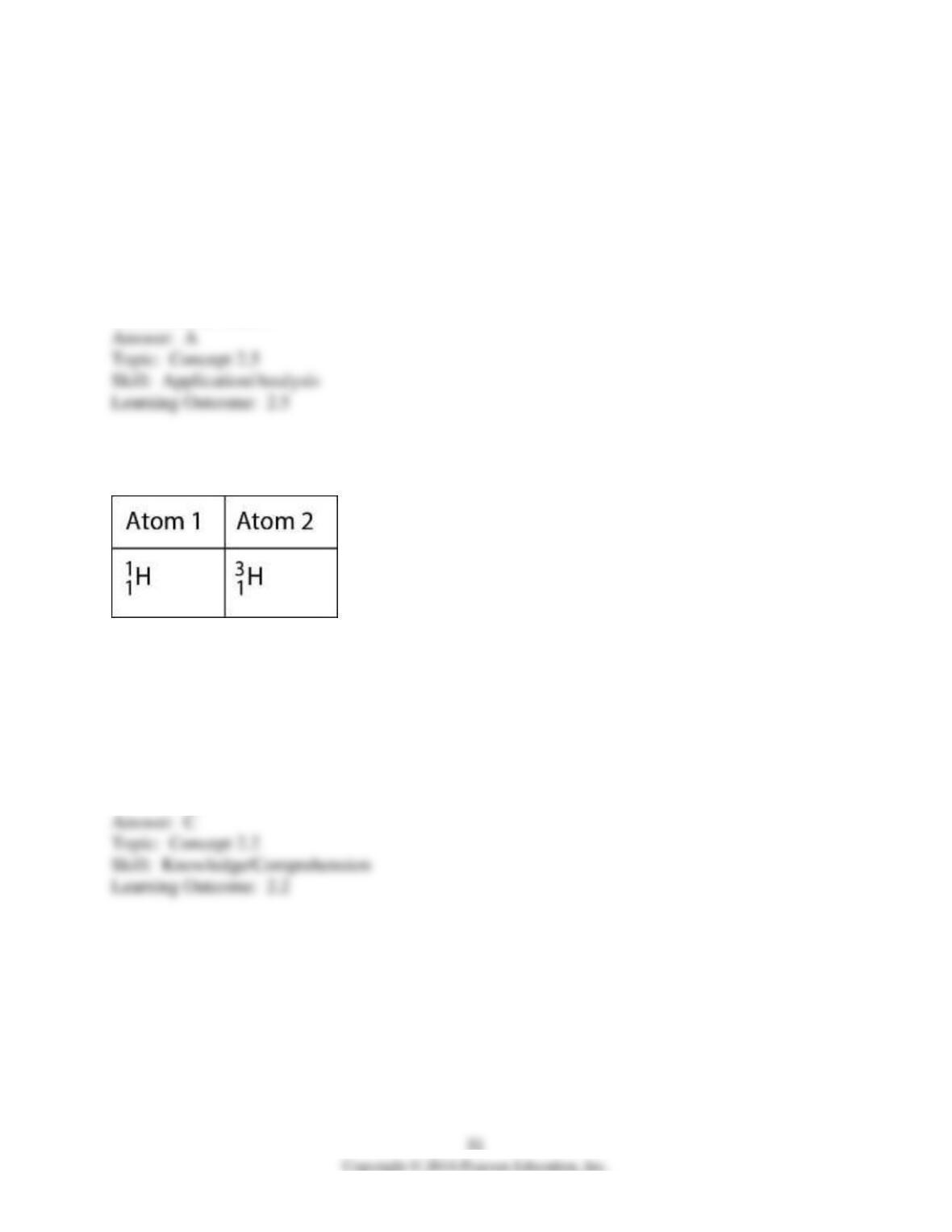
1)
Figure 2.1
Which of the following best describes the relationship between the atoms described in Figure
2.1?
A) They are compounds.
B) They are polymers.
C) They are isotopes.
D) They contain 1 and 3 protons, respectively.
E) They each contain 1 neutron.
2)
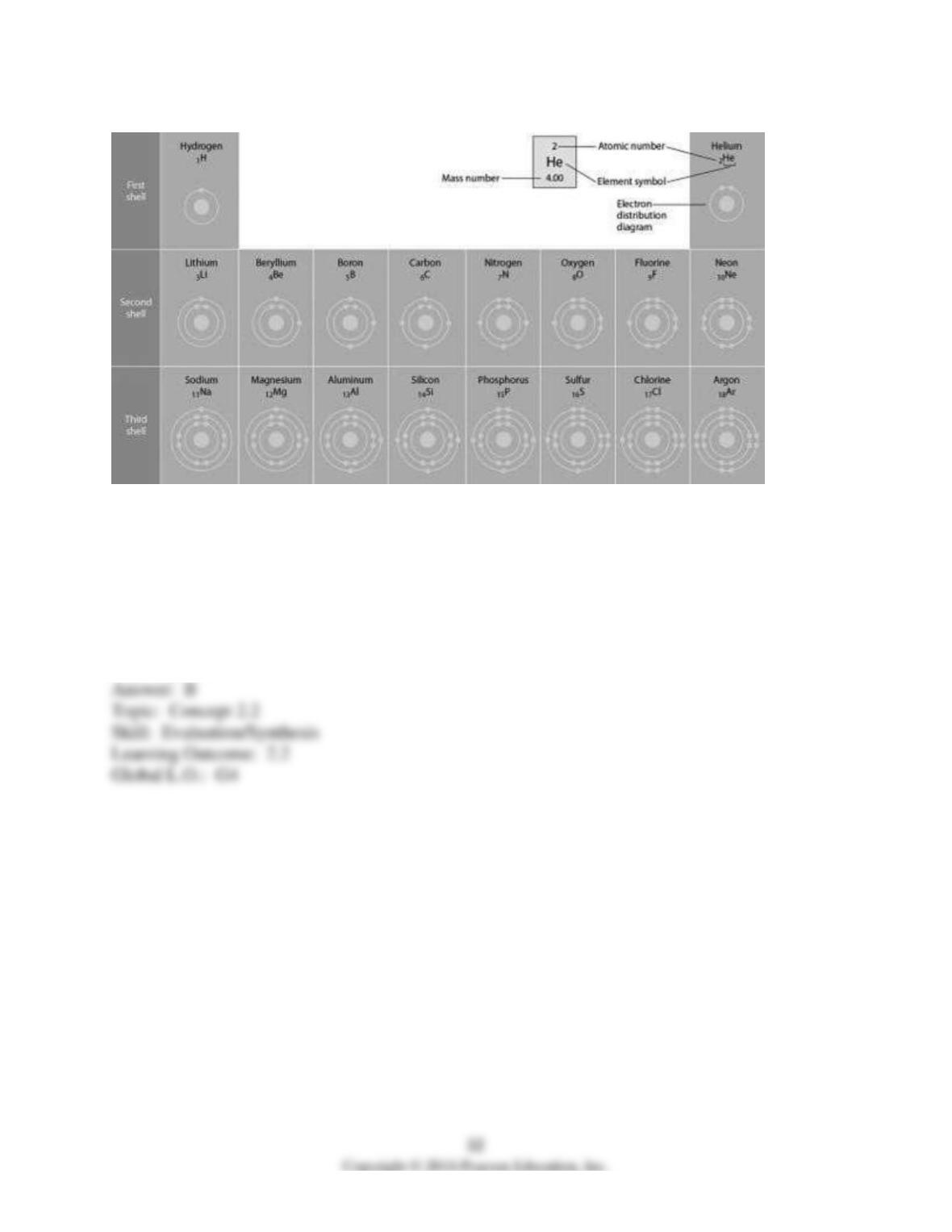
Figure 2.2
Refer to Figure 2.2 (first three rows of the periodic table). If life arose on a planet where carbon
is absent, which element might fill the role of carbon?
A) boron
B) silicon
C) nitrogen
D) aluminum
E) phosphorus
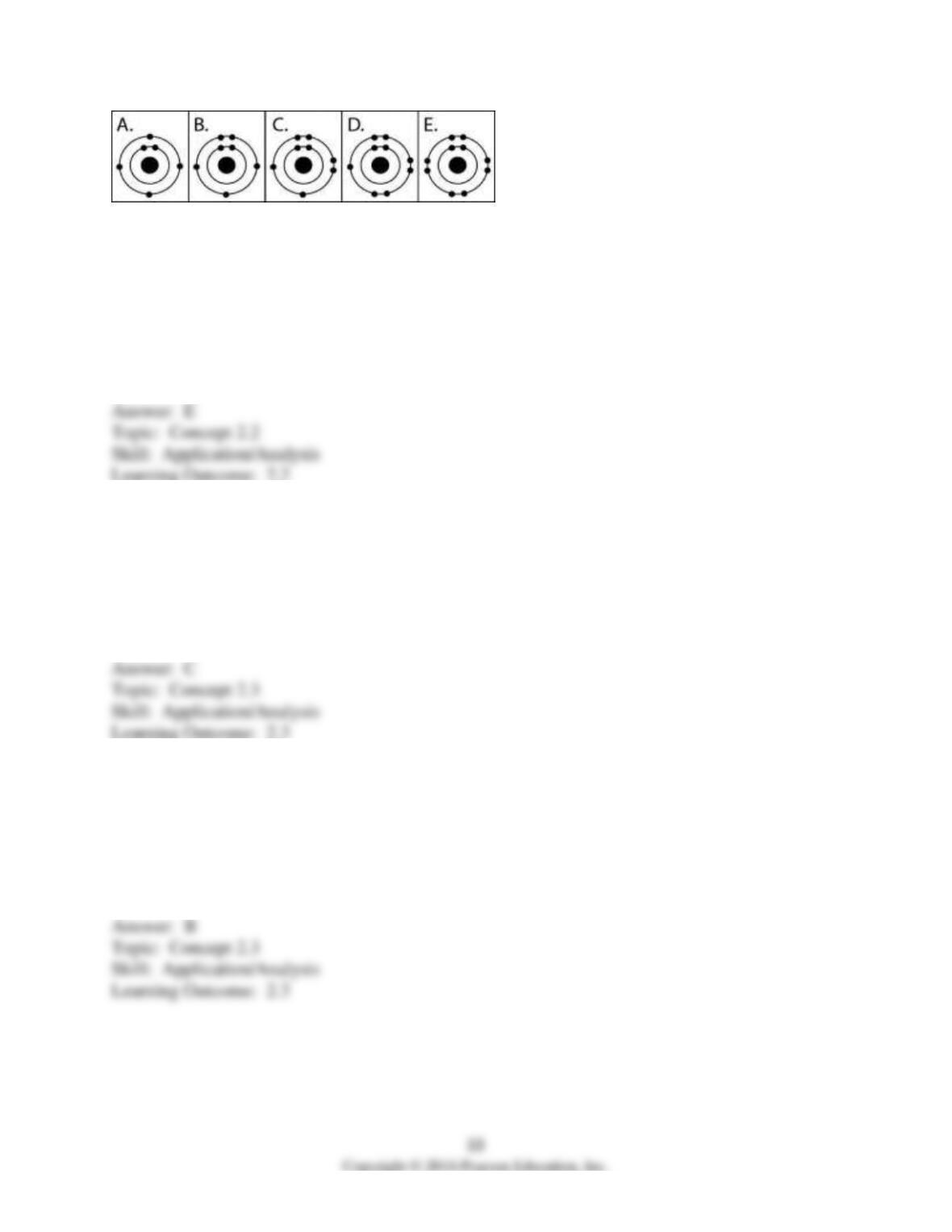
Figure 2.3
3) Which drawing in Figure 2.3 depicts the electron configuration of an element with chemical
properties most similar to those of helium (2He)?
A) A
B) B
C) C
D) D
E) E
4) Which drawing in Figure 2.3 depicts the electron configuration of an atom that can form
covalent bonds with two hydrogen atoms?
A) A
B) B
C) C
D) D
E) E
5) Which drawing in Figure 2.3 depicts the electron configuration of an atom capable of forming
three covalent bonds with other atoms?
A) A
B) B
C) C
D) D
E) E
6) Which drawing in Figure 2.3 is of the electron configuration of a sodium 11Na+ ion?
A) A
B) B
C) C
D) D
E) E
7) Which drawing in Figure 2.3 depicts an atom with a valence of 3?
A) A
B) B
C) C
D) D
E) E
8) Which drawing in Figure 2.3 depicts an atom with a valence of 2?
A) A
B) B
C) C
D) D
E) E
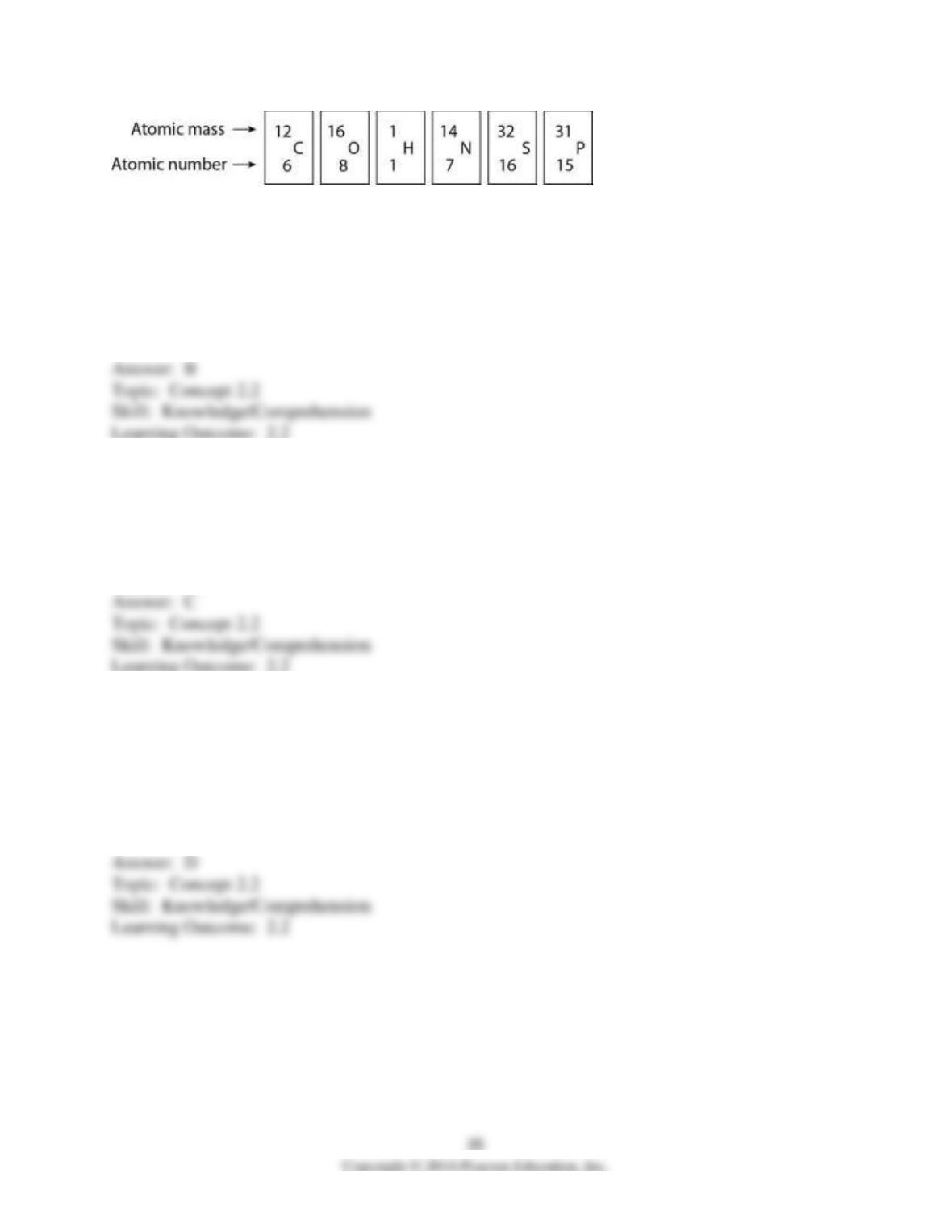
Figure 2.4
9) In Figure 2.4, how many electrons does nitrogen have in its valence shell?
A) 2
B) 5
C) 7
D) 8
E) 14
10) In Figure 2.4, how many unpaired electrons does phosphorus have in its valence shell?
A) 15
B) 2
C) 3
D) 7
E) 5
11) How many neutrons are present in the nucleus of a phosphorus-32 (32P) atom (see Figure
2.4)?
A) 5
B) 15
C) 16
D) 17
E) 32
12) How many electrons does an atom of sulfur have in its valence shell (see Figure 2.4)?
A) 4
B) 6
C) 8
D) 16
E) 32
13) Based on electron configuration, which of the elements in Figure 2.4 would exhibit a
chemical behavior most like that of oxygen?
A) carbon
B) hydrogen
C) nitrogen
D) sulfur
E) phosphorus
14)
Figure 2.5
Figure 2.5 shows a representation of formic acid. A formic acid molecule
A) will dissociate in water, thus increasing the pH.
B) will dissociate in water, thus decreasing the pH.
C) contains primarily nonpolar covalent bonds.
D) is held together by hydrogen bonds.
E) has a tetrahedral shape.