CHAPTER 2
Cell Chemistry and Biosynthesis
Questions
2-1 A major goal of interplanetary research is to find evidence of water on other
planets, in the search for extraterrestrial life. All known life requires water.
A. Describe three properties of water that make it uniquely suited for life. In
one or two sentences, describe each property and a consequence of that
property for cells or organisms.
B. Both C–H bonds and O–H bonds have special properties that make life
possible. What is the most notable difference between a C–H bond and an
O–H bond? Why is this difference important? Is an N–H bond more like
an O–H bond or a C–H bond?
C. In the search for interplanetary life, scientists are designing detection
methods for an unmanned rover that can be used to identify five kinds of
biomolecules. Name four of these five critical biomolecules.
2-2 Your friend learns about Avogadro’s number and thinks it is so huge that there
may not even be a mole of living cells on Earth. You have recently heard that
there are about 50 trillion (50 1012) human cells in each adult human body, so
you bet your friend $5 that there is more than a mole of cells on Earth. Once you
learn that each human contains more bacterial cells (in the digestive system) than
human cells, you are sure that you have won the bet. In the year 2000, the human
population surpassed 6 billion (6 109). What calculation can you show your
friend to convince him you are right?
2-3 Your friend challenges you to a bet. He says that cola is so sweet that the sugar
molecules in cola are more crowded than people packed into a 747 airplane. After
an uncomfortable cross-country airplane trip, you think this cannot be true. Cola
has 39 grams of sugar in 240 ml (0.9 M sugar). A person is roughly 2 1026 times
larger than a sugar molecule, so scaling a person down to the size of a sugar
molecule would correspondingly scale down the cabin volume of a 747 from
about a million liters to 4 10–21 liters. The maximum capacity of a 747 is 568
people. Which is more crowded, the sugar molecules in soda or the passengers on
a 747? What is the molarity of people on a 747, using the scaling described?
2-4 The yeast species Saccharomyces cerevisiae is commonly used to brew beer and
leaven bread (the Latin words of the species name mean “sugar fungus” and
“beer”). In making bread and beer, the yeast converts sugars to carbon dioxide,
which forms bubbles that cause dough to rise, and ethanol, which gives beer its
alcoholic punch. From the facts about sugar metabolism, you can explain to your
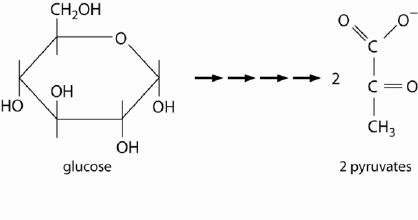
friends how the alcohol and carbon dioxide arise. In glycolysis, a glucose
molecule is converted into two pyruvate molecules (see Figure Q2-4).
A. Yeast can grow in the presence or absence of oxygen (aerobically or
anaerobically, respectively). Does glycolysis oxidize glucose? Can cells
growing anaerobically perform glycolysis? Explain.
B. Pyruvate can be converted to acetyl CoA or ethanol. Acetyl CoA then
enters the citric acid cycle; ethanol is not metabolized further. Use
chemical formulas to show what happens to the three carbon molecules in
pyruvate in each case when both reactions are complete (drawn as in
Figure Q2-4).
C. Is more ethanol made if yeast grows aerobically or anaerobically? Is more
CO2 made if yeast grows aerobically or anaerobically? Explain.
D. Bread yeast strains have been optimized for their task. What do you think
would happen if you brewed beer using bread yeast?
E. Some yeast (called rho–) have defective mitochondria, unlike the
functional wild-type rho+ yeast. A friend gave you a rho– strain and a rho+
strain, but forgot to label the strains. What carbon source would you use to
determine the identities of the strains? Name a carbon source that will
allow both strains to grow and one that will allow only one to grow (and
indicate which will grow).
Figure Q2-4
2-5 Lysine and glutamate are amino acids that are often positively and negatively
charged, respectively, in proteins in the cell.
A. The neutral forms are shown in Figure Q2-5. Write the charged forms of
the amino acids.
B. Consider a protein that has eight lysines and five glutamates, and no other
potentially charged amino acids. What will be the net charge on the
protein when it is dissolved in a solution at pH 3? At pH 7? At pH 13?
C. Histidine is usually neutral at high pH and charged at low pH when
incorporated in a protein. Its pKa is about 6.5. Roughly what percentage of
histidines will be charged in a solution at pH 6.5? At pH 5.5? At pH 8.5?
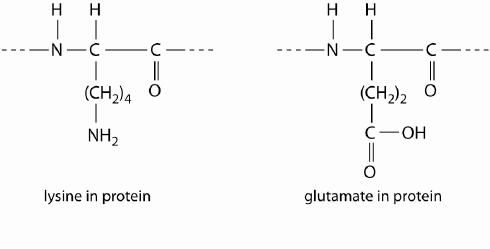
Figure Q2-5
2-6 Consider the reaction X → Y in a cell at 37°C. At equilibrium, the concentrations
of X and Y are 80 M and 16 M, respectively.
G° = –0.616 ln Keq
G = G° + 0.616 ln [Y]/[X]
The natural log of a number z will be negative when z < 1, positive when z
> 1, and 0 when z = 1.
A. What is the value of Keq for this reaction?
B. Is the standard free-energy change of this reaction positive or negative? Is
the reaction X → Y an energetically favorable or unfavorable reaction
under standard conditions?
C. Imagine circumstances in which the concentration of X is 1000 M and Y
is 1 M. Is a net conversion of X to Y favorable? For a given X molecule,
will it be converted to a Y molecule quickly? Explain.
D. Consider 20 M of Y added to a test tube with 80 M of X that contains a
radioactive atom to allow tracing of the individual atoms. The mixture is
incubated for 2 hours before separating Y from X and measuring the
radioactivity of Y. Does the information provided allow you to determine
whether the Y molecules contain any radioactivity? If the reaction also
contained an enzyme that catalyzes the interconversion of X and Y, would
the Y molecules be radioactive? Explain.
E. Imagine starting conditions in which the reaction X → Y is unfavorable,
yet the cell needs to produce more Y. Describe two ways in which this
may be accomplished.
2-7 Many critical molecules in cells are polymers. Which is more disordered, a
polymer or a collection of monomers? On the basis of your answer, is the G° of
a condensation reaction positive, negative, or zero? What about the G° of a
hydrolysis reaction? Is a condensation or a hydrolysis reaction usually coupled to
a reaction involving ATP or another activated carrier molecule?
2-8 The energetic trajectory of a series of reactions in a catabolic pathway can be
plotted on a graph like that in Figure Q2-8. The graph shows a hypothetical
pathway similar to glycolysis, in which the catabolic intermediates are designated
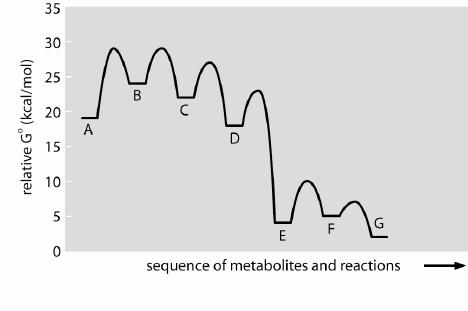
A, B, C, etc. The energetic contributions of activated carrier molecules have been
omitted from this energy plot. Which reaction is most likely to occur without an
enzyme? Which reaction is most likely to be catalyzed by an enzyme that
simultaneously uses ATP as a substrate? Which reaction is most likely to be
catalyzed by an enzyme that simultaneously uses ADP as a substrate and produces
ATP? Which reaction can most readily be driven by a subsequent reaction that
acts as a siphon on the product? For each of the four answers, explain your
reasoning.
Figure Q2-8
Answers