Campbell Biology in Focus, 2e (Urry)
Chapter 2 The Chemical Context of Life
2.1 Multiple-Choice Questions
1) About 20-25% of the 92 natural elements are known to be essential to life. Which four of
these elements make up approximately 96% of living matter?
A) carbon, sodium, hydrogen, nitrogen
B) carbon, oxygen, phosphorus, hydrogen
C) oxygen, hydrogen, calcium, nitrogen
D) carbon, hydrogen, nitrogen, oxygen
E) carbon, oxygen, nitrogen, calcium
2) Trace elements are those required by an organism in only minute quantities. Which of the
following is a trace element that is required by humans and other vertebrates?
A) nitrogen
B) calcium
C) iodine
D) sodium
E) phosphorus
3) Trace elements are those required by an organism in only minute quantities. Which of the
following is a trace element that is required by all organisms?
A) iron
B) calcium
C) iodine
D) sodium
E) potassium
4) Which of the following is primarily responsible for the unique chemical properties of each
element?
A) Each element has a unique atomic mass.
B) Each element has a unique atomic number.
C) Each element has a unique number of protons.
D) Each element has a unique number of neutrons.
E) Each element has unique radioactive properties.
5) From the atomic mass, one can deduce the number of ________ in each atom of an element.
A) protons
B) neutrons
C) electrons
D) protons plus electrons
E) protons plus neutrons
6) In what way are elements in the same column of the periodic table the same?
A) They have the same number of protons.
B) They have the same number of neutrons.
C) They have the same number of electrons.
D) They have the same number of electrons in their valence shell.
E) They have the same number of electron shells.
7) In what way are elements in the same row of the periodic table the same?
A) They have the same number of protons.
B) They have the same number of neutrons.
C) They have the same number of electrons.
D) They have the same number of electrons in their valence shell.
E) They have the same number of electron shells.
8) The nucleus of a nitrogen atom contains 7 neutrons and 7 protons. Which of the following is a
correct statement concerning nitrogen?
A) The nitrogen atom has a mass number of 7 and an atomic number of 14.
B) The nitrogen atom has a mass number of 14 and an atomic number of 7.
C) The nitrogen atom has a mass number of 14 and an atomic number of 14.
D) The nitrogen atom has a mass number of 7 and an atomic number of 21.
E) The nitrogen atom has a mass number of 14 and an atomic number of 21.
9) For elements in the first three rows of the periodic table, the position of an element in the row
indicates which of the following?
A) the total number of electrons in the element
B) the total number of protons in the element
C) the total number of neutrons in the element
D) the number of electron orbitals in the element
E) the number of electrons in the valence shell
10) The chemical behavior of an atom depends primarily upon which of the following?
A) the number of neutrons in the nucleus
B) the number of protons in the nucleus
C) the number of electrons in the valence shell
D) the total number of electrons contained by the atom
E) the number of electron shells contained by the atom
11) Molybdenum has an atomic number of 42. Several common isotopes exist, with mass
numbers of 92, 94, 95, 96, 97, 98, and 100. Therefore, which of the following is true?
A) Molybdenum atoms can have between 50 and 58 neutrons.
B) The isotopes of molybdenum have different electron configurations.
C) The isotopes of molybdenum can have between 50 and 58 protons.
D) The isotopes of molybdenum have between 50 and 58 neutrons and have different electron
configurations.
E) The isotopes of molybdenum have between 50 and 58 protons and have different electron
configurations.
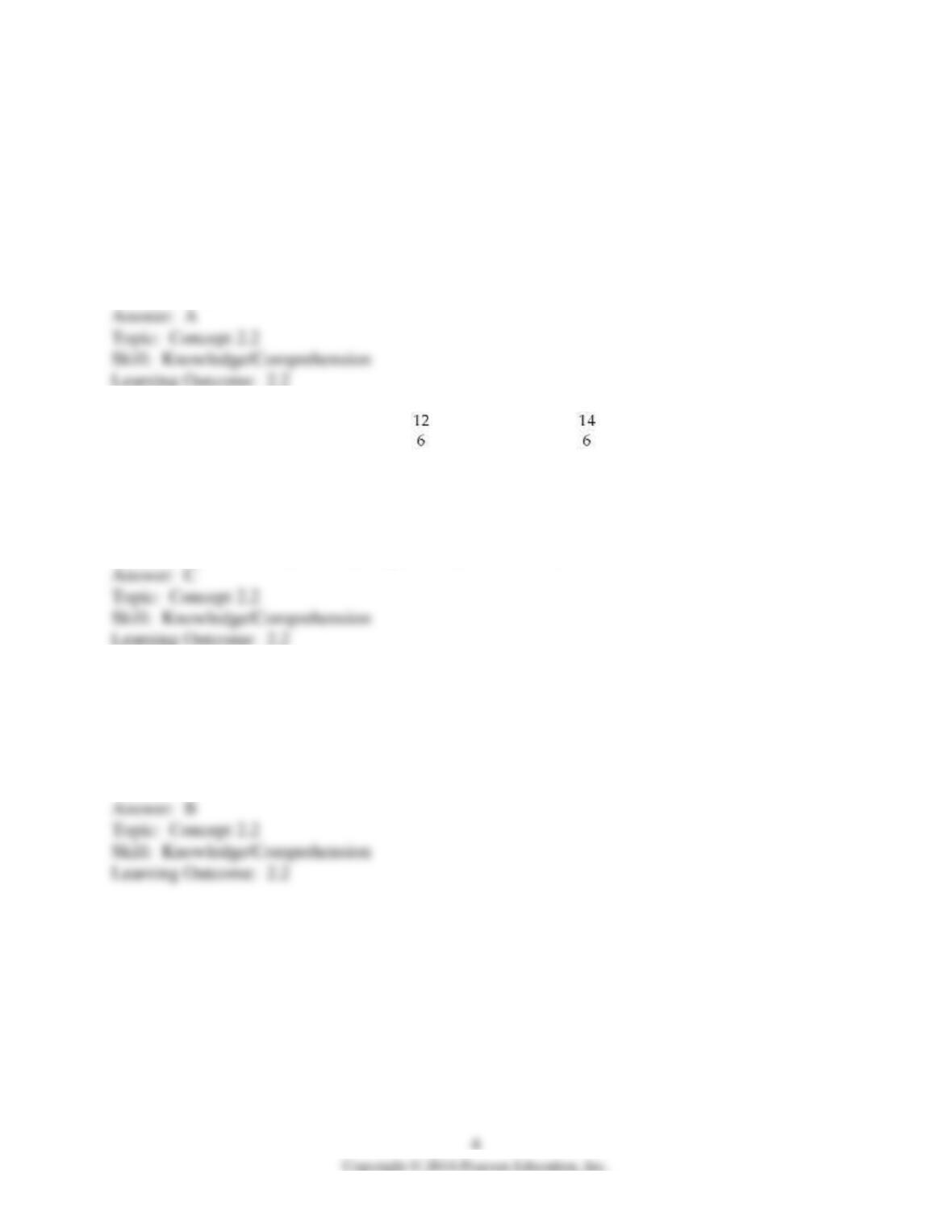
12) One difference between carbon-12 ( C) and carbon-14 ( C) is that carbon-14 has
A) two more protons than carbon-12.
B) two more electrons than carbon-12.
C) two more neutrons than carbon-12.
D) two more protons and two more neutrons than carbon-12.
E) two more electrons and two more protons than carbon-12.
13) An atom has 6 electrons in its outer shell. How many unpaired electrons does it have?
A) 0
B) 2
C) 4
D) 6
E) 2 or 4
14) The atomic number of nitrogen is 7. Nitrogen-15 is heavier than nitrogen-14 because the
atomic nucleus of nitrogen-15 contains how many neutrons?
A) 6
B) 7
C) 8
D) 12
E) 14
15) Argon has atomic number 18. Which of the following statements about argon is true?
A) It has 10 electrons in its outer electron shell.
B) It is inert.
C) It has an atomic mass of 18 daltons.
D) It has six valence electrons.
E) It resides in the first column of the periodic table.
16) The atomic number of sulfur is 16, which indicates that a sulfur atom contains
A) 16 neutrons.
B) 16 protons.
C) 16 protons and 16 neutrons.
D) 8 electrons in its outermost electron shell.
E) 8 protons and 8 neutrons.
17) The atomic number of each atom is given to the left of each of the following elements.
Which of the atoms has the same valence as carbon ( C)?
A) 7N nitrogen
B) 9F fluorine
C) 10Ne neon
D) 12Mg magnesium
E) 14Si silicon
18) Two atoms that have the same mass number must have the same
A) atomic number.
B) number of electrons.
C) protons.
D) number of protons + neutrons.
E) chemical properties.
19) Phosphorus-32, a radioactive isotope of phosphorus-31 (atomic number 15), undergoes a
form of radioactive decay whereby a neutron turns into a proton, which is retained in the nucleus,
and emits radiation in the form of an electron. What is the product of such radioactive decay of
phosphorus-32?
A) phosphorus-31
B) a positively charged phosphorus-31 ion
C) a negatively charged phosphorus-32 ion
D) sulfur-32 (atomic number 16)
E) the conversion of the phosphorus-32 atom into pure energy
20) Fluorine has an atomic number of 9 and a mass number of 19. How many electrons are
needed to complete the valence shell of a fluorine atom?
A) 1
B) 3
C) 0
D) 7
E) 9
21) Oxygen has an atomic number of 8 and a mass number of 16. What is the atomic mass of an
oxygen atom?
A) approximately 8 grams
B) approximately 8 daltons
C) approximately 16 grams
D) approximately 16 daltons
E) approximately 24 grams
22) An atom with atomic number 12 would have what type of chemical behavior in bonding with
other elements?
A) It would form ions with a +1 charge.
B) It would form ions with a +2 charge.
C) It would form ions with a -1 charge.
D) It would form ions with a -2 charge.
E) It would form two covalent bonds with other atoms.
23) A covalent chemical bond is one in which
A) electrons are removed from one atom and transferred to another atom so that the two atoms
become oppositely charged.
B) protons and neutrons are shared by two atoms so as to satisfy the requirements of both atoms.
C) outer-shell electrons of two atoms are shared so as to occupy the outer electron shells of both
atoms.
D) outer-shell electrons of one atom are transferred to fill the inner electron shell of another
atom.
E) an electron from a full outer electron shell of one atom is shared so as to occupy the outer
electron shell of both atoms.
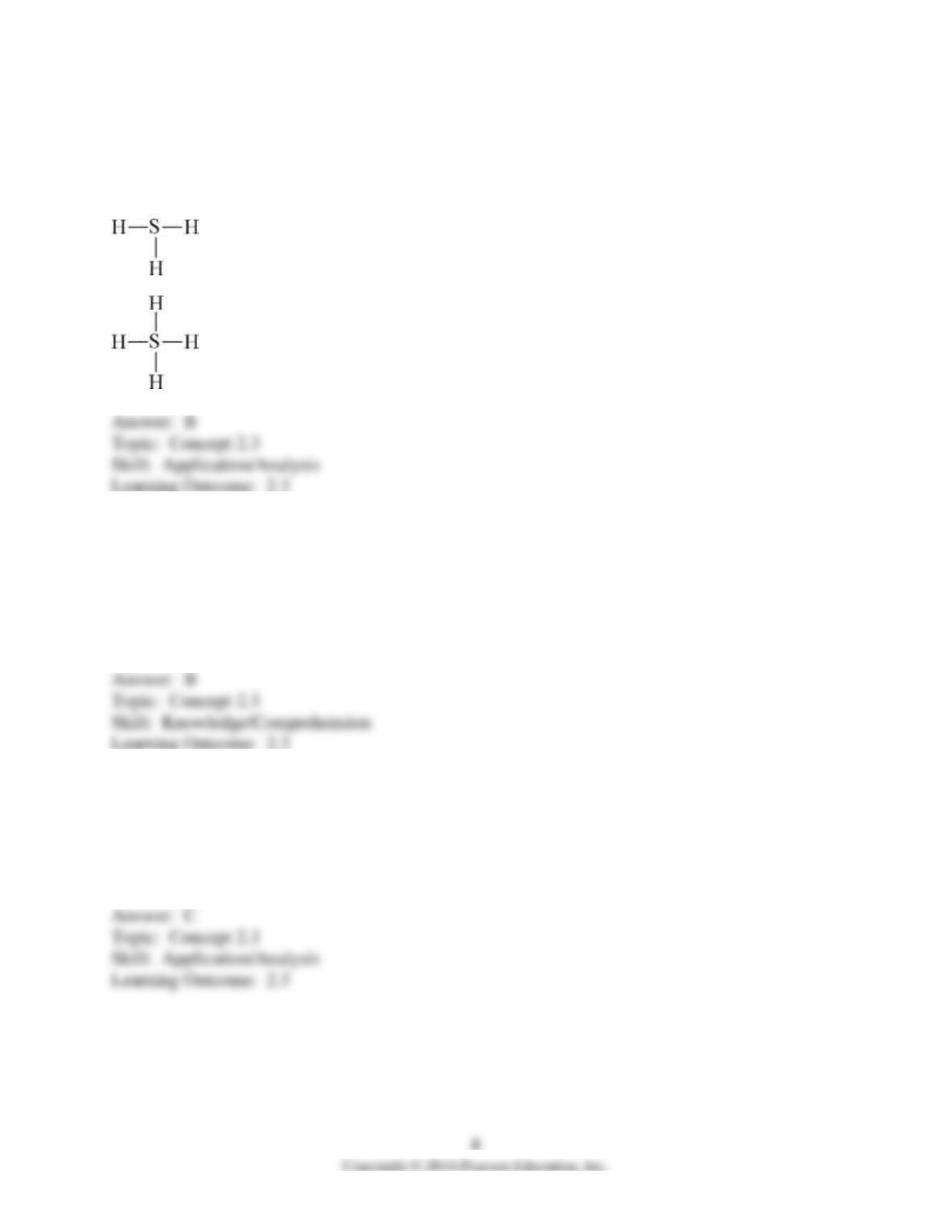
24) If an atom of sulfur (atomic number 16) were allowed to react with atoms of hydrogen
(atomic number 1), which of the following molecules would be formed?
A) S—H
B) H—S—H
C)
D)
E) H = S = H
25) What is the maximum number of covalent bonds an element with atomic number 8 can make
with hydrogen?
A) 1
B) 2
C) 3
D) 4
E) 6
26) Sulfur (atomic number 16) will have chemical properties most similar to
A) carbon (atomic number 6).
B) nitrogen (atomic number 7).
C) oxygen (atomic number 8).
D) phosphorous (atomic number 15).
E) chlorine (atomic number 17).

27) Nitrogen (N) is much more electronegative than hydrogen (H). Which of the following
statements about the atoms in ammonia (NH3) is correct?
A) Each hydrogen atom has a partial positive charge; the nitrogen atom has a partial negative
charge.
B) The nitrogen atom has a full positive charge; each hydrogen atom has a full positive charge.
C) Each hydrogen atom has a partial negative charge; the nitrogen atom has a full positive
charge.
D) The nitrogen atom has a partial positive charge; each hydrogen atom has a partial negative
charge.
E) There are nonpolar covalent bonds between the hydrogen atoms and polar covalent bonds
between each hydrogen atom and the nitrogen atom.
28) When two atoms are equally electronegative, they will interact to form
A) hydrogen bonds.
B) van der Waals interactions.
C) polar covalent bonds.
D) nonpolar covalent bonds.
E) ionic bonds.
29) What results from an unequal sharing of electrons between atoms?
A) a nonpolar covalent bond
B) a polar covalent bond
C) an ionic bond
D) a hydrophobic interaction
30) A covalent bond is likely to be polar when
A) one of the atoms sharing electrons is much more electronegative than the other atom.
B) the two atoms sharing electrons are equally electronegative.
C) oxygen is one of the two atoms sharing electrons.
D) the two atoms sharing electrons are the same element.
E) the two atoms sharing electrons are different elements.
31) Which of the following molecules contains the most polar covalent bond?
A) H2
B) O2
C) CO2
D) H2O
E) CH4
32) What is the difference between covalent bonds and ionic bonds?
A) Covalent bonds are formed between atoms to form molecules; ionic bonds are formed
between atoms to form compounds.
B) Covalent bonds involve the sharing of pairs of electrons between atoms; ionic bonds involve
the sharing of single electrons between atoms.
C) Covalent bonds involve the sharing of electrons between atoms; ionic bonds involve the
electrical attraction between atoms.
D) Covalent bonds involve the sharing of electrons between atoms; ionic bonds involve the
sharing of protons between atoms.
E) Covalent bonds involve the transfer of electrons between atoms; ionic bonds involve the
sharing of electrons between atoms.
33) A covalent bond is formed by
A) sharing of a pair of electrons between two atoms.
B) sharing of a single electron between two atoms.
C) sharing of a pair of protons between two atoms.
D) transfer of an electron from one atom to another.
E) transfer of a proton from one atom to another.
34) An ionic bond is formed by
A) sharing of a pair of electrons between two atoms.
B) sharing of a single electron between two atoms.
C) sharing of a pair of protons between two atoms.
D) transfer of an electron from one atom to another.
E) transfer of a proton from one atom to another.
35) The most stable interaction between magnesium (atomic number 12) and chlorine (atomic
number 17) forms
A) MgCl, in which atoms are joined by covalent bonds.
B) MgCl, in which atoms are joined by ionic bonds.
C) Mg2Cl, in which atoms are joined by ionic bonds.
D) MgCl2, in which atoms are joined by covalent bonds.
E) MgCl2, in which atoms are joined by ionic bonds.
36) In ammonium chloride salt (NH4Cl), the anion is a single chloride ion, Cl. What is the cation
of NH4Cl?
A) N, with a charge of +1
B) NH, with a charge of +1
C) H3, with a charge of +1
D) NH4, with a charge of +1
E) NH4, with a charge of +4
37) The atomic number of chlorine is 17. The atomic number of calcium is 20. What is the
chemical formula for calcium chloride?
A) CaCl
B) CaCl2
C) Ca2Cl
D) Ca2Cl2
E) CaCl3

38) How many electron pairs are shared between carbon atoms in a molecule that has the
formula C2H4?
A) 0
B) 1
C) 2
D) 3
E) 4
39) How many electron pairs are shared between carbon atoms in a molecule that has the
formula C2H6?
A) 0
B) 1
C) 2
D) 3
E) 4
40) Which bond or interaction would be most difficult to disrupt when compounds are put into
water?
A) covalent bond
B) hydrogen bond
C) van der Waals interaction
D) ionic bond
41) What type of bonding or interaction is most likely to occur among a broad array of molecules
with various physical properties (polar, nonpolar, hydrophilic, hydrophobic)?
A) covalent bonding
B) polar covalent bonding
C) ionic bonding
D) hydrogen bonding
E) van der Waals interactions

42) Which of the following are the strongest molecular interactions?
A) van der Waals interactions
B) van der Waals interactions in a nonpolar environment
C) ionic bonds in an aqueous environment
D) covalent bonds
E) hydrogen bonds
43) Which of the following are considered compounds?
A) H2O, O2, and CH4
B) H2O and O2
C) O2 and CH4
D) CH4 and O2, but not H2O
E) H2O and CH4, but not O2
44) What is the maximum number of hydrogen atoms that can be covalently bonded in a
molecule containing two carbon atoms?
A) 2
B) 3
C) 4
D) 6
E) 8
45) Which of the following correctly describes chemical equilibrium?
A) Forward and reverse reactions continue with no effect on the concentrations of the reactants
and products.
B) The concentrations of the products are higher than the concentrations of the reactants.
C) Forward and reverse reactions have stopped so that the concentrations of the reactants and
products remain constant.
D) Reactions stop only when all reactants have been converted to products.
46) Which of the following correctly describes any reaction that has reached chemical
equilibrium?
A) The concentration of the reactants equals the concentration of the products.
B) The rate of the forward reaction is equal to the rate of the reverse reaction.
C) All of the reactants have been converted to the products of the reaction.
D) All of the products have been converted to the reactants of the reaction.
47) In an aqueous solution, water molecules associate with one another through which of the
following?
A) hydrogen bonds
B) ionic bonds
C) polar covalent bonds
D) covalent bonds
E) hydrophobic interaction
48) If a salamander clings to surfaces through hydrogen bonds, it would have the most difficulty
clinging to which of the following surfaces?
A) a surface coated with a thin film of water
B) a surface coated with a thin film of vinegar (acetic acid)
C) a surface coated with a thin film of vegetable oil
D) a surface coated with a thin film of ammonia (NH3)
49) In a single molecule of water, two hydrogen atoms are bonded to a single oxygen atom by
A) hydrogen bonds.
B) nonpolar covalent bonds.
C) polar covalent bonds.
D) ionic bonds.
E) van der Waals interactions.
50) The slight negative charge at one end of one water molecule is attracted to the slight positive
charge of another water molecule. What is this attraction called?
A) a covalent bond
B) a hydrogen bond
C) an ionic bond
D) a hydrophilic bond
E) a van der Waals interaction
51) Sulfur is in the same column of the periodic table as oxygen but has electronegativity similar
to carbon. Compared to water molecules, molecules of H2S will
53) Which of the following effects is produced by the high surface tension of water?
A) Lakes don’t freeze solid in winter despite low temperatures.
B) A water strider can walk across the surface of a small pond.
C) Organisms resist temperature changes, although they give off heat due to chemical reactions.
D) Evaporation of sweat from the skin helps to keep people from overheating.
E) Water flows upward from the roots to the leaves in plants.
54) Which of the following takes place as an ice cube cools a drink?
A) Molecular collisions in the drink increase.
B) Kinetic energy in the drink decreases.
C) A calorie of heat energy is transferred from the ice to the water of the drink.
D) The specific heat of the water in the drink decreases.
E) Evaporation of the water in the drink increases.
55) A dietary Calorie equals 1 kilocalorie. Which of the following statements correctly defines 1
kilocalorie?
A) 1,000 calories, or the amount of heat required to raise the temperature of 1 g of water by
1,000°C
B) 100 calories, or the amount of heat required to raise the temperature of 100 g of water by 1°C
C) 10,000 calories, or the amount of heat required to raise the temperature of 1 kg of water by
1°F
D) 1,000 calories, or the amount of heat required to raise the temperature of 1 kg of water by 1°C
E) 1,000 calories, or the amount of heat required to raise the temperature of 100 g of water by
100°C
56) The nutritional information on a cereal box shows that one serving of a dry cereal has 200
kilocalories. If a person were to ignite one serving of the cereal in a bowl, the amount of heat
given off would be sufficient to raise the temperature of 20 kg of water how many degrees
Celsius?
A) 0.2°C
B) 1.0°C
C) 2.0°C
D) 10.0°C
E) 20.0°C
57) Which type of bond must be broken for water to vaporize?
A) ionic bonds
B) both hydrogen bonds and ionic bonds
C) polar covalent bonds
D) hydrogen bonds
E) both polar covalent bonds and hydrogen bonds
58) Why does ice float in liquid water?
A) The high surface tension of liquid water keeps the ice on top.
B) The ionic bonds between the molecules in ice prevent the ice from sinking.
C) Ice always has air bubbles that keep it afloat.
D) Hydrogen bonds stabilize and keep the molecules of ice farther apart than the water
molecules of liquid water.
E) The crystalline lattice of ice causes it to be denser than liquid water.
59) Hydrophobic substances such as vegetable oil are
A) nonpolar substances that repel water molecules.
B) nonpolar substances that have an attraction for water molecules.
C) polar substances that repel water molecules.
D) polar substances that have an affinity for water.
E) charged molecules that hydrogen-bond with water molecules.
60) One mole (mol) of glucose (molecular mass = 180 daltons) is
A) 180 × 1023 molecules of glucose.
B) 1 kg of glucose dissolved in 1 L of solution.
C) the largest amount of glucose that can be dissolved in 1 L of solution.
D) 180 grams of glucose.
E) 180 grams of glucose dissolved in 1 L of solution.
61) Glucose has a molecular mass of 180 g/mol. How many glucose molecules are present in 90
grams of glucose?
A) 90 × 1023
B) (6.02/180) × 1023
C) (6.02/90) × 1023
D) (90 × 6.02) × 1023
E) (90/180) × 6.02 × 1023
62) How many molecules of glycerol (C3H8O3; molecular mass = 92) are present in 1 L of a 0.5
M glycerol solution?
A) 1 × 10²³
B) 0.5 × 6.02 × 1023
C) 92/2 × 6.02 × 1023
D) 0.5 × 6.02/92 × 1023
E) 6.02 × 10²³
63) How many molecules of glycerol (C3H8O3; molecular mass = 92) are present in 0.5 L of a 1
M glycerol solution?
A) 1 × 10²³
B) 0.5 × 6.02 × 1023
C) 92/2 × 6.02 × 1023
D) 0.5 × 6.02/92 × 1023
E) 6.02 × 10²³

64) When an ionic compound such as sodium chloride (NaCl) is placed in water, the component
atoms of the NaCl crystal dissociate into individual sodium ions (Na+) and chloride ions (Cl–). In
contrast, the atoms of covalently bonded molecules (e.g., glucose, sucrose, glycerol) do not
generally dissociate when placed in aqueous solution. Which of the following solutions would be
expected to contain the greatest number of solute particles (molecules or ions)?
A) 1 L of 0.5 M NaCl
B) 1 L of 0.5 M glucose
C) 1 L of 1.0 M NaCl
D) 1 L of 1.0 M glucose
E) 2 L of 0.5 M glucose.
65) The molar mass of glucose is 180 g/mol. Which of the following procedures should you
carry out to make a 1 M solution of glucose?
A) Dissolve 1 g of glucose in 1 L of water.
B) Dissolve 180 g of glucose in 1 L of water.
C) Dissolve 180 g of glucose in 180 g of water.
D) Dissolve 180 milligrams (mg) of glucose in 1 L of water.
E) Dissolve 180 g of glucose in 0.8 L of water, and then add more water until the total volume of
the solution is 1 L.
66) The molar mass of glucose (C6H12O6) is 180 g/mol. Which of the following procedures
should you carry out to make a 0.5 M solution of glucose?
A) Dissolve 0.5 g of glucose in a small volume of water, and then add more water until the total
volume of the solution is 1 L.
B) Dissolve 90 g of glucose in a small volume of water, and then add more water until the total
volume of the solution is 1 L.
C) Dissolve 180 g of glucose in a small volume of water, and then add more water until the total
volume of the solution is 1 L.
D) Dissolve 0.5 g of glucose in 1 L of water.
E) Dissolve 180 g of glucose in 0.5 L of water.
67) How many glucose molecules are contained in one liter of a 0.1 M solution of glucose in
water?
A) 6.02 × 10²³
B) 3.01 × 10²³
C) 6.02 × 1024
D) 12.04 × 10²³
E) 6.02 × 10²²
68) How many glucose molecules are contained in 0.1 liter of a 10 M solution of glucose in
water?
A) 6.02 × 10²³
B) 3.01 × 10²³
C) 6.02 × 1024
D) 12.04 × 10²³
E) 6.02 × 10²²
69) How many glucose molecules are contained in 1 liter of a 10 M solution of glucose in water?
A) 6.02 × 10²³
B) 3.01 × 10²³
C) 6.02 × 1024
D) 12.04 × 10²³
E) 6.02 × 10²²