19.2 Art Questions
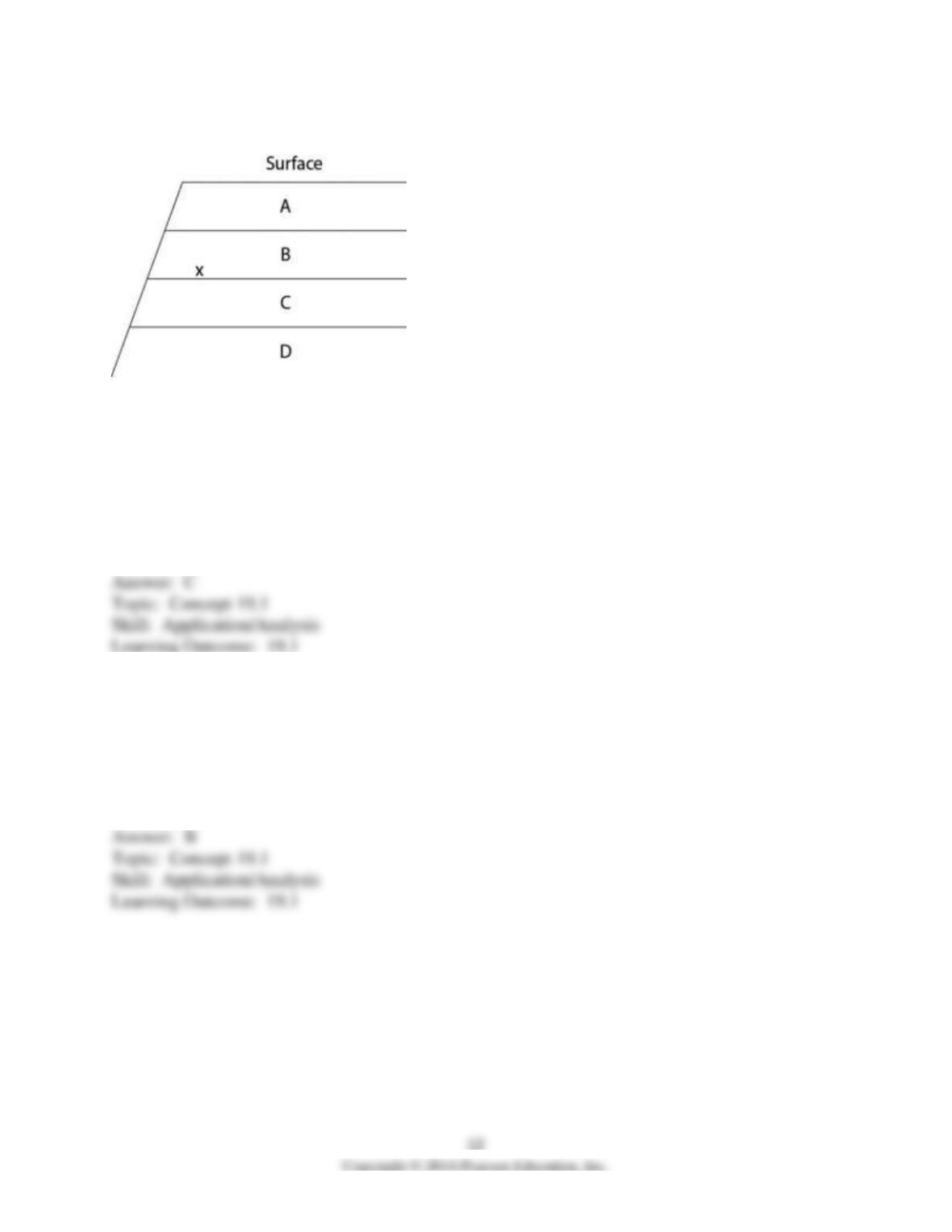
Figure 19.1
1) Figure 19.1 shows an outcrop of sedimentary rock whose strata are labeled A-D. If x indicates
the location of fossils of two closely related species, then fossils of their most-recent common
ancestor are most likely to occur in which stratum?
A) A
B) B
C) C
D) D
2) Figure 19.1 shows an outcrop of sedimentary rock whose strata are labeled A-D. If x indicates
the fossils of two closely related species, neither of which is extinct, then their remains may be
found in how many of these strata?
A) one stratum
B) two strata
C) three strata
D) four strata
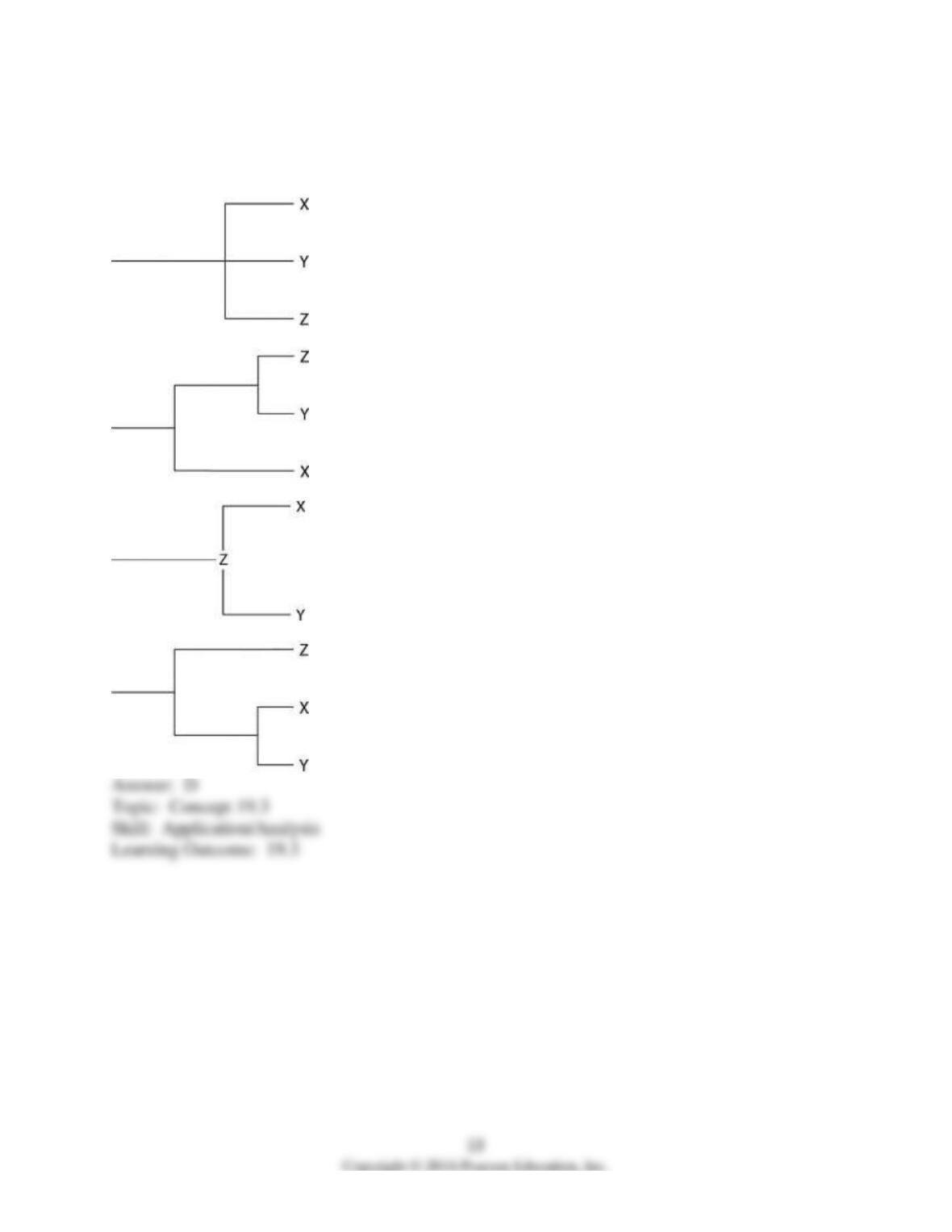
3) Currently, two extant elephant species (X and Y) are placed in the genus Loxodonta, and a
third species (Z) is placed in the genus Elephas. Assuming this classification reflects
evolutionary relatedness, which of the following is the most accurate phylogenetic tree?
A)
B)
C)
D)
Please use the following information to answer the question(s) below.
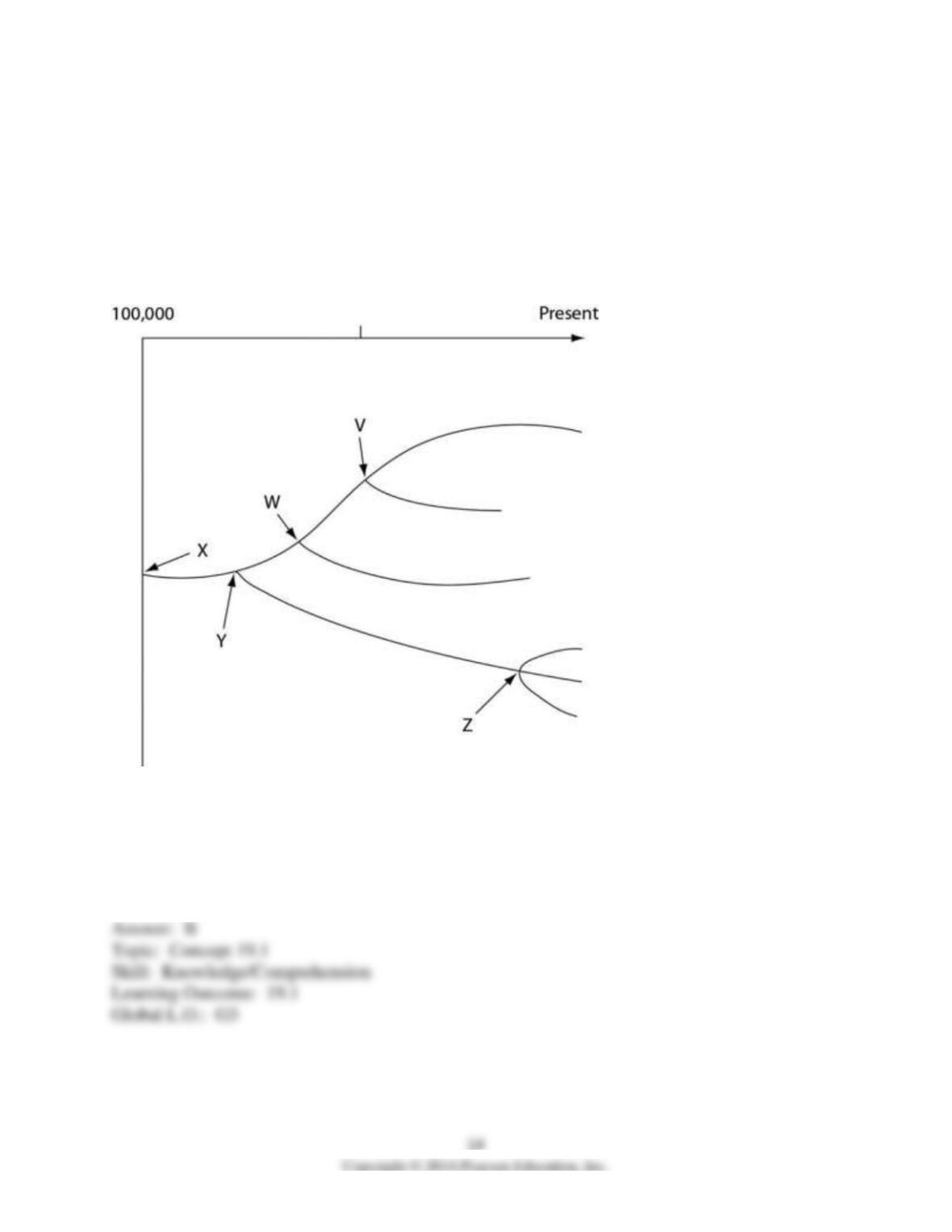
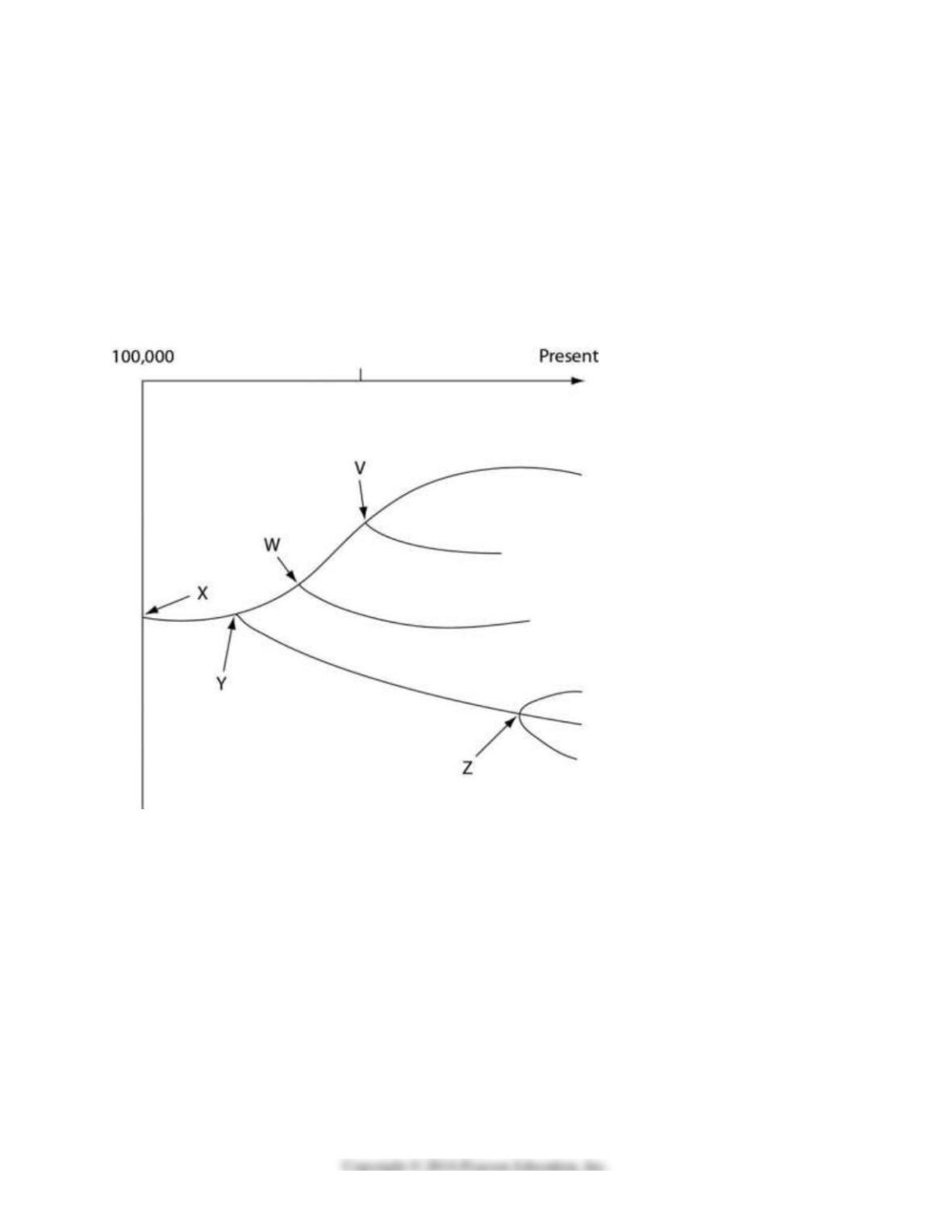
The following questions refer to the evolutionary tree below. The horizontal axis of the
cladogram depicted below is a timeline that extends from 100,000 years ago to the present; the
vertical axis represents nothing in particular. The labeled branch points on the tree (V-Z)
represent various common ancestors. Let’s say that only since 50,000 years ago has there been
enough variation between the lineages depicted here to separate them into distinct species, and
only the tips of the lineages on this tree represent distinct species.
Figure 19.2
4) Which pair would probably have agreed with the process that is depicted by this tree?
A) Cuvier and Lamarck
B) Lamarck and Wallace
C) Aristotle and Lyell
D) Wallace and Linnaeus

5) How many separate species, both extant and extinct, are depicted in this tree?
A) two
B) four
C) five
D) six
6) According to this tree, what percent of the species seem to be extant (in other words, not
extinct)?
A) 25%
B) 33%
C) 50%
D) 66%
7) Which of the five common ancestors, labeled V-Z, has given rise to the greatest number of
species, both extant and extinct?
A) V
B) W
C) Both W and Z can be considered to have given rise to the greatest number of extant and
extinct species.
D) Both X and Y can be considered to have given rise to the greatest number of extant and
extinct species.

8) Which of the five common ancestors, labeled V-Z, has been least successful in terms of the
percent of its derived species that are extant?
A) V
B) W
C) X
D) Y
9) Which of the five common ancestors, labeled V-Z, has been most successful in terms of the
percent of its derived species that are extant?
A) V
B) W
C) X
D) Z
10)
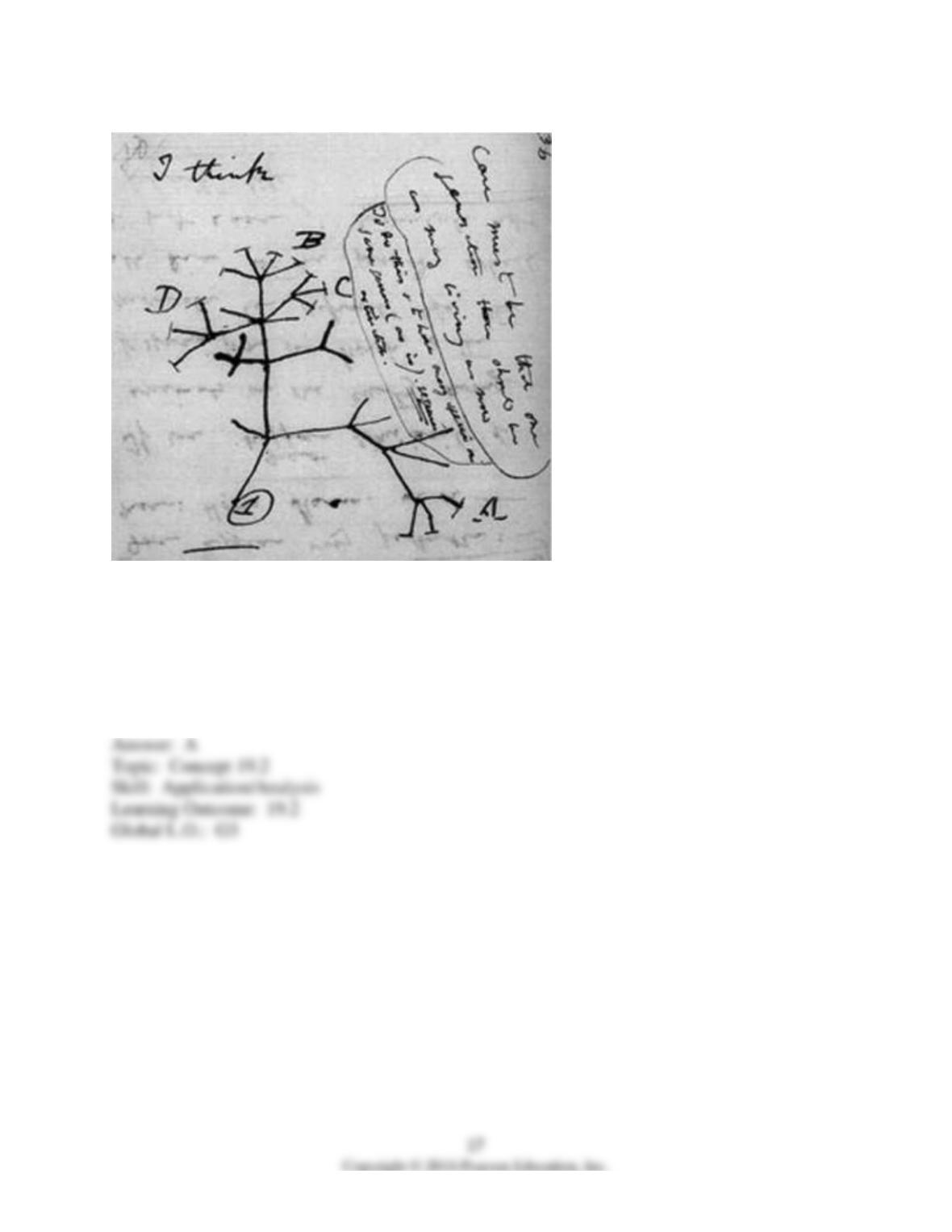
Figure 19.3
Darwin viewed the history of life as a tree, with multiple branchings from a common trunk to the
tips of the twigs. Which part of that tree represents extant organisms?
A) tips of the twigs
B) unlabeled branches
C) common trunk
D) forks of the tree
18
19.3 Scenario Questions
Please use the following information to answer the question(s) below.
The following questions refer to the evolutionary tree below. The horizontal axis of the
cladogram depicted below is a timeline that extends from 100,000 years ago to the present; the
vertical axis represents nothing in particular. The labeled branch points on the tree (V-Z)
represent various common ancestors. Let’s say that only since 50,000 years ago has there been
enough variation between the lineages depicted here to separate them into distinct species, and
only the tips of the lineages on this tree represent distinct species.
Figure 19.2
About 13 different species of finches inhabit the Galápagos Islands today, all descendants of a
common ancestor from the South American mainland that arrived a few million years ago.
Genetically, there are four distinct lineages, but the 13 species are currently classified among
three genera. The first lineage to diverge from the ancestral lineage was the warbler finch (genus
Certhidea). Next to diverge was the vegetarian finch (genus Camarhynchus), followed by five
tree finch species (also in genus Camarhynchus) and six ground finch species (genus Geospiza).
1) If the six ground finch species have evolved most recently, then which of these is the most
logical prediction?
A) They should be limited to the six islands that most recently emerged from the sea.
B) Their genomes should be more similar to each other than are the genomes of the five tree
finch species.
C) They should share fewer anatomical homologies with each other than they share with the tree
finches.
D) The chances of hybridization between two ground finch species should be less than the
chances of hybridization between two tree finch species.
2) According to a 1999 study, the vegetarian finch is genetically no more similar to the tree finch
than it is to the ground finch, despite the fact that it is placed in the same genus as the tree finch.
Based on this finding, it is reasonable to conclude that the vegetarian finch
A) is no more closely related to the tree finch than it is to the ground finch, despite its
classification.
B) should be reclassified as a warbler finch.
C) is not truly a descendent of the original ancestral finch.
D) is a hybrid species, resulting from a cross between a ground finch and a tree finch.
3) An article in the New York Times stated the following: “Scientists have discovered micro-
organisms living beneath the ocean floor that appear to have not evolved for more than two
billion years, a finding that nonetheless may support the theory of evolution.” The lack of
evolution of these microorganisms could be caused by
A) organisms adapting to a changing physical or biological environment.
B) the bacteria’s unchanging environment.
C) lack of protection in an environment that’s existed on Earth, unchanged.
D) comparison of the specimens to modern communities of sulfur bacteria.
4) An article in the New York Times noted that the human population has shown a significant
increase in height. When the relationship of height to reproductive success in humans was
examined across three decades (1935-1967), height had a positive correlation to the number of
children born and the number of surviving children. These observations suggest that
A) individuals vary in heritable characteristics.
B) humans produce more offspring than the environment can support.
C) individuals who are taller are better suited to their environment.
D) over time, favorable traits will accumulate in the population.
19.4 End-of-Chapter Questions
1) Which of the following is not an observation or inference on which natural selection is based?
A) There is heritable variation among individuals.
B) Poorly adapted individuals never produce offspring.
C) Species produce more offspring than the environment can support.
D) Only a fraction of an individual’s offspring may survive.
2) Which of the following observations helped Darwin shape his concept of descent with
modification?
A) Species diversity declines farther from the equator.
B) Fewer species live on islands than on the nearest continents.
C) Birds live on islands located farther from the mainland than the birds’ maximum nonstop
flight distance.
D) South American temperate plants are more similar to the tropical plants of South America
than to the temperate plants of Europe.

3) Within six months of effectively using methicillin to treat S. aureus infections in a
community, all new S. aureus infections were caused by MRSA. How can this best be
explained?
A) A patient must have become infected with MRSA from another community.
B) In response to the drug, S. aureus began making drug-resistant versions of the protein targeted
by the drug.
C) Some drug-resistant bacteria were present at the start of treatment, and natural selection
increased their frequency.
D) S. aureus evolved to resist vaccines.
4) The upper forelimbs of humans and bats have fairly similar skeletal structures, whereas the
corresponding bones in whales have very different shapes and proportions. However, genetic
data suggest that all three kinds of organisms diverged from a common ancestor at about the
same time. Which of the following is the most likely explanation for these data?
A) Forelimb evolution was adaptive in people and bats, but not in whales.
B) Natural selection in an aquatic environment resulted in significant changes to whale forelimb
anatomy.
C) Genes mutate faster in whales than in humans or bats.
D) Whales are not properly classified as mammals.
5) DNA sequences in many human genes are very similar to the sequences of corresponding
genes in chimpanzees. The most likely explanation for this result is that
A) humans and chimpanzees share a relatively recent common ancestor.
B) humans evolved from chimpanzees.
C) chimpanzees evolved from humans.
D) convergent evolution led to the DNA similarities.