CHAPTER 19
Cell Junctions, Cell Adhesion, and the Extracellular Matrix
Questions
19-1 Your two friends are having an argument. Henry, who works in a lab studying
signal transduction, claims that ligand–receptor interactions are higher affinity
interactions than those between two cadherin molecules. In contrast, Oliver, who
works in a lab studying the cell junctions, claims that the interactions between two
cadherin molecules must be stronger, because epithelial tissues can be extremely
difficult to pull apart and anchoring junctions are joined by forces that are much
stronger than the usually transient interactions of a ligand and a receptor. Who is
correct and why?
19-2 Sam, the undergraduate working with you in your lab, has just asked for help.
You and Sam are investigating the role of the -catenin protein at adherens
junctions. Your adviser has asked you to clone the -catenin gene by PCR. When
Sam took the PCR clone you produced and sequenced it, he found a mutation that
would change a conserved arginine to a methionine. When Sam ran the -catenin
protein through some web-based protein domain-finding algorithms, he found that
this arginine was a conserved residue in a predicted nuclear-localization signal
(NLS) and thus figured it did not matter that much because the -catenin at
adherens junctions must be a cytoplasmic protein. To Sam’s dismay, your adviser
was horrified at this news. Explain why a protein localized at an adherens junction
might need an NLS.
19-3 You have purified a large complex of proteins that are at the presynaptic
membranes of some neurons that you believe contribute to cold tolerance in
Drosophila. You have purified six different proteins from this complex that you
name Cld1 to Cld6. You discover that Cld6 is a transmembrane protein that seems
to interact physically with Cld4 and none of the other Cld proteins. You create
mutations in each of the genes that encode these proteins and examine the
localization of the other “cold” proteins in each mutant background and get the
results shown in Table Q19-3.
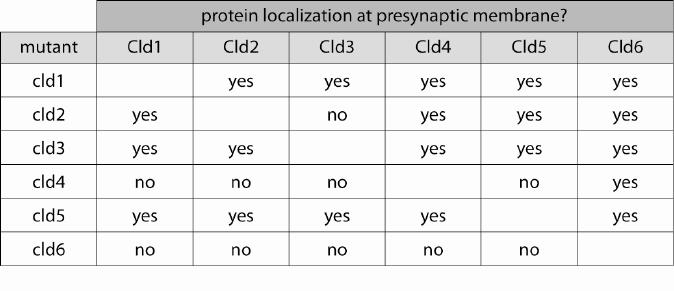
Table Q19-3
Which of the six Cld proteins is the best candidate for a scaffolding molecule?
Explain.
19-4 You are interested in epithelial tissue formation and work in a lab studying
Madin–Darby canine kidney (MDCK) cells. MDCK cells spontaneously form
hollow epithelial vesicles. Staining these vesicles with an anti-actin antibody
demonstrates the existence of apical microvilli near the central cavity of the
vesicle. A new postdoctoral fellow in the lab comes to you in a panic. You had
given her some dissociated MDCK cells that have been cultured as single cells in
a collagen matrix. Because the cells did not look obviously polarized to her, she
stained the dissociated MDCK cells to visualize the microvilli and she does not
see any signs of polarized microvilli localization in these cells. Explain why you
are confident that you did not give her the wrong cell line, and suggest a better
experiment that will allow her to test whether the cells you gave her are MDCK
cells.
19-5 You are interested in integrin activation and perform mutagenesis studies on
integrin. You find a mutant form of integrin which you call int-act, because the
int-act mutation causes the extracellular domain to exist always in an unfolded
state regardless of the presence or absence of ligand. When you determine the
sequence of int-act, you find that the mutation is in the intracellular domain of
integrin. Explain how this intracellular mutation could affect the conformation of
the extracellular domain of integrin.
19-6 Your friend, who is an engineering major, is interested in the mechanical
properties of extracellular matrix and wants to study how secreted collagen
molecules assemble into a collagen fiber. As part of his studies, he has been trying
to speed up the rate at which cells can produce the collagen protein and is
considering reducing the size of the propeptide that is attached to the collagen
chain such that it contains only the ER targeting sequence as well as the site for
cleavage of the propeptide. To his surprise, this modification causes collagen to
be degraded inside the cell. Can you explain why?
19-7 You are interested in studying the extracellular matrix and its interaction with cell
signaling and have isolated a new signaling molecule important for whisker cell
proliferation in mice that you call WGF. You decide to test whether the heparan
sulfate chains of proteoglycans are required for WGF signaling by creating
several lines of transgenic mice. You create one line of mice that does not
produce any WGF and one line of mice that cannot add any heparan sulfate chains
onto proteoglycans. You find that wgf– mice and Heparan sulfate– mice both lack
whiskers, whereas wild-type mice have whiskers.
A. Explain whether this is consistent with a role for proteoglycans in WGF
signaling.
You decide to carry out further experiments by creating transgenic mice that
overexpress WGF. Using mouse genetics, you create mice that overexpress WGF
but lack heparan sulfate. You see that some normal-looking whiskers are
produced in these animals.
B. Given this new result and the data above, do you think that the fact that
these WGF-overexpressing mice can produce normal-looking whiskers is
consistent with a role for proteoglycans in WGF signaling? Explain.
19-8 You are working in a lab studying cell wall deposition in plants. You are about to
start a set of experiments examining the interactions of microtubules with
cellulose synthase, when your friend shows you a set of relatively recent papers
that show how the treatment of plant cells with either the microtubule-
destabilizing drug oryzalin or the microtubule-stabilizing drug Taxol does not
alter the orientation of the cellulose microfibrils deposited during the time of drug
treatment. Are these results consistent with the current model of how
microtubules are involved in cellulose deposition? Why?
Answers