Chapter 19 Harvesting Electrons from the Cycle
Matching Questions
Use the following to answer questions 1-10:
Choose the correct answer from the list below. Not all of the answers will be used.
a) cytosol
b) isocitrate dehydrogenase
c) anaplerotic
d) harvesting
e) cis-aconitate
f) malonate
g) metabolic hub
h) oxaloacetate
i) inner membrane
j) citrate
k) carbon dioxide
l) glyoxylate cycle
m) malate dehydrogenase
1.
The function of the citric acid cycle is ____________ high-energy electrons.
2.
____________ The product found by the condensation of oxaloacetate and acetyl CoA.
Ans: j
Section: 19.2
3.
____________ This is the intermediate between citrate and isocitrate.
Ans: e
Section: 19.2
4.
____________ This is the location of succinate dehydrogenase.
Ans: i
5.
____________ This citric acid cycle intermediate is both at the beginning and at the end of the
citric acid cycle.
Ans: h
Sections: 19.2 and 19.3
Ans: d
Section: Introduction
Chapter 19 Harvesting Electrons from the Cycle
2
6.
____________ This is the product of the complete oxidation of carbon in the citric acid cycle.
7.
____________ This is a name suggested for the citric acid cycle’s role in the cell.
Ans: g
Section: 19.3
8.
____________ This substance is a competitive inhibitor of succinate dehydrogenase.
Ans: f
Section: 19.3
9.
__________ is the primary control point of the citric acid cycle.
Section: 19.4
10.
Ans: c
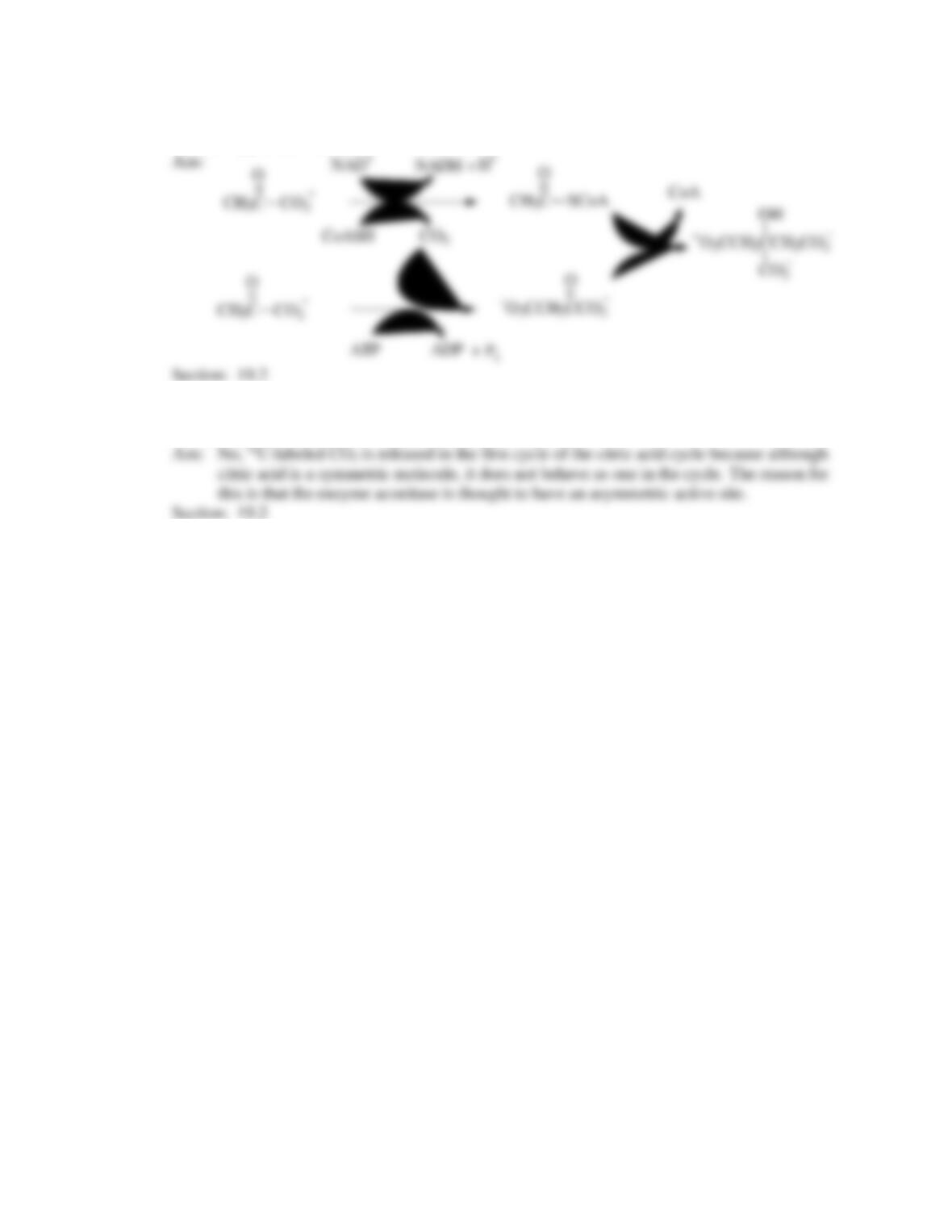
Section: 19.5
____________ This is the name applied to metabolic reactions that replenish citric acid cycle
intermediates that are depleted because they were used for biosynthesis.
Fill–in-the-Blank Questions
11.
Carbons from carbohydrate enter the citric acid cycle in the form of .
Ans: acetyl CoA Section: Introduction
12.
In the citric acid cycle, the is produced by a substrate-level phosphorylation.
Ans: GTP Section: 19.2
13.
The free energy at standard state for malate DHase in the direction of the citric acid cycle is .
Ans: positive Section: 19.3
14.
reactions refer to the process of filling up a cycle with outside carbon compounds.
Ans: Anaplerotic Section: 19.5
15.
is a citric acid cycle enzyme that is also an example of an iron-sulfur protein.
Ans: Aconitase or succinate dehydrogenase Section: 19.2
16.
The is an organelle in plants and some bacteria where two-carbon acetyl units are converted
into four-carbon units (succinate) for glucose synthesis, energy production, and biosynthesis.
Ans: glyoxysome Section: 19.5
Ans: k
Section: 19.2
Chapter 19 Harvesting Electrons from the Cycle
3
17.
During the oxidation of isocitrate, the intermediate that is decarboxylated to form α–
ketoglutarate is .
18.
In general, the citric acid cycle is inhibited under (high, low) energy conditions.
Ans: high Section: 19.4
19.
is the first citric acid cycle intermediate to be oxidized.
Ans: Isocitrate Section: 19.2
20.
Organisms that can convert fat into sugar use the cycle.
Ans: glyoxylate Section: 19.4
Multiple-Choice Questions
21.
A mutation in the active site of succinyl CoA synthetase where His is converted to Lys would
result in which of the following?
A)
increased stable folding
D)
All of the above.
B)
loss of a succinyl phosphate
intermediate
E)
None of the above.
C)
loss of a positively charged amino acid
necessary for catalysis
Ans: B Section: 19.3
22.
What molecule initiates the citric acid cycle by reacting with oxaloacetate?
A)
pyruvate
D)
All of the above.
B)
acetyl CoA
E)
None of the above.
C)
oxaloacetate
Ans: B Section: Introduction
23.
In muscle, the enzyme that catalyzes a substrate level phosphorylation is:
A)
nucloside triphosphate transferase
D)
succinyl CoA synthetase
B)
protein kinase C
E)
ATP-GTP transferase
C)
GTP kinase
Ans: D Section: 19.1
24.
The direct movement of substrates from one enzyme to the next is called _________.
A)
protein complex
D)
cell with sufficient available water
B)
substrate channeling
E)
electron acceptor
C)
linker coenzyme
Ans: B Section: 19.3
Ans: oxalosuccinate Section: 19.2
Chapter 19 Harvesting Electrons from the Cycle
4
25.
Which of the following vitamins are precursors to coenzymes that are necessary for the
formation of succinyl CoA from α-ketoglutarate?
A)
thiamine, riboflavin, niacin, lipoic acid, and pantothenic acid
B)
thiamine, riboflavin, niacin, lipoic acid, pantothenic acid, and biotin
C)
thiamine, riboflavin, niacin, and biotin
D)
thiamine, riboflavin, and lipoic acid
E)
None of the above.
26.
Isomerization of citrate is catalyzed by ___________.
A)
citrate synthase
D)
aconitase
B)
aldolase
E)
citrate isomerase
C)
-ketogutarate dehydroenase
Ans: D Section: 19.2
27.
Formation of citrate from acetyl CoA and oxaloacetate is a(n) _________ reaction.
A)
oxidation
D)
ligation
B)
reduction
E)
None of the above.
C)
condensation
Ans: C Section: 19.1
28.
What is(are) the chemical change(s) involved in the conversion of citrate into isocitrate?
A)
hydration followed by dehydration
D)
dehydration followed by hydration
B)
oxidation
E)
A and B.
C)
oxidation followed by reduction
Ans: D Section: 19.3
29.
In which reaction is GTP (or ATP) directly formed in the citric acid cycle?
A)
conversion of succinyl CoA to succinate
B)
decarboxylation of -ketoglutarate
C)
conversion of isocitrate to -ketoglutarate
D)
All of the above.
E)
None of the above.
Ans: A Section: 19.2 and Figure 19.5 on p. 348
30.
In which step of the citric acid cycle is FADH2 formed?
A)
the conversion of succinate to malate
B)
the conversion of succinate to oxaloacetate
C)
the conversion of succinate to fumarate
D)
the conversion of malate to oxaloacetate
E)
None of the above.
Ans: C Section: 19.3
Ans: A Section: 19.3 and Table 19.1
Chapter 19 Harvesting Electrons from the Cycle
5
31.
Which of these compounds is oxidized by a multi-enzyme complex that requires five different
coenzymes?
A)
–O2CC
H
CCO2–
H
D)
–O2CCH2CH
OH
CO2–
B)
–O2CCH2CH2CCO2–
O
E)
CH3C SCoA
O
C)
–O2CCH2CCO2–
O
32.
Succinate dehydrogenase deficiency or genetic mutation results in ___________.
A)
cancer through HIF-1
D)
A and B.
B)
decreased rate of glycolysis
E)
A, B, and C.
C)
depletion of succinate in mitochondria
Ans: A Section: 19.4
33.
Approximately how many ATP or GTP equivalents are produced during one turn of the citric
acid cycle?
A) 10 B) 6 C) 9 D) 12 E) None of the above.
Ans: A Section: 19.3
34.
In addition to pyruvate dehydrogenase, what other enzymes are key regulatory sites in the citric
acid cycle?
A)
isocitrate dehydrogenase
D)
A and B.
B)
-ketoglutarate dehydrogenase
E)
A, B, and C.
C)
citrate synthase (in bacteria)
Ans: E Section: 19.4
35.
The glyoxylate cycle enables plants to survive using only:
A)
pyruvate.
D)
All of the above.
B)
acetate.
E)
None of the above.
C)
oxaloacetate.
Ans: B Section: 19.5
36.
The citric acid cycle (CAC) is activated in the presence of oxygen, but what is the link between
the CAC and oxygen?
A)
Oxygen is an allosteric activator for citrate synthase.
B)
The presence of O2 in the mitochondrial matrix releases CO2 into the cytosol.
C)
The one substrate-level phosphorylation in the CAC can occur in the absence of oxygen.
D)
A primary product of the CAC is NADH, the principle electron donor to the O2, the last
electron acceptor in the electron-transport system.
E)
The iron-sulfur center requires oxygen to be in the appropriate oxidation state.
Ans: D Section: 19.1
Ans: B Section: 19.3
Chapter 19 Harvesting Electrons from the Cycle
6
37.
What role does isocitrate lyase play in allowing plants to grow on acetate?
A)
Isocitrate lyase hydrolyzes isocitrate to form malate and acetate; acetate is used to
synthesize fatty acids.
B)
Isocitrate lyase hydrolyzes isocitrate to form malate and acetate; acetate is used to
synthesize glucose.
C)
One product of isocitrate lyase is succinate, an intermediate in glucose synthesis via the
glyoxylate cycle.
D)
One product of isocitrate lyase is succinate, a potent inhibitor of pyruvate kinase.
E)
One product of isocitrate lyase is succinate, an intermediate in steroid synthesis.
38.
Although we study the citric acid cycle as the final stage oxidation of carbon from glucose, an
in-depth look at the cycle shows intermediates entering and leaving the cycle from a number of
metabolic pathways. With all of these demands on the cycle, how does it maintain a minimal
level of oxaloacetate (OAA) to allow the cycle to function?
A)
OAA can be formed by the condensation of two moles of acetyl CoA and occurs when
the energy charge of the cell is high.
B)
The rate of the cycle is increased when the cell has high levels of NADH.
C)
Isocitrate dehydrogenase is allosterically inhibited by ADP, which signifies the need for
more energy.
D)
OAA is formed directly via the deamination of glutamate.
E)
OAA is synthesized via pyruvate carboxylase in an anapleurotic reaction that occurs
when acetyl CoA is present.
Ans: E Section: 19.4
39.
Chemically, why is it necessary for citrate to undergo an isomerization to isocitrate prior to
decarboxylation?
A)
This conversion forms an unstable α-ketoacid, which drives the cycle forward.
B)
The aconitase reaction is a thermodynamically unfavored hydration reaction followed by
a highly favored dehydration.
C)
The tertiary alcohol in citrate does not favor the oxidative carboxylation that occurs next;
however, the secondary alcohol of isocitrate does.
D)
Citrate induces a major structural rearrangement in aconitase leading to the creation of
the binding site for the water molecule in the hydration step.
E)
Only when the alcohol is attached to C-2 can it block prolyl hydroxylase 2 activity,
ensuring synthesis of glycolytic proteins.
Ans: C Section: 19.2
Short-Answer Questions
40.
Draw each reaction and the name of the enzyme for the production of CO2 from pyruvate.
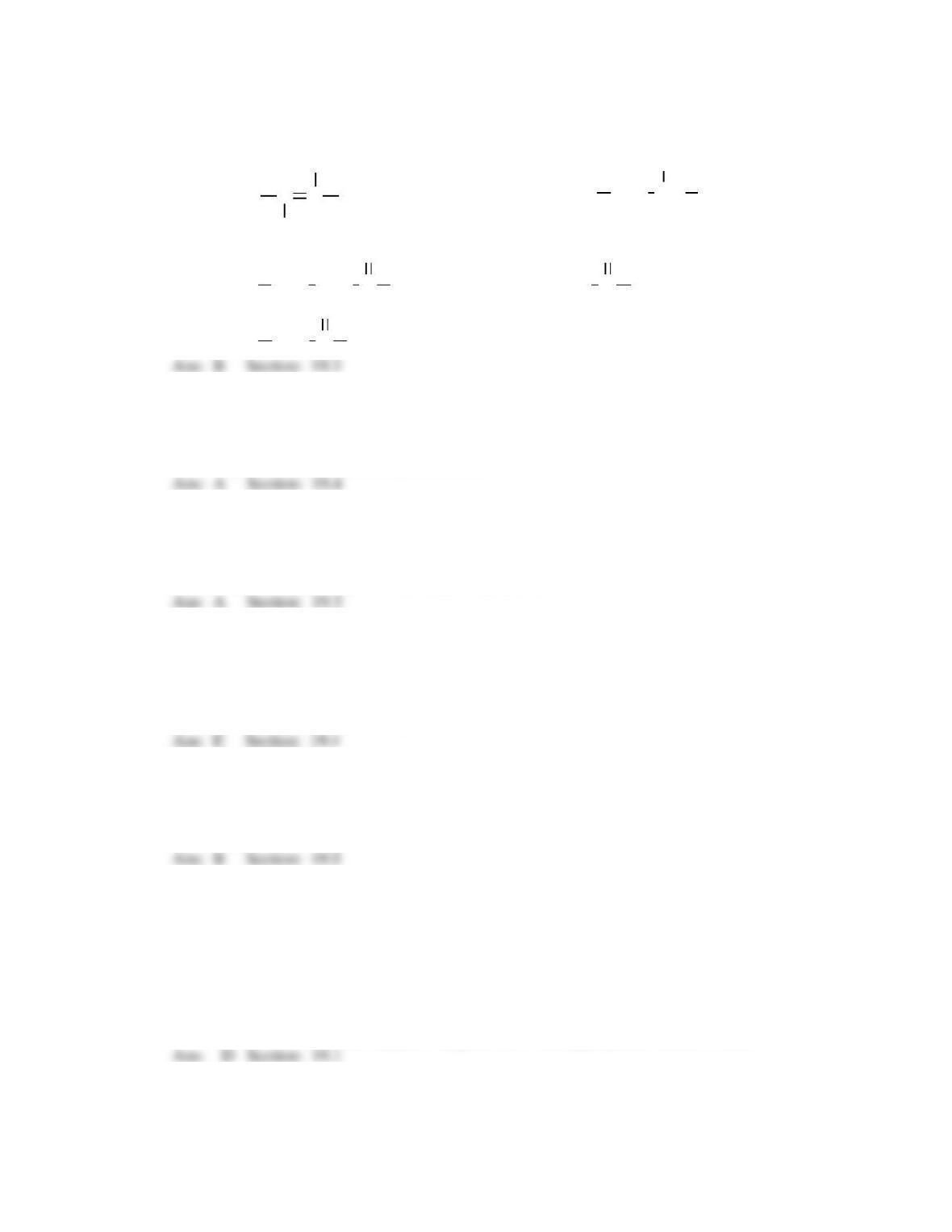
Ans:
Use both the pathways from Chapters 17 and 19 to start with pyruvate and one full turn of
the Krebs cycle.
Sections: Chapters 18 and 19
Ans: C Section: 19.5
Chapter 19 Harvesting Electrons from the Cycle
7
41.
Why is the isomerization of citrate to isocitrate a necessary step of the citric acid cycle?
42.
List the five coenzymes that are required for the oxidative decarboxylation of α–ketoglutarate
and give the essential nutrient (vitamin) that is required for each.
Section: 19.2
43.
Explain when GDP vs. ADP is used as a substrate with succinyl CoA synthetase.
heart, and one found in liver. The muscle enzyme uses ADP in the forward direction of
the citric acid cycle and the liver enzyme uses GDP in the reverse direction in heme
synthesis.
Section: 19.3
44.
Give the reaction in the citric acid cycle by which the energy is conserved in the formation of a
phosphoanhydride bond by substrate level phosphorylation. Give the name of the enzyme that
catalyzes this reaction and give the structures of the reactants and products of this reaction.
Section: 19.3
45.
What reaction serves to link glycolysis and the citric acid cycle?
pyruvate + CoA + NAD+ → acetyl CoA + NADH + H++ CO2
Section: Introduction
46.
In the α-ketoglutarate dehydrogenase enzyme complex, why is the observed electron transfer
from FADH2 to NAD+ unusual?
Ans:
It is unusual because the electrons are passed to the NAD+ from the FADH2. The transfer
is usually in the other direction.
Section: 19.2
47.
What is the energy source that drives the condensation of oxaloacetate and acetyl CoA to
produce citrate?
CoA. This reaction is easily reversible. The hydrolysis of the thioester of citryl CoA
forms citrate and regenerates the CoA. The hydrolysis of the high-energy thioester drives
the reaction toward citrate.
Section: 19.2
Ans:
Citrate is a tertiary alcohol that cannot be oxidized. The isomerization converts the 3°
alcohol into isocitrate, which is a 2° alcohol that can be oxidized.
Section: 19.2
Chapter 19 Harvesting Electrons from the Cycle
8
48.
How does the decarboxylation of -ketoglutatarate resemble that of pyruvate decarboxylation?
49.
How many ATP equivalents are produced from the total oxidation of one pyruvate to 3 CO2.
equivalents are produced (4 2.5 + 1.5 + 1 = 12.5).
Section: 19.3
50.
exergonic.
conversion of malate to oxaloacetate does not produce CO2 and is endergonic. In
contrast, the loss of CO2 makes the conversion of isocitrate to α-ketoglutarate very
favorable.
Section: 19.3
ΔG˚′ = −21 kJ/mol for the reaction catalyzed by isocitrate dehydrogenase yet ΔG˚′ = +29.7
kJ/mol for the reaction catalyzed by malate dehydrogenase. Both of these reactions involve the
oxidation of a secondary alcohol. Give an explanation as to why the oxidation of isocitrate is so
51.
How is succinate dehydrogenase unique when compared to the other enzymes in the citric acid
cycle?
associated with the electron-transport chain.
Section: 19.3
52.
Are the acetyl carbons that enter the citric acid cycle the exact same carbons that leave as CO2?
Briefly explain.
randomize, eventually all carbons are turned over.
Section: 19.2
53.
Explain the difference in how carbon from fat can be converted to sugar.
Ans:
the glyoxylate cycle
Section: 19.5
Both are -ketoacids, which are decarboxylated, and involve formation of a thioester with
CoA, which has high transfer potential. The enzymatic complexes and mechanisms are
similar, and the dihydrolipoyl dehydrogenase components are identical.
Sections: 19.1 and 19.2
Chapter 19 Harvesting Electrons from the Cycle
9
54.
Give a sequence of metabolic reactions by which all six carbons in citrate could be obtained
from two pyruvate molecules.
55.
If 14C-labeled acetyl CoA is added to isolated mitochondria, is 14C-labeled CO2 released in the
first full cycle of the citric acid cycle? Explain your answer.
this is that the enzyme aconitase is thought to have an asymmetric active site.
Section: 19.2