
1
Campbell Essential Biology, 6e (Simon/Dickey/Hogan/Reece)
Chapter 18 An Introduction to Ecology and the Biosphere
Chapter 18 Learning Outcomes
18 Biology and Society: Penguins, Polar Bears, and People in Peril
18.1 Describe the causes and impacts of global climate changes over the past century.
18.1 An Overview of Ecology
18.2 Compare the biosphere’s four levels of ecology within the context of abiotic and biotic
factors, and explain how ecologists learn about the structure and processes of our natural
world.
18.2 Living in Earth’s Diverse Environments
18.3 Describe the major abiotic factors that affect the distribution of life in the biosphere and
the three main types of responses that enable plants or animals to adjust to changes in
their environments.
18.3 Biomes
18.4 Distinguish major characteristics of freshwater and marine biomes.
18.5 Compare the properties of a stream or river at its source and at the place where it empties
into a lake or the sea.
18.6 Distinguish major characteristics of the types of terrestrial biomes: tropical forest,
savanna, desert, chaparral, temperate grassland, temperate broadleaf forest, coniferous
forest, tundra, and polar ice.
18.7 Describe the values of aquatic and terrestrial biomes to natural ecosystems and humans.
18.8 Explain how the biosphere is linked by the global water cycle.
18.9 Explain how climate change and humans have impacted the world’s biomes within the
context of goals of sustainability.
18.4 Global Climate Change
18.10 Describe how greenhouse gases affect global climates and how global climate change
affects the distribution and interactions of species.
18.11 Describe the causes of increasing greenhouse gas levels in the global atmosphere and
how you can decrease your carbon footprint.
18 Evolution Connection: Climate Change as an Agent of Natural Selection
18.12 Explain why organisms with low genetic diversity and long life spans might suffer the
most in a rapidly changing climate.
Global Learning Outcomes
1. Demonstrate an understanding of the principles of scientific inquiry.
2. Demonstrate the ability to think critically and employ critical-thinking skills.
3. Read and interpret models, graphs, and data.
4. Demonstrate the quantitative skills needed to succeed in biology.
5. Demonstrate an understanding of the impact of science on society.
6. Evaluate the credibility of scientific information from various sources.
7. Demonstrate the ability to make connections between concepts across biology.
8. Communicate effectively in writing.
9. Apply the scientific method to interpret information and draw conclusions.
18.1 Multiple Choice Questions
1) Suppose that a group of climate scientists claims that they can predict future impacts of global
climate change with 98% accuracy. Why should you be skeptical of this claim?
A) They do not have reliable methods to measure this change.
B) Their predictions are based on incomplete information about species diversity and interactions
of living organisms with each other and with their environments.
C) They should be focusing their predictions based only on climate change in the polar regions
where the greatest effects of climate change are experienced.
D) They have not accounted for abiotic factors that affect global climate change in their
predictions.
2) Ecology is the study of ________.
A) life
B) human effects on the environment
C) interactions between humans and other species
D) interactions between organisms and their environments
3) Which of the following is abiotic?
A) a protist
B) a plant
C) a fungus
D) a rock
4) If you study how two species of finches compete for food, you are trying to answer a question
about ________.
A) community ecology
B) population ecology
C) organismal ecology
D) ecosystems ecology
5) What level of ecology is concerned with the adaptations of individuals?
A) community
B) organismal
C) ecosystem
D) population
6) What level of ecology is concerned with groups of individuals of the same species?
A) community
B) organism
C) ecosystem
D) population
7) What level of ecology is concerned with groups of individuals of different species?
A) community
B) organism
C) ecosystem
D) population
8) What is a population?
A) a group of organisms living in a particular geographic area
B) a group of organisms of the same species living in a particular geographic area
C) a community as well as all the abiotic factors in a particular geographic area
D) all of the organisms of a species existing at a particular time
9) Which of these is a community?
A) all of the Staphylococcus aureus (a species of bacteria living on your skin
B) all of the organisms living in your home
C) all of the people living in your neighborhood
D) all of the nut grass (considered a weed) in your backyard
10) What level of ecology is concerned with both the biotic and abiotic aspects of an
environment?
A) community
B) organism
C) ecosystem
D) population
11) Which of the following organisms are NOT ultimately dependent on sunlight for energy?
A) species that live in hydrothermal vent habitats
B) migratory bird species
C) marine species that live in the aphotic zone
D) trees that have experienced “flagging”
12) Aquatic organisms ________.
A) have a waxy coating to prevent water loss
B) may experience problems with water balance
C) typically have a plentiful supply of nitrogen
D) never find light to be in short supply
13) Which nutrients often limit the distribution and abundance of photosynthetic organisms?
A) water and oxygen
B) nitrogen and phosphorus
C) carbon dioxide and nitrogen
D) water and carbon dioxide
14) What term applies to the physical and physiological changes experienced by astronauts who
spend months in space?
A) acclimation
B) adaptation
C) camouflaging
D) flagging
15) Which of the following is a behavioral response to environmental variability?
A) migrating to a different location
B) acclimation
C) endothermy
D) “flagging” by trees
16) In an aquatic ecosystem, what name is given to the region where photosynthesis can occur?
A) pelagic zone
B) aphotic zone
C) benthic realm
D) photic zone
17) Wetlands ________.
A) are important in improving water quality
B) include rivers, streams, ponds, and lakes
C) are bodies of swiftly flowing water
D) are found in the intertidal zone
18) What are estuaries?
A) types of freshwater biomes
B) areas near the start of a river
C) regions where ocean meets land
D) transition areas between a river and the ocean
19) Which of these biomes is one of the most biologically productive of all biomes?
A) open oceans
B) estuaries
C) temperate grasslands
D) coniferous forests
20) What name is given to the region where sea meets land?
A) pelagic realm
B) intertidal zone
C) benthic realm
D) aphotic zone
21) What name is given to the open ocean?
A) pelagic realm
B) intertidal zone
C) benthic realm
D) photic zone
22) In what part of the ocean are phytoplankton found?
A) pelagic realm
B) intertidal zone
C) benthic realm
D) aphotic zone
23) What name is given to the seafloor?
A) pelagic realm
B) intertidal zone
C) benthic realm
D) aphotic zone
24) Temperate zones ________.
A) have the coolest climates on Earth
B) have milder climates than the tropics
C) are relatively dry
D) are concentrated in the polar regions
25) Which of the following can moderate climate by absorbing heat when the air is warm and
releasing heat when the air is cold?
A) clouds
B) glaciers
C) mountains
D) oceans
26) Water-storing plants and deeply rooted shrubs are plants that characterize ________.
A) tropical forests
B) chaparral
C) deserts
D) savanna
27) The Sahara Desert and the Negev Desert belong to the same ________.
A) community
B) savanna ecosystem
C) biome
D) temperate grassland
28) Long, snowy winters as well as evergreen trees such as pine and fir are found in ________.
A) chaparral
B) temperate broadleaf forests
C) coniferous forests
D) temperate grasslands
29) ________ are the dominant herbivores of savanna ecosystems.
A) Antelopes
B) Zebras
C) Buffalo
D) Insects
30) What is one important difference between savannas and temperate grasslands?
A) Savannas only rarely experience fires.
B) Temperate grasslands are mostly treeless.
C) Savannas are inhabited by grazing mammals.
D) Temperate grasslands have nutrient-poor soil.
31) Which of these biomes are maintained by fire?
A) temperate broadleaf forests and chaparral
B) chaparral and savannas
C) deserts and chaparral
D) savanna and temperate grasslands
32) Permafrost, or permanently frozen subsoil, characterizes ________.
A) temperate broadleaf forest
B) chaparral
C) tundra
D) coniferous forest
33) Most of the temperate grassland in North America has been converted to ________.
A) cities
B) farmland
C) national parks
D) small neighborhoods
34) Water moves from land to the atmosphere through ________.
A) precipitation only
B) transpiration only
C) transpiration and evaporation
D) evaporation and precipitation
35) With regard to the environment as a whole, when is the worst time to apply pesticide to your
lawn?
A) when it is raining, or is about to rain
B) when it is cold, or is about to get cold
C) at the same time you apply fertilizer
D) at night
36) What fraction of Earth’s surface has been altered by human use?
A) 25%
B) 50%
C) 75%
D) 95%
37) The greenhouse effect causes an increase in global temperatures. This increase is due
primarily to ________.
A) CO2 and other greenhouse gases allowing more solar radiation to penetrate Earth’s surface
B) CO2 and other greenhouse gases slowing the escape of UV radiation from Earth
C) the loss of ozone that trapped cooling UV radiation in the atmosphere
D) CO2 and other greenhouse gases slowing the escape of heat from Earth
38) Temperature increases due to global warming have been greatest ________.
A) close to the poles
B) in the sea
C) in the tropics
D) in deserts
39) An effect of deforestation has been to ________.
A) decrease the amount of carbon dioxide in the atmosphere
B) increase the amount of carbon dioxide in the atmosphere
C) increase the rate at which carbon dioxide is incorporated into organic material
D) decrease the rate of carbon dioxide production through cellular respiration
40) In the oceans, global warming has ________.
A) decreased the amount of oxygen available
B) benefited corals
C) made the water more basic
D) made the water more acidic
41) Which of the following is NOT a result of global warming?
A) changes in the breeding seasons of some species
B) increased forest clearing for agricultural purposes
C) melting permafrost
D) shifts in the ranges of some species
42) Malaria is an infectious disease transmitted to humans from a parasite that infects mosquitoes
that feed on humans. World health officials have concerns that climate change may impact the
transmission of malaria into tropical highland areas in Africa. If these concerns turn out to be
valid, they would be evidence for which of the following?
A) Global climate change affects the distribution of species.
B) Global climate change will negatively impact the transmission of malaria only in Africa.
C) Global climate change affects freshwater and marine biomes.
D) Global climate change will enable scientists to more easily control the spread of malaria.
43) Which of the following actions would increase your carbon footprint?
A) reusing or recycling items
B) eating more vegetables and less meat
C) eating more beef and less chicken
D) walking instead of driving
44) Which of the following is NOT a cause of increasing CO2 levels?
A) burning of fossil fuels
B) home energy use
C) production of manufactured goods
D) creating compost piles from vegetable waste
45) Scientists have documented that spring seasons starting earlier due to climate change have
resulted in some caterpillar species beginning their maturation stage earlier than normal. There
are bird species that need the caterpillars to feed their chicks. However, since the caterpillars are
maturing before the chicks hatch (and therefore cannot be used for chick food), the birds are
experiencing a drop in their lifetime reproductive success. Interestingly, scientists have also
documented that the individual birds that are best able to change when they lay their eggs to
align with earlier spring seasons have the greatest lifetime reproductive success. These
phenomena are examples of ________.
A) an evolutionary response to climate change
B) an increase in global greenhouse gas emissions due to climate change
C) a change in species distribution due to climate change
D) the effects of terrestrial biome distribution due to climate change
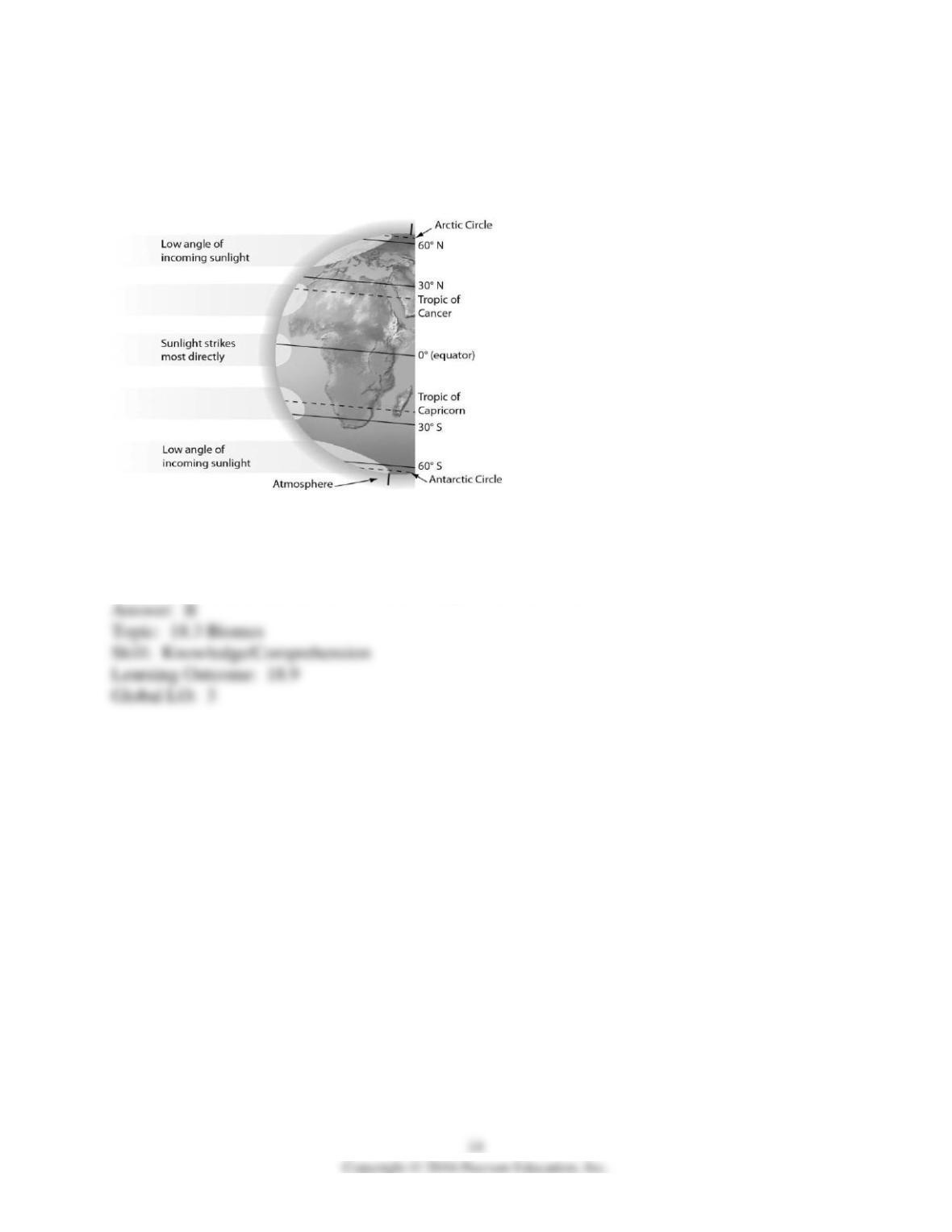
18.2 Art Questions
1) Examine the figure below. Which part of Earth receives the greatest intensity of solar
radiation?
A) Tropic of Cancer and Tropic of Capricorn
B) equator
C) North and South Poles
D) All parts of Earth receive the same intensity of solar radiation.
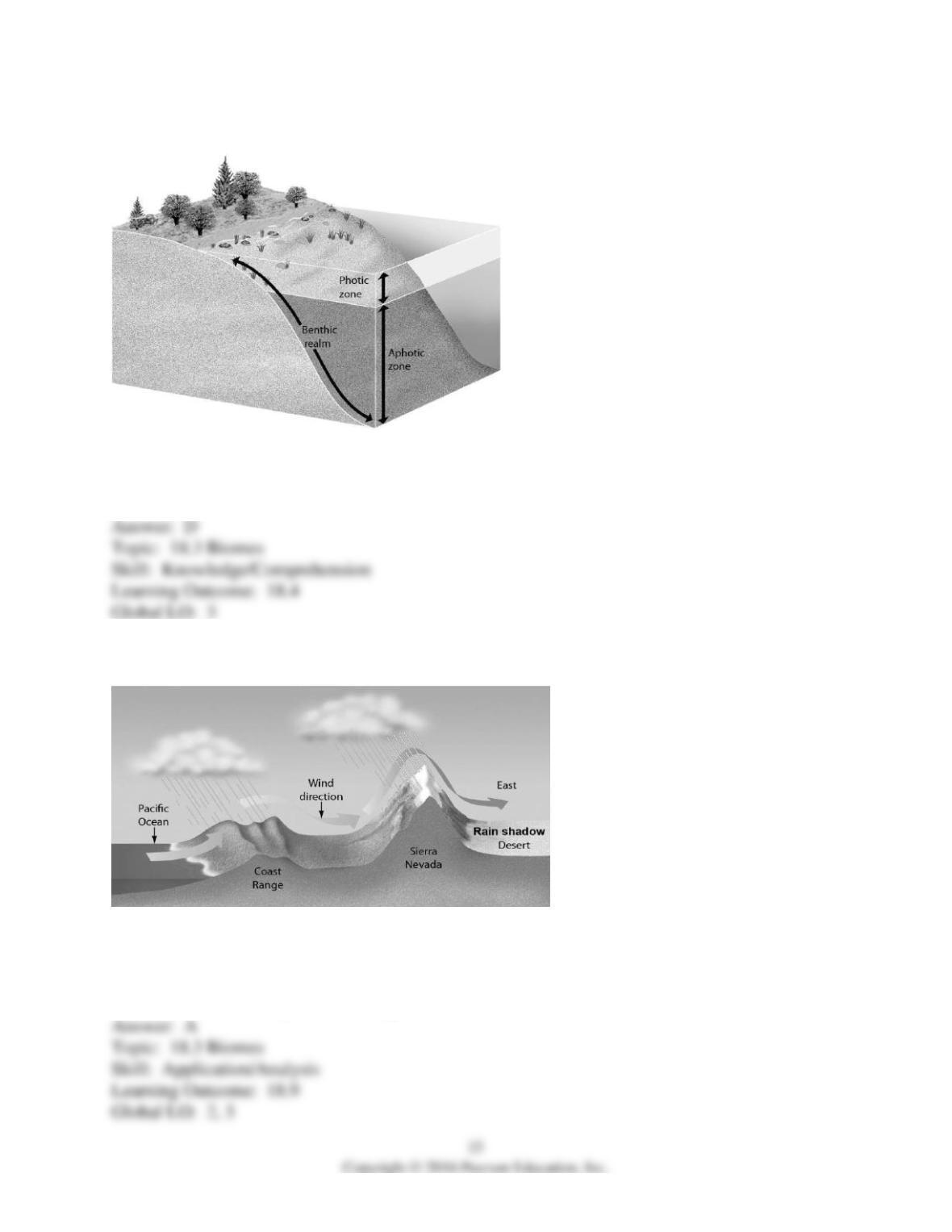
2) Examine the figure below. Phytoplankton live in the ________.
A) photic zone and aphotic zone
B) aphotic zone
C) benthic realm
D) photic zone
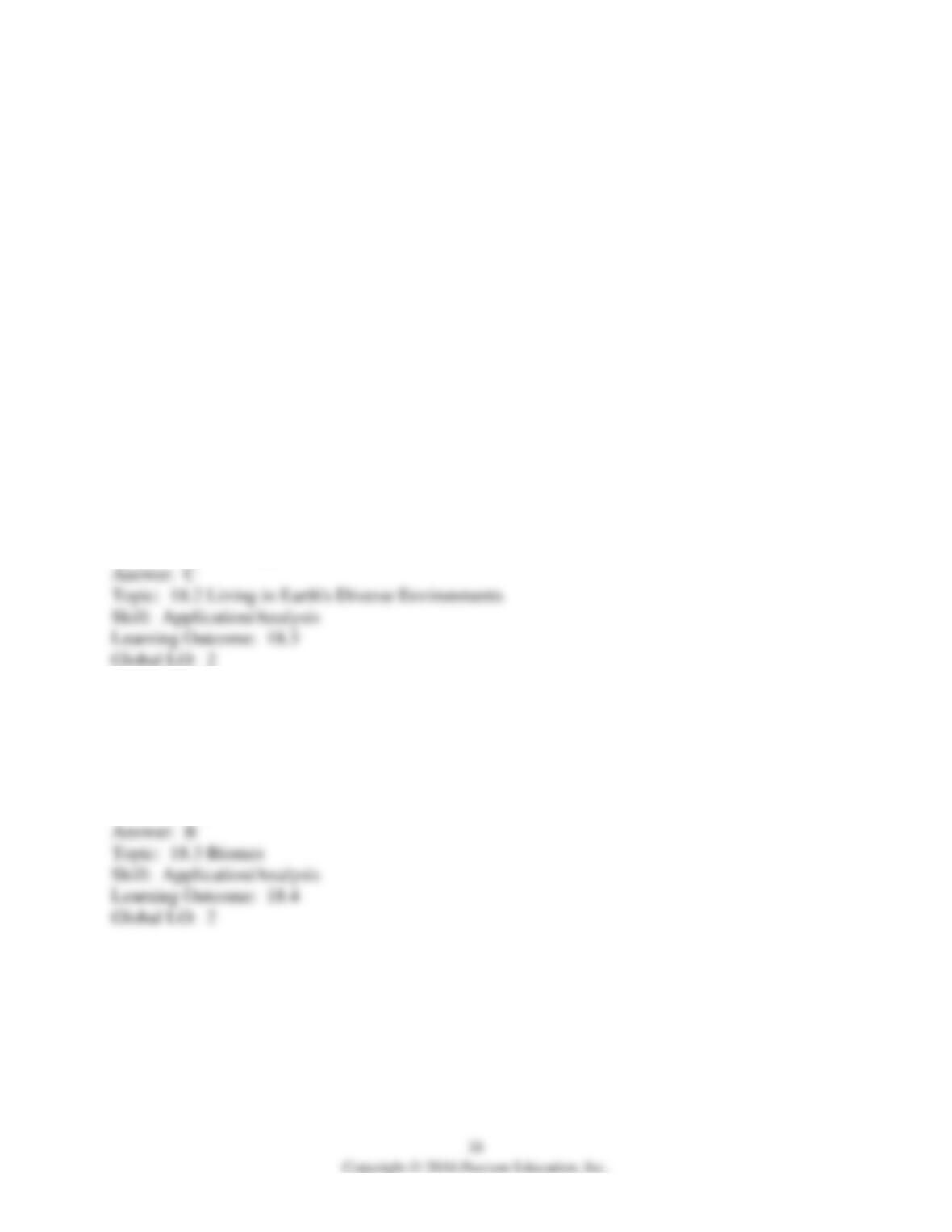
3) Examine the figure below. Globally, the largest amount of water moves from ________.
A) the oceans to the atmosphere by evaporation
B) land to the atmosphere by evaporation and transpiration
C) the atmosphere to land by precipitation
D) land to the oceans by surface and groundwater runoff
18.3 Scenario Questions
Please read the following scenario to answer the following questions.
Salmon eggs hatch in freshwater streams and, during their first year of life, the young salmon
migrate distances up to 1,000 km in order to reach the ocean. Here they spend up to 5 years
where they feed and grow, acquiring more than 95% of their biomass. During the summer of
their maturing year, they begin the long journey back to their home streams to spawn. Although
it is still uncertain how salmon navigate back to their spawning grounds, current hypotheses
suggest that they have a highly developed sense of smell that allows them to remember odors
they encountered on their migration to the ocean. They then use these odors to help them
navigate back to the streams where they were born. At the spawning grounds, females use their
tails to form a hollow cavity in the stream gravel where they lay up to 8,000 eggs. The males
fertilize the eggs, and both adults typically die soon thereafter.
1) The physiological response that allows salmon to survive in fresh water, then in salt water,
and then fresh water again is an example of ________.
A) a behavioral response
B) evolution
C) acclimation
D) an anatomical response
2) At different times in their lives, salmon can be found in all of the following EXCEPT
________.
A) a freshwater biome
B) a chaparral
C) the pelagic realm
D) an estuary

Please read the following scenario to answer the following questions.
CO2 is not the only greenhouse gas that impacts global climate change. Other greenhouse gases
(GHGs) may be equally or more effective than CO2 at trapping heat on Earth. Climate scientists
determine how much a GHG may impact global warming based on two factors: the efficiency
with which a GHG absorbs energy (i.e. traps heat on Earth) and the length of time (in years) that
the gas remains in the atmosphere. A unit of measurement called the Global Warming Potential
(GWP) is used to describe how much energy a GHG absorbs over a specific period of time (100
years is a standard time frame). All GWP values of GHGs are compared to the GWP of CO2,
which is given a value of 1.
3) In this scenario, how would you best describe CO2?
A) It is a baseline comparison for the GWP values of all other GHGs.
B) It is a GHG whose GWP value is dependent upon the GWP values of all other GHGs.
C) It is the GHG that is the most efficient at trapping heat on Earth.
D) It is the GHG that is the least efficient at trapping heat on Earth.
4) has a GWP over 20 times higher than CO2. However, CH4 emitted today lasts for only about
a decade in the atmosphere, while the GWP of CO2 can last for thousands of years. What is a
possible reason that CH4 can have such a high GWP as compared to CO2?
A) The 100-year time frame is too short of a time frame to compare CH4 and CO2.
B) CH4 absorbs more energy than CO2.
C) CH4 is less efficient at trapping heat on Earth.
D) CH4 is not a proven greenhouse gas.

5) Chlorofluorocarbons (CFCs) are greenhouse gases that, for a specific amount of mass, trap
significantly more heat than CO2. How can you classify CFCs?
A) gases with lower GWP values than CO2
B) gas with equal GWP values to CO2
C) gases with greater GWP values than CO2
D) gases that do not have GWP values