Chapter 18—The Classification of Plants and Other Organisms Key
1. Which of the following statements concerning herbals is FALSE?
2. Taxonomy is the science of
3. Carolus Linnaeus
4. Prior to Linnaeus, a plant was described using
5. Linnaeus is most famous for
6. Which of the following statements concerning scientific names is FALSE?
7. Any given specific epithet
8. The scientific name for white oak is Quercus alba. Consequently, we know that the name of the genus is
9. The scientific name for white willow is Salix alba. Consequently, we know that the name of the species is
10. The scientific name for sugar maple is Acer saccharum. Consequently, we know that the specific epithet
genus is
11. Scientific names are useful because
12. The third part of the scientific name is the
13. The basic unit of classification is the
14. Which of the following statements concerning a species is FALSE?
15. A cultivar
16. In the name Prunus persica cv. Rosea,
17. The system of classification used in plant taxonomy, in order from largest category to smallest, is
18. One or more related genera are next assigned to the same
19. Organisms belonging to the same class are next grouped into the same
20. Modern plant classification is based on
21. A reconstruction of the evolutionary history of organisms is called
22. If all the plants within a group share the same common ancestor, the group is referred to as
23. Cladists use the ____ as the basis for classification.
24. Which of the following statements concerning cladistics is FALSE?
25. In cladistics, an outgroup is
26. Recent DNA studies support a ____ kingdom scheme of classification.
27. ____ proposed that prokaryotes should be classified into two kingdoms.
28. Members of the kingdom Archaebacteria
29. Members of the kingdom Bacteria
30. Members of the kingdom Bacteria belong to the domain
31. Members of the kingdom Archaebacteria belong to the domain
32. Which of the following kingdoms is NOT part of the domain Eukarya?
33. Members of the kingdom Fungi
34. Members of the kingdom Animalia
35. Which of the following statements concerning the kingdom Protista is FALSE?
36. Mushrooms and molds belong to the kingdom
37. Algae belong to the kingdom
38. Water molds and slime molds belong to the kingdom ____ and domain ____.
39. Members of the kingdom Plantae
40. Which of the following kingdoms is paraphyletic?
41. The need for classifying plants became important recently, within the last 50 years.

42. Carolus Linnaeus developed a system of naming plants using a three-part name.
43. The generic name can be used alone to designate all species in the genus.
44. Both parts of the scientific binomial must be underlined or italicized.
45. Members of a species share a common evolutionary ancestry.
46. A subspecies is a geographically distinct population whose members can interbreed with other populations.
47. A subspecies is the same as a cultivar.
48. Each taxonomic level in the classification hierarchy is more general than the one above.
49. Cladistics is the branch of systematics that emphasizes phylogeny by focusing on when evolutionary lines of
descent divide into two different branches.
50. The domain Archaea is more closely related to the domain Bacteria than to the domain Eukarya.
51. Most members of the kingdom Protista are multicellular and plantlike.

52. Most members of the kingdom Bacteria have prokaryotic cells, are unicellular and microscopic, and have
cell walls with peptidoglycan.
53. Mushrooms belong to the domain Eukarya.
54. The kingdom Protista is considered to be a monophyletic group.
55. The domain Bacteria contains the kingdom Archaebacteria.
56. ____________________ were early botanical books containing drawings and descriptions of plants.
57. A collection of dried, pressed, and labeled plant specimens are stored in a(n) ____________________.
58. The ____________________ is a system of naming organisms based on a unique two-part name.
59. The ____________________ designates the particular species within a genus, but it cannot be used alone.
60. ____________________ is the language used for scientific names.
61. The ____________________ is the basic unit of classification.

62. Plants produced using selective breeding are called ____________________.
63. A(n) ____________________ consists of a series of two contrasting statements and is used to help identify
an unknown plant.
64. ____________________ is the classification of organisms into groups based on their evolutionary
relationships.
65. A branching diagram used by cladists is a(n) ____________________.
66. In a cladogram, the group that that is considered to have diverged earlier than any other group is called a(n)
____________________.
67. A group consisting of several evolutionary lines, not including a common ancestor, is called
____________________.
68. Members of all kingdoms but ____________________ and ____________________ have eukaryotic cells.
69. The kingdom ____________________ includes jellyfish, clams, and grasshoppers.
70. The members of kingdom ____________________ have eukaryotic cells, are nonphotosynthetic, and have
cell walls containing chitin.
71. Prokaryotes that live in extreme environments belong to the domain ____________________.
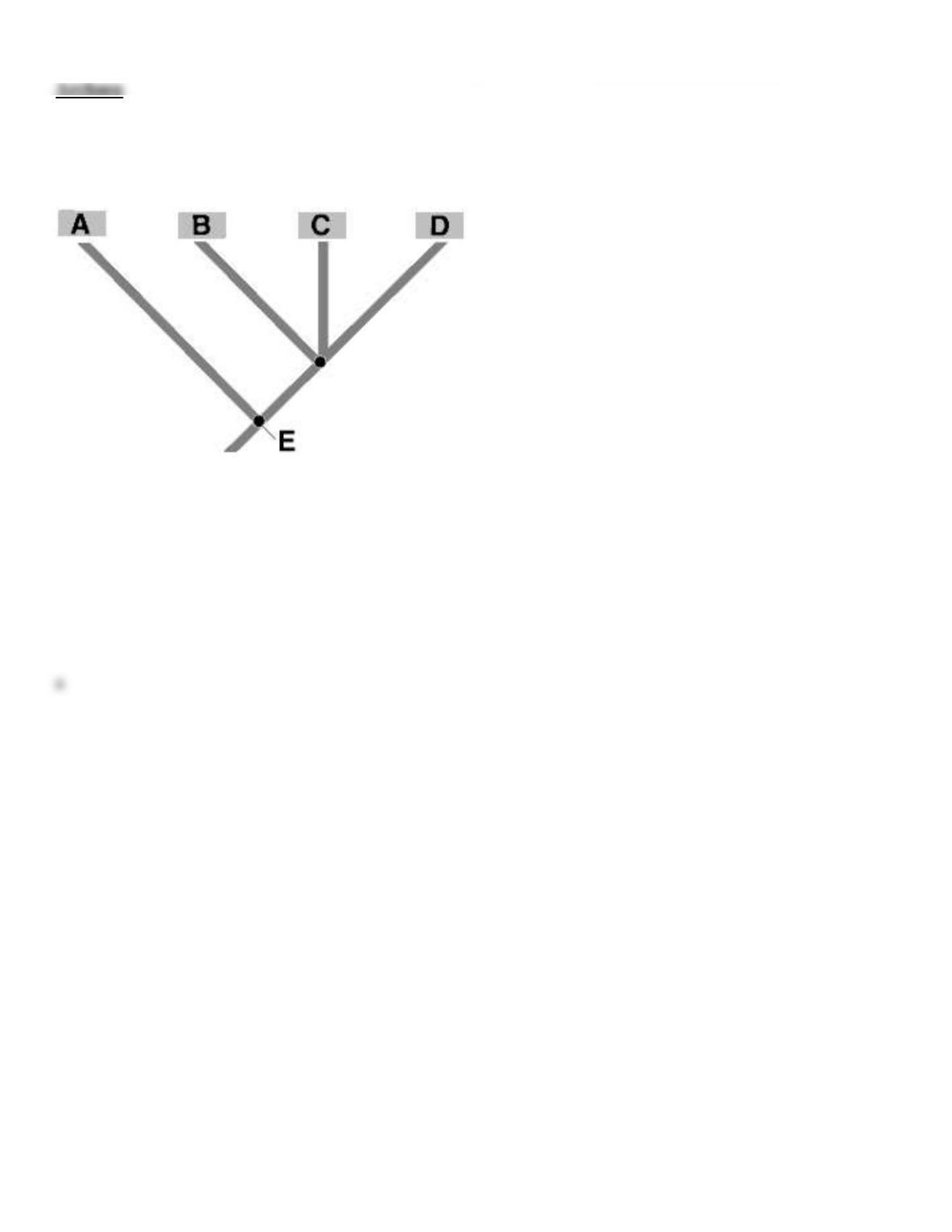
72. Figure 18-1
Refer to Figure 18-1. In this cladogram, which letter indicates the outgroup?
a.
A
b.
B
c.
C
d.
D
e.
E
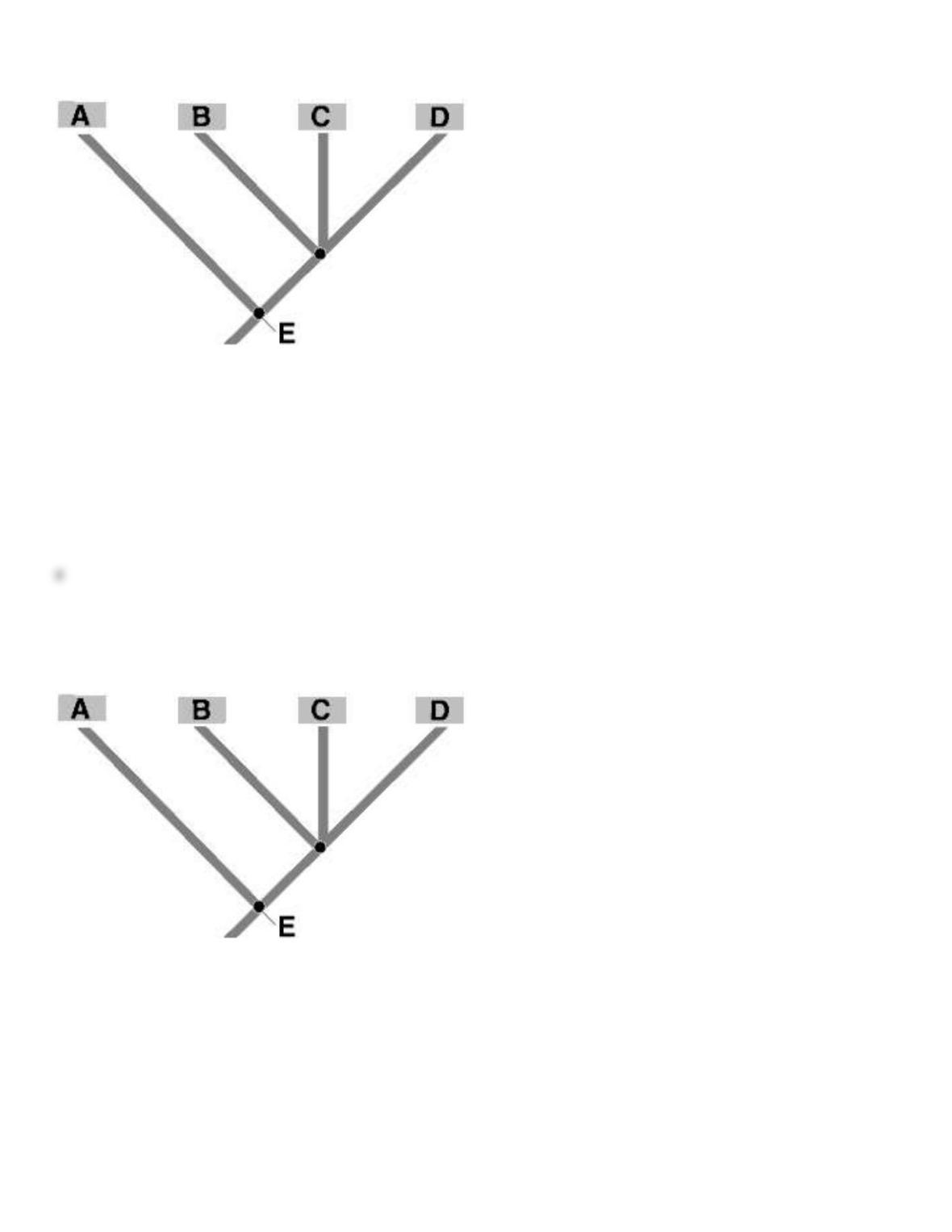
73. Figure 18-1
Refer to Figure 18-1. Which letter indicates the common ancestor?
a.
A
b.
B
c.
C
d.
D
e.
E
74. Figure 18-1
Refer to Figure 18-1. Which two groups are the most closely related?
a.
A and B
b.
A and C
c.
B and C
d.
B and D
e.
C and D
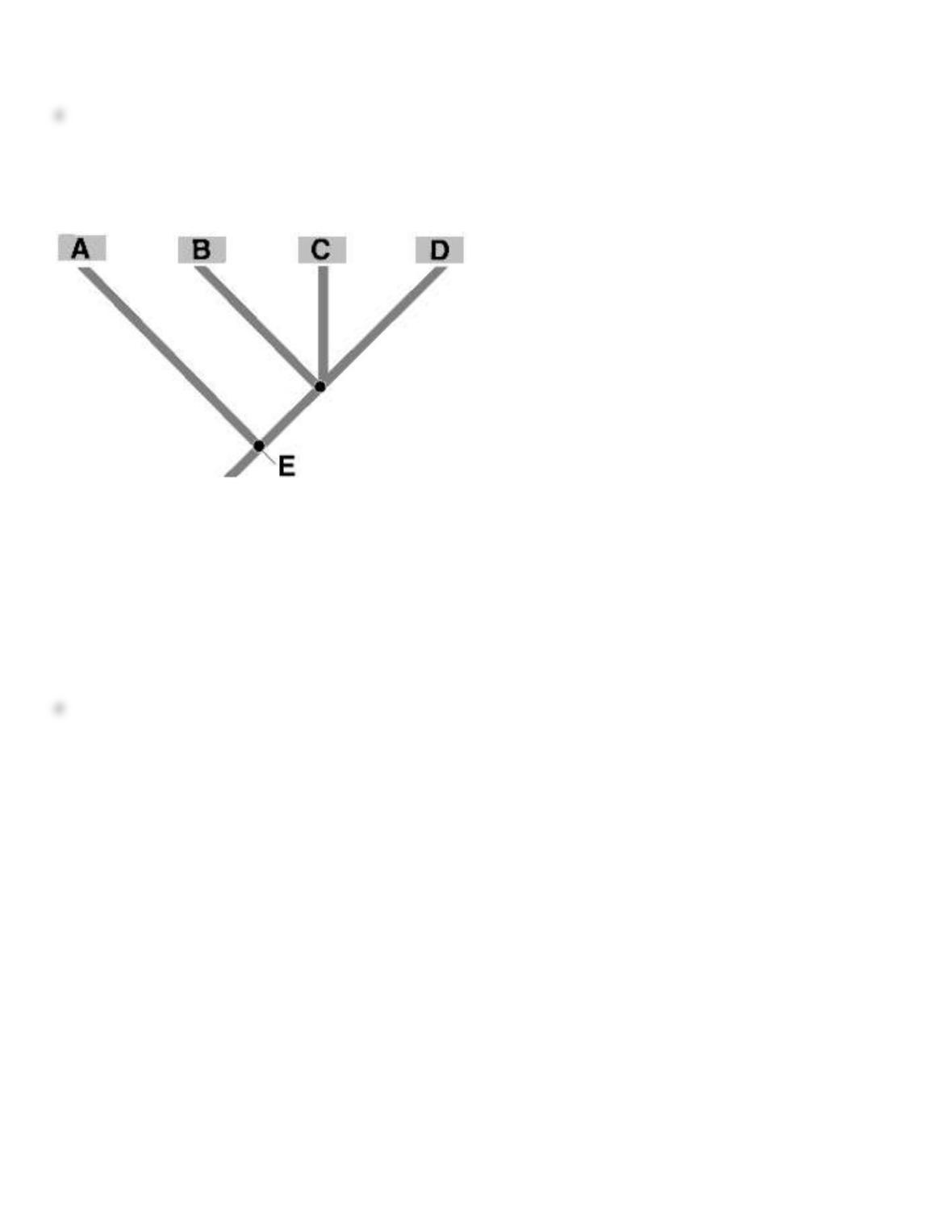
75. Figure 18-1
Refer to Figure 18-1. Which letter best indicates a node?
a.
A
b.
B
c.
C
d.
D
e.
E
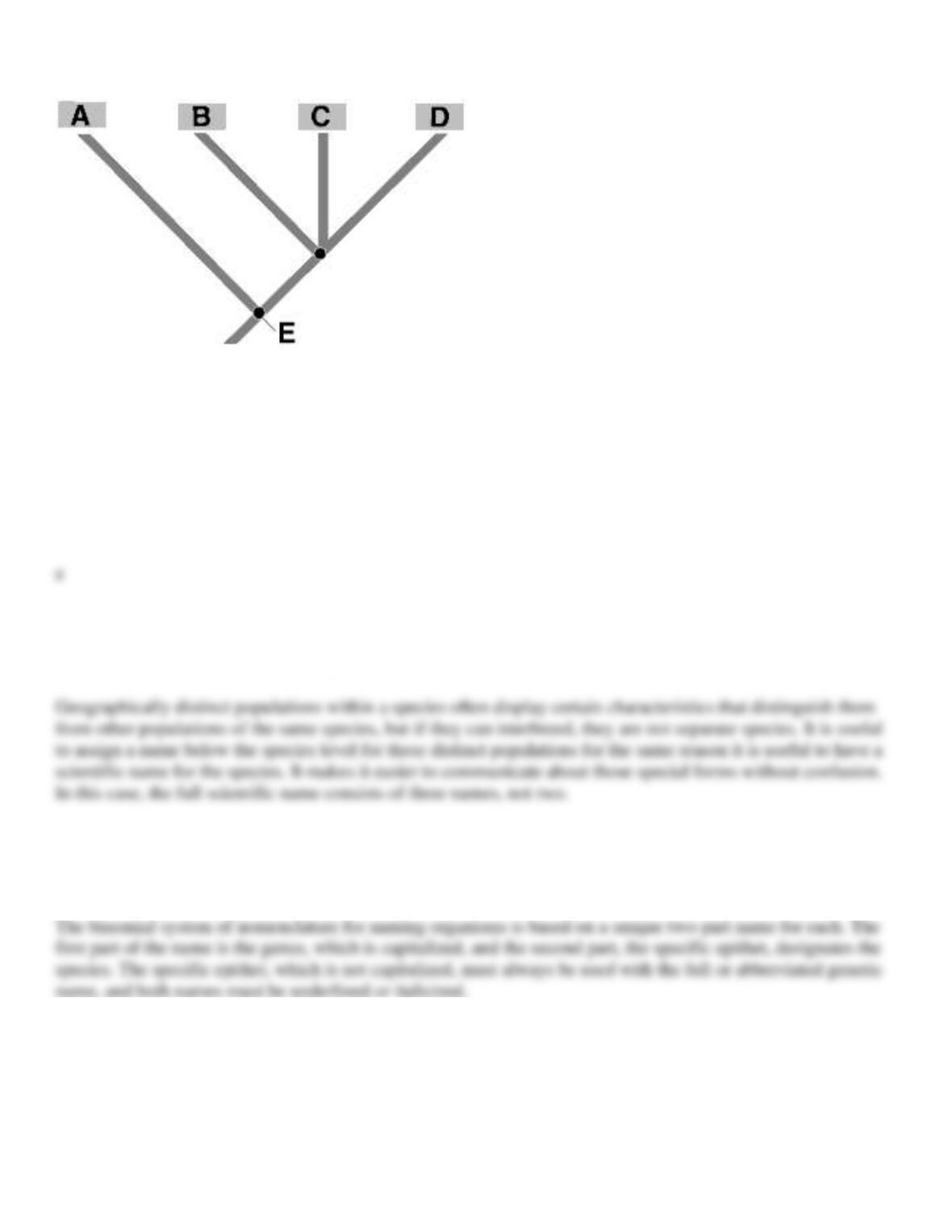
76. Figure 18-1
Refer to Figure 18-1. Which two groups were the most recent to diverge?
a.
A and B
b.
A and C
c.
B and C
d.
B and D
e.
C and D
77. What is the purpose to the naming of subspecies or cultivars?
78. Describe the general scheme of the binomial system of nomenclature.

79. What is the basis for the recent separation of the bacteria into two kingdoms, and how do the members of
these two kingdoms differ?