
Microbiology: An Introduction, 13e (Tortora et al.)
Chapter 18 Practical Applications of Immunology
18.1 Multiple-Choice Questions
1) All of the following are generally used in vaccines EXCEPT
A) toxoids.
B) parts of bacterial cells.
C) live, attenuated viruses.
D) inactivated viruses.
E) antibodies.
2) Patient’s serum, influenza virus, and red blood cells are mixed in a tube. What happens if the
patient has antibodies against influenza virus?
A) agglutination
B) hemagglutination
C) complement fixation
D) hemolysis
E) hemagglutination-inhibition
3) A patient shows the presence of antibodies against diphtheria toxin. Which of the following
statements is FALSE?
A) The patient may have the disease.
B) The patient may have had the disease and has recovered.
C) The patient may have been vaccinated.
D) A recent transfusion may have passively introduced the antibodies.
E) The patient was near someone who had the disease.

4) In an agglutination test, eight serial dilutions to determine antibody titer were set up. Tube #1
contained a 1:2 dilution; tube #2, a 1:4, etc. If tube #6 is the last tube showing agglutination,
what is the antibody titer?
A) 6
B) 1:6
C) 64
D) 1:32
E) 32
5) An ELISA for Hepatitis C has 95 percent sensitivity and 90 percent specificity. This means
that the test
A) detects 95 percent of the true positive samples and has 10 percent false positive results.
B) detects 5 percent of the true positive samples and has 90 percent false positive results.
C) detects 90 percent of the true positive samples and has 5 percent false positive results.
D) detects 95 percent of the true positive samples and has 90 percent false positive results.
E) detects 5 percent of the true positive samples and has 10 percent false positive results.
6) Which of the following are sources of antibodies for serological testing?
A) vaccinated animals
B) cells producing monoclonal antibodies
C) viral cultures
D) vaccinated animals and cells producing monoclonal antibodies
E) vaccinated animals, cells producing monoclonal antibodies, and viral cultures

7) A reaction between an antibody and soluble antigen, forming larger, interlocking molecular
lattices, is called a(n)
A) agglutination reaction.
B) complement fixation.
C) immunofluorescence.
D) neutralization reaction.
E) precipitation reaction.
8) A reaction between antibody and particulate antigen is called a(n)
A) agglutination reaction.
B) complement fixation.
C) immunofluorescence.
D) neutralization reaction.
E) precipitation reaction.
9) A reaction that uses the absence of hemolysis of red blood cells to indicate an antigen–
antibody reaction is called a(n)
A) agglutination reaction.
B) complement fixation.
C) immunofluorescence.
D) neutralization reaction.
E) precipitation reaction.
10) A DNA plasmid encoding a protein antigen from West Nile virus is injected into muscle
cells of a horse. This is an example of a(n)
A) subunit vaccine.
B) conjugated vaccine.
C) nucleic acid vaccine.
D) attenuated whole-agent vaccine.
E) live whole-agent vaccine.

11) Toxoid vaccines, such as the vaccines against diphtheria and tetanus, elicit a(n)
A) TC cell response.
B) immune complex.
C) dendritic cell proliferation.
D) antibody response against these bacterial toxins.
E) antibody response against gram-positive bacteria.
12) The clumping of test red blood cells indicates a negative test result (no antibodies against the
virus in the patient’s serum) in the
A) direct agglutination test.
B) indirect agglutination test.
C) complement-fixation test.
D) precipitation test.
E) neutralization test.
13) What type of vaccine involves host synthesis of viral antigens?
A) conjugated vaccine
B) subunit vaccine
C) nucleic acid vaccine
D) attenuated whole-agent vaccine
E) toxoid vaccine

14) Purified protein from Bordetella pertussis is used in a(n)
A) conjugated vaccine.
B) subunit vaccine.
C) nucleic acid vaccine.
D) attenuated whole-agent vaccine.
E) toxoid vaccine.
15) What type of vaccine is the live, weakened measles virus?
A) conjugated vaccine
B) subunit vaccine
C) nucleic acid vaccine
D) attenuated whole-agent vaccine
E) toxoid vaccine
16) A test used to identify antibodies against Treponema pallidum in a patient’s serum is the
A) direct fluorescent-antibody test.
B) indirect fluorescent-antibody test.
C) direct agglutination test.
D) direct ELISA test.
E) neutralization test.

17) A test used to identify Streptococcus pyogenes in a patient’s throat swab is the
A) direct fluorescent-antibody test.
B) indirect fluorescent-antibody test.
C) hemagglutination test.
D) neutralization test.
E) indirect ELISA test.
18) A test used to detect anti-Rickettsia antibodies in a patient’s serum is the
A) direct fluorescent-antibody test.
B) indirect fluorescent-antibody test.
C) direct ELISA test.
D) direct agglutination test.
19) Which of the following is a pregnancy test used to find the fetal hormone HCG in a woman’s
urine using anti-HCG and latex spheres?
A) direct agglutination reaction
B) indirect agglutination reaction
C) immunofluorescence
D) neutralization reaction
E) precipitation reaction

20) Which of the following is a test to determine a patient’s blood type by mixing the patient’s
red blood cells with antisera?
A) direct agglutination reaction
B) passive agglutination reaction
C) immunofluorescence
D) neutralization reaction
E) precipitation reaction
21) Which of the following is a test to determine the presence of soluble antigens in a patient’s
saliva?
A) direct agglutination reaction
B) passive agglutination reaction
C) immunofluorescence
D) neutralization reaction
E) precipitation reaction
22) A patient’s serum, Mycobacterium, guinea pig complement, sheep red blood cells, and anti-
sheep red blood cell antibodies are mixed in a test tube. What happens if the patient has
antibodies to Mycobacterium?
A) Bacteria fluoresce.
B) Hemagglutination occurs.
C) Hemagglutination-inhibition occurs.
D) Hemolysis occurs.
E) No hemolysis occurs.

23) A vaccine against HIV proteins made by a genetically-engineered vaccinia virus that has
infected a eukaryotic cell line is a(n)
A) conjugated vaccine.
B) subunit vaccine.
C) nucleic acid vaccine.
D) inactivated whole-agent vaccine.
E) toxoid vaccine.
24) Inactivated tetanus toxin is a(n)
A) conjugated vaccine.
B) subunit vaccine.
C) nucleic acid vaccine.
D) inactivated whole-agent vaccine.
E) toxoid vaccine.
25) A hybridoma results from the fusion of a(n)
A) B cell with a T cell.
B) B cell with a myeloma cell.
C) antigen with an antibody.
D) antigen with a B cell.
E) myeloma cell with a virus.

Table 18.1
Antibody Titer
Day 1 Day 7 Day 14 Day 21
Patient A 0 0 256 512
Patient B 128 256 512 1024
Patient C 0 0 0 0
Patient D 128 128 128 128
26) In Table 18.1, who probably has the disease?
A) Patients A and B
B) Patients B and C
C) Patients A and C
D) Patients C and D
E) Patients A and D
27) In Table 18.1, who is most likely protected from the disease, as observed by the test results
over time?
A) Patient A
B) Patient B
C) Patient C
D) Patient D
28) In Table 18.1, who showed seroconversion during these observations?
A) Patient A
B) Patient B
C) Patient C
D) Patient D

29) In Table 18.1, what is the most likely and reasonable explanation for the results observed in
Patient C?
A) The patient has advanced HIV/AIDS, with no ability to make an immune response.
B) The patient was not exposed to the pathogen and has not become infected, so no response is
being produced over time.
C) The patient has significantly stronger innate immunity than adaptive immunity mechanisms.
D) The patient is producing a protective adaptive response that doesn’t involve antibodies.
30) If the table continued on to another week of testing, what is the one outcome below that you
might NOT expect to see for Patient B at Day 28?
A) a drop to zero antibody titer
B) antibody titer continuing to rise
C) antibody titer leveling off
D) antibody titer starting to decrease slightly
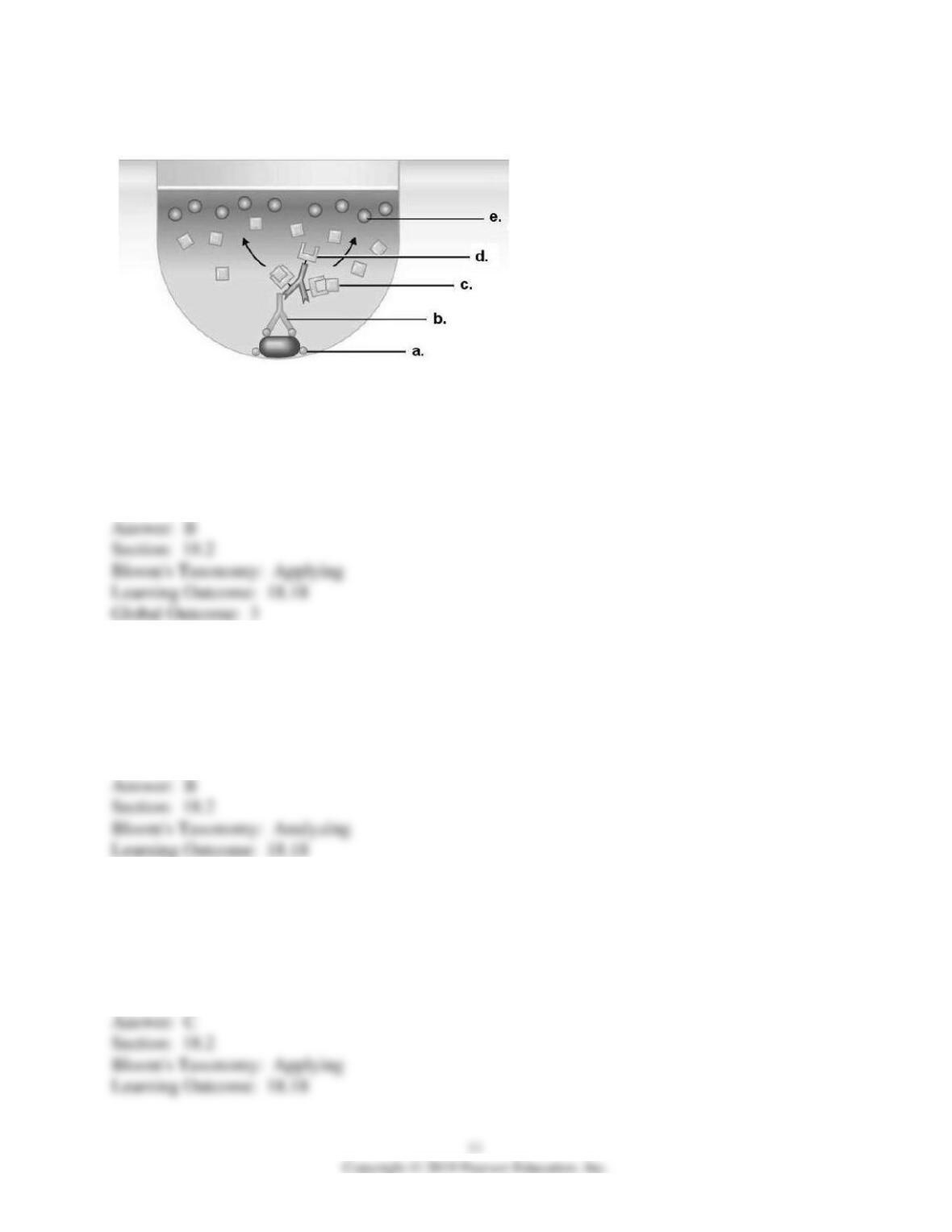
Figure 18.1
31) Which component in Figure 18.1 came from the patient in this indirect ELISA test?
A) a
B) b
C) c
D) d
E) e
32) Figure 18.1 is an illustration of a(n)
A) negative indirect ELISA test.
B) positive indirect ELISA test.
C) complement fixation test.
D) hemagglutination test.
E) precipitation test.
33) In Figure 18.1, which component represents the substrate for the enzyme in the assay?
A) a
B) b
C) c
D) d
E) e

34) In Figure 18.1, items c and e are different from each other. How are they different?
A) Item c is the enzyme that modifies item e, the substrate.
B) Item e is the enzyme that modifies the substrate, item c.
C) Item c is the substrate acted on by the enzyme in the assay, and item e is the colored end
product of that enzymatic reaction.
D) Item e is the substrate acted on by the enzyme in the assay, and item c is the colored end
product of that enzymatic reaction.
35) Monoclonal antibodies are used in diagnostic tests and disease treatments because they
A) are highly specific.
B) can be produced in large quantities.
C) contain a mixture of antibodies.
D) are highly specific and they can be produced in large quantities.
E) are highly specific, they can be produced in large quantities, and they contain a mixture of
antibodies.
36) The following steps are used to produce monoclonal antibodies. What is the fourth step?
A) A B cell is activated to produce antibodies.
B) Culture the hybridoma in a selective medium.
C) Fuse a B cell to a myeloma cell.
D) Isolate antibody-producing B cells.
E) Vaccinate a mouse.

37) Palivizumab is used to treat respiratory syncytial virus disease. This antiviral drug is a(n)
A) toxoid.
B) monoclonal antibody.
C) vaccine.
D) immunosuppressive.
E) nucleoside analog.
38) Live weakened polio virus can be used directly in a(n)
A) inactivated whole-agent vaccine.
B) attenuated whole-agent vaccine.
C) conjugated vaccine.
D) subunit vaccine.
E) toxoid vaccine.
39) Haemophilus capsule polysaccharide plus diphtheria toxoid is a(n)
A) inactivated whole-agent vaccine.
B) attenuated whole-agent vaccine.
C) conjugated vaccine.
D) subunit vaccine.
E) toxoid vaccine.

40) Dead Bordetella pertussis can be used in a(n)
A) inactivated whole-agent vaccine.
B) attenuated whole-agent vaccine.
C) conjugated vaccine.
D) subunit vaccine.
E) toxoid vaccine.
41) Isolated and purified hepatitis B virus surface antigen can be used in a(n)
A) inactivated whole-agent vaccine.
B) attenuated whole-agent vaccine.
C) conjugated vaccine.
D) subunit vaccine.
E) toxoid vaccine.
42) In a direct ELISA test to screen for drugs in a patient’s urine, what is the third step in the test
process?
A) Substrate for the enzyme is added.
B) Enzyme-labeled antibody against the drug being tested is added.
C) The patient’s urine sample is diluted.
D) Antibody against the drug being tested is added.
43) Which item is from the patient in a direct ELISA test?
A) substrate for the enzyme
B) antigen
C) antihuman immune serum
D) antibodies against the antigen

44) Which of the following tests is MOST useful in determining the presence of AIDS
antibodies?
A) agglutination
B) complement fixation
C) neutralization
D) indirect ELISA
E) direct fluorescent-antibody
45) Which of the following uses fluorescent-labeled antibodies?
A) agglutination
B) complement fixation
C) precipitation
D) flow cytometry
E) neutralization
46) Which of the following is NOT an advantage of live attenuated vaccine agents?
A) They elicit lifelong immunity.
B) They stimulate by cell-mediated and humoral immune responses.
C) They occasionally revert to virulent forms.
D) They require few or no booster immunizations.
E) The immune response generated by the vaccine closely mimics a real infection.

47) In an immunodiffusion test to diagnose the fungal disease histoplasmosis, a patient’s serum is
placed in a well in an agar plate. In a positive test, a precipitate forms as the serum diffuses from
the well and meets material diffusing from a second well. In this test process, what is the most
likely identity of the material in the second well?
A) antibodies
B) a purified fungal antigen
C) entire fungal cells
D) a purified protozoan antigen
E) red blood cells
48) In an immunodiffusion test to diagnose histoplasmosis, a patient’s serum is placed in a well
in an agar plate. In a positive test, a line forms as the serum diffuses from the well and meets
material diffusing from a second well. What type of test is this?
A) an agglutination reaction
B) a precipitation reaction
C) a complement-fixation test
D) an indirect ELISA test
E) a direct ELISA test
49) Which of the following statements about measles is FALSE?
A) It is a serious disease.
B) It is preventable by vaccination.
C) Annually, it kills thousands of children worldwide.
D) The disease has been eradicated in the United States.
E) Complications include pneumonia, encephalitis, and death.

50) When producing monoclonal antibodies, the use of ________ is critical after fusion to
specifically allow only hybrid cells to grow.
A) selective medium
B) neutralizing antibodies
C) enzymatically-labeled antibodies
D) fluorescently-labeled antibodies
E) complement
18.2 True/False Questions
1) Vaccines are preparations of organisms or fractions of organisms that are used to induce
protective immune responses.
2) In a vaccine preparation, the term “attenuated” means that the agent does NOT replicate.
3) An injection of “naked” DNA into muscle cells to induce an immune response against the
proteins encoded by the DNA is an example of a subunit vaccine.
4) Adjuvants such as aluminum salts are used in vaccines to directly produce highly-specific
immune responses.

5) Blood typing tests are examples of hemagglutination reactions.
6) A positive complement-fixation test is indicated by the lysis of the sheep red blood cells added
in the indicator phase of the test.
7) The home pregnancy test kit is an example of a direct ELISA.
8) Western blotting uses DNA probes to detect specific sequences in a mixture of proteins.
9) A highly specific diagnostic test will be unlikely to indicate a positive result if a specimen
being tested is a true negative.
10) Agglutination tests use particulate antigens while precipitation tests use soluble antigens.

18.3 Essay Questions
1) Describe an ELISA test to detect the presence of HIV antibodies in a patient.
2) Design a serological test to detect botulinum toxin in food.
3) In your work in a county public health clinic, you encounter parents of a three-month-old who
are considering not vaccinating their child. What concerns might the parents raise regarding
vaccine safety? As a microbiology student and public health care worker, what do you say to
these parents regarding the risks of not vaccinating their child?
4) In a recent influenza epidemic, physicians were utilizing a rapid diagnostic test to determine
which patients were infected with influenza type A, type B, or not infected with influenza virus.
Such a test was not available in the massive 1918 outbreak that killed millions of people around
the globe. How might the availability of such a test have impacted that outbreak, and why?
5) One of the objections many people have about vaccinations is the amount and variety of
chemicals in them. Many people don’t realize how easy the ingredients are to find — they’re
required in the product inserts for each vaccination produced. Using the internet, go and find a
product insert for a typical vaccine (e.g. influenza vaccine, HPV vaccine, hepatitis B vaccine,
etc.). Identify each component contained within it, the amount of that component, and briefly
describe what that component does.