
Microbiology with Diseases by Body System, 5e (Bauman)
Chapter 17 Immunization and Immune Testing
17.1 Multiple Choice Questions
1) What is the most efficient and cost-effective way to control infectious diseases?
A) variolation
B) active immunization by vaccination
C) passive immunotherapy using immunoglobulins
D) immune testing
E) autoimmunization
2) Contact immunity within a population can be produced by ________ vaccines.
A) attenuated
B) DNA
C) inactivated
D) subunit
E) toxoid
3) The first true vaccine provided immunity to
A) anthrax.
B) cholera.
C) pertussis.
D) rabies.
E) smallpox.
4) Development of new vaccines has slowed in recent decades. This is due to
A) the ineffectiveness of vaccines against disease.
B) the availability of vaccines against nearly all serious diseases.
C) the high cost of development.
D) the high level of risk with immunization.
E) a lack of need with modern medical treatments.

5) Almost a century after Edward Jenner introduced successful vaccination, Louis Pasteur
developed vaccine(s) against
A) anthrax.
B) human cholera.
C) rabies.
D) influenza.
E) both anthrax and rabies.
6) The discovery of antibodies and the understanding of their actions lead to
A) improved vaccine design.
B) the development of genetically engineered vaccines.
C) improved methods of immunization.
D) the development of passive immunotherapy.
E) the use of the technique known as variolation.
7) Pathogens may be attenuated for use in vaccines by
A) raising the pathogen for several generations in tissue culture cells.
B) genetic manipulation.
C) treatment with formaldehyde.
D) genetic manipulation coupled with treatment with formaldehyde.
E) genetic manipulation and/or raising the pathogen for several generations in tissue culture
cells.
8) The polio vaccine currently administered in the U.S., known as IPV, is an example of a(n)
________ vaccine.
A) attenuated
B) whole inactivated
C) subunit
D) toxoid
E) recombinant

9) Which of the following statements regarding an inactivated vaccine is FALSE?
A) It can be produced with deactivated whole microorganisms.
B) It can be produced from antigenic fragments of a pathogen.
C) It is safer than an attenuated vaccine.
D) It is made from mutated forms of the pathogen.
E) It is made from pathogens that cannot replicate.
10) Large quantities of pure antigen produced using recombinant DNA technology can be used
to prepare ________ vaccines.
A) attenuated
B) inactived whole
C) toxoid
D) subunit
E) DNA
11) Killed vaccines work by stimulating
A) an antibody response.
B) phagocytic activity.
C) the cell-mediated immune response.
D) cytotoxic T cells.
E) lymphocyte proliferation.
12) Which of the following substances is commonly used to inactivate microbes?
A) formaldehyde
B) alcohol
C) synthetic detergents
D) fluorescent dyes
E) alum

13) What type of vaccine is the hepatitis B vaccine?
A) inactivated whole pathogen
B) attenuated vaccine
C) toxoid vaccine
D) a recombinant vaccine composed of a single antigen of the hepatitis virus
E) a vaccine produced by treating the virus with formaldehyde
14) Which of the following statements regarding toxoids is FALSE?
A) They are produced against the toxin of the microorganism rather than the microorganism
itself.
B) They provide lifelong immunity.
C) They stimulate antibody immune responses.
D) They have few antigenic determinants.
E) They are chemically or thermally modified.
15) An infectious disease researcher isolates the pathogen responsible for an emerging disease.
The microbe is grown in the lab. A preparation of the laboratory-grown microbe is treated with a
lethal dose of ionizing radiation and then tested for its potential as a vaccine. What type of
vaccine is this?
A) attenuated
B) subunit
C) combination
D) toxoid
E) inactivated whole

16) The attenuated oral poliovirus vaccine (OVP) is no longer administered in the U.S.A.
because it
A) is very toxic.
B) does not provide good immunity.
C) can revert to wild-type virulence.
D) can be spread to contacts.
E) can be spread to contacts and can revert to wild-type virulence.
17) A person who has been exposed to rabies receives both HRIG (human rabies
immunoglobulin) injected near the bite site and the rabies vaccine. What does this strategy
represent?
A) active immunization
B) passive immunotherapy
C) viral hemagglutination inhibition
D) passive immunotherapy combined with viral hemagglutination inhibition
E) active immunization combined with passive immunotherapy
18) A person exposed to hepatitis A virus may be treated with an injection of antibody
molecules. This type of treatment is
A) immunization.
B) serology.
C) vaccine therapy.
D) passive immunotherapy.
E) adjuvant therapy.
19) Antivenin is a(n)
A) antitoxin used to treat exposure to a venom.
B) antigen produced from a virus.
C) antiserum produced from hybridomas.
D) vaccine made toward the endotoxin of a virus.
E) vaccine produced against the endotoxin of a bacterium.
20) Monoclonal antibodies are obtained from
A) human serum.
B) animal serum.
C) hybridomas.
D) human B cells in culture.
E) both human and animal serum
21) Analysis of blood to detect specific antigens or antibodies is known as
A) immunology.
B) hematology.
C) serology.
D) cytology.
E) histology.
22) Which of the following diagnostic procedures depends on precipitation of antigen-antibody
complexes?
A) blood typing
B) immunodiffusion
C) viral hemagglutination inhibition tests used to diagnose viral infections
D) ELISA
E) fluorescent antibody tests
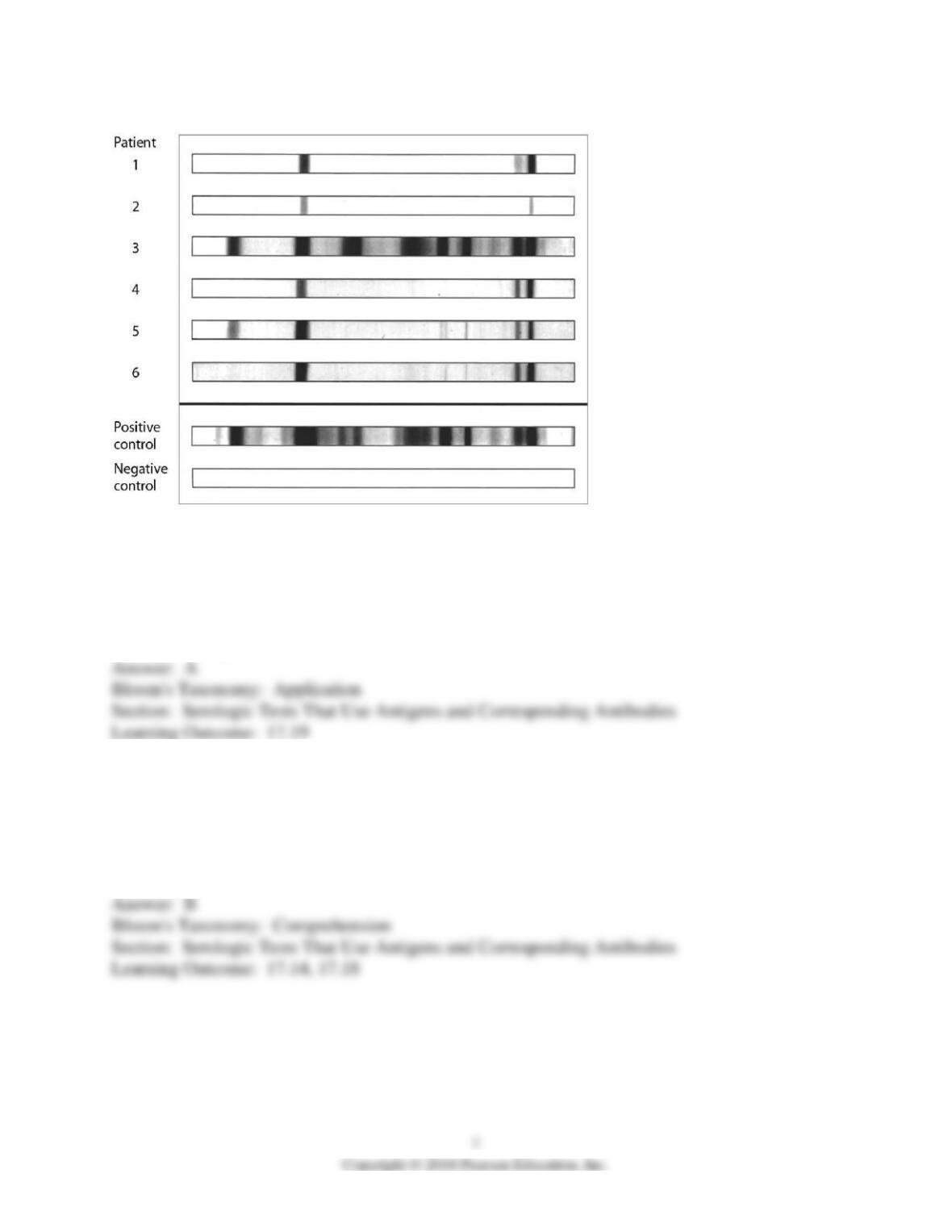
23)
The assay shown in Figure 17.1 is used for what?
A) detecting antibodies against a complex mix of antigens
B) verifying infection with a virus
C) determining the concentration of antibodies
D) detecting neutralizing antibodies
E) blood typing
24) Which of the following tests does NOT detect an immune response to a virus infection?
A) a viral neutralization test
B) a direct immunofluorescent antibody test
C) a viral hemagglutination test
D) a complement fixation test
E) a direct ELISA
25) Tuberculosis may be diagnosed using a(n) ________ on sputum (lung fluid) samples.
A) direct fluorescent antibody test
B) complement fixation test
C) neutralization test
D) immunochromatographic assay
E) viral hemagglutination test
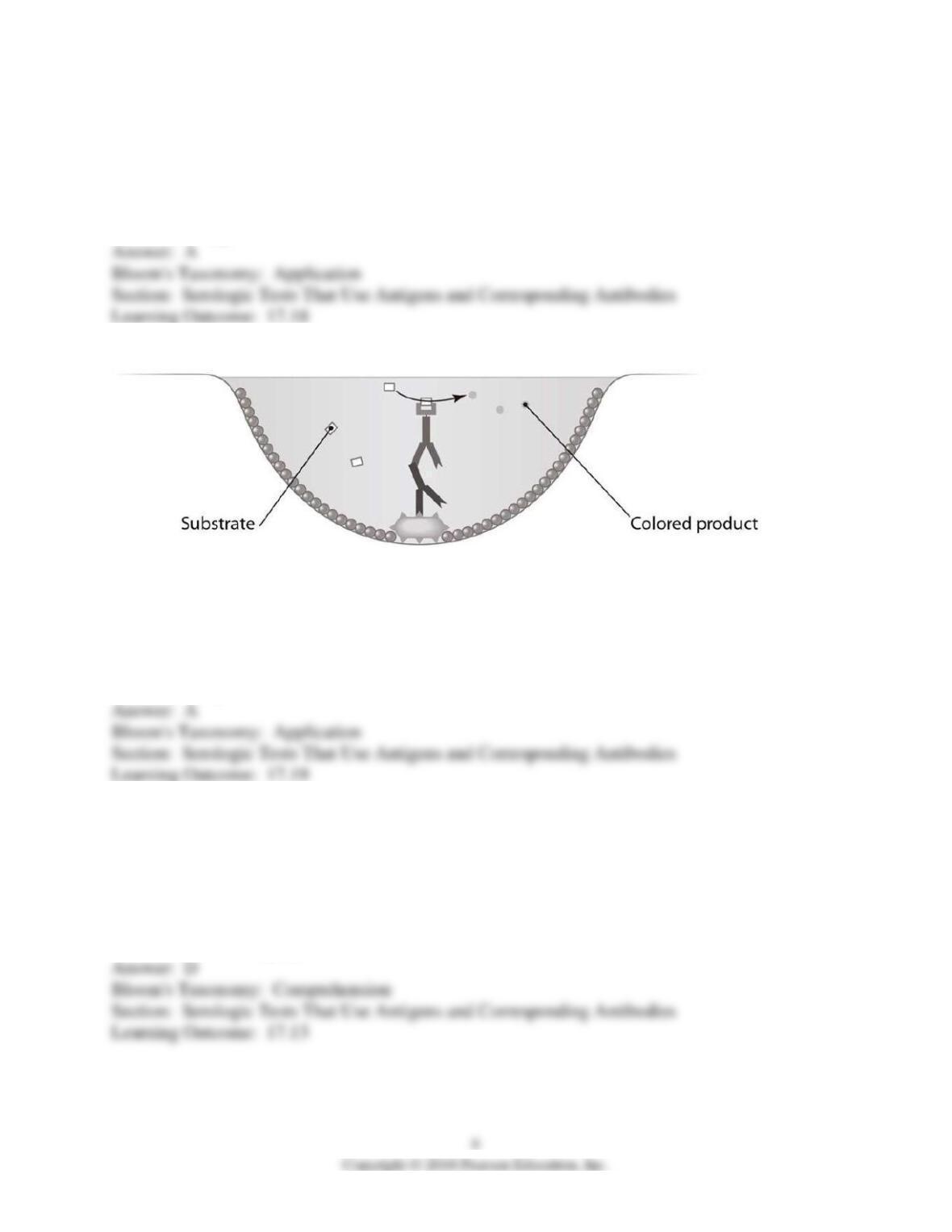
26)
The assay represented in Figure 17.2 is used to
A) detect antigen-specific antibodies in patient serum.
B) detect specific antigen in patient serum.
C) determine the titer of IgM in patient serum.
D) determine the presence of an antibody-modifying enzyme in a patient sample.
E) detect cytopathic effects of viral infection.
27) The concentration (or titer) of antibody to a specific antigen can be determined using a
________ test.
A) hemagglutination
B) precipitation
C) complement fixation
D) agglutination
E) immunochromatographic
28) Viral neutralization testing is based on the fact that
A) antibodies can be produced against the toxin of a pathogen.
B) antibodies have different molecular weights.
C) viruses introduced into appropriate cell cultures have a cytopathic effect.
D) the gene for a pathogen’s antigen can be isolated and introduced into a host cell by way of a
plasmid.
E) antibodies to certain microbes can be given a fluorescent label.
29) The presence of fungus in patient specimens can be detected by the ________ test.
A) direct fluorescent antibody
B) indirect fluorescent antibody
C) hemagglutination
D) complement fixation
E) ELISA
30) Which of the following statements regarding ELISAs is TRUE?
A) They are not quantitative.
B) They require large amounts of serum.
C) The antibody label is a fluorescent molecule.
D) They can be used to detect antibody or antigen.
E) They involve the use of membrane filters.
31) Which of the following assays is a function of the formation of immune complexes?
A) immunoblot tests
B) ELISAs
C) neutralization tests
D) direct fluorescent antibody tests
E) precipitation tests
32) A hemagglutination test is useful for
A) determining antibody titer.
B) blood typing.
C) determining effectiveness of immunization.
D) detecting presence of a pathogen in patient serum.
E) diagnosing viral infection.
33) In precipitation tests, maximum precipitation takes place when
A) the amount of the antibody exceeds the amount of the antigen.
B) the amount of the antigen exceeds the amount of the antibody.
C) the amount of the antibody and the amount of the antigen are at optimal proportions.
D) a toxin is present.
E) a complex solution of many antibodies is used.
34) A woman uses a home pregnancy test kit that tests for hCG hormone in urine. She knows
this is a type of antibody assay from the kit brochure. Antibodies reacting with the hormone
produce two lines on the test strip. What specific type of antibody assay does this represent?
A) a direct immunofluoresence test
B) a complement fixation test
C) an immunochromatographic assay
D) an ELISA
E) a neutralization assay
35) The complement fixation test uses red blood cells as the target for complement activation.
Test serum containing antibodies is combined with a known amount of antigen in a tube, and
then the RBCs and antibodies against the RBCs are added. A positive result for the complement
fixation test would be
A) a line of precipitate near the bottom of the tube.
B) a cloudy solution in the tube.
C) loss of color in the tube.
D) a fluorescent precipitate.
E) a solution that is clear due to precipitation of RBCs.
36) Which property of antibodies is the basis for complement fixation tests?
A) agglutination
B) opsonization
C) neutralization
D) direct killing
E) complement activation
37) A new virus is discovered that causes cells to lyse. Which of the following types of assay
would be useful for diagnosing infection with this virus?
A) agglutination
B) complement fixation test
C) viral hemagglutination
D) both agglutination and complement fixation tests
E) viral neutralization
38) Serologic tests may be used to detect ________ for diagnosis of disease.
A) the concentration of serum proteins
B) the ability of the patient’s antibodies to activate the complement system
C) antigen-specific antibodies
D) specific epitopes
E) the proportion of plasma in a patient’s blood
39) Anti-human antibodies (specific for human IgG antibodies) with fluorescent molecules
covalently attached are used for
A) direct fluorescent antibody tests.
B) indirect fluorescent antibody tests.
C) direct ELISAs.
D) indirect ELISAs.
E) immunodiffusion tests.
40) How is an immunofiltration assay different from an ELISA?
A) Test antigens are bound to filters rather than plastic plates.
B) Positive results are the result of precipitate formation.
C) Fluorescent molecules are attached to antigen rather than enzyme.
D) Antibodies are bound to filters rather than plastic plates.
E) They take longer than ELISAs.
41) Infection with HIV is routinely verified using a(n) ________ assay.
A) direct fluorescent antibody
B) immunodiffusion precipitation
C) viral neutralization
D) viral hemagglutination inhibition
E) immunoblot
42) Infection with the fungus Coccidioides immitis is commonly diagnosed using a(n) ________
assay.
A) precipitation
B) immunoblot
C) direct fluorescent antibody
D) hemagglutination inhibition
E) neutralization
43) A(n) ________ assay is used for rapid identification of strep (group A Streptococcus)
infections.
A) direct fluorescent antibody
B) immunodiffusion precipitation
C) viral neutralization
D) immunochromatographic
E) immunoblot
44) Rabies virus can be directly detected in brain tissue using a(n) ________ assay.
A) viral neutralization
B) direct fluorescent antibody
C) immunodiffusion precipitation
D) viral hemagglutination inhibition
E) immunoblot
45) Infection with influenzavirus is commonly diagnosed using
A) an immunoblot assay.
B) viral neutralization tests.
C) immunochromatographic assay.
D) viral hemagglutination inhibition test.
E) both immunochromatographic assay and viral hemagglutination inhibition test.
1) Edward Jenner was the physician who first used cowpox to vaccinate individuals against
smallpox.
2) Passive immunotherapy does not result in immunological memory.
3) For some bacterial diseases such as tetanus, it is more effective to produce an immune
response against the bacterial toxin than against the bacteria.
4) Because attenuated live vaccines contain viruses that are less virulent, many booster vaccines
must be given to produce an effective immune response.
5) Agglutination tests are used to detect soluble antigens.
6) Anti-antibodies are used in indirect antibody assays.
7) Complement fixation is a more sensitive test for the presence of specific antibodies than are
agglutination tests.
8) The immunochromatographic assay uses enzyme-linked anti-antibodies.
9) The hepatitis B vaccine is an attenuated vaccine.
10) The MMR (measles, mumps, rubella) vaccine requires multiple immunizations in the first
year because it is composed of whole killed viruses.
17.3 Short Answer Questions
1) Deliberate infection of young children with particles of ground smallpox scabs from children
who had survived mild cases of smallpox was known as (vaccination/variolation/immunization).
2) Raising viruses for numerous generations can produce an (adjuvant/attenuated/inactivated)
form of the virus.
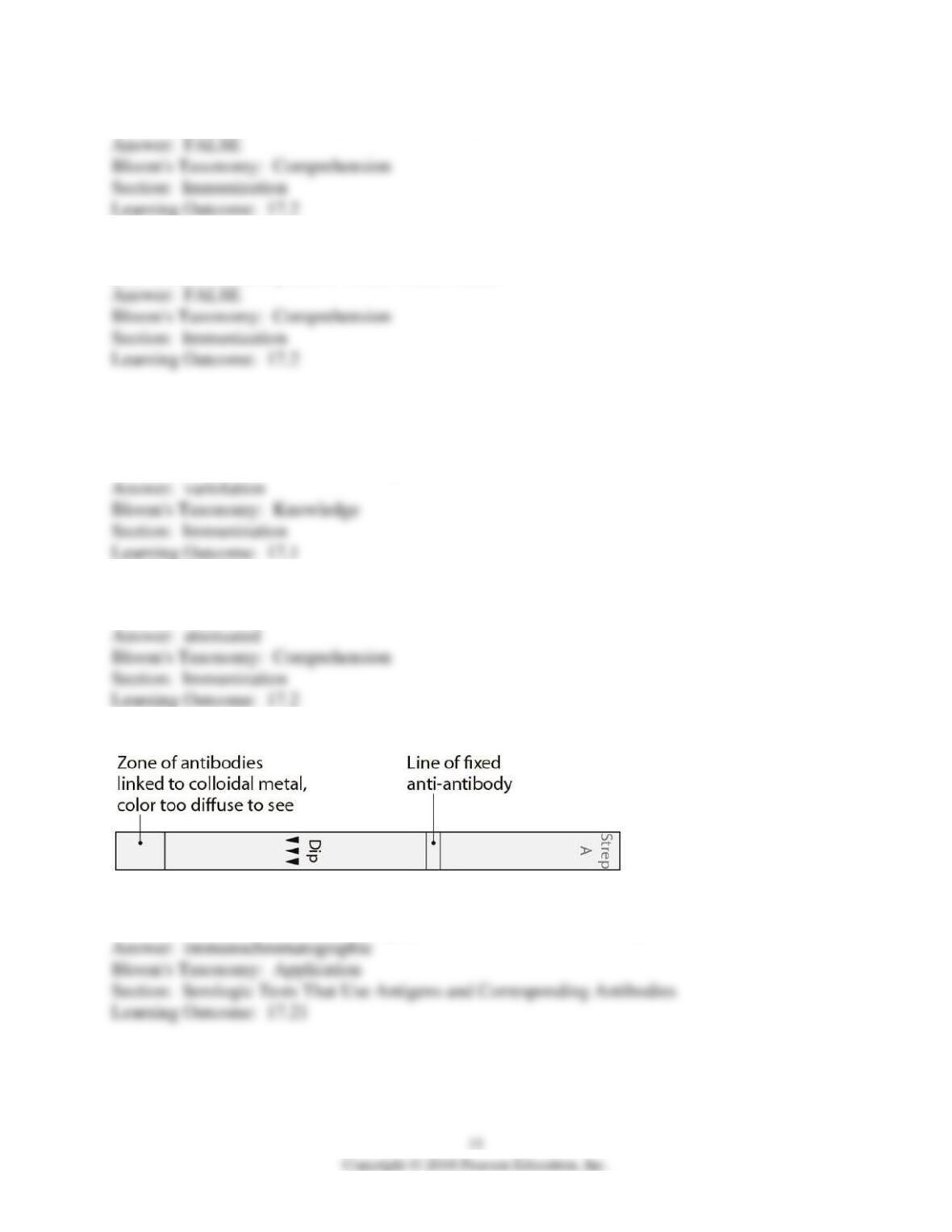
3)
The “dipstick” illustrated in Figure 17.3 is used in a(n)
(immunodiffusion/immunochromatographic/ immunofluorescent) assay.

4) When vaccines do not provide lifelong immunity, (adjuvants/ boosters/subunits) must be
given to maintain protection.
5) An advantage of (attenuated/inactivated/subunit) vaccines is that they usually elicit cell-
mediated immune responses.
6) The vaccine to prevent cervical cancer is a(n) (attenuated/recombinant/toxoid) vaccine.
7) A researcher uses genetic recombination techniques to remove a virulence gene from a
pathogen, producing a(n) (attenuated/inactivated/subunit/toxoid) vaccine.
8) Chemically or thermally modified toxins that are used for vaccination are called
(adjuvants/antigens/toxoids).
9) Modern vaccine technology can involve inserting the DNA encoding the pathogen’s antigen(s)
into a (plasmid/hybridoma/cell) and injecting it into an individual.
10) An (ELISA/immunofiltration/immunoblot) assay uses antibodies bound on the surface of a
membrane filter to detect antigens.
11) A technician places a serum sample in a well in an agar plate and a solution of antigens in a
second well in the plate. The technician has set up a(n)
(agglutination/immunodiffusion/immunoblot) assay.
12) Antisera directed against toxins are known as (antibodies/antitoxins/anti-antibodies).
13) Snakebites are treated with (antisera/antitoxins/antivenins).
14) Fluorescent antibody, ELISA, and immunoblotting tests involve the use of
(hybridoma/labeled/unlabeled) antibodies.
15) One way to measure the antibody levels in the blood is by
(neutralization/titration/turbidimetry) using agglutination tests.
17.4 Essay Questions
1) Discuss the similarities and differences between immunodiffusion and
immunochromatographic assays.
2) Compare and contrast viral neutralization and viral hemagglutination tests.
3) Two types of vaccines for polio have been developed, an inactivated whole (IPV ) and a live
attenuated (OPV ) vaccine. Compare and contrast the advantages and disadvantages of the two
polio vaccines.
4) Discuss the concept of herd immunity and its importance in creating and maintaining a
healthy population.
5) How has modern technology helped to produce new types of vaccines?