
Campbell Biology in Focus, 2e (Urry)
Chapter 17 Viruses
17.1 Multiple-Choice Questions
1) Viral envelopes can best be analyzed with which of the following techniques?
A) antibodies against specific proteins not found in the host membranes
B) DNA staining and visualization with the light microscope
C) use of plaque assays for quantitative measurement of viral titer
D) immunofluorescent tagging of capsid proteins
2) Which of the following characteristics determine a virus’s host range?
A) the enzymes carried by the virus
B) whether its nucleic acid is DNA or RNA
C) the proteins in the host’s cytoplasm
D) the proteins on its surface and that of the host
3) Which of the following is why someone who has had a herpesvirus-mediated cold sore or
genital sore may have flare-ups for the rest of his or her life?
A) re-infection by a closely related herpesvirus of a different strain
B) re-infection by the same herpesvirus strain
C) co-infection with an unrelated virus that causes the same symptoms
D) copies of the herpesvirus genome remaining as mini-chromosomes in some host cell nuclei

4) Which of the following responses correctly lists the order of events in a generalized viral
replicative cycle?
A) enzymes transcribe the viral genome into mRNA, the virus enters the cell, host enzymes
replicate the viral genome
B) the virus enters the cell, host enzymes replicate the viral genome, enzymes transcribe the viral
genome into mRNA
C) host enzymes replicate the viral genome, enzymes transcribe the viral genome into mRNA,
the virus enters the cell
D) the virus enters the cell, enzymes transcribe the viral genome into mRNA, host enzymes
replicate the viral genome
5) Which of the following statements correctly describes one characteristic of the lytic cycle of
viral replication?
A) Many bacterial cells containing viral DNA are produced.
B) Viral DNA is incorporated into the host genome.
C) The viral genome replicates without destroying the host.
D) A large number of phages are released at a time.
6) Which of the following statements correctly describes the lysogenic cycle of lambda (λ)
phage?
A) After infection, the viral genes immediately turn the host cell into a lambda-producing
factory, and the host cell then lyses.
B) Most of the prophage genes are activated by the product of a particular prophage gene.
C) The phage genome replicates along with the host genome.
D) Certain environmental triggers can cause the phage to exit the host genome, switching from
the lytic to the lysogenic.

7) Most molecular biologists think that viruses originated from naked bits of cellular nucleic
acid. Which of the following observations supports this theory?
A) Viruses contain either DNA or RNA.
B) Viruses are enclosed in protein capsids rather than plasma membranes.
C) Viruses can reproduce only inside host cells.
D) Viruses can infect both prokaryotic and eukaryotic cells.
E) Viral genomes are usually similar to the genome of the host cell.
8) A researcher lyses a cell that contains nucleic acid molecules and capsomeres of tobacco
mosaic virus (TMV). The cell contents are left in a covered test tube overnight. The next day this
mixture is sprayed on tobacco plants. Which of the following would be expected to occur?
A) The plants would develop some but not all of the symptoms of the TMV infection.
B) The plants would develop symptoms typically produced by viroids.
C) The plants would develop the typical symptoms of TMV infection.
D) The plants would not show any disease symptoms.
9) Which viruses have single-stranded RNA that acts as a template for DNA synthesis?
A) lytic phages
B) proviruses
C) viroids
D) bacteriophages
E) retroviruses
10) What is the function of reverse transcriptase in retroviruses?
A) It hydrolyzes the host cell’s DNA.
B) It uses viral RNA as a template for DNA synthesis.
C) It converts host cell RNA into viral DNA.
D) It uses viral RNA as a template for making complementary RNA strands.

11) Why do RNA viruses tend to have unusually high rates of mutation?
A) RNA nucleotides are more unstable than DNA nucleotides.
B) Replication of their genomes does not involve proofreading.
C) RNA viruses replicate faster.
D) RNA viruses can incorporate a variety of nonstandard bases.
12) Which of the following processes can be effective in preventing the onset of viral infection in
humans?
A) taking vitamins
B) getting vaccinated
C) taking antibiotics
D) applying antiseptics
13) Which of the following statements accurately describes plant virus infections?
A) They can be controlled by the use of antibiotics.
B) They are spread via the plasmodesmata.
C) They have little effect on plant growth.
D) They are rarely spread by insects.
14) Which of the following statements correctly describes one difference between vertical and
horizontal transmission of plant viruses?
A) Vertical transmission is transmission of a virus from a parent plant to its progeny, and
horizontal transmission is one plant spreading the virus to another plant.
B) Vertical transmission is the spread of viruses from the upper leaves to the lower leaves of the
plant, and horizontal transmission is the spread of a virus among leaves at the same general level.
C) Vertical transmission is the spread of viruses from trees and tall plants to bushes and other
smaller plants, and horizontal transmission is the spread of viruses among plants of similar size.
D) Vertical transmission is the transfer of DNA from one type of plant virus to another, and
horizontal transmission is the exchange of DNA between two plant viruses of the same type.

15) Which of the following statements correctly describes the best predictor of how much
damage a virus causes?
A) ability of the infected cell to undergo normal cell division
B) ability of the infected cell to carry on translation
C) whether the infected cell produces viral protein
D) whether the viral mRNA can be transcribed
16) Antiviral drugs that have become useful are usually associated with which of the following
properties?
A) ability to remove all viruses from the infected host
B) interference with viral replication
C) removal of viral proteins
D) removal of viral mRNAs
17) Which of the following series of events best reflects what we know about how the flu virus
moves between species?
A) An avian flu virus undergoes several mutations and rearrangements such that it is able to be
transmitted to other birds and then to humans.
B) The flu virus in a pig is mutated and replicated in alternate arrangements so that humans who
eat the pig products can be infected.
C) A flu virus from a human epidemic or pandemic infects birds; the birds replicate the virus
differently and then pass it back to humans.
D) An animal such as a pig is infected with more than one virus, genetic recombination occurs,
the new virus mutates and is passed to a new species such as a bird, and the virus mutates and
can be transmitted to humans.

18) Which of the following statements correctly describes the most probable fate of a newly
emerging virus that causes high mortality in its host?
A) It is able to spread to a large number of new hosts quickly because the new hosts have no
immunological memory of them.
B) The new virus replicates quickly and undergoes rapid adaptation to a series of divergent hosts.
C) Sporadic outbreaks will be followed almost immediately by a widespread pandemic.
D) The newly emerging virus will die out rather quickly or will mutate to be far less lethal.
17.2 Art Questions
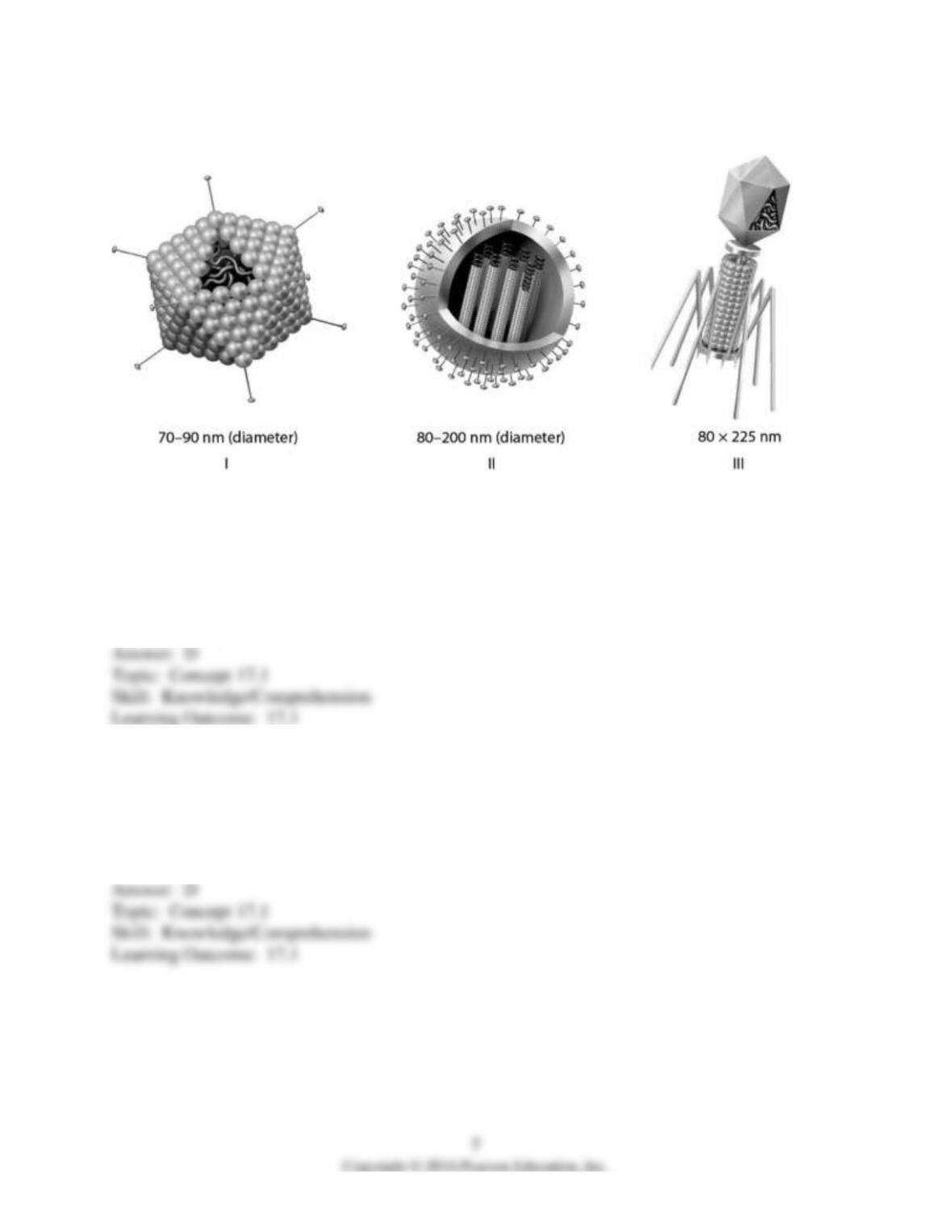
Figure 17.1
1) Which of the three types of viruses shown in Figure 17.1 would you expect to include
glycoproteins as part of their overall structure?
A) I only
B) II only
C) III only
D) I and II only
2) Which of the three types of viruses shown in Figure 17.1 would you expect to include a
capsid(s) as part of their overall structure?
A) I only
B) II only
C) III only
D) all three
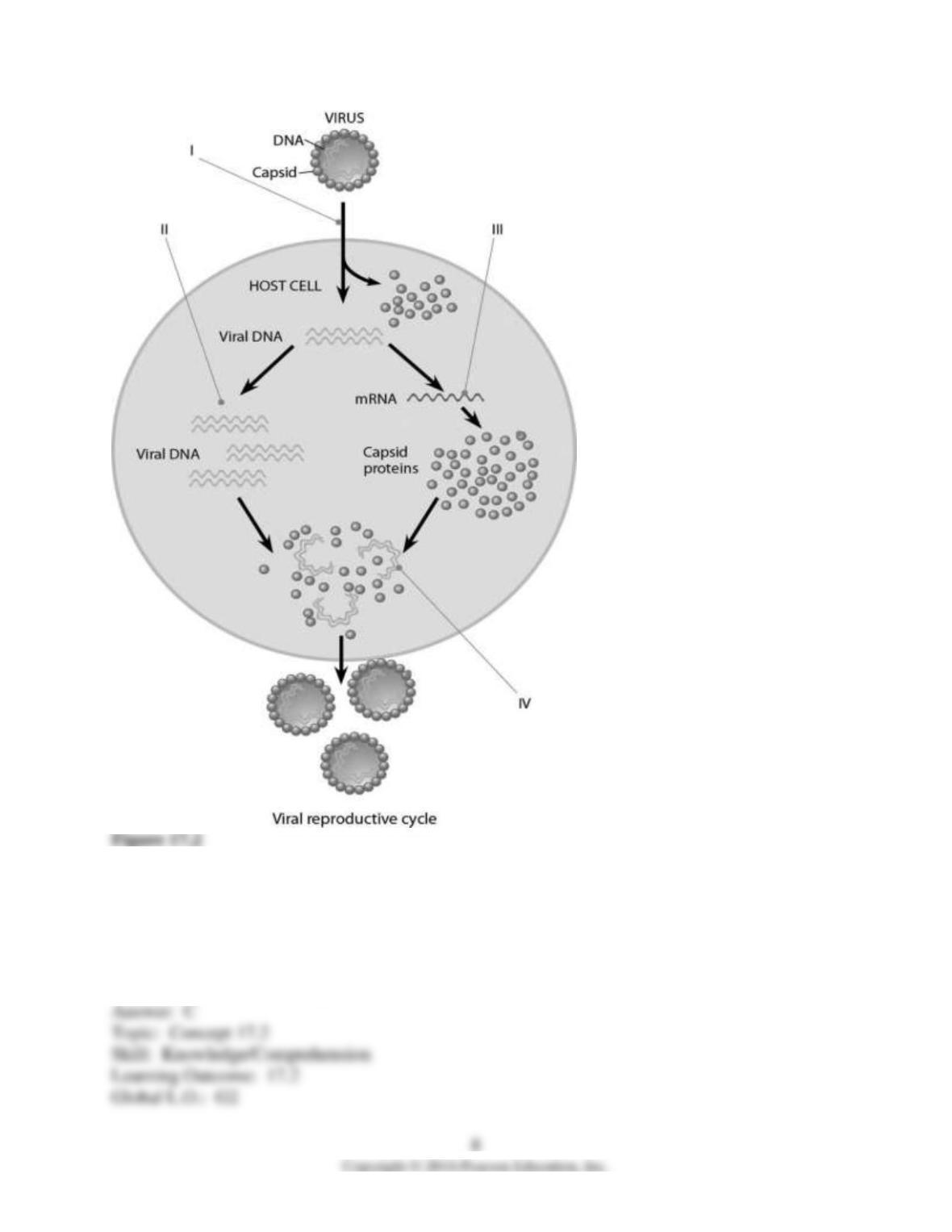
3) In Figure 17.2, at the arrow marked II, what enzyme(s) is (are) being utilized?
A) reverse transcriptase
B) viral DNA polymerase
C) host cell DNA polymerase
D) host cell RNA polymerase
E) host cell DNA and RNA polymerases
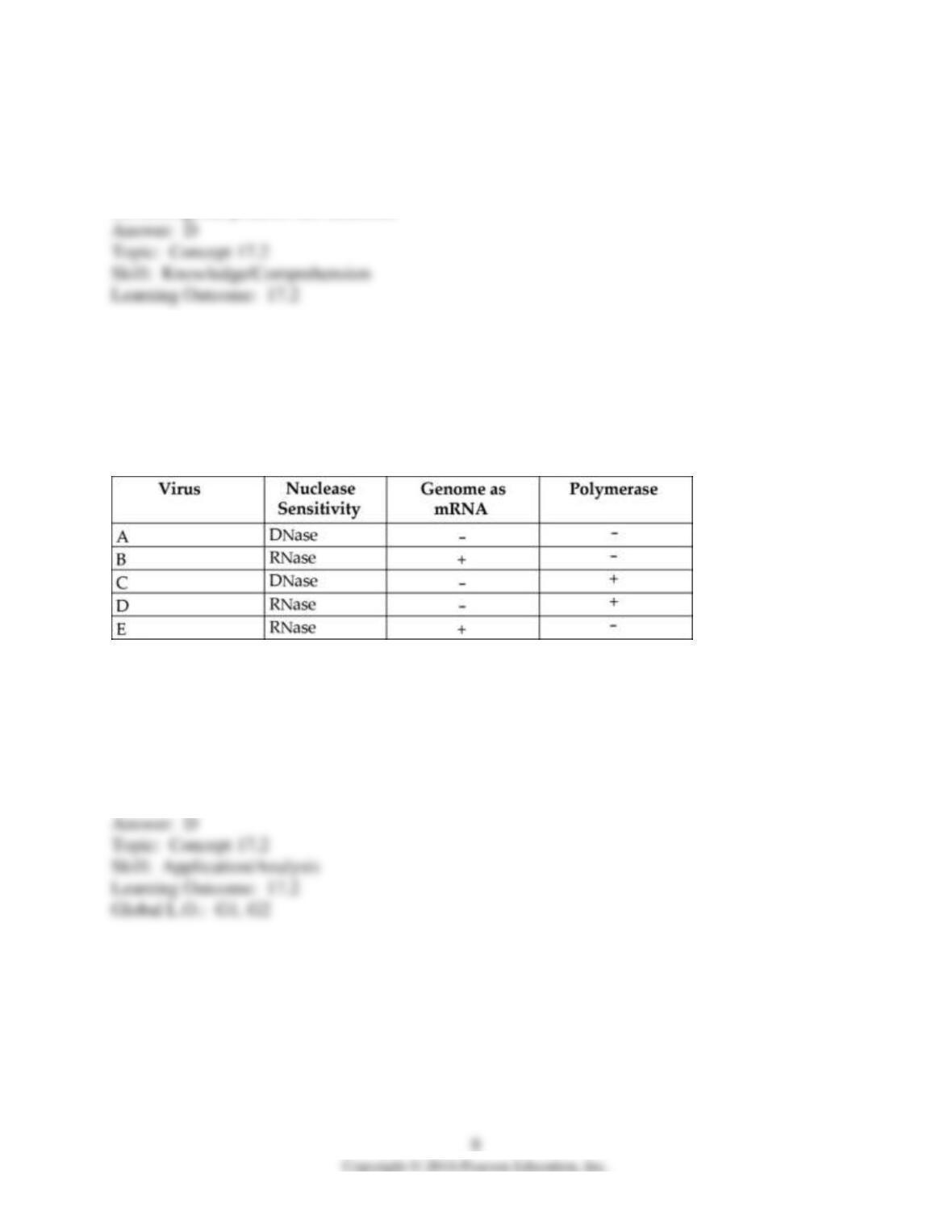
4) In Figure 17.2, when new viruses are being assembled (IV), what mediates the assembly?
A) host cell chaperones
B) assembly proteins coded for by the host nucleus
C) assembly proteins coded for by the viral genes
D) nothing; the proteins self-assemble
Please use the following information to answer the question(s) below.
In 1971, David Baltimore described a scheme for classifying viruses based on how the virus
produces mRNA. Table 17.1 shows the results of testing five viruses (A-E) for nuclease
sensitivity , the ability of the viral genome to act as an mRNA, and the presence (+) or absence
(-) of each virus’s own polymerase.
Table 17.1
5) Based on Table 17.1, which virus meets the Baltimore requirements for a retrovirus?
A) A
B) B
C) C
D) D
E) E

6) Based on Table 17.1, which virus meets the requirements for a bacteriophage?
A) A
B) B
C) C
D) D
E) E

17.3 Scenario Questions
1) Some viruses can be crystallized and their structures analyzed. One such virus is yellow
mottle virus, which infects beans. This virus has a single-stranded RNA genome containing
about 6,300 nucleotides. Its capsid is 25-30 nm in diameter and contains 180 identical
capsomeres. If the yellow mottle virus capsid has 20 facets, how many proteins form each facet?
A) 1
B) 5
C) 9
D) 20
E) 180
Refer to the treatments listed below to answer the following question(s).
You isolate an infectious substance that is capable of causing disease in plants, but you do not
know whether the infectious agent is a bacterium, virus, or prion. You have four methods at your
disposal that you can use to analyze the substance in order to determine the nature of the
infectious agent.
I. Treat the substance with nucleases that destroy all nucleic acids and then determine whether
it is still infectious.
II. Filter the substance to remove all elements smaller than what can be easily seen under a light
microscope.
III. Culture the substance by itself on nutritive medium, away from any plant cells.
IV. Treat the sample with proteases that digest all proteins and then determine whether it is still
infectious.
2) If you already knew that the infectious agent was either bacterial or viral, which treatment
would allow you to distinguish between these two possibilities?
A) I
B) II
C) III
D) IV
E) either II or IV

3) If you already knew that the infectious agent was a prion, which treatment would allow you to
distinguish this?
A) I only
B) II only
C) III only
D) IV only
E) either I or IV
Please use the following information to answer the question(s) below.
The herpesviruses are very important enveloped DNA viruses that cause disease in all vertebrate
species and in some invertebrates such as oysters. Some of the human ones are herpes simplex
virus (HSV) types I and II, causing facial and genital lesions, and the varicella zoster virus
(VSV), causing chicken pox and shingles. Each of these three actively infects nervous tissue.
Primary infections are fairly mild, but the virus is not then cleared from the host; rather, viral
genomes are maintained in cells in a latent phase. The virus can then reactivate, replicate again,
and be infectious to others.
4) If scientists are trying to use what they know about HSV to devise a means of protecting other
people from being infected, which of the following would have the best chance of lowering the
number of new cases of infection?
A) vaccination of all persons with preexisting cases
B) interference with new viral replication in preexisting cases
C) treatment of the HSV lesions to shorten the breakout
D) medication that destroys surface HSV before it gets to neurons

5) In electron micrographs of HSV infection, it can be seen that the intact virus initially reacts
with cell-surface proteoglycans, then with specific receptors. This is later followed by viral
capsids docking with nuclear pores. Afterward, the capsids go from being full to being “empty.”
Which of the following statements best describes these observations?
A) Viral capsids are needed for the cell to become infected; only the capsids enter the nucleus.
B) The viral envelope is not required for infectivity, since the envelope does not enter the
nucleus.
C) Only the genetic material of the virus is involved in the cell’s infectivity, and it is injected like
the genome of a phage.
D) The viral envelope mediates entry into the cell, the capsid enters into the nuclear membrane,
and the genome is all that enters the nucleus.
E) The viral capsid mediates entry into the cell, and only the genomic DNA enters the nucleus,
where it may or may not replicate.
6) In order to be able to remain latent in an infected live cell, HSV must be able to shut down
what process?
A) DNA replication
B) transcription of viral genes
C) apoptosis of a virally infected cell
D) all immune responses

17.4 End-of-Chapter Questions
1) Which of the following characteristics, structures, or processes is common to both bacteria
and viruses?
A) metabolism
B) ribosomes
C) genetic material composed of nucleic acid
D) cell division
2) Emerging viruses arise by
A) mutation of existing viruses.
B) the spread of existing viruses to new host species.
C) the spread of existing viruses more widely within their host species.
D) all of the above
3) A human pandemic is
A) a viral disease that infects all humans.
B) a flu that kills more than 1 million people.
C) an epidemic that extends around the world.
D) a virus that increases in mortality rate as it spreads.
4) A bacterium is infected with an experimentally constructed bacteriophage composed of the T2
phage protein coat and T4 phage DNA. The new phages produced would have
A) T2 protein and T4 DNA.
B) T4 protein and T2 DNA.
C) T2 protein and T2 DNA.
D) T4 protein and T4 DNA.

5) RNA viruses require their own supply of certain enzymes because
A) host cells rapidly destroy the viruses.
B) host cells lack enzymes that can replicate the viral genome.
C) these enzymes translate viral mRNA into proteins.
D) these enzymes penetrate host cell membranes.