Chapter 17—The Evolution of Populations and Species Key
1. A population is a group of
2. Evolution occurs in
3. A species is
4. Which of the following statements concerning a gene pool is FALSE?
5. In populations that are not evolving,
6. In a population that is in genetic equilibrium
7. A population of well-adapted plants growing in a relatively stable environment
8. Which of the following statements concerning the Hardy-Weinberg principle is FALSE?
9. The Hardy-Weinberg principle
10. Which of the following is NOT one of the five conditions necessary for a population to be in genetic
equilibrium according to the Hardy-Weinberg principle?
11. According to the Hardy-Weinberg principle, a population in genetic equilibrium can
12. Microevolution
13. Mutations
14. Mutations arise from
15. Of the five mechanisms for producing deviations from Hardy-Weinberg allele frequencies, only ____
introduces new variation into the gene pool.
16. Which statement concerning mutations is FALSE?
17. In a small population, the random loss of alleles due to chance is called
18. Which of the following statements concerning genetic drift is FALSE?
19. Gene flow tends to
20. Gene flow is caused by
21. The founder effect is an example of
22. Natural selection acts by weeding out
23. Individuals with successful adaptations tend to
24. Which of the following leads to adaptive evolutionary change?
25. Which of the following statements concerning natural selection is FALSE?
26. Stabilizing natural selection
27. Directional natural selection
28. Disruptive natural selection
29. Which statement concerning the biological species concept is FALSE?
30. One of the problems with the biological species concept in relation to plants is that
31. According to the biological species concept, organisms that interbreed in a greenhouse but not in nature
32. Which of the following is an example of a mechanism for reproductive isolation between two species?
33. Hybridization between certain species of tobacco produces hybrids that develop abnormal growth and fail to
flower. This is an example of ____.
34. Mechanisms that prevent a successful interbreeding are referred to as reproductive ____ mechanisms.
35. There are floral differences among some related species of plants that result in pollination by different
pollinators. In this case, reproductive isolation is due to
36. Allopatric speciation occurs when
37. Geographic barriers
38. Which of the following statements concerning a cline is FALSE?
39. Sympatric speciation occurs when
40. Polyploidy
41. Which of the following statements concerning allopolyploidy is FALSE?
42. The rapid evolution of an ancestral population into many new species is called
43. Adaptive radiation is usually associated with
44. There have been ____ major mass extinctions.
45. Past mass extinctions may have been caused by
46. Which of the following statements concerning extinctions is FALSE?
47. Individuals can evolve during their lifetimes.
48. When mating in a population is random, matings occur in proportion to the frequencies of the genotypes.
49. Natural selection favors certain genotypes over others.
50. The Hardy-Weinberg principle operates on small populations.
51. All mutations that occur in the DNA affect the offspring.
52. Mutations are usually negligible as an evolutionary force.

53. Because many rare and endangered species have small populations, genetic drift tends to increase their
chances of extinction.
54. The founder effect is a type of genetic drift.
55. Gene flow tends to counteract natural selection because it tends to reduce the genetic variation between two
populations.
56. Natural selection acts on the genotype, not the phenotype.
57. In disruptive natural selection, the intermediate phenotype is selected against.
58. Individuals that are reproductively isolated from each other belong to the same species.
59. An interspecific hybrid is an individual formed by the union of two different species.
60. Sterile hybrids are unable to reproduce, usually because of chromosomal differences.
61. Speciation will occur whenever two populations are separated geographically.
62. The common yarrow exhibited taller growth at higher elevations than at lower elevations.

63. A polyploid individual has more than two sets of chromosomes.
64. Polyploidy is interesting, but it is of no importance in the evolution of flowering plants.
65. An allopolyploid individual is reproductively isolated from its two parent species.
66. Mass extinction refers to the continual, low-level loss of species that has occurred due to gradual changes in
the environment.
67. Some biologists think that humans are currently creating the greatest period of mass extinction in the Earth’s
history.
68. A(n) ____________________ of a population is all the genetic material, or alleles, of all the individuals of
the population.
69. Evolutionary changes occurring within a population is called ____________________.
70. Of the processes that can change the gene pool of a population, only ____________________ brings genetic
variation into harmony with the environment and leads to adaptive change.
71. ____________________ is a sudden change in a gene, which is inheritable by future generations.

72. ____________________ is the ultimate source of genetic variation in a population.
73. An evolutionary modification that improves an organism’s chances of survival and reproductive success is
called a(n) ____________________.
74. The ____________________ refers to the situation when a few individuals from a large population colonize
a new area.
75. Only ____________________ (small or large) populations are likely to undergo genetic drift.
76. A type of natural selection in which both phenotypic extremes are selected against is called
____________________.
77. A type of natural selection in which one phenotype gradually replaces another is called
____________________.
78. According to the biological species concept, the definition of a species is based on ____________________
79. A(n) ____________________ results from interbreeding between members of two species.
80. Although fertilization may occur between two related species, seeds are not usually produced because the
____________________ fails to grow and develop.

81. The formation of new species due to geographic isolation is called ____________________.
82. Geographic variation among members of a population is referred to as a(n) ____________________.
83. ____________________ is the formation of a new species from a parent population without geographic
separation.
84. Fertile interspecific hybrids produced by ____________________ can produce a new species in a single
generation.
85. In ____________________, an ancestral organism evolves rapidly into many new species.
86. ____________________ refers to the large-scale loss of species that have occurred five or six times during
Earth’s history.
87. Low rates of extinction in response to gradual changes in the environment over time are known as
____________________ extinction.
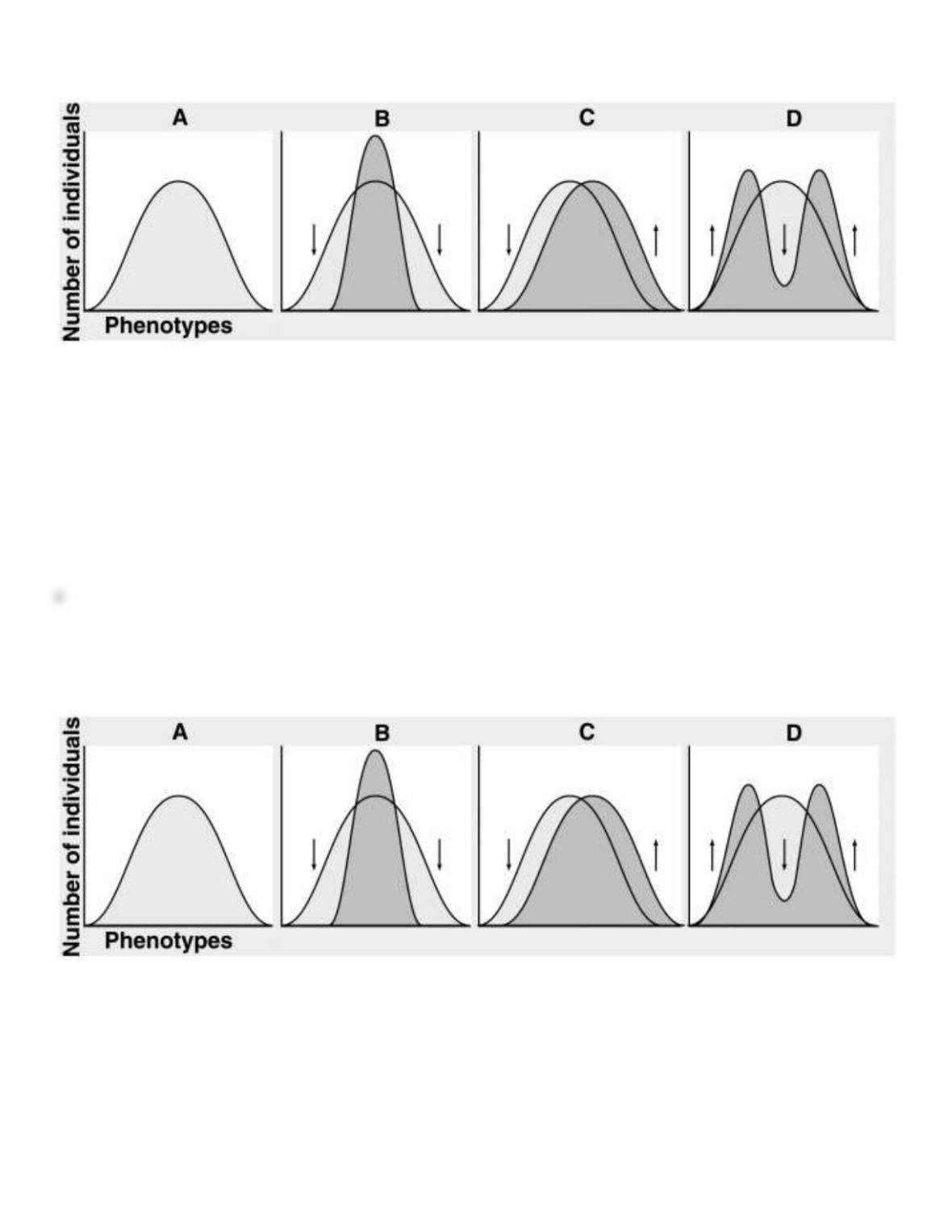
88. Figure 17-1
Refer to Figure 17-1. The graph labeled B is an example of
a.
adaptive radiation.
b.
disruptive natural selection.
c.
stabilizing natural selection.
d.
directional natural selection.
e.
extinction.
89. Figure 17-1
Refer to Figure 17-1. The graph labeled C is an example of
a.
adaptive radiation.
b.
disruptive natural selection.
c.
stabilizing natural selection.
d.
directional natural selection.
e.
extinction.
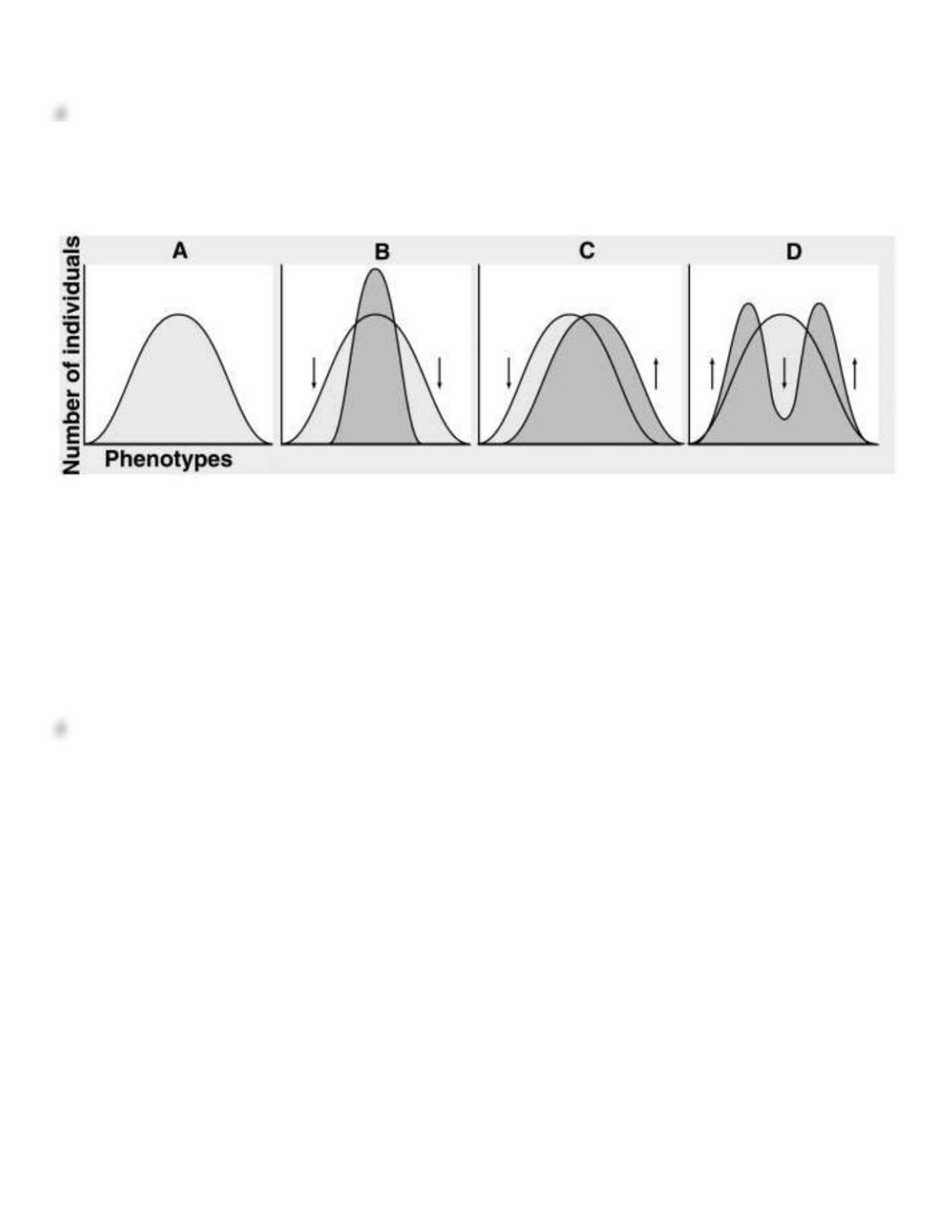
90. Figure 17-1
Refer to Figure 17-1. In which graph is the average phenotype being selected against?
a.
A
b.
B
c.
C
d.
D
e.
none of these
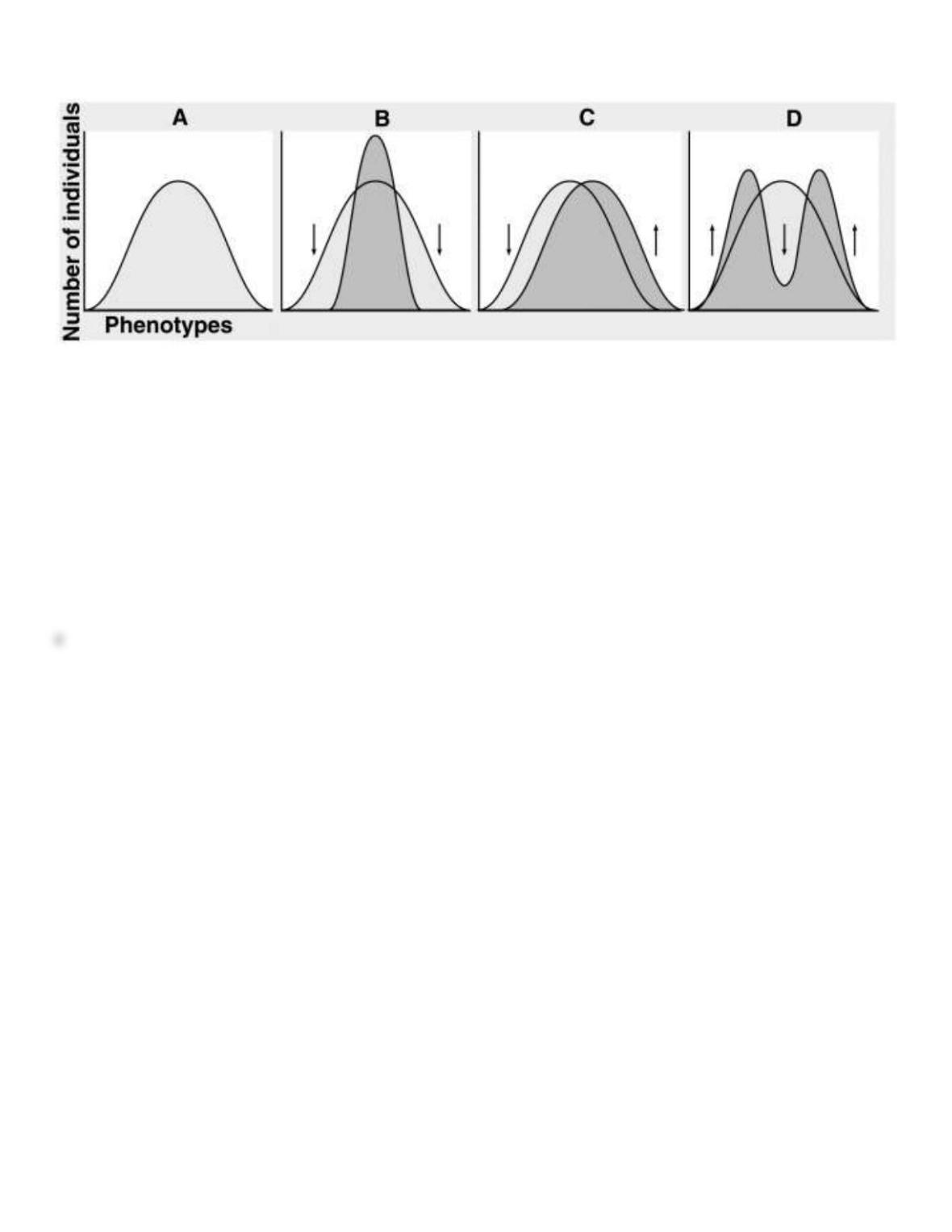
91. Figure 17-1
Refer to Figure 17-1. Suppose the phenotype in question is plant height, with the graph displaying a gradation
from short to tall. In this case, which graph best illustrates a situation in which large size is favored over small
size?
a.
A
b.
B
c.
C
d.
D
e.
none of these
92. Figure 17-1
Refer to Figure 17-1. Which graph shows one or more traits being selected for and one or more traits being
selected against?
a.
B only
b.
C only
c.
D only
d.
both B and D
e.
both C and D
93. Describe how a biologist could determine if a population is in genetic equilibrium.
94. Compare allopatric speciation and sympatric speciation. In your answer, use the terms: allele frequencies,
mutations, selection pressures, geographical barriers, and reproductive isolation.
95. Describe adaptive radiation, using an example.