Campbell Biology, 10e (Reece)
Chapter 17 Gene Expression: From Gene to Protein
1) Garrod hypothesized that “inborn errors of metabolism” such as alkaptonuria occur because
_____.
A) metabolic enzymes require vitamin cofactors, and affected individuals have significant
nutritional deficiencies
B) enzymes are made of DNA, and affected individuals lack DNA polymerase
C) certain metabolic reactions are carried out by ribozymes, and affected individuals lack key
splicing factors
D) genes dictate the production of specific enzymes, and affected individuals have genetic
defects that cause them to lack certain enzymes
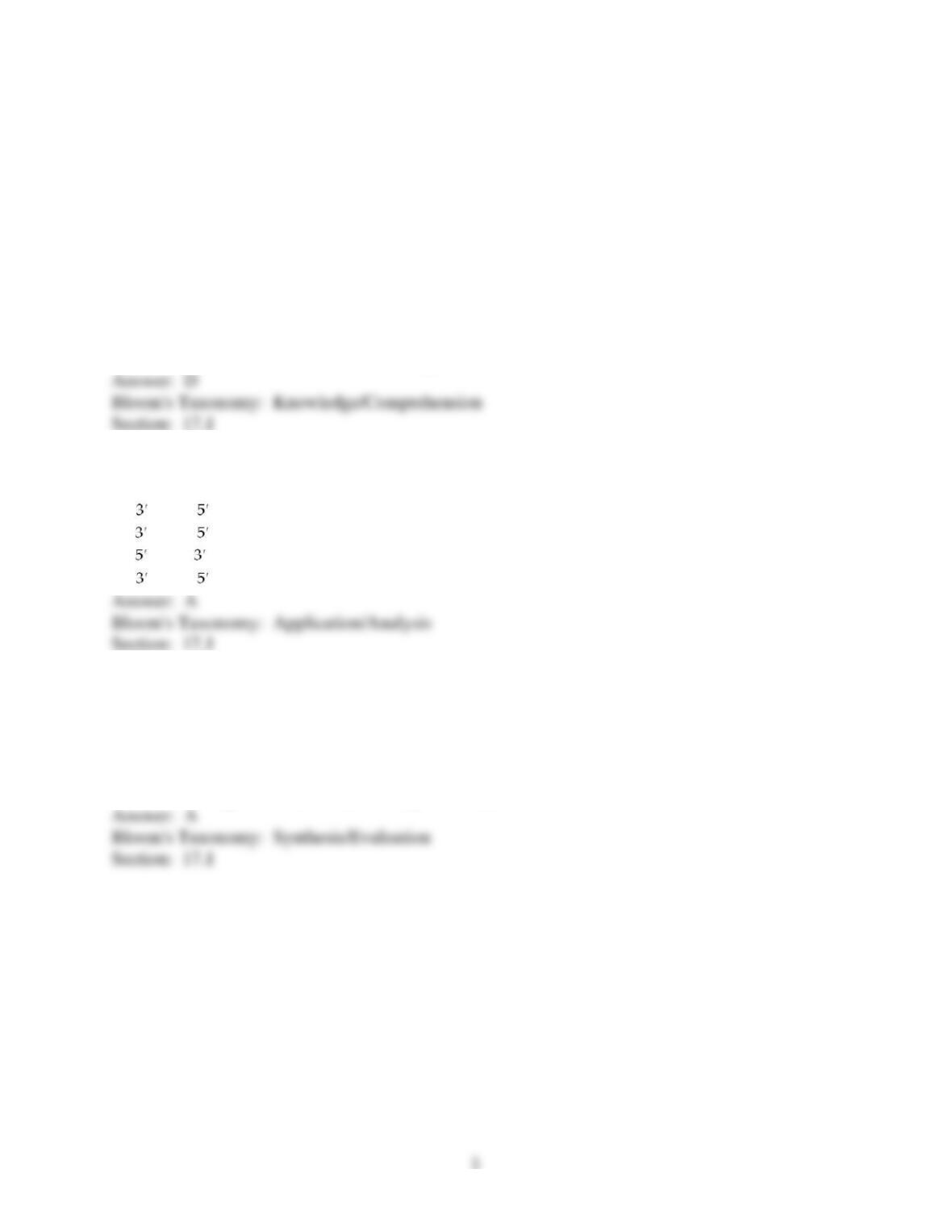
2) A particular triplet of bases in the template strand of DNA is 5′ AGT 3′. The corresponding
codon for the mRNA transcribed is _____.
A) UCA
B) UGA
C) TCA
D) ACU
3) The genetic code is essentially the same for all organisms. From this, one can logically assume
which of the following?
A) A gene from an organism can theoretically be expressed by any other organism.
B) DNA was the first genetic material.
C) The same codons in different organisms translate into different amino acids.
D) Different organisms have different types of amino acids.
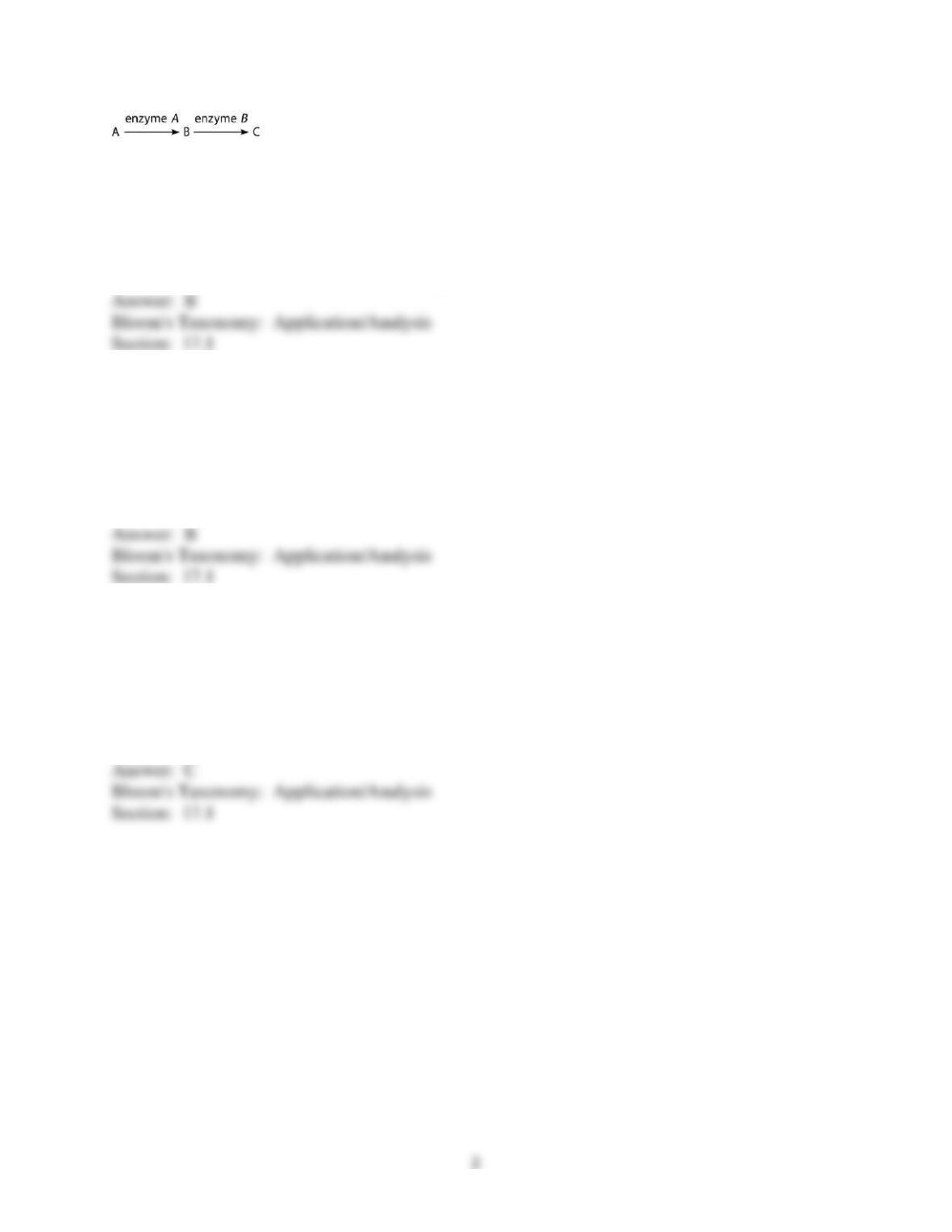
4) The figure above shows a simple metabolic pathway. According to Beadle and Tatum’s
hypothesis, how many genes are necessary for this pathway?
A) 1
B) 2
C) 3
D) It cannot be determined from the pathway.
5) Refer to the metabolic pathway illustrated above. If A, B, and C are all required for growth, a
strain that is mutant for the gene-encoding enzyme A would be able to grow on medium
supplemented with _____.
A) nutrient A only
B) nutrient B only
C) nutrient C only
D) nutrients A and C
6) Refer to the metabolic pathway illustrated above. If A, B, and C are all required for growth, a
strain mutant for the gene-encoding enzyme B would be able to grow on medium supplemented
with _____.
A) nutrient A only
B) nutrient B only
C) nutrient C only
D) nutrients A and C
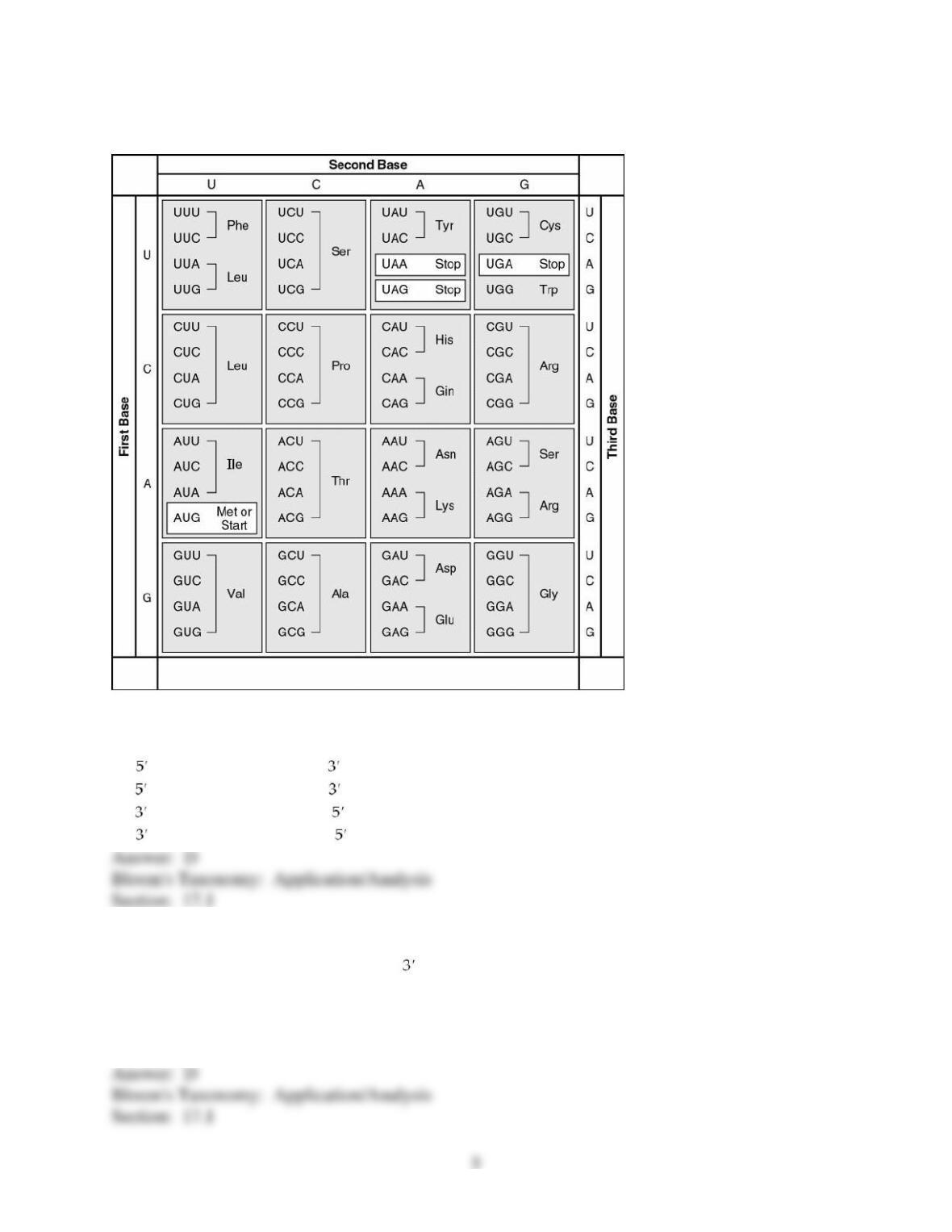
The following questions refer to this table of codons.
7) A possible sequence of nucleotides in the template strand of DNA that would code for the
polypeptide sequence phe-leu-ile-val would be _____.
A) TTG-CTA-CAG-TAG
B) AUG-CTG-CAG-TAT
C) AAA-AAT-ATA-ACA
D) AAA–GAA-TAA-CAA
8) What amino acid sequence will be generated, based on the following mRNA codon sequence?
5′ AUG-UCU-UCG-UUA-UCC-UUG
A) met-arg-glu-arg-glu-arg
B) met-glu-arg-arg-glu-leu
C) met-ser-leu-ser-leu-ser
D) met-ser-ser-leu-ser-leu
9) Refer to the figure above. What would the anticodon be for a tRNA that transports
phenylalanine to a ribosome?
A) UUU
B) AAA
C) TTT
D) CCC
10) Which of the following contradicts the one-gene, one-enzyme hypothesis?
A) A mutation in a single gene can result in a defective protein.
B) Alkaptonuria results when individuals lack a single enzyme involved in the catalysis of
homogentisic acid.
C) Sickle-cell anemia results in defective hemoglobin.
D) A single antibody gene can code for different related proteins, depending on the splicing that
takes place post-transcriptionally.
11) Which of the following is directly related to a single amino acid?
A) the base sequence of the tRNA
B) the amino acetyl tRNA synthase
C) the three-base sequence of mRNA
D) the complementarity of DNA and RNA
12) In the process of transcription, _____.
A) DNA is replicated
B) RNA is synthesized
C) proteins are synthesized
D) mRNA attaches to ribosomes
13) Codons are part of the molecular structure of _____.
A) a protein
B) mRNA
C) tRNA
D) rRNA
14) What does it mean when we say the genetic code is redundant?
A) A single codon can specify the addition of more than one amino acid.
B) The genetic code is different for different domains of organisms.
C) The genetic code is universal (the same for all organisms).
D) More than one codon can specify the addition of the same amino acid.
15) Once researchers identified DNA as the unit of inheritance, they asked how information was
transferred from the DNA in the nucleus to the site of protein synthesis in the cytoplasm. What is
the mechanism of information transfer in eukarotes?
A) DNA from a single gene is replicated and transferred to the cytoplasm, where it serves as a
template for protein synthesis.
B) Messenger RNA is transcribed from a single gene and transfers information from the DNA in
the nucleus to the cytoplasm, where protein synthesis takes place.
C) Proteins transfer information from the nucleus to the ribosome, where protein synthesis takes
place.
D) Transfer RNA takes information from DNA directly to a ribosome, where protein synthesis
takes place.
16) According to the central dogma, what molecule should go in the blank?
DNA → _____ → Proteins
A) mtDNA
B) rRNA
C) mRNA
D) tRNA
17) Codons are three-base sequences that specify the addition of a single amino acid. How do
eukaryotic codons and prokaryotic codons compare?
A) Prokaryotic codons usually contain different bases than those of eukaryotes.
B) Prokaryotic codons usually specify different amino acids than those of eukaryotes.
C) The translation of codons is mediated by tRNAs in eukaryotes, but translation requires no
intermediate molecules such as tRNAs in prokaryotes.
D) Codons are a nearly universal language among all organisms.
18) Which of the following occurs in prokaryotes but not in eukaryotes?
A) post-transcriptional splicing
B) concurrent transcription and translation
C) translation in the absence of a ribosome
D) gene regulation
19) Which of the following statements best describes the termination of transcription in
prokaryotes?
A) RNA polymerase transcribes through the polyadenylation signal, causing proteins to associate
with the transcript and cut it free from the polymerase.
B) RNA polymerase transcribes through the terminator sequence, causing the polymerase to
separate from the DNA and release the transcript.
C) Once transcription has initiated, RNA polymerase transcribes until it reaches the end of the
chromosome.
D) RNA polymerase transcribes through a stop codon, causing the polymerase to stop advancing
through the gene and release the mRNA.
20) In eukaryotes there are several different types of RNA polymerase. Which type is involved in
transcription of mRNA for a globin protein?
A) RNA polymerase I
B) RNA polymerase II
C) RNA polymerase III
D) primase
7
21) Transcription in eukaryotes requires which of the following in addition to RNA polymerase?
A) start and stop codons
B) ribosomes and tRNA
C) several transcription factors
D) aminoacyl-tRNA synthetase
22) Which of the following best describes the significance of the TATA box in eukaryotic
promoters?
A) It is the recognition site for a specific transcription factor.
B) It sets the reading frame of the mRNA.
C) It is the recognition site for ribosomal binding.
D) Its significance has not yet been determined.
23) Which of the following does not occur in prokaryotic gene expression, but does occur in
eukaryotic gene expression?
A) mRNA, tRNA, and rRNA are transcribed.
B) RNA polymerase binds to the promoter.
C) A cap is added to the end of the mRNA.
D) RNA polymerase requires a primer to elongate the molecule.
24) A ribozyme is _____.
A) a catalyst that uses RNA as a substrate
B) an RNA with catalytic activity
C) an enzyme that catalyzes the association between the large and small ribosomal subunits
D) an enzyme that synthesizes RNA as part of the transcription process
25) Alternative RNA splicing _____.
A) is a mechanism for increasing the rate of translation
B) can allow the production of proteins of different sizes and functions from a single mRNA
C) can allow the production of similar proteins from different RNAs
D) increases the rate of transcription
26) In the structural organization of many eukaryotic genes, individual exons may be related to
which of the following?
A) the sequence of the intron that immediately precedes each exon
B) the number of polypeptides making up the functional protein
C) the various domains of the polypeptide product
D) the number of start sites for transcription
27) In an experimental situation, a student researcher inserts an mRNA molecule into a
eukaryotic cell after she has removed its cap and poly-A tail. Which of the following would
you expect her to find?
A) The mRNA is quickly converted into a ribosomal subunit.
B) The cell adds a new poly-A tail to the mRNA.
C) The mRNA attaches to a ribosome and is translated, but more slowly.
D) The molecule is digested by enzymes because it is not protected at the end.
Use this model of a eukaryotic transcript to answer the following question(s).
E = exon and I = intron
UTR E1 I1 E2 I2 E3 I3 E4 UTR
28) Which components of the previous molecule will also be found in mRNA in the cytosol?
A) UTR I1 I2 I3 UTR
B) E1 E2 E3 E4
C) UTR E1 E2 E3 E4 UTR
D) E1 I1 E2 I2 E3 I3 E4
29) Which one of the following statements about RNA processing is true?
A) Exons are cut out before mRNA leaves the nucleus.
B) Ribozymes may function in RNA splicing.
C) RNA splicing can be catalyzed by tRNA.
D) A primary transcript is often much shorter than the final RNA molecule that leaves the
nucleus.
30) A primary transcript in the nucleus of a eukaryotic cell is _____ the functional mRNA, while
a primary transcript in a prokaryotic cell is _____ the functional mRNA.
A) the same size as; smaller than
B) larger than; the same size as
C) larger than; smaller than
D) the same size as; larger than
31) A particular triplet of bases in the coding sequence of DNA is AAA. The anticodon on the
tRNA that binds the mRNA codon is _____.
A) TTT
B) UUA
C) UUU
D) AAA
32) Accuracy in the translation of mRNA into the primary structure of a polypeptide depends on
specificity in the _____.
A) binding of ribosomes to mRNA
B) binding of the anticodon to small subunit of the ribosome
C) attachment of amino acids to rRNAs
D) binding of the anticodon to the codon and the attachment of amino acids to tRNAs
33) A mutant bacterial cell has a defective aminoacyl-tRNA synthetase that attaches a lysine to
tRNAs with the anticodon AAA instead of the normal phenylalanine. The consequence of this
for the cell will be that _____.
A) none of the proteins in the cell will contain phenylalanine
B) proteins in the cell will include lysine instead of phenylalanine at amino acid positions
specified by the codon UUU
C) the cell will compensate for the defect by attaching phenylalanine to tRNAs with lysine–
specifying anticodons
D) the ribosome will skip a codon every time a UUU is encountered
34) There are sixty-one mRNA codons that specify an amino acid, but only forty-five tRNAs.
This is best explained by the fact that _____.
A) some tRNAs have anticodons that recognize four or more different codons
B) the rules for base pairing between the third base of a codon and tRNA are flexible
C) many codons are never used, so the tRNAs that recognize them are dispensable
D) the DNA codes for all sixty-one tRNAs, but some are then destroyed
35) Which of the following is the first event to take place in translation in eukaryotes?
A) base pairing of activated methionine-tRNA to AUG of the messenger RNA
B) binding of the larger ribosomal subunit to smaller ribosomal subunits
C) covalent bonding between the first two amino acids
D) the small subunit of the ribosome recognizes and attaches to the cap of mRNA
36) A signal peptide _____.
A) directs an mRNA molecule into the cisternal space of the ER
B) terminates translation of messenger RNA
C) helps target a protein to the ER
D) signals the initiation of transcription
37) The release factor (RF) _____.
A) binds to the stop codon in the A site in place of a tRNA
B) releases the amino acid from its tRNA to allow the amino acid to form a peptide bond
C) supplies a source of energy for termination of translation
D) releases the ribosome from the ER to allow polypeptides into the cytosol
Use the following information to answer the question(s) below.
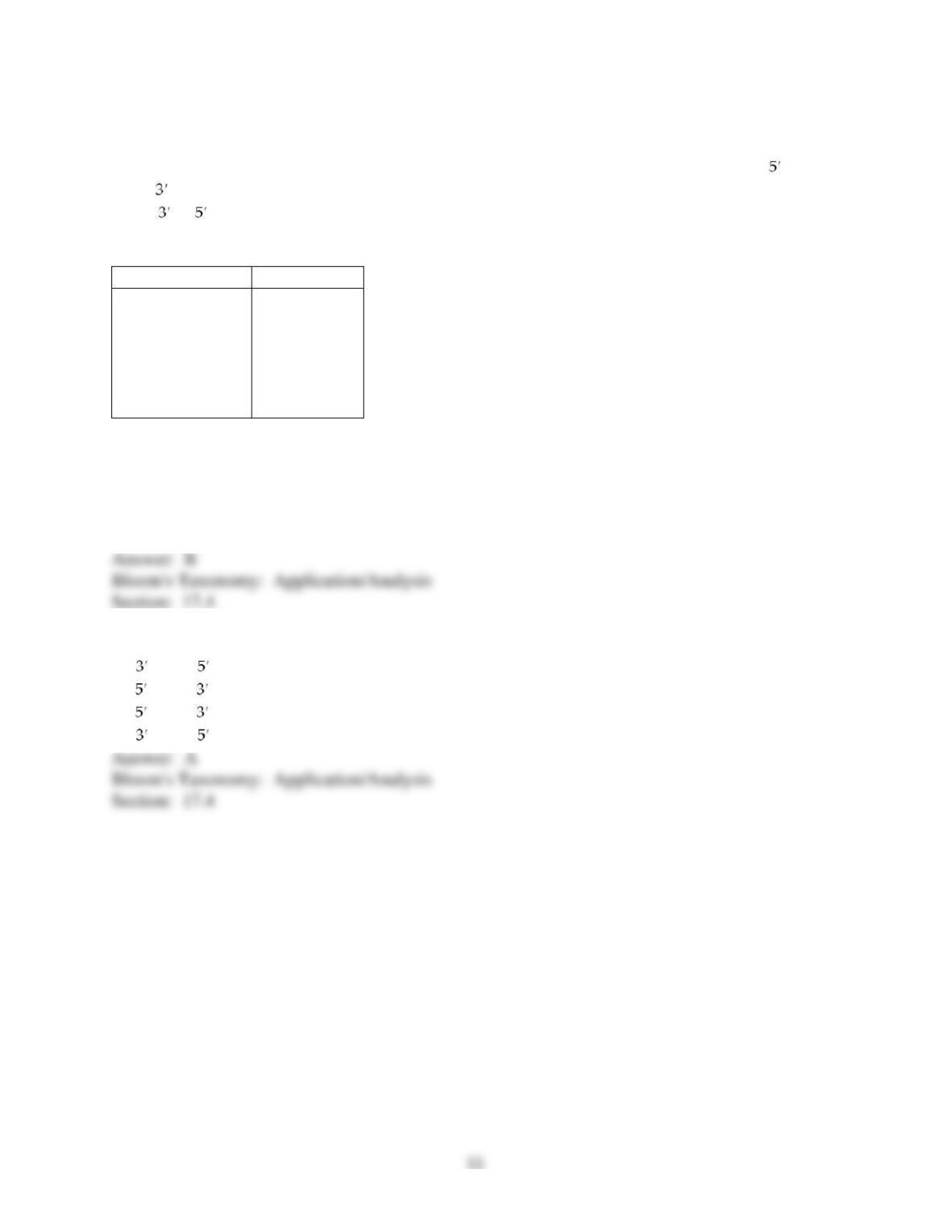
A part of an mRNA molecule with the following sequence is being read by a ribosome: CCG–
ACG (mRNA). The following charged transfer RNA molecules (with their anticodons shown
in the to direction) are available. Two of them can correctly match the mRNA so that a
dipeptide can form.
tRNA Anticodon
Amino Acid
GGC
CGU
UGC
CCG
ACG
CGG
Proline
Alanine
Threonine
Glycine
Cysteine
Alanine
38) The dipeptide that will form will be _____.
A) cysteine-alanine
B) proline-threonine
C) glycine-cysteine
D) alanine-alanine
39) The anticodon loop of the first tRNA that will complement this mRNA is
A) GGC
B) GGC
C) UGC
D) UGC
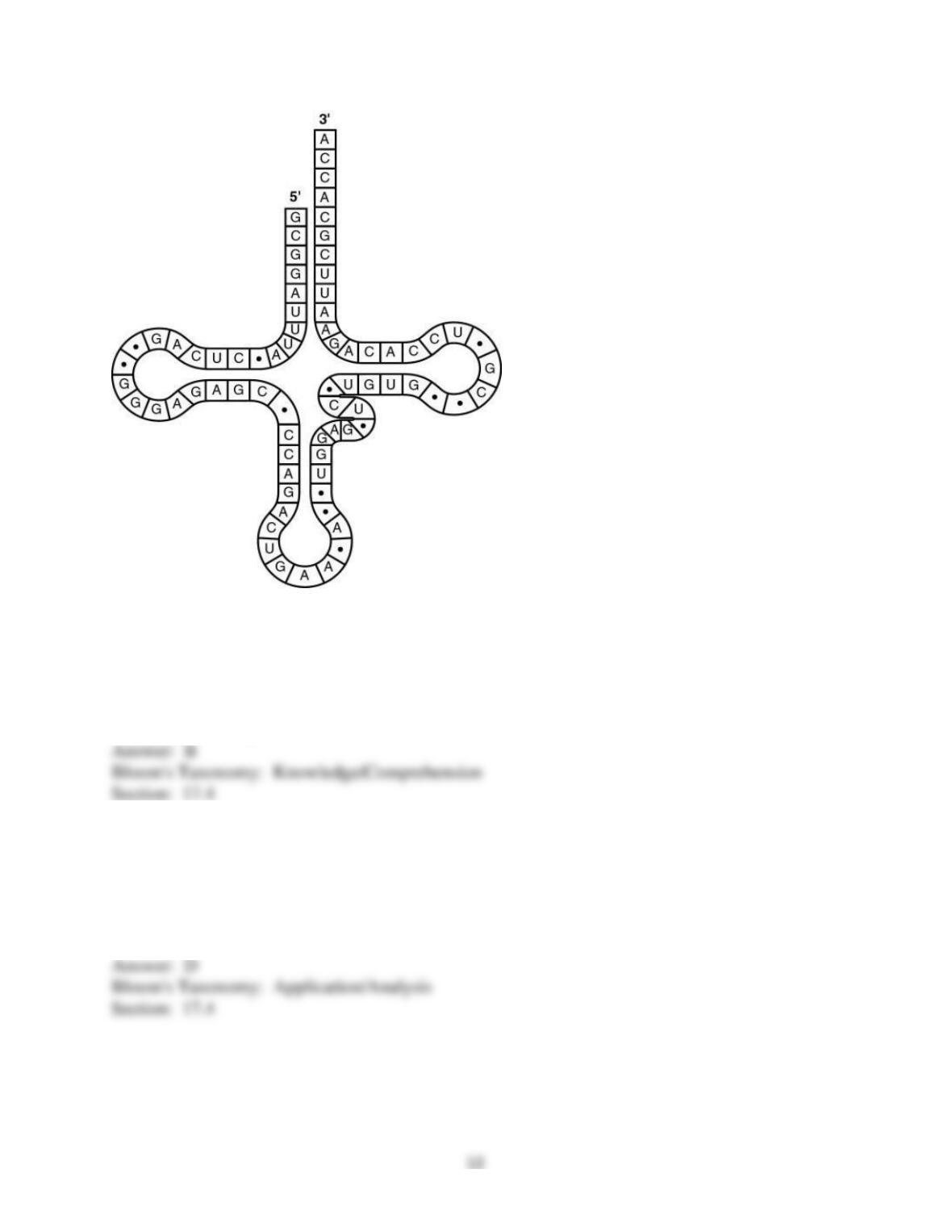
40) What type of bonding is responsible for maintaining the shape of the tRNA molecule shown
in the figure above?
A) ionic bonding between phosphates
B) hydrogen bonding between base pairs
C) van der Waals interactions between hydrogen atoms
D) peptide bonding between amino acids
41) The figure above represents tRNA that recognizes and binds a particular amino acid (in this
instance, phenylalanine). Which codon on the mRNA strand codes for this amino acid?
A) UGG
B) GUG
C) GUA
D) UUC
42) The tRNA shown in the figure above has its end projecting beyond its end. What will
occur at this end?
A) The amino acid binds covalently.
B) The excess nucleotides (ACCA) will be cleaved off at the ribosome.
C) The small and large subunits of the ribosome will attach to it.
D) The cap of the mRNA will become covalently bound.
43) What must occur before a newly made polypeptide is secreted from a cell?
A) It must be translated by a ribosome that remains free within the cytosol.
B) Its signal sequence must target it to the ER, after which it goes to the Golgi.
C) Its signal sequence must be cleaved off before the polypeptide can enter the ER.
D) Its signal sequence must target it to the plasma membrane, where it causes exocytosis.
44) Translation requires _____.
A) mRNA, tRNA, DNA, and rRNA
B) mRNA, DNA, and rRNA
C) mRNA, tRNA, and rRNA
D) mRNA, tRNA, and DNA
45) During elongation, which site in the ribosome represents the location where a codon is being
read?
A) E site
B) P site
C) A site
D) the small ribosomal subunit
46) Once a peptide has been formed between the amino acid attached to the tRNA in the P site
and the amino acid associated with the tRNA in the A site, what occurs next?
A) translocation
B) reading of the next codon of mRNA
C) initiation
D) The codon-anticodon hydrogen bonds holding the tRNA in the A site are broken.
47) Which one of the following, if missing, would usually prevent translation from starting?
A) exon
B) cap
C) AUG codon
D) poly-A tail
48) Put the following events of elongation in prokaryotic translation in chronological order.
1. Binding of mRNA with small ribosomal subunit
2. Recognition of initiation codon
3. Complementary base pairing between initiator codon and anticodon of initiator tRNA
4. Base pairing of the mRNA codon following the initiator codon with its complementary tRNA
5. Attachment of the large subunit
A) 1, 2, 3, 4, 5
B) 2, 1, 4, 3, 5
C) 5, 4, 3, 2, 1
D) 1, 2, 3, 5, 4
49) How does termination of translation take place?
A) The end of the mRNA molecule is reached.
B) A stop codon is reached.
C) The cap is reached.
D) The poly-A tail is reached.
50) Post-translational modifications of proteins may include the _____.
A) removal of introns
B) addition of a 5’ cap
C) addition of a poly-A tail
D) addition of carbohydrates to form a glycoprotein
51) Which of the following statements is true about protein synthesis in prokaryotes?
A) Extensive RNA processing is required before prokaryotic transcripts can be translated.
B) Translation can begin while transcription is still in progress.
C) Prokaryotic cells have complicated mechanisms for targeting proteins to the appropriate
cellular organelles.
D) Unlike eukaryotes, prokaryotes require no initiation or elongation factors.
52) Which of the following types of mutation, resulting in an error in the mRNA just after the
AUG start of translation, is likely to have the most serious effect on the polypeptide product?
A) a deletion of a codon
B) a deletion of two nucleotides
C) a substitution of the third nucleotide in an ACC codon
D) a substitution of the first nucleotide of a GGG codon
53) A nonsense mutation in a gene _____.
A) changes an amino acid in the encoded protein
B) has no effect on the amino acid sequence of the encoded protein
C) introduces a premature stop codon into the mRNA
D) alters the reading frame of the mRNA
54) Which of the following DNA mutations is most likely to damage the protein it specifies?
A) a base-pair deletion
B) an addition of three nucleotides
C) a substitution in the last base of a codon
D) a codon deletion
55) The most commonly occurring mutation in people with cystic fibrosis is a deletion of a
single codon. This results in _____.
A) a base-pair substitution
B) a frameshift mutation
C) a polypeptide missing an amino acid
D) a nonsense mutation
56) Of the following, which is the most current description of a gene?
A) a unit of heredity that causes formation of a phenotypic characteristic
B) a DNA subunit that codes for a single complete protein
C) a DNA sequence that is expressed to form a functional product: either RNA or polypeptide
D) a discrete unit of hereditary information that consists of a sequence of amino acids
57) How might a single base substitution in the sequence of a gene affect the amino acid
sequence of a protein encoded by the gene, and why?
A) Only a single amino acid could change, because the reading frame is unaffected.
B) The amino acid sequence would be substantially altered, because the reading frame would
change with a single base substitution.
C) All amino acids following the substitution would be affected, because the reading frame
would be shifted.
D) It is not possible for a single base substitution to affect protein structure, because each codon
is three bases long.
58) An original section of DNA has the base sequence AGCGTTACCGT. A mutation in this
DNA strand results in the base sequence AGGCGTTACCGT. This change represents _____.
A) a missense mutation
B) a point mutation
C) a silent mutation
D) frameshift mutation
59) A single base substitution mutation is least likely to be deleterious when the base change
results in _____.
A) a stop codon
B) a codon that specifies the same amino acid as the original codon
C) an amino acid substitution that alters the tertiary structure of the protein
D) an amino acid substitution at the active site of an enzyme
60) Rank the following one-base point mutations (from most likely to least likely) with respect to
their likelihood of affecting the structure of the corresponding polypeptide.
1. insertion mutation deep within an intron
2. substitution mutation at the third position of an exonic codon
3. substitution mutation at the second position of an exonic codon
4. deletion mutation within the first exon of the gene
A) 1, 2, 3, 4
B) 4, 3, 2, 1
C) 2, 1, 4, 3
D) 3, 1, 4, 2