
1
Campbell Essential Biology, 6e (Simon/Dickey/Hogan/Reece)
Chapter 16 The Evolution of Plants and Fungi
Chapter 16 Learning Outcomes
16 Biology and Society: The Diamond of the Kitchen
16.1. Describe the commercial importance of truffles and their symbiotic relationship with
trees.
16.1 Colonizing Land
16.2. Compare the structural, physiological, and reproductive adaptations that allowed plants to
successfully survive a transition from water to land.
16.3. Relate the origin of plants to green algae.
16.2 Plant Diversity
16.4. Compare the four major periods of plant evolution and the major adaptations associated
with each stage.
16.5. Describe the life cycle and two key terrestrial adaptations of mosses.
16.6. Compare ferns and mosses, noting the relationship between ancient ferns and modern
fossil fuels.
16.7. Describe the environmental conditions that favored the evolution of gymnosperms as
well as three adaptations to life on land that first appeared in gymnosperms.
16.8. Describe the structures and functions of a flower including the adaptive significance of
pollinator attraction.
16.9. Describe the significance of angiosperms to humans and natural ecosystems.
16.3 Fungi
16.10. Describe the feeding mechanisms, structure, reproduction, ecological roles, and
commercial uses of fungi.
16 The Process of Science: Did a Fungus Lead to the Salem Witch Hunt?
16.11. Explain the importance of the interaction of plants and fungi.
16 Evolution Connection: A Mutually Beneficial Symbiosis
16.12. Distinguish parasitic and mutually beneficial symbiotic relationships between fungi and
plants (mycorrhizae) and algae and bacteria (lichens).
Global Learning Outcomes
1. Demonstrate an understanding of the principles of scientific inquiry.
2. Demonstrate the ability to think critically and employ critical-thinking skills.
3. Read and interpret models, graphs, and data.
4. Demonstrate the quantitative skills needed to succeed in biology.
5. Demonstrate an understanding of the impact of science on society.
6. Evaluate the credibility of scientific information from various sources.
7. Demonstrate the ability to make connections between concepts across biology.
8. Communicate effectively in writing.
9. Apply the scientific method to interpret information and draw conclusions.

16.1 Multiple Choice Questions
1) Which aspect of truffle mushrooms drives their commercial importance?
A) size
B) smell
C) taste
D) texture
2) Why is the symbiotic relationship of truffle mushrooms and tree roots considered to be crucial
to the colonization of land?
A) This relationship is found in some of the oldest plant fossils.
B) Truffles have the terrestrial adaptation of seeds.
C) Tree roots can be found only in terrestrial environments.
D) Truffles provide trees with sugars.
3) Mutualistic associations of plant roots and fungi are called ________.
A) mycorrhizae
B) mycelia
C) shoots
D) hyphae
4) The ________ help(s) plants retain water.
A) hypha
B) cuticle
C) mycorrhiza
D) lignin

5) ________, a chemical that hardens cell walls and supports terrestrial plants, is found in all
plants EXCEPT ________.
A) Lignin… bryophytes
B) Cellulose… bryophytes
C) Cellulose… ferns
D) Lignin… ferns and bryophytes
6) Would you expect desert plants to have a thin or thick cuticle?
A) thin because desert plants do not have stomata
B) thin because desert plants have a short root system
C) thick because desert plants have an extensive shoot system
D) thick because desert plants need to retain water in this dry environment
7) Some companies that produce paper will also produce a by-product that is sold as a binder
(something that binds, or holds, things together). From which part of trees does this by-product
come?
A) leaves
B) mycorrhizae
C) lignin
D) stomata
8) Which of the following is the lineage of green algae believed to most resemble early plant
ancestors?
A) charophytes
B) ulva
C) volvox
D) dinoflagellates

9) Plants first moved onto land at least ________ years ago.
A) 65 million
B) 475 million
C) 1.2 billion
D) 3.5 billion
10) Which of the following correctly illustrates the sequence of the origin of modern groups of
plants?
A) gymnosperms, ferns, bryophytes, angiosperms
B) bryophytes, ferns, gymnosperms, angiosperms
C) bryophytes, ferns, angiosperms, gymnosperms
D) ferns, gymnosperms, angiosperms, bryophytes
11) Which of the following lack vascular tissue?
A) cone-bearing plants
B) grasses
C) ferns
D) mosses
12) Why are bryophytes considered incompletely liberated from their ancestral aquatic habitat?
A) They lack lignin.
B) Their sperm are flagellated.
C) The gametophyte generation is dominant.
D) They lack a cuticle.

13) In ________ the gametophyte is more obvious than the sporophyte.
A) conifers
B) mosses
C) grasses
D) ferns
14) Gametophytes are ________; sporophytes are ________.
A) male… female
B) an adaptation to an aquatic existence… an adaptation to a terrestrial existence
C) haploid… diploid
D) the dominant stage of the conifer life cycle… the less obvious stage of the conifer life cycle
15) Gametophytes reproduce ________.
A) by producing sperm and eggs
B) by fission
C) by meiosis of special cells in the gametophyte
D) by budding
16) ________ are seedless vascular plants.
A) Ferns
B) Angiosperms
C) Bryophytes
D) Gymnosperms

17) Why are ferns considered incompletely adapted to the terrestrial environment, when
compared with other plants?
A) They lack vascular tissue.
B) Their sperm are flagellated.
C) The gametophyte generation is dominant.
D) They lack cuticle.
18) Much of the coal we use today came from ________ that lived during the Carboniferous.
A) gymnosperms
B) mosses
C) angiosperms
D) ferns
19) Of the following, which is the earliest step in the formation of fossil fuels?
A) subjecting organic matter to extreme pressure
B) flooding swamps with seawater
C) incomplete decomposition of organic matter
D) subjecting organic matter to extreme heat
20) If you wanted to propagate (grow) ferns, what do you need to collect from existing ferns?
A) diploid zygote cells
B) haploid spores
C) fossil fuels
D) seeds

21) What is an evolutionary reason why individual ferns may produce millions of spores?
A) Having many spores increases the chances that they will produce fossil fuels.
B) Having many spores increases the chances that they can produce seeds.
C) Spores can germinate only in the right environmental conditions, so producing many spores
increases the chances that at least one will end up in an area of those conditions.
D) Spores can disperse only short distances, so producing many spores increases the chances that
at least one will travel far enough to germinate.
22) What global climatic change gave gymnosperms an advantage over ferns?
A) the climate becoming hotter and wetter
B) increased fluctuations in global climate temperatures
C) the climate becoming cooler and drier
D) the climate becoming hotter and drier
23) Which of these adaptations to a terrestrial existence evolved most recently?
A) vascular tissue
B) seeds
C) lignin
D) cuticle
24) A pollen grain is a(n) ________.
A) female gametophyte
B) sporophyte
C) male gametophyte
D) integument

25) ________ were the first plants that did not require water for transferring sperm to eggs.
A) Bryophytes
B) Gymnosperms
C) Ferns
D) Angiosperms
26) Seeds develop from ________.
A) carpels
B) anthers
C) ovules
D) ovaries
27) Why are gymnosperms considered to be “naked seed” plants?
A) Their seeds have a thin layer of endosperm.
B) They do not produce seeds; they produce only spores.
C) Their seeds are not enclosed within ovaries.
D) Their seeds develop on the surface of sporophytes.
28) In angiosperms, the ________ is a nutrient-storing tissue that nourishes a developing
embryo.
A) fruit
B) seed
C) carpels
D) endosperm

29) In angiosperms, the male gametophyte develops within ________.
A) male cones
B) filaments
C) anthers
D) stigma
30) Which of the following is a component of the female structure of a flowering plant?
A) petal
B) filament
C) anther
D) stigma
31) Which structure of a flower traps pollen?
A) style
B) stigma
C) ovary
D) filament
32) Gymnosperms and angiosperms share multiple similarities. Which of the following is NOT a
shared feature of angiosperms and gymnosperms?
A) Both produce flowers.
B) Both have pollen grains that are male gametophytes.
C) Both have a dominant sporophyte generation.
D) Both have seeds.

33) In angiosperms, what structures house female gametophytes?
A) stigmas
B) petals
C) ovules
D) sepals
34) The edible portion of a(n) ________ is a ripened ovary.
A) cucumber
B) broccoli stalk
C) radish
D) onion
35) From the point of view of an angiosperm, what is the function of fruit?
A) It is where the male gametophyte develops.
B) It is a mechanism for the dispersal of seeds.
C) It provides nutrients to germinating seeds.
D) It attracts pollinators.
36) Which of the following statements about pollination and fertilization is CORRECT?
A) Pollination is identical to fertilization.
B) Pollination is not the same as fertilization, but pollination guarantees fertilization will occur.
C) Pollination and fertilization are unrelated.
D) Pollination is not the same as fertilization, and pollination does not guarantee fertilization will
occur.

37) Nearly all food plants are ________.
A) bryophytes
B) gymnosperms
C) ferns
D) angiosperms
38) Exploring in the tropics, you discover a nonvascular plant that produces pollen. What type of
plant have you discovered?
A) an angiosperm
B) a fern
C) a bryophyte
D) an entirely new type that you will get to name
39) Which of the following statements is NOT true?
A) Rainforests regenerate slowly and cannot sustain slash-and-burn clearing.
B) Humans depend on plants for food, wood, and medicines.
C) Only a fraction of plant species have been tested as potential medicine sources.
D) Local knowledge of rainforest plant communities has no impact on the production of new
medicines.
40) Nutritionally, all fungi are ________.
A) heterotrophs that acquire their nutrients by absorption
B) autotrophs that acquire their nutrients from solar energy
C) autotrophs that acquire their nutrients from chemicals
D) parasites that acquire their nutrients from other organisms

41) What are hyphae?
A) symbiotic associations between plant roots and fungi
B) threadlike filaments that make up fungal bodies
C) fungal digestive enzymes
D) fungal spores
42) Like plants, fungi have ________; however, in plants they are composed of ________,
whereas in fungi they are composed of ________.
A) cell walls… cellulose… chitin
B) cell walls… cellulose… peptidoglycan
C) cell membranes… phospholipids… chitin
D) cell walls… phospholipids… cellulose
43) The function of a mushroom is to ________.
A) produce seeds
B) store nutrients
C) produce spores
D) photosynthesize
44) What important role do fungi play in many ecosystems?
A) They decompose organic material.
B) They pollinate plants.
C) They disperse the fruits of angiosperms.
D) They perform photosynthesis.

45) Biocontrol, short for biological control, is a means to control pest populations (e.g., insects,
plants) by intentionally introducing natural enemies of those pests. Biocontrol methods have
benefits of typically being less expensive and less environmentally damaging than chemical
pesticides. Which of the following should NOT be considered an example of biocontrol?
A) the spores of the Chinese caterpillar fungus that are sprayed on crop pests to parasitize and
kill them
B) the application of herbicides that kill weeds harboring pest populations
C) the introduction of mites that prey upon citrus rust mites that infest and destroy citrus crops
D) the introduction of insect herbivores that eat weeds but do not feed on native plant species
46) Suppose that, while on a forest hike, you notice a blue fungus and a pink plant growing along
the hiking trail. As you continue walking, you observe that if a blue fungus and a pink plant are
growing side by side, they are both much larger than if the fungus and the plant are farther apart.
What can you hypothesize about the relationship between the fungus and the plant?
A) The fungus and the plant have a symbiotic relationship that allows them to have more
significant growth when they are near each other than when farther apart.
B) The fungus and the plant have a parasitic relationship that allows them to have more
significant growth when they are near each other than when farther apart.
C) The roots of the plant are choking off nutrient flow to the fungal hyphae.
D) The plant is helping the fungus decompose leaf litter on the forest floor.
47) Corn smut is a fungus that grows in the ears of corn and changes corn kernels into black,
powdery balls of fungus tissue. What would you hypothesize is the significance of the
relationship between corn smut and corn?
A) Corn smut has a parasitic relationship with corn so that it can use the corn as a way to spread
spores.
B) Corn smut has a symbiotic relationship with corn so that it can use the corn as a way to spread
spores.
C) Corn smut helps to decompose corn more quickly and therefore replenishes nutrients in the
soil at a faster rate.
D) Corn smut slows decomposition of corn and therefore reduces the rate at which nutrients are
returned to the soil.
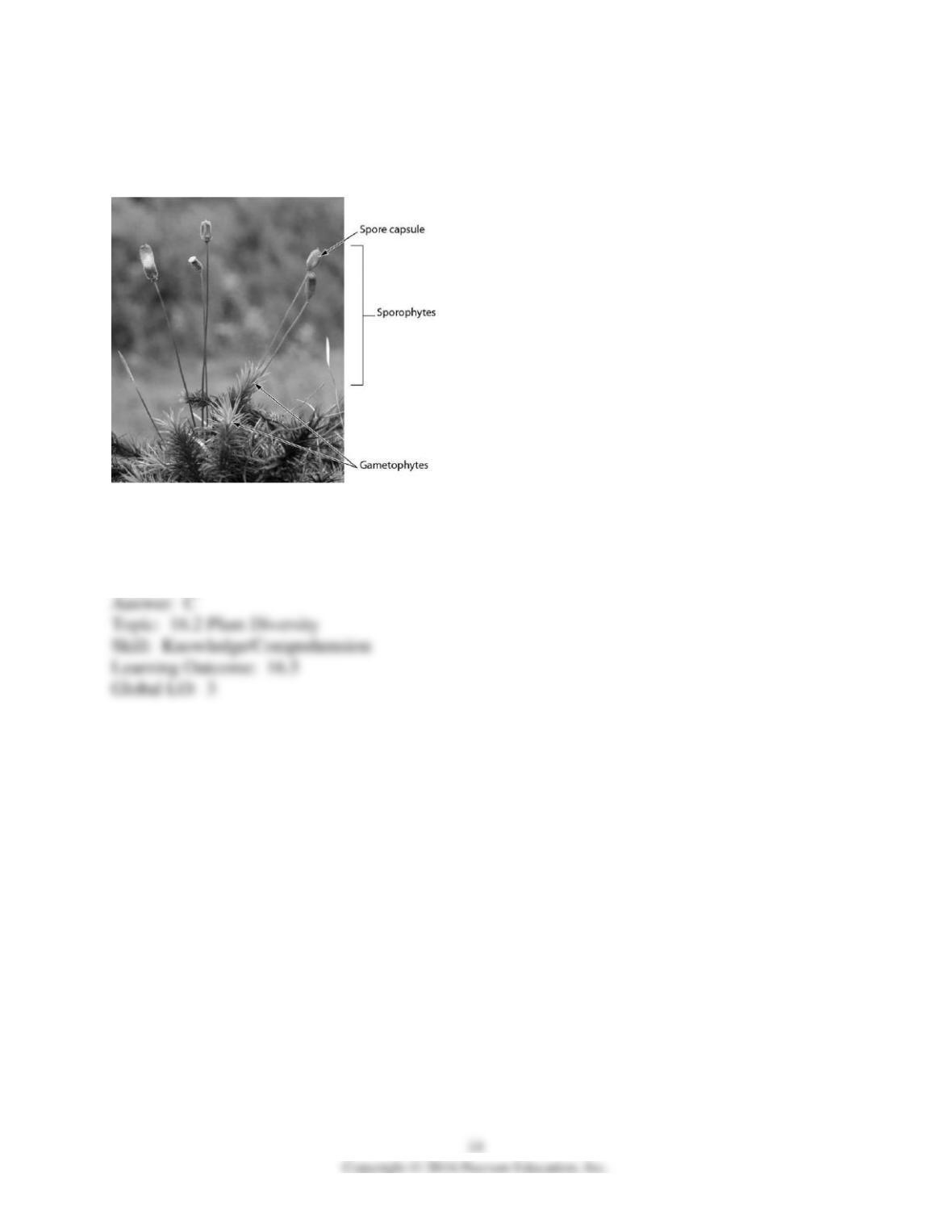
16.2 Art Questions
1) What is this organism?
A) fern
B) fungus
C) bryophyte
D) gymnosperm
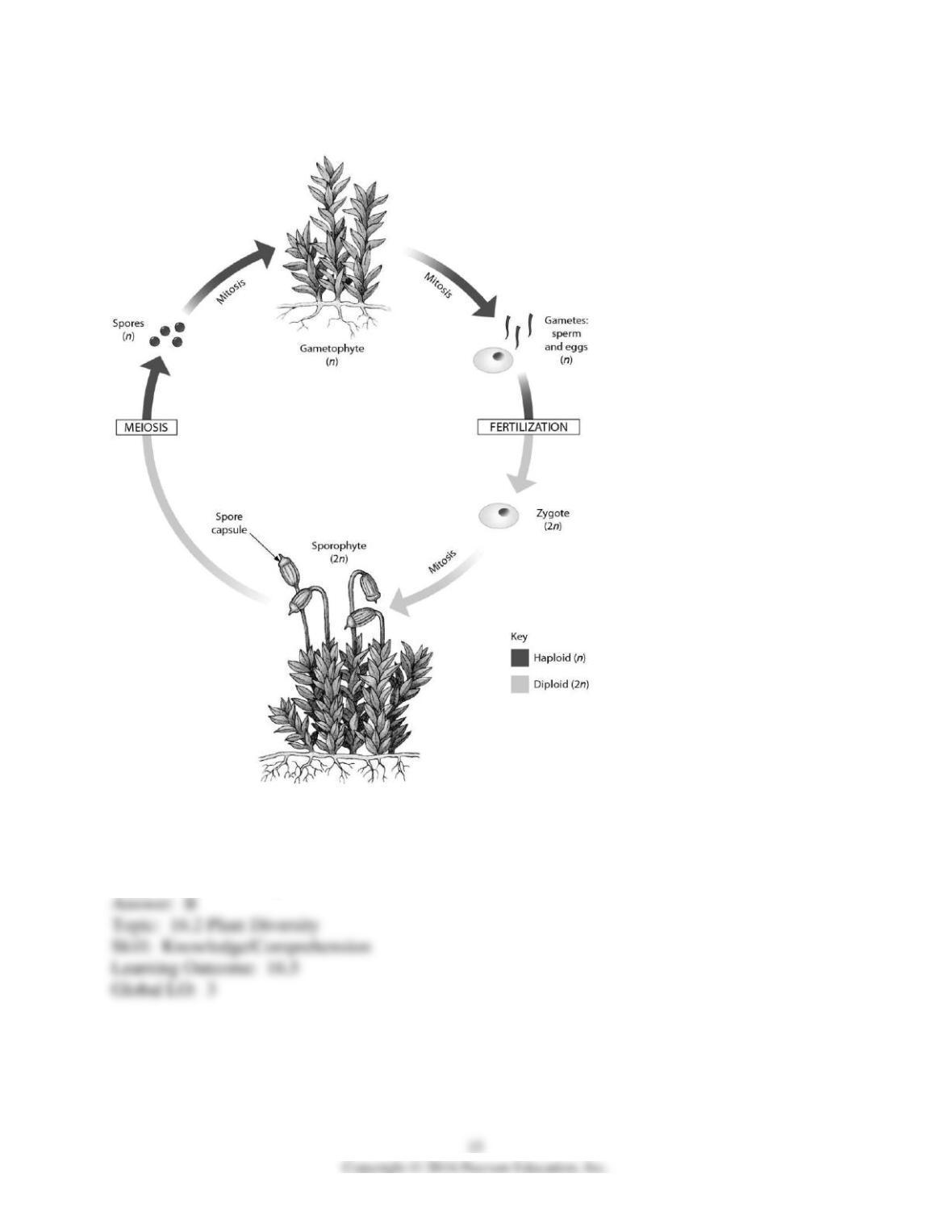
2) This diagram shows what process?
A) origin of plants from green algae
B) alternation of generations
C) angiosperm life cycle
D) gymnosperm life cycle
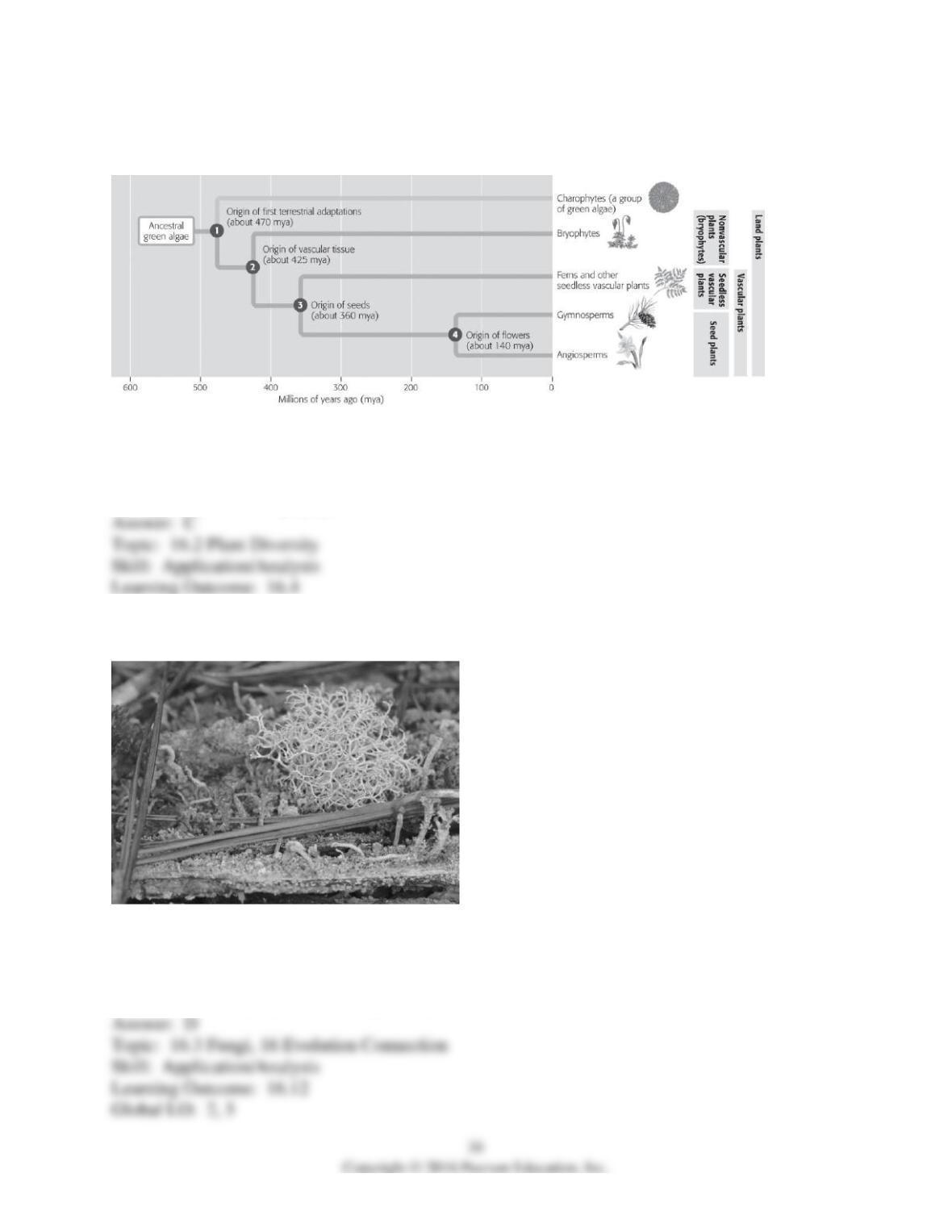
3) If seed production had never evolved, which organisms would be missing in today’s
landscape?
A) bryophytes and ferns
B) ferns and gymnosperms
C) gymnosperms and angiosperms
D) angiosperms and bryophytes
4) The photo below shows ________.
A) a cluster of fern spore capsules
B) a fairy ring
C) an algal cell with extensive thread-like cilia
D) a lichen, a mutually beneficial symbiosis

16.3 Scenario Questions
Read the following scenario to answer the following questions.
People utilize plants to meet many everyday needs, including food, fiber, and building materials.
However, not many of the over 300,000 known species of plants are used by people. One species
with a lot of future promise is the jatropha tree. This species is native to Central America and is
now found throughout the tropics. Many people believe the jatropha could help alleviate poverty
in many areas of the world, as the seeds produce an oil that can be used for cooking, lighting, or
generating electricity. This oil can also be mixed with diesel fuel or petrol to produce a biofuel.
Mature trees produce between 5 and 15 kg of seeds per year and can live more than 30 years.
However, critics argue that planting the jatropha tree will take land needed for food production,
which will in turn harm the poor.
1) What would NOT be an advantage of using oil from jatropha seeds?
A) The oil is considered a renewable resource.
B) The oil can be used for generating electricity.
C) The oil can be used as a biofuel.
D) Growing jatropha tress to produce oil may lower food production.
2) Which of the following statements concerning the jatropha tree is TRUE?
A) Jatropha trees are found all over the world.
B) Everyone believes planting jatropha trees will be beneficial.
C) Humans use over half of the known species of plants for everyday uses.
D) Currently, the most valuable part of the jatropha tree is the seed.