CHAPTER 16
The Cytoskeleton
Questions
16-1 Actin-binding proteins can modify the properties of actin. You purify an actin–
binding protein called Abp. You examine the effect of Abp on actin
polymerization by measuring the kinetics of in vitro actin filament formation, in
which pure actin is added in the presence and the absence of purified Abp protein.
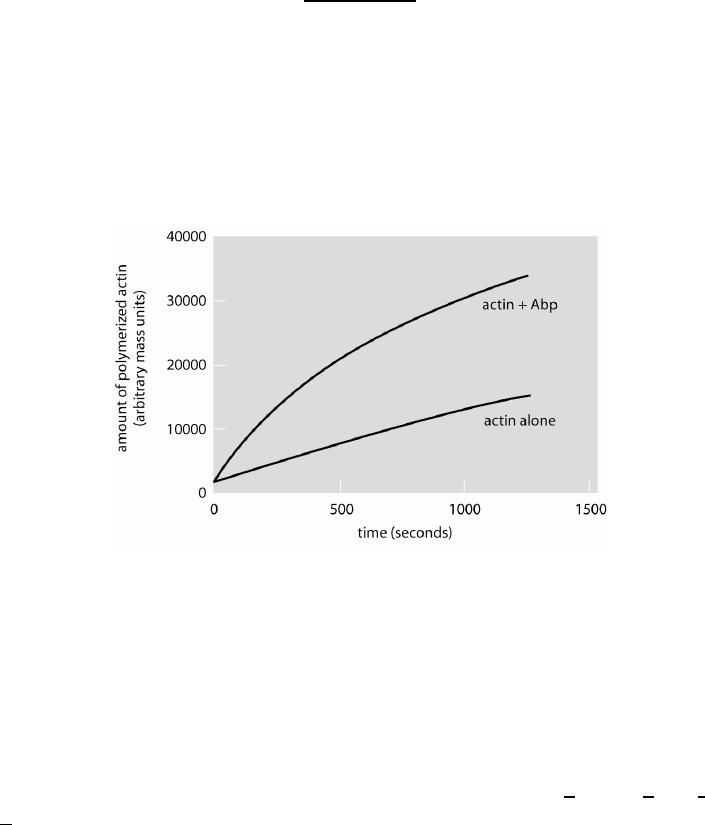
You obtain the results shown in Figure Q16-1.
Figure Q16-1
Further experiments show that Abp binds to the side of actin filaments and
preferentially binds to ADP-containing actin filaments. Propose a possible
molecular mechanism consistent with the data above.
16-2 You have discovered a new cytoskeletal polymer that resembles actin in an
archaean; you call the subunit for this polymer AALP (for archaea actin-like
protein). AALP binds to ATP and can catalyze the hydrolysis of ATP to ADP. As
with actin, this hydrolysis occurs more quickly when AALP is in a filament and
most of the free AALP is bound to ATP. You measure the rate of AALP filament
growth in vitro at the plus (more quickly growing) end and at the minus (more
slowly growing) end and obtain the graph diagrammed in Figure Q16-2.
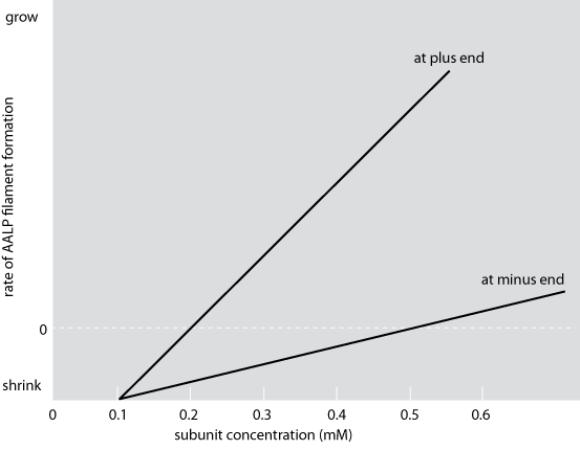
Figure Q16-2
A. What is the critical concentration for the plus end?
B. What is the critical concentration for the minus end?
C. Under what conditions would you expect to see treadmilling occur?
16-3 Your friend has been examining the assembly of -tubulin dimers into
microtubules. She has been performing in vitro polymerization experiments in the
presence of a single centrosome and finds that she can grow microtubules readily,
even at concentrations of less than 5 µM -tubulin dimers. She has repeated this
experiment several times, varying the concentrations of -tubulin dimers and
finds that at 25 µM -tubulin dimers, she can create about 50 microtubules per
centrosome. However, when she doubles the concentration of -tubulin dimers,
she does not seem to be able to create many more than 50 microtubules per
centrosome.
A. Given that the critical concentration for microtubules is 15 µM, explain
why she can grow microtubules at 5 µM.
B. Can you explain why she seems to have reached a limit as to how many
microtubules she can polymerize?
16-4 Your friend works in a lab that examines microtubules. He decides to grow some
microtubules using GMPCPP-bound -tubulin dimers. GMPCPP is analog of
GTP that cannot be hydrolyzed to GDP.
A. Will he observe dynamic instability in his GMPCPP-bound microtubules?
Explain.
B. Next, he decides to add GTP-bound -tubulin dimers to his preformed
GMPCPP-bound microtubules. To these new microtubules he adds a
fluorescently labeled microtubule-binding protein, MBP, and he sees three
different patterns of protein binding.
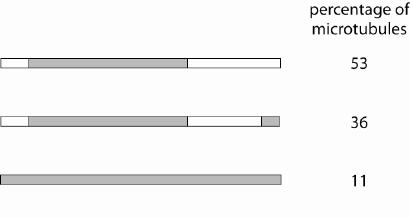
(1) Microtubules that are labeled along the center only.
(2) Microtubules that are labeled along the center and at the very tip.
(3) Microtubules that are labeled all along their length.
The percentages of microtubules falling into each category are diagrammed in
Figure Q16-4.
Figure Q16-4
Where, on a normal microtubule, would you expect MBP to bind? Explain.
16-5 You have purified a protein, MT1, that binds only to GTP-bound tubulin. You
proceed to fuse MT1 to GFP and find that the fusion of GFP to MT1 does not
disrupt MT1 function in any way (good news!). You use a different dye to label
the microtubules in red so that you can visualize MT1-GFP and the microtubules
at the same time. (Note that the red dye does not affect the microtubule’s
properties.)
A. If you were to polymerize some red-labeled microtubules in a dish, would
you expect MT1-GFP to be associated with one or both ends of a
microtubule, with the middle of the microtubule, or be evenly distributed
throughout the microtubule? Explain.
B. You examine the red microtubules and MT1-GFP in a cell in interphase.
Do you think that you will see MT1-GFP associating with all
microtubules? Explain.
C. If you were to take time-lapse images in which you visualize only MT1-
GFP (and not microtubules), what would you expect to see? Describe what
you think would happen to MT1-GFP over time with respect to its
localization inside of this cell.
16-6 Amyotrophic lateral sclerosis (ALS) is associated with abnormal assembly of
neurofilaments, and overexpression of either NF-L or NF-H (two neurofilament
proteins) in transgenic mice can lead to an ALS-like disease. The simultaneous
overexpression of NF-L, however, reverses the pathologies caused by
overexpression of NF-H, and vice versa. Given what you know about
neurofilaments, explain this finding.
16-7 The movement of molecular motors depends on the conformational changes that
the proteins undergo as they proceed through the cycle of nucleotide binding,
hydrolysis, and release.
A. Muscle contraction uses large amounts of ATP. What are the two main
uses of ATP during muscle contraction?
B. If you were to add a nonhydrolyzable form of ATP to myosin, at what
point would you block its movement? How is this similar to or different
from adding a nonhydrolyzable form of ATP to kinesin?
16-8 Constitutive activation of the GTPase Cdc42 leads to a different set of actin
rearrangements from those brought about by constitutive activation of the GTPase
Rho. It is now known that WASp proteins are targets of Cdc42, whereas formins
are targets of Rho1. Both WASp and formins promote actin polymerization.
Explain why the activation of these two different types of actin polymerization-
enhancing molecules could lead to differences in the actin cytoskeleton.
Answers