Campbell Biology in Focus, 2e (Urry)
Chapter 15 Regulation of Gene Expression
15.1 Multiple-Choice Questions
1) What is the role of a molecule that controls a repressible operon?
A) bind to the promoter region and decrease the affinity of RNA polymerase for the promoter
B) bind to the operator region and block the attachment of RNA polymerase to the promoter
C) increase the production of inactive repressor proteins
D) bind to the repressor protein and deactivate it
E) bind to the repressor protein and activate it
2) The tryptophan operon in some bacteria is a repressible operon that is
A) permanently turned on.
B) turned on only when tryptophan is present in the growth medium.
C) turned off only when glucose is present in the growth medium.
D) turned on only when glucose is present in the growth medium.
E) turned off whenever tryptophan is added to the growth medium.
3) Which of the following is a protein product of a regulatory gene?
A) operon
B) inducer
C) promoter
D) repressor
E) corepressor
4) A lack of which of the following molecules would result in the cell’s inability to “turn off”
genes?
A) operon
B) inducer
C) promoter
D) ubiquitin
E) corepressor
5) Which of the following molecules, when taken up by the cell, binds to the repressor so that the
repressor no longer binds to the operator?
A) ubiquitin
B) inducer
C) promoter
D) repressor
E) corepressor
6) Most repressor proteins are allosteric. Which of the following molecules binds with the
repressor to alter its structure?
A) inducer
B) promoter
C) RNA polymerase
D) transcription factor
E) cAMP

7) What would be the result of a mutation that deactivates the regulatory gene of a repressible
operon in an Escherichia coli cell?
A) continuous transcription of the structural gene controlled by that regulator
B) complete inhibition of transcription of the structural gene controlled by that regulator
C) irreversible binding of the repressor to the operator
D) inactivation of RNA polymerase by alteration of its active site
E) continuous translation of the mRNA because of alteration of its structure
8) Which of the following environments would most likely lead to the transcription of the lactose
operon?
A) There is more glucose in the cell than lactose.
B) The cyclic AMP levels are low.
C) There is glucose but no lactose in the cell.
D) The cyclic AMP and lactose levels are both high within the cell.
E) The cAMP level is high and the lactose level is low.
9) Transcription of the genes in an inducible operon
A) occurs continuously in the cell.
B) begins when the product of the metabolic pathway is present.
C) begins when the substrate of the metabolic pathway is present.
D) ceases when the product of the metabolic pathway is present.
10) For a repressible operon to be transcribed, which of the following must occur?
A) A corepressor must be present.
B) RNA polymerase and the active repressor must be present.
C) RNA polymerase must bind to the promoter, and the repressor must be inactive.
D) RNA polymerase cannot be present, and the repressor must be inactive.
11) Allolactose, an isomer of lactose, is formed in small amounts from lactose. An E. coli cell is
presented for the first time with the sugar lactose (containing allolactose) as a potential food
source. Which of the following occurs when the lactose enters the cell?
A) The repressor protein attaches to the regulator.
B) Allolactose binds to the repressor protein.
C) Allolactose binds to the operator.
D) The repressor protein and allolactose bind to RNA polymerase.
E) Allolactose binds to the inducer.
12) Altering patterns of gene expression in prokaryotes would most likely contribute to the
organism’s survival in which of the following ways?
A) organizing gene expression so that genes are expressed in a given order
B) allowing each gene to be expressed an equal number of times
C) allowing the organism to adjust to changes in environmental conditions
D) allowing young organisms to respond differently than more mature organisms
13) In response to chemical signals, prokaryotes can carry out which of the following activities?
A) turn off translation of their mRNA
B) alter the level of production of various enzymes
C) increase the number and responsiveness of their ribosomes
D) inactivate their mRNA molecules
14) In positive control of several sugar-metabolism-related operons, the cAMP receptor protein
(CRP) binds to DNA to stimulate transcription. What causes an increase in CRP?
A) increase in glucose and increase in cAMP
B) decrease in glucose and increase in cAMP
C) increase in glucose and decrease in cAMP
D) decrease in glucose and increase in repressor
E) decrease in glucose and decrease in repressor
15) A type of mutation in the repressor results in a molecule known as a super-repressor because
it represses the lac operon permanently. Which of these would characterize such a mutant?
A) It cannot bind to the operator.
B) It cannot make a functional repressor.
C) It cannot bind to the inducer.
D) It makes molecules that bind to one another.
16) Which of the following mechanisms is used to coordinate the expression of multiple, related
genes in eukaryotic cells?
A) A specific combination of control elements in each gene’s enhancer coordinates the
simultaneous activation of the genes.
B) The genes share a single common enhancer, which allows appropriate activators to turn on
their transcription at the same time.
C) The genes are organized into large operons, allowing them to be transcribed as a single unit.
D) A single repressor is able to turn off several related genes.
E) Environmental signals enter the cell and bind directly to promoters.
17) If you were to observe the activity of methylated DNA, you would expect it to
A) be replicating nearly continuously.
B) be unwinding in preparation for protein synthesis.
C) be transcriptionally inactive.
D) be very actively transcribed and translated.
E) induce protein synthesis by not allowing repressors to bind to it.
18) When DNA is compacted by histones into 10-nm and 30-nm fibers, the DNA is unable to
interact with proteins required for gene expression. Therefore, to allow for these proteins to act,
the chromatin must constantly alter its structure. Which processes contribute to this dynamic
activity?
A) DNA methylation and phosphorylation of histone tails
B) hydrolysis of DNA molecules where they are wrapped around the nucleosome core
C) accessibility of heterochromatin to phosphorylating enzymes
D) binding of an inducer to a repressor molecule
19) Two potential functions that eukaryotic cells perform to regulate transcription are
A) DNA methylation and histone amplification.
B) DNA amplification and histone methylation.
C) DNA acetylation and methylation.
D) DNA methylation and histone modification.
E) histone amplification and DNA acetylation.
20) Which of the following events occurs during DNA replication?
A) All methylation of the DNA is lost at the first round of replication.
B) DNA polymerase is blocked by methyl groups, and methylated regions of the genome are
therefore left uncopied.
C) Methylation of the DNA is maintained because methylation enzymes act at DNA sites where
one strand is already methylated and thus correctly methylate daughter strands after replication.
D) Methylation of the DNA is maintained because DNA polymerase directly incorporates
methylated nucleotides into the new strand opposite any methylated nucleotides in the template.
E) Methylated DNA is copied in the cytoplasm, and unmethylated DNA is copied in the nucleus.
21) In eukaryotes, general transcription factors
A) are required for the expression of specific protein-encoding genes.
B) bind to other proteins or to a sequence element within the promoter called the TATA box.
C) inhibit RNA polymerase binding to the promoter and begin transcribing.
D) usually lead to a high level of transcription even without additional specific transcription
factors.
E) bind to sequences just after the start site of transcription.
22) Steroid hormones produce their effects in cells by
A) activating key enzymes in metabolic pathways.
B) activating translation of certain mRNAs.
C) promoting the breakdown of specific mRNAs.
D) binding to receptors inside the cell and promoting transcription of specific genes.
23) Transcription factors in eukaryotes usually have DNA-binding domains as well as other
domains that are specific for binding other molecules. In general, which of the following would
you expect many of them to be able to bind?
A) repressors
B) protein-based hormones
C) other transcription factors
D) tRNA
24) Gene expression might be altered based on post-transcriptional processing in eukaryotes
rather than prokaryotes because of which of the following?
A) Eukaryotic mRNAs get 5′ caps and 3′ tails.
B) Prokaryotic genes are expressed as mRNA, which is more stable in the cell.
C) Eukaryotic exons may be spliced in alternative patterns.
D) Prokaryotes use ribosomes of different structure and size.
25) Which of the following is a function of the protein called ubiquitin?
A) It attaches to proteins that are marked for destruction in the cell.
B) It assists in the removal of introns from a eukaryotic pre-mRNA.
C) It initiates the formation of a transcription complex.
D) It adds the 3′ and 5′ caps to eukaryotic pre-mRNA.
26) Gene expression can be blocked by small RNA molecules called siRNAs. What is this
process called?
A) RNA interference
B) RNA blocking
C) RNA targeting
D) RNA disposal
27) At the beginning of this century there was a general announcement regarding the sequencing
of the human genome and the genomes of many other multicellular eukaryotes. There was
surprise expressed by many that the number of protein-coding sequences in the human genome
was much smaller than had been expected. Which of the following could account for most of the
rest of the DNA in the human genome?
A) “junk” DNA that serves no possible purpose
B) rRNA and tRNA coding sequences
C) DNA that is translated directly without being transcribed
D) non-protein-coding DNA that is transcribed into several kinds of small RNAs with biological
function
E) non-protein-coding DNA that is transcribed into several kinds of small RNAs without
biological function
28) Among the newly discovered small noncoding RNAs, one type reestablishes methylation
patterns during gamete formation and blocks expression of some transposons. These RNAs are
called
A) miRNA.
B) piRNA.
C) snRNA.
D) siRNA.
E) RNAi.
29) Which of the following best describes siRNA?
A) a short double-stranded RNA, one of whose strands can block gene expression
B) a double-stranded RNA that is formed by cleavage of hairpin loops in a larger precursor
C) a portion of rRNA that allows it to bind to several ribosomal proteins in forming large or
small subunits
D) an RNA sequence that can block the expression of some transposons
30) One way scientists hope to use the recent knowledge gained about noncoding RNAs lies with
the possibilities for their use in medicine. Of the following scenarios for future research, which
would you expect to gain most from RNAs?
A) exploring a way to turn on the expression of introns
B) targeting siRNAs to disable the expression of an allele associated with an autosomal recessive
disease
C) targeting siRNAs to disable the expression of an allele associated with an autosomal dominant
disease
D) creating knockout organisms that can be useful for pharmaceutical drug design
E) looking for a way to prevent viral DNA from causing infection in humans
31) Since Watson and Crick described DNA in 1953, which of the following statements might
best explain why the function of small RNAs is still being explained?
A) As RNAs have evolved since that time, they have taken on new functions.
B) Watson and Crick described DNA but did not predict any function for RNA.
C) The functions of small RNAs could not be approached until the entire human genome was
sequenced.
D) Ethical considerations prevented scientists from exploring this material until recently.
E) Changes in technology as well as our ability to determine how much of the DNA is expressed
have now made this possible.
32) You are given an experimental problem involving control of a gene’s expression in the
embryo of a particular species. One of your first questions is whether the gene’s expression is
controlled at the level of transcription or translation. Which of the following experiments might
best give you an answer?
A) You explore whether there has been alternative splicing by examining amino acid sequences
of very similar proteins.
B) You measure the quantity of the appropriate pre-mRNA in various cell types and find they are
all the same.
C) You assess the position and sequence of the promoter and enhancer for this gene.
D) You analyze amino acid production by the cell and find that there is an increase at this stage
of embryonic life.
33) In a genome-wide expression study using a DNA microarray assay, what is each well used to
detect?
A) fate of proteins produced by a cell
B) location of a protein produced by a cell
C) location of a gene within a cell
D) expression of a specific gene by a cell
34) How have DNA microarrays had such a huge impact on genomic studies?
A) They can identify the function of any gene in a genome.
B) They can be used to introduce entire genomes into bacterial cells.
C) They allow the expression of many or even all of the genes in a genome to be compared at
once.
D) They allow physical maps of the genome to be assembled in a very short time.
35) Researchers are looking for better treatments for breast cancer. For a particular DNA
microarray assay (DNA chip), cDNA has been made from the mRNAs of a dozen patients’ breast
tumor biopsies. What would the researchers be looking for in this type of assay?
A) a particular gene that is amplified in all or most of the patient samples
B) a pattern of fluorescence that indicates which cells are overproliferating
C) a pattern shared among some or all of the samples that indicates gene expression differing
from control samples
D) a group of cDNAs that act differently from those on the rest of the grid
E) a group of cDNAs that match those in non-breast-cancer control samples from the same
population

36) Which of the following techniques involves reverse transcriptase, PCR amplification, and gel
electrophoresis?
A) DNA microarray assays
B) RT-PCR
C) in situ hybridization
D) nucleic acid hybridization
15.2 Art Questions
1)
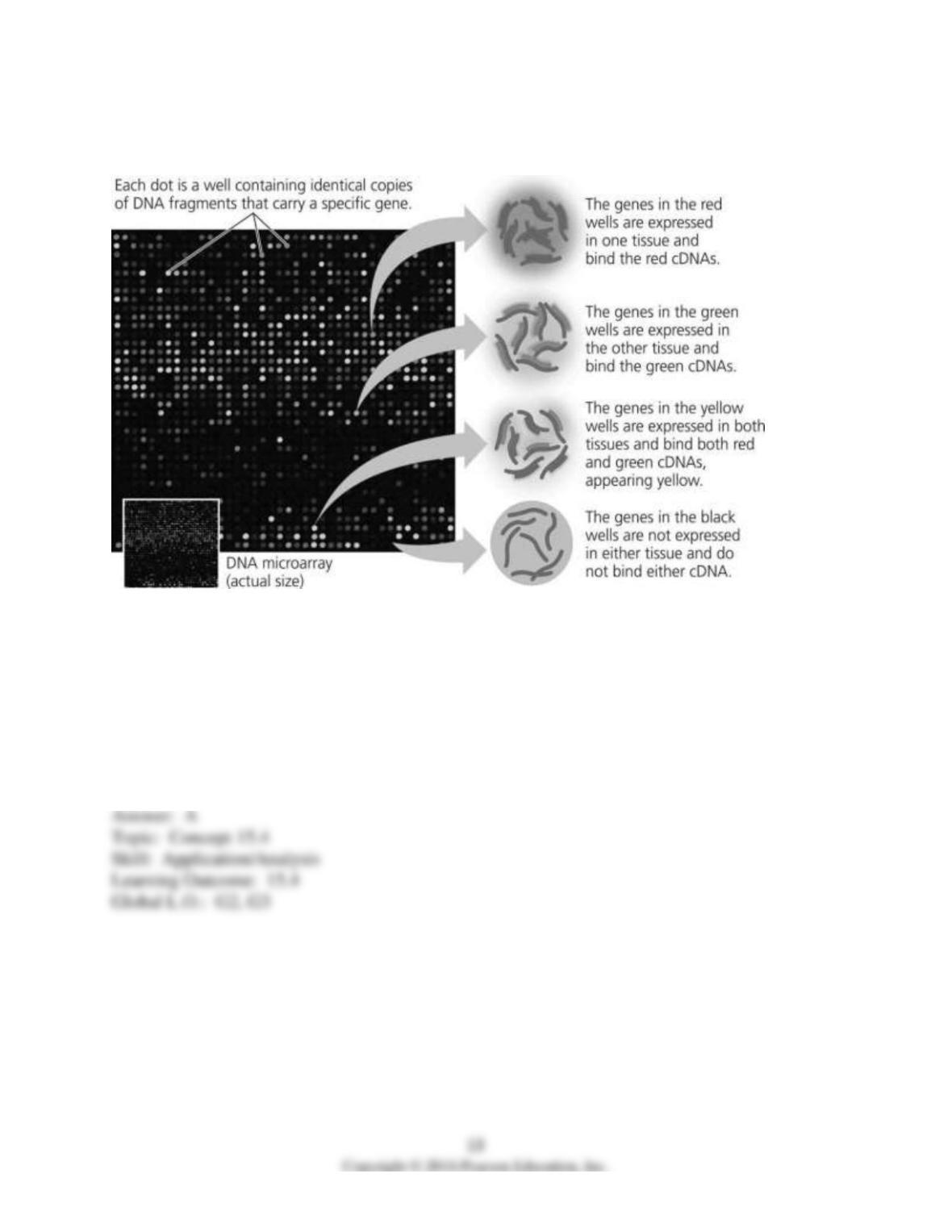
Figure 15.1
In the microarray shown in Figure 15.1, if you were searching for genes whose expression was
inhibited by hormone treatment, you would search for sequences spotted on the array that
showed ________ fluorescence.
A) no
B) high levels of
C) green
D) red
E) yellow
15.3 Scenario Questions
Please use the following information to answer the question(s) below.
Suppose an experimenter becomes proficient with a technique that allows her to move DNA
sequences within a prokaryotic genome.
1) If she moves the promoter for the lac operon to the region between the beta galactosidase
(lacZ) gene and the permease (lacY) gene, which of the following would be likely?
A) The three genes will be expressed normally.
B) RNA polymerase will no longer transcribe permease.
C) The operon will no longer be inducible.
D) Beta galactosidase will not be produced.
E) The cell will continue to metabolize but more slowly.
2) If she moves the operator to the far end of the operon, past the transacetylase (lacA) gene,
which of the following would likely occur when the cell is exposed to lactose?
A) The inducer will no longer bind to the repressor.
B) The repressor will no longer bind to the operator.
C) The operon will never be transcribed.
D) The three genes of the operon will be transcribed continuously.
E) The repressor protein will no longer be produced.
3) If she moves the regulatory gene (lac I), along with its promoter, to a position some several
thousand base pairs away from its normal position, which would you expect to occur?
A) The repressor will no longer be made.
B) The repressor will no longer bind to the operator.
C) The repressor will no longer bind to the inducer.
D) The lac operon will be expressed continuously.
E) The lac operon will function normally.
4) A researcher found a method she could use to manipulate and quantify phosphorylation and
methylation in embryonic cells in culture. In one set of experiments she succeeded in decreasing
methylation of histone tails. Which of the following results would she most likely see?
A) increased chromatin condensation
B) decreased chromatin condensation
C) activation of histone tails for enzymatic function
D) decreased binding of transcription factors
E) inactivation of the selected genes
5) A researcher found a method she could use to manipulate and quantify methylation of DNA in
embryonic cells in culture. One of her colleagues suggested she try increased methylation of C
nucleotides in a mammalian system. Which of the following results would she most likely see?
A) increased chromatin condensation
B) decreased chromatin condensation
C) activation of histone tails for enzymatic function
D) decreased binding of transcription factors
E) decreased transcription of the selected genes
6) A researcher found a method she could use to manipulate and quantify acetylation and
methylation in embryonic cells in culture. In one set of experiments using this procedure in
Drosophila, she was readily successful in increasing acetylation of amino acids adjacent to
methylated amino acids in histone tails. Which of the following results would she most likely
see?
A) increased chromatin condensation
B) decreased chromatin condensation
C) activation of histone tails for enzymatic function
D) decreased binding of transcription factors
E) inactivation of the selected genes
7) A researcher introduces double-stranded RNA into a culture of mammalian cells. The double-
stranded RNA corresponds to a region of a protein-coding gene of interest. How may the
introduced RNA affect gene expression in these cells?
A) The overall rate of translation in the cell may be significantly reduced.
B) The overall rate of transcription in the cell may be significantly reduced.
C) The overall rate of transcription in the cell may be significantly increased.
D) The amount of protein produced by the target gene may be significantly reduced.
E) The amount of mRNA produced by the target gene may be significantly increased.
15.4 End-of-Chapter Questions
1) If a particular operon encodes enzymes for making an essential amino acid and is regulated
like the trp operon, then
A) the amino acid inactivates the repressor.
B) the repressor is active in the absence of the amino acid.
C) the amino acid acts as a corepressor.
D) the amino acid turns on transcription of the operon.
2) The functioning of enhancers is an example of
A) a eukaryotic equivalent of prokaryotic promoter functioning.
B) transcriptional control of gene expression.
C) the stimulation of translation by initiation factors.
D) post-translational control that activates certain proteins.
3) Which of the following is an example of post-transcriptional control of gene expression?
A) the addition of methyl groups to cytosine bases of DNA
B) the binding of transcription factors to a promoter
C) the removal of introns and alternative splicing of exons
D) the binding of RNA polymerase to transcription factors
4) What would occur if the repressor of an inducible operon were mutated so it could not bind
the operator?
A) irreversible binding of the repressor to the promoter
B) reduced transcription of the operon’s genes
C) buildup of a substrate for the pathway controlled by the operon
D) continuous transcription of the operon’s genes
5) Which statement about DNA in one of your brain cells is true?
A) Most of the DNA codes for protein.
B) The majority of genes are likely to be transcribed.
C) It is the same as the DNA in one of your liver cells.
D) Many genes are grouped into operon-like clusters.
6) Which of the following would not be true of cDNA produced using human brain tissue as the
starting material?
A) It could be amplified by the polymerase chain reaction.
B) It was produced from pre-mRNA using reverse transcriptase.
C) It could be labeled and used as a probe to detect genes expressed in the brain.
D) It lacks the introns of the pre-mRNA.